ezETH is an Ethereum liquid restaking token launched by Renzo Protocol. It primarily represents users' economic interest in ETH staking and EigenLayer restaking strategies through Renzo. Unlike directly holding ETH, ezETH's value is linked to the underlying assets managed by the protocol and their accumulated rewards. It can also be transferred, traded, or used as collateral in DeFi applications that support the token.
As restaking infrastructure such as EigenLayer develops, the use of Ethereum staking assets is expanding from maintaining Ethereum network security to supporting more decentralized services. By issuing LRTs, liquid restaking protocols consolidate complex processes that would otherwise require users to directly manage operators, delegations, and exit procedures, providing a relatively simplified way to participate. However, using assets to provide additional economic security services also makes reward sources and risk structures more complex.
Understanding ezETH requires distinguishing among ETH, liquid staking tokens (LSTs), and liquid restaking tokens (LRTs). It also requires examining how Renzo manages assets through EigenLayer, how ezETH minting and exchange rates work, and how AVS rewards, DeFi composability, and redemption mechanisms affect holders' actual returns.
Key Takeaways
-
ezETH is a liquid restaking token (LRT) issued by Renzo. It represents a corresponding share of the ETH-related restaked assets managed by the protocol and their associated economic interest.
-
Through EigenLayer, Renzo uses eligible ETH and liquid staking assets in restaking strategies, enabling users to participate in the economic security framework of Actively Validated Services (AVSs) in addition to base staking.
-
ezETH uses a non-rebasing mechanism. The number of tokens held typically does not increase as rewards accrue; instead, the value of underlying assets and accumulated rewards is reflected through changes in the protocol exchange rate.
-
ezETH can be used for trading, lending, and providing liquidity in compatible DeFi protocols, but additional lending and leverage activities also introduce new risks.
-
ezETH's protocol redemption value may differ from its secondary market price. Redemption waiting periods, insufficient liquidity, smart contract vulnerabilities, and restaking slashing may all affect actual returns.
What Is ezETH? How Does It Differ From ETH and stETH?
ezETH is Renzo's liquid restaking token, representing holders' economic interest in ETH-related restaked assets managed by the protocol. After depositing eligible assets through Renzo, users can receive ezETH based on the protocol exchange rate without directly operating the underlying restaking infrastructure.
Understanding ezETH's role begins with ETH and liquid staking tokens. ETH is Ethereum's native asset. It can be used to pay network gas fees and participate in proof-of-stake staking. Users who directly stake ETH contribute to network security through validators and receive rewards according to applicable rules.
stETH is a liquid staking token issued by Lido. It represents the economic interest of participating in Ethereum staking through Lido. By holding stETH, users can gain exposure to staking rewards without directly operating validators and can use the asset in compatible DeFi applications.
ezETH further introduces a restaking mechanism. Renzo allocates eligible underlying assets to relevant staking and EigenLayer restaking strategies, allowing assets to potentially support other decentralized services in addition to participating in base staking.
| Comparison |
ETH |
stETH |
ezETH |
| Asset Type |
Ethereum native asset |
Liquid staking token (LST) |
Liquid restaking token (LRT) |
| Primary Uses |
Gas, transfers, staking, and DeFi |
ETH staking exposure and DeFi |
Restaking exposure and DeFi |
| Primary Reward Source |
Base staking rewards from participating in staking |
Lido staking rewards |
Underlying staking and related restaking rewards |
| How Rewards Are Reflected |
Changes in staked balance or protocol interest |
stETH is typically reflected through balance adjustments |
ezETH is primarily reflected through the exchange rate |
| Additional Risks |
ETH market and staking risks |
Smart contract, operator, and liquidity risks |
Restaking, slashing, redemption, and liquidity risks |
It is important to note that ezETH does not mean holders can immediately redeem ETH at a fixed 1:1 ratio at any time. Its protocol exchange rate may change with underlying assets, while its secondary market price may also be affected by liquidity and market sentiment.
Therefore, ezETH is better understood as a tokenized asset receipt with restaking exposure rather than a fully equivalent substitute for ETH.
How Does Renzo Deposit ETH Into the EigenLayer Restaking System?
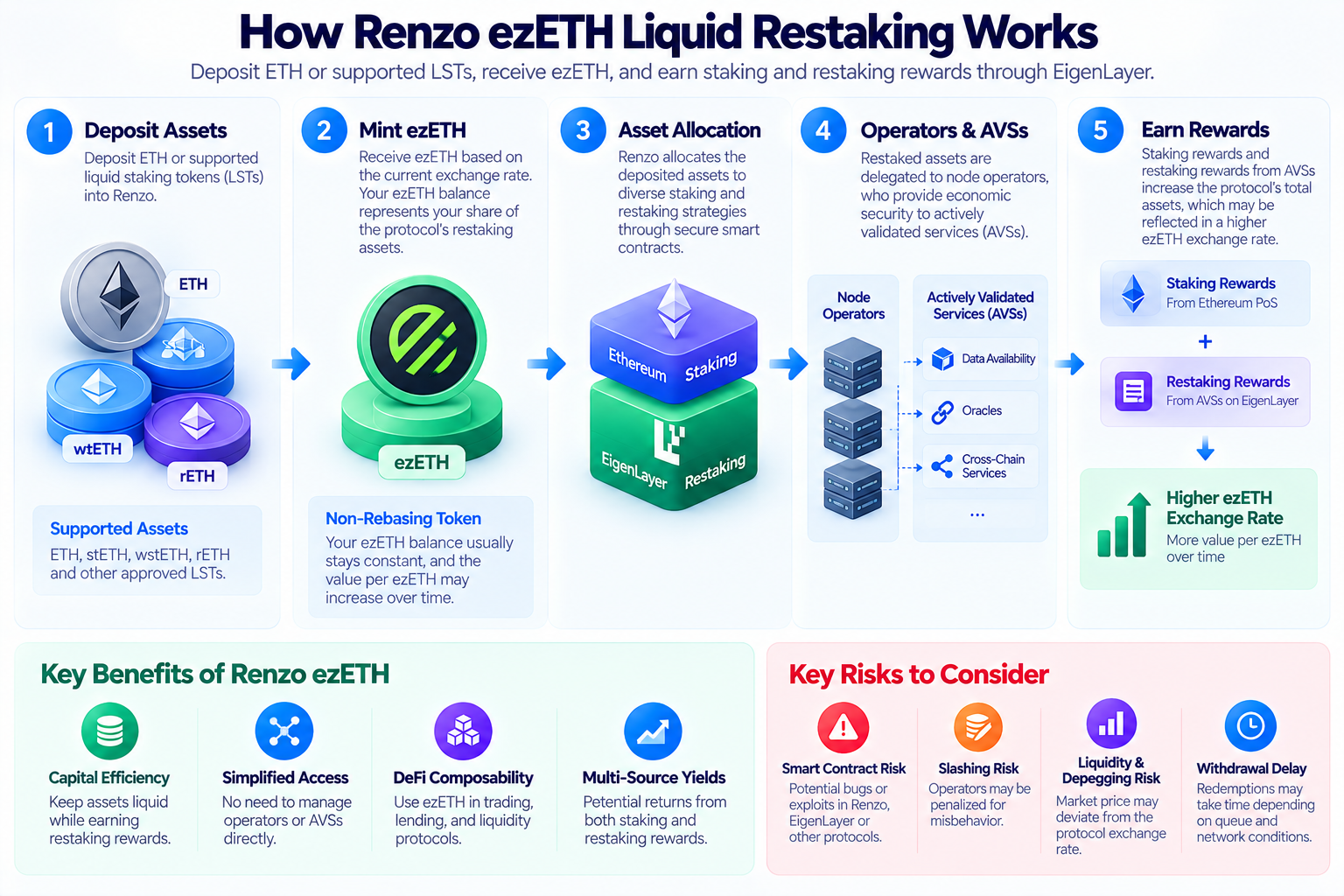
Renzo's core function is to convert assets deposited by users into protocol-managed restaking positions and issue ezETH as the corresponding liquid receipt.
For ordinary users, directly participating in EigenLayer may require understanding asset delegation, operator selection, AVS risks, and exit procedures. Renzo integrates these steps within the protocol through smart contracts and strategy management mechanisms.
Users first deposit ETH or liquid staking tokens supported by the protocol into Renzo. The protocol calculates the amount of ezETH to mint based on the current exchange rate and sends the corresponding tokens to the user's wallet. The underlying assets are then placed into Ethereum staking or the EigenLayer restaking system according to protocol strategies.
In this process, EigenLayer provides the restaking infrastructure, Renzo handles asset onboarding, position management, and liquid token issuance, while operators run the relevant nodes and support eligible Actively Validated Services.
When operators complete services as required, the relevant networks may distribute additional rewards. After applicable fees are deducted, these rewards may increase the value of the underlying assets managed by Renzo and be further reflected in ezETH's exchange rate.
This structure reduces the operational complexity of directly managing multiple operators and AVSs, but it does not mean that Renzo assumes all risks. Users' economic interest may still be affected by operator performance, the operating status of underlying protocols, and smart contract security.
For example, even if Renzo's deposit and minting functions are operating normally, the value of ezETH holders' assets may still be affected if an underlying operator violates rules or if an EigenLayer-related mechanism malfunctions.
Therefore, ezETH's returns and security should be evaluated in the context of the overall operations of Renzo, EigenLayer, operators, and relevant AVSs.
How Is ezETH Minted? Why Might Depositing 1 ETH Not Result in 1 ezETH?
The amount of ezETH minted depends on the value of the assets deposited by the user and Renzo's current protocol exchange rate. As underlying staking and restaking rewards accumulate, the ETH value represented by each ezETH may change. Therefore, the amount of ETH deposited and the amount of ezETH received may not be the same.
For example, assume that 1 ezETH currently represents 1.05 ETH. If a user deposits 10 ETH, they may receive approximately 9.52 ezETH, excluding additional fees. Although the number of tokens received is less than 10, the initial asset value represented by these ezETH is still approximately 10 ETH.
ezETH uses a non-rebasing mechanism, meaning that the number of tokens held typically does not automatically increase as rewards accrue. Instead, related returns are primarily reflected in the value of the underlying assets represented by each ezETH.
Renzo's exchange rate is determined by the total value of underlying assets managed by the protocol and the total ezETH supply. When the protocol earns net rewards through staking and restaking without a proportional increase in ezETH supply, the asset value represented by each ezETH may increase.
However, the exchange rate is not guaranteed to continue rising. If underlying assets are slashed, incur losses, or experience other negative events, the value of protocol assets may decline, affecting ezETH's redemption value.
In addition, the protocol exchange rate is not the same as the secondary market trading price. Even if 1 ezETH represents 1.05 ETH at the protocol level, users may still receive a lower actual price when selling on a DEX due to insufficient liquidity, changes in market supply and demand, or trading slippage.
How Do EigenLayer AVSs Provide Additional Rewards for ezETH?
AVS is short for Actively Validated Services. These are services or networks that use the EigenLayer restaking system to obtain economic security support.
Traditional Ethereum staking is primarily used to protect Ethereum's own consensus security. Restaking allows eligible assets to provide economic security for other services while taking on additional constraints.
These services may include data availability, oracles, cross-chain validation, and other infrastructure that requires decentralized operators to perform tasks.
In EigenLayer, operators can participate in different AVSs based on their capabilities and service requirements. AVSs may distribute corresponding compensation based on operator service performance, reward programs, and protocol rules.
Renzo allocates user assets to relevant operators and restaking strategies, allowing ezETH holders to gain indirect exposure to underlying rewards.
From a return perspective, ezETH's potential returns primarily come from base staking rewards and restaking rewards. The former are generated by ETH participating in Ethereum proof-of-stake staking, while the latter come from additional incentives earned when eligible assets support EigenLayer-related services.
However, not all AVSs continuously provide the same level of rewards, and not all restaked assets can receive returns from every AVS at the same time.
Actual returns depend on operator participation, service reward mechanisms, protocol fees, and potential slashing losses. Renzo also charges protocol fees from relevant restaking rewards for purposes such as protocol reserves and operator incentives.
Therefore, ezETH's returns are not solely driven by ETH price appreciation. They are related to the actual rewards generated by underlying assets. Even if the ETH price remains flat, ezETH's exchange rate against ETH may still change as net rewards accumulate.
Conversely, even if ezETH's exchange rate rises, holders may still experience losses in dollar terms if ETH's dollar-denominated price declines significantly.
Why Can ezETH Be Used for DeFi Lending and Liquidity Pools?
As a transferable liquid restaking token, ezETH can be used in DeFi protocols that support it. This is an important difference between liquid restaking and traditional locked staking.
When users directly participate in certain staking or restaking strategies, underlying assets may need to complete an exit process before they can be used again. ezETH represents the corresponding economic interest as an on-chain token, allowing it to move among compatible trading, lending, and liquidity protocols.
Common uses include trading ezETH on DEXs, providing ezETH and ETH to liquidity pools, and using ezETH as collateral in lending protocols that support the asset.
For example, after holding ezETH, users can borrow other assets in lending markets that allow it as collateral. This gives users additional access to capital while retaining ezETH price exposure.
However, improved capital efficiency does not mean that returns can be compounded without risk.
Suppose a user pledges ezETH as collateral to borrow ETH, then deposits the borrowed ETH into Renzo to mint more ezETH. This looping strategy can increase total restaking exposure, but it also expands the scale of debt.
If ezETH's market price declines relative to ETH, the collateral value may decrease, while the borrowed ETH debt does not automatically decrease. Users may face liquidation if the health factor of their lending position falls below protocol requirements.
Some DeFi strategies also manage such looping positions automatically, but automated execution does not eliminate borrowing rate, collateral ratio, or liquidation risks.
Therefore, DeFi composability expands ezETH's use cases, but every additional layer of protocol interaction may introduce new risks. For ordinary users, directly holding ezETH and using ezETH to establish leveraged positions should be viewed as two strategies with different risk levels.
Why Might ezETH's Price Deviate From ETH? What Does Depegging Mean?
To understand ezETH price deviations, it is necessary to first distinguish between two concepts: the protocol exchange rate and the secondary market trading price.
The protocol exchange rate reflects the value of underlying assets represented by each ezETH and is typically calculated based on the total value of assets managed by Renzo and the ezETH supply.
The secondary market price is determined by buying and selling supply and demand on DEXs or other trading venues. Even if the protocol exchange rate indicates that each ezETH represents 1.05 ETH, the market may temporarily trade it at a lower price.
For example, assume that 1 ezETH represents 1.05 ETH at the protocol level, but the actual trading price on a DEX is only 1.01 ETH. This means that ezETH's market price is trading at an approximately 3.81% discount to its protocol redemption value.
This does not necessarily mean that ezETH's underlying assets have incurred losses, nor does it mean that the market price will immediately recover.
Reasons for a discount may include short-term selling pressure, insufficient DEX liquidity, redemption waiting periods, market concerns about underlying protocol risks, and concentrated liquidations of leveraged positions.
For example, when many users want to exit ezETH immediately but protocol redemption requires a waiting period, some holders may choose to sell at a discount on a DEX in exchange for immediate liquidity.
If available buying interest on a DEX is insufficient, large sell orders may further push down the price. For users who use ezETH as lending collateral, price declines may also worsen collateral ratios and trigger liquidation.
At the same time, theoretical arbitrage mechanisms do not guarantee that a discount will disappear immediately. Arbitrageurs need to consider redemption waiting periods, funding costs, smart contract risks, and transaction fees. They may participate only when expected returns are sufficient to cover these costs.
Therefore, an ezETH price discount may be a short-term liquidity phenomenon or reflect deeper market risks. The size of the discount alone cannot determine whether a risk-free arbitrage opportunity exists.
How Can ezETH Be Redeemed for ETH? What Is the Difference Between Standard and Instant Redemption?
The primary ways to exit an ezETH position are redeeming underlying assets through the Renzo protocol or selling ezETH on supported DEXs.
Protocol redemption typically involves three stages: submitting a request, waiting, and claiming. After users submit a redemption request, the relevant ezETH enters the exit process. Users can claim the corresponding assets once the underlying assets meet withdrawal conditions.
Renzo uses an exit queue to manage the redemption process and determines the actual waiting time based on available liquidity buffers and the progress of underlying asset exits.
Standard ezETH redemption may take several days to approximately 15 days, depending on EigenLayer's exit requirements, Ethereum validator exit procedures, and the protocol's buffer assets. Actual waiting times may be extended due to changes in network and protocol conditions.
When the protocol has sufficient available liquidity, the waiting period may be shorter. When liquidity buffers are insufficient, users may need to wait for underlying assets to complete the exit process.
In addition, Renzo provides an instant redemption feature. When eligibility conditions are met, this feature allows users to pay a dynamic fee to exit an ezETH position more quickly without waiting through the full traditional exit process.
| Comparison |
Standard Redemption |
Instant Redemption |
DEX Sale |
| Exit Method |
Through the Renzo exit queue |
Uses the protocol liquidity buffer |
Trades with market counterparties |
| Expected Speed |
May take several days to approximately 15 days |
Near instant when conditions are met |
Depends on transaction confirmation and liquidity |
| Primary Cost |
Opportunity cost during the waiting period and applicable fees |
Dynamic instant exit fee |
Trading fees and slippage |
| Price Basis |
Protocol redemption rules |
Protocol exchange rules and related fees |
Market execution price |
| Primary Limitations |
Exit queue and underlying unstaking |
Liquidity buffer and fee parameters |
Market depth and price discounts |
Instant redemption fees change based on the use of the protocol liquidity buffer. Fees may increase as the available buffer declines. If an exit request would reduce the buffer below the minimum safety threshold, the transaction may not be executed.
In addition, after users initiate a standard redemption, the relevant ezETH typically stops accruing rewards. Therefore, when comparing exit methods, users should consider not only explicit fees but also the potential rewards lost during the waiting period.
Users holding ezETH deployed on other networks should also confirm whether the relevant network supports direct redemption. In some cases, users may need to first return assets to the Ethereum mainnet through officially supported cross-chain methods before completing the exit.
What Smart Contract and Restaking Risks Does Renzo's ezETH Face?
ezETH's risks include not only ETH market price changes, but also multiple layers of protocols, operators, and liquidity mechanisms.
First, there is smart contract risk. Renzo's asset management, minting, and redemption rely on smart contracts, while EigenLayer and related DeFi applications also have their own contract systems. Vulnerabilities, permission configuration errors, or abnormal operations at any layer may affect asset security.
Second, there is restaking slashing risk. EigenLayer's economic security mechanism allows relevant services to penalize operators or collateral positions that violate rules. If underlying assets are slashed, the value of protocol assets represented by ezETH may decline.
Third, there is liquidity and price discount risk. Although ezETH held by users can be transferred, this does not mean that sufficiently deep trading markets exist at all times. During concentrated redemptions or market panic, DEX quotes may be significantly lower than the protocol redemption value.
Fourth, there is DeFi composability risk. When ezETH is used as lending collateral, in liquidity pools, or in leveraged strategies, users also take on liquidation risk, changes in borrowing rates, trading slippage, and smart contract risks from other protocols.
Fifth, there is cross-chain infrastructure risk. If ezETH is deployed on multiple networks, users also need to consider cross-chain bridges, target chain operations, and asset migration requirements. ezETH on different networks may have different liquidity and exit channels.
Finally, there is reward uncertainty. Both base staking rewards and AVS rewards may change with network conditions, service demand, and protocol rules. Historical returns do not guarantee future returns.
Therefore, when evaluating ezETH, users should not only compare its expected APY but also consider whether the returns are sufficient to compensate for additional protocol and liquidity risks.
What Is the Relationship Between ezETH and REZ? How Can You Learn About the Renzo Ecosystem on Gate?
Both ezETH and REZ belong to the Renzo ecosystem, but they have different economic characteristics.
ezETH is a liquid restaking receipt that primarily reflects the economic interest generated by users participating in ETH-related restaking strategies through Renzo.
REZ is Renzo's governance token, used to participate in protocol governance and related ecosystem mechanisms. Holding REZ does not mean directly holding ezETH, nor does it mean automatically receiving ETH staking rewards.
The connection between them primarily comes from the same protocol ecosystem: ezETH reflects Renzo's underlying restaking product, while REZ's governance mechanisms can influence certain aspects of the protocol's risk management, asset support, and development direction.
However, REZ's market price is not directly linked to ezETH's exchange rate. Even if ezETH continues to accumulate staking rewards, REZ may still decline due to token supply, market sentiment, or other factors.
Users who want to learn more about Renzo can view market information and trading data for REZ on Gate.
On the trading page, REZ/USDT means trading the REZ governance token using USDT as the quote asset, rather than directly depositing ETH to participate in Renzo's restaking strategies.
Therefore, users need to clearly distinguish between the two activities: holding ezETH provides restaking-related economic exposure, while buying and selling REZ involves participating in the governance token market, where returns and risks primarily depend on changes in REZ's market price.
Summary
ezETH is a liquid token launched by Renzo around the EigenLayer restaking system. It is primarily used to convert ETH-related restaking interest into transferable and composable on-chain assets.
Unlike directly holding ETH or traditional liquid staking tokens, ezETH involves not only Ethereum base staking rewards but may also receive restaking rewards provided by relevant AVSs. Its returns are primarily reflected through changes in the protocol exchange rate rather than a continuous increase in the amount of ezETH in a wallet.
Renzo manages underlying assets through smart contracts and operator delegation mechanisms, reducing the operational complexity of directly participating in EigenLayer. However, users still bear smart contract, operator slashing, redemption waiting period, and liquidity risks.
In addition, while ezETH's composability in DeFi improves capital efficiency, it may also introduce lending and leverage risks. Especially during periods of substantial market volatility, an ezETH discount relative to its protocol redemption value may affect collateral value and further increase liquidation pressure.
ezETH's core value is maintaining a degree of liquidity for restaking interest, rather than turning staked assets into a risk-free yield product. For users who want to participate in the Renzo ecosystem, understanding exchange rates, reward sources, exit mechanisms, and potential risks is an important foundation for evaluating liquid restaking strategies.