Phala Network is an infrastructure project built around Trusted Execution Environments (TEE), Confidential Computing, and verifiable computing. Its core goal is to enable code and data to run in hardware-protected, isolated environments, while allowing external users to verify through remote attestation whether specific workloads executed as intended.Confidential AI
In its early stages, the project primarily served Web3 Confidential Computing and off-chain computing use cases. As AI's demand for GPU Hashrate, model privacy, and data security has grown rapidly, Phala has progressively shifted its technical focus toward Confidential AI, developing products and technical initiatives such as Phala Cloud, GPU TEE, dstack, and private AI Agents.
Key Takeaways
-
Phala Network (PHA) is an infrastructure project centered on Trusted Execution Environments (TEE) and Confidential Computing. Initially focused on Web3 Confidential Computing, it has expanded into areas including Confidential AI, GPU TEE, and AI Agents.
-
TEE is the foundation of Phala's technology stack, using hardware isolation to protect code and data in use and remote attestation to verify that the computing environment meets expectations.
-
Phala Cloud and GPU TEE extend Confidential Computing to AI workloads, allowing models, Prompts, user data, and inference processes to run in protected CPU and GPU environments.
-
dstack is Phala's open-source Confidential Computing Runtime for developers. It simplifies TEE application deployment, authentication, key management, and attestation, enabling workloads such as AI Agents to run in verifiable confidential environments.
What Is Phala Network (PHA)? The Evolution of a Decentralized Confidential Computing Network
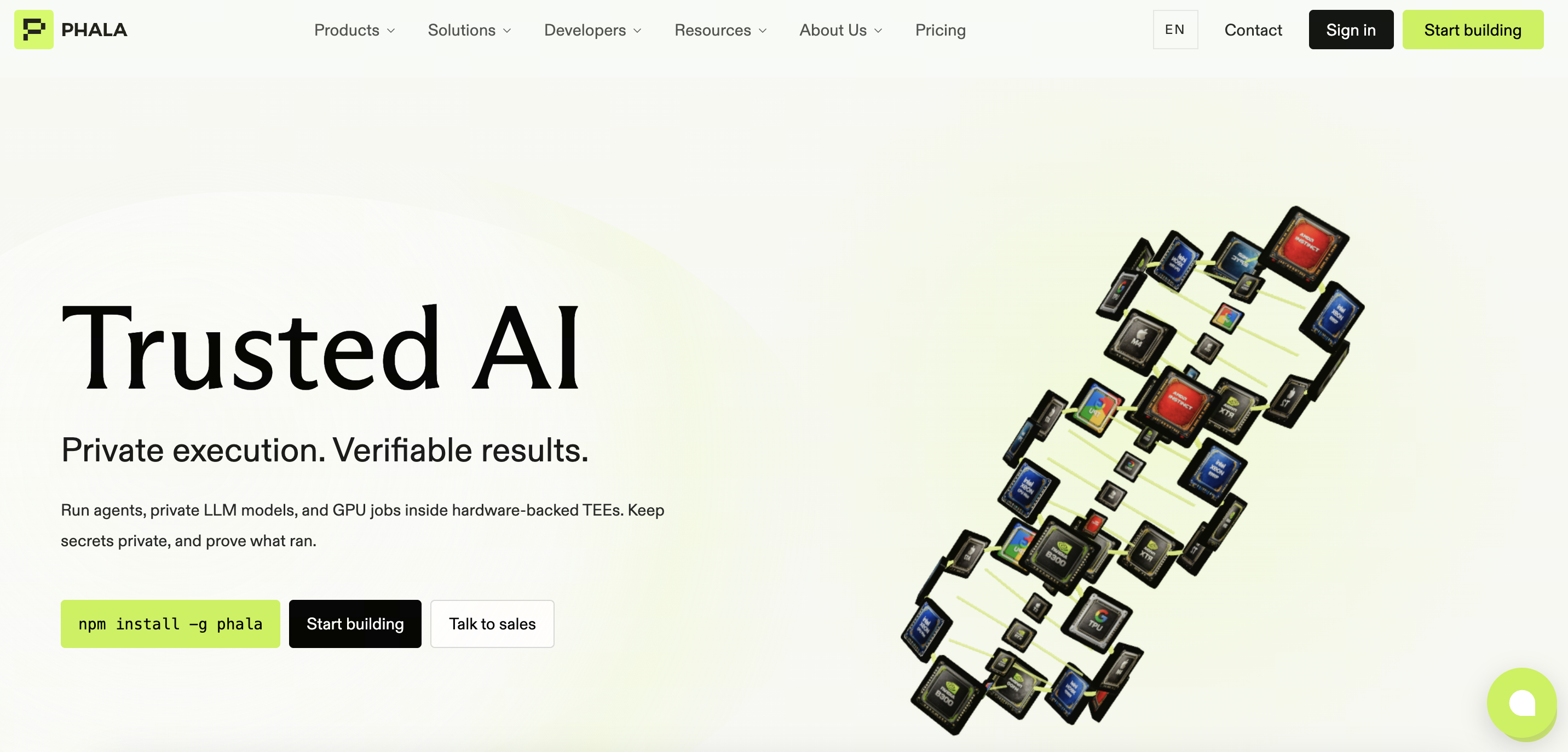
Phala Network is a computing infrastructure project centered on Trusted Execution Environments and Confidential Computing. It initially targeted Web3 Confidential Computing, off-chain computing, and smart contract extensions, and later extended its TEE capabilities to AI inference, model protection, private data processing, and AI Agents. Its fundamental approach is not to put the entire computing process directly on the blockchain, but to execute high-cost or sensitive tasks off-chain and establish a verifiable trust relationship through hardware security mechanisms and cryptographic proofs.
Phala's early development was closely tied to the Polkadot ecosystem. The network initially used TEE technologies such as Intel SGX, with Worker nodes running TEE responsible for Confidential Computing tasks and PHA used to incentivize computing resource providers. As Intel SGX's memory capacity and performance limitations in large-scale AI computing became increasingly apparent, Phala began shifting its technical focus toward next-generation Confidential Computing technologies, including Intel TDX, AMD SEV-SNP, and NVIDIA GPU Confidential Computing.
This shift also led to architectural changes. According to Phala's 2025 annual summary, the project discontinued its original Polkadot parachain model in 2025 and migrated to Ethereum L2, further integrating staking, governance, and computing rewards while establishing TDX and GPU Confidential Computing as new infrastructure priorities.
Phala's development can therefore be summarized as follows: it initially addressed Web3 Confidential Computing, later expanded into a general-purpose TEE computing infrastructure, and is now building infrastructure for Confidential AI and verifiable AI Agents.
Why Did Phala Shift From Web3 Confidential Computing to Confidential AI?
AI's development has made computing privacy increasingly important. In traditional cloud environments, users generally need to submit models, Prompts, databases, or inference requests to cloud service providers for processing. Even when HTTPS or other encryption methods protect data in transit, users must still trust the infrastructure operator once the data enters server memory and is used for computation.
That trust model may be sufficient for ordinary applications, but AI applications involve more complex sensitive information. An enterprise, for example, may need to protect its model weights, internal knowledge base, and customer data. A personal AI Agent may need access to a wallet, email, code repository, or other accounts. A financial institution may want a model to process trading data without allowing the cloud platform to read the data directly.
Confidential AI is based on the idea of performing AI computations in hardware-protected execution environments, ensuring that models, data, and runtime states remain protected during use while attestation provides verifiable proof of the runtime environment.
Phala's shift from Web3 Confidential Computing to Confidential AI represents an extension of its technical capabilities to meet evolving application needs. In 2026, Phala continued advancing GPU TEE, dstack, private AI models, and AI Agents. Its official research pages also identify Trusted Execution Environments, secure GPU inference, and verifiable systems as key research areas.
In June 2026, Phala announced Confidential Computing research based on Blackwell GPUs and continued advancing the operation of models such as GLM-5.2 in GPU TEE environments including H200. This shows that Confidential AI is moving from proof of concept toward larger-scale model inference infrastructure.
What Is TEE? Phala's Trusted Execution Environment Technology Explained
TEE, or Trusted Execution Environment, is a computing environment that protects code and data through hardware isolation.
In a traditional server, applications can restrict access through permissions, but an operating system, Hypervisor, or administrator with elevated privileges may theoretically still access data in use. TEE seeks to establish an isolated area at the hardware level, allowing sensitive code and data to run in protected memory.
TEE primarily addresses three issues: isolated execution, data confidentiality, and code integrity. Once data enters a TEE, hardware-level memory encryption can reduce the risk of external access. When a program starts, the runtime environment can be measured, and attestation can then prove that specific code and configurations are running on hardware that meets the required standards.
Phala's technology roadmap has expanded from CPU TEE to CPU + GPU TEE. Early SGX technology was better suited to relatively small Trusted Computing tasks, while large AI models must process substantial volumes of model parameters, KV Cache, and intermediate activation data. GPU TEE is therefore more important for Confidential AI.
Phala Cloud currently supports CPU-side Confidential Computing technologies such as Intel TDX and combines them with the Confidential Computing capabilities of NVIDIA GPUs such as H100 and H200 to provide hardware-isolated environments for AI inference.
What Is Phala Cloud? Confidential Computing Cloud and GPU TEE Infrastructure Explained
Phala Cloud is the Confidential Computing cloud infrastructure Phala provides to developers. Unlike ordinary cloud servers, its core distinction is not simply the provision of GPU Hashrate, but the ability to run computing tasks in an environment that offers hardware protection and verifiability.
In a typical architecture, an AI application runs in a Confidential VM (CVM), with Intel TDX or AMD SEV-SNP providing isolation on the CPU side while AI inference tasks are delegated to NVIDIA GPUs that support Confidential Computing. This allows models and input data to remain protected across both CPU and GPU execution environments.
When Phala Cloud introduced GPU TEE support in 2025, it focused on NVIDIA H100 and H200 and emphasized that AI workloads could run in hardware-protected environments with real-time attestation.
By 2026, Phala Cloud's product offering had expanded further. Its Confidential VM product supports Docker workloads and binds information such as hardware, virtual machines, images, and application configurations to attestation evidence. Developers can therefore use familiar container-based deployment methods to build AI Agents, private APIs, inference services, and GPU workloads without implementing TEE infrastructure from scratch.
This is an important part of Phala's transformation from a blockchain Confidential Computing network into Confidential Computing Infrastructure.
What Is dstack? Phala's Open-Source Confidential Computing Runtime Explained
dstack is Phala's open-source Confidential Computing Runtime, designed to simplify the deployment, verification, and key management of TEE workloads.
If TEE is the hardware-level security foundation, dstack is the runtime framework connecting hardware, cloud environments, and applications. It can bind application configurations such as Docker Compose, operating system images, hardware attestations, and key-release policies together, ensuring that an application receives the corresponding keys only when predefined security conditions are met.
Phala's current dstack architecture supports multiple attestation paths, including Intel TDX, AMD SEV-SNP, TPM, AWS Nitro NSM, and NVIDIA Confidential Computing, and establishes a chain of trust from hardware to applications through attestation.
The value of this design is that developers do not have to simply trust that a particular server is running the correct software. Instead, they can use cryptographic proofs generated by the machine to verify the runtime environment. In June 2026, a technical study released by Phala and OPPO further extended this mechanism to the Kubernetes Pod level, allowing AI workloads to obtain remote attestations bound to hardware, software, and Pod identities.
dstack can therefore be understood as runtime infrastructure that packages complex TEE technology into a form more closely aligned with developers' workflows.
How Does Phala Protect AI Models, Prompts, and User Data?
Confidential AI protects more than user inputs. For AI applications, model weights, Prompts, contexts, databases, inference results, and intermediate computation states may all be sensitive assets.
Consider an enterprise AI assistant. A user may submit internal financial data to the model, while the model itself loads enterprise-developed model weights and an internal knowledge base. If all of this runs on ordinary cloud servers, the enterprise must trust not only the cloud service provider but also the server administrators and the security of the infrastructure and runtime environment.
In a TEE architecture, sensitive data can enter a hardware-protected CVM or GPU TEE, while the model runs within the same trusted boundary. Phala's Confidential AI product design also covers private inference, private data processing, and model training. For example, its current Confidential AI products support private model training in TEE environments while protecting datasets, gradients, Checkpoints, and evaluation processes.
TEE does not mean that something is absolutely secure under all circumstances. It primarily addresses runtime confidentiality and integrity under specific threat models. Actual security still depends on the hardware implementation, software stack, key management, application code, and deployment configuration.
How Does Phala Enable AI Agents to Run in Private Environments?
Compared with ordinary chatbots, AI Agents must handle more long-term state and permissions, making Confidential Computing especially important.
An Agent with practical execution capabilities may need access to API Keys, wallet signing permissions, code repositories, email, databases, or even on-chain accounts. If the Agent runs on an ordinary server, the service provider or server administrator may theoretically access this sensitive information.
Phala's approach is to run the Agent in an attested Confidential VM and use dstack to bind the application's identity, runtime environment, and permission scope. This allows the keys, tools, and memory data used by the Agent to remain in a protected environment, while external systems can verify the Agent's runtime status based on attestation.
This model is particularly attractive for Web3. Blockchain is well suited to recording public, verifiable states, but is not suitable for directly storing private keys, user Prompts, or internal model states. TEE can handle private off-chain execution, while the blockchain manages assets, permissions, settlement, and governance, allowing the two to complement each other.
A Confidential AI Agent is therefore more than a chatbot with an additional layer of encryption. It seeks to establish Agent infrastructure based on “private execution + verifiable identity + auditable results.”
What Is Attestation? How Phala Verifies AI Workloads
Attestation, or remote attestation, is the key mechanism connecting hardware security with user trust in Confidential Computing.
Simply placing a program in a TEE does not automatically convince remote users that it is running the correct code. Users also need to know: What hardware is being used? What system image was loaded? What application is running? Has the configuration been modified?
Attestation provides cryptographic proofs for these questions.
In Phala's dstack architecture, an application's Compose configuration, image, platform state, and KMS policy can be bound to an application identity. After verifying the attestation evidence, external users can decide whether to trust the corresponding runtime environment or release sensitive keys.
This mechanism is particularly important for AI applications. Users may need to verify not only that “this is an AI model API,” but also that “this API uses the specified model version and runs in a Confidential Computing environment that meets the requirements.”
Attestation can therefore be understood as the “verifiable entry point” of Confidential AI: TEE protects the execution process, while attestation proves that the process actually took place in the expected environment.
What Is PHA? The Uses of Phala Network's Native Token
PHA is the native token of the Phala ecosystem. In its early stages, it was primarily used for computing resource incentives, network governance, staking, and related mechanisms.
Under Phala's original network model, Worker nodes provided TEE computing resources and received incentives through PHA. PHA holders could also participate in network security and governance through staking or delegation. Phala's official materials have defined PHA as the network's native Utility and Governance Token, used to incentivize Workers, support computing resource usage, and facilitate governance.
As Phala migrates from its original Polkadot parachain architecture to Ethereum L2, PHA's technical infrastructure and value-capture mechanisms are also evolving. The 2025 migration plan further integrated staking, governance, computing rewards, and asset transfers into the new architecture.
When evaluating PHA, it is important to distinguish between token utility and token price. PHA's network utility primarily comes from computing resource incentives, governance, and ecosystem participation, while its market price is influenced by crypto market liquidity, project development, supply and demand dynamics, and market expectations. The two should not be equated directly.
How Does Phala Connect AI, Web3, and the Confidential Computing Ecosystem?
An important feature of Phala is that its infrastructure does not need to force AI and blockchain into the same execution environment.
AI is better suited to run on GPUs and high-performance cloud infrastructure, while blockchains are better suited to handling asset ownership, transactions, settlement, and public verification. TEE can serve as the private execution layer between them.
For example, a Web3 AI Agent can place model inference and private key operations in a TEE and submit transaction results on-chain. A DeFi application can place sensitive strategies in a Confidential Computing environment and use verified results in on-chain logic. An enterprise can allow an AI model to access an internal database without exposing the raw data to a cloud service provider.
This architecture also explains why Phala continued expanding its AI Agent, Confidential AI, and Web3 computing use cases in 2026. Its recent ecosystem content covers areas including DeFi, AI Agents, LLMs, GPU TEE, and cloud-native AI.
From a broader industry perspective, Phala is addressing the “trust layer” of AI infrastructure: computing power may come from the cloud, models may come from different developers, and data may come from different institutions, but a mechanism is ultimately needed to prove that these resources performed computations in an environment that met expectations.
What Challenges Does Phala Face? TEE, GPU Costs, and Confidential AI Development
Although demand for Confidential AI continues to grow, TEE remains a technology with important limitations.
-
Hardware and cost. AI models are growing larger, driving continued increases in GPU memory and bandwidth requirements, while Confidential Computing requires additional security mechanisms and hardware support. The prices and resource availability of H100, H200, and newer-generation GPUs will directly affect the scale of Confidential AI commercialization.
-
Performance. Phala's public materials indicate that its goal is to bring Confidential GPU workloads as close as possible to native performance, but actual overhead depends on factors such as model architecture, communication methods, GPU utilization, and CPU-GPU data transfers. Phala's 2026 research noted that, in Blackwell GPU Confidential Computing scenarios, bridging between the CVM and GPU may become an important factor affecting LLM Serving performance.
-
The trust boundaries of TEE itself. TEE can reduce the level of trust required in cloud service providers and system administrators, but it cannot eliminate all software vulnerabilities or replace application-layer security, key management, and access control. Different CPU and GPU vendors use different hardware architectures and attestation mechanisms, making unified cross-platform verification another issue that infrastructure must address.
-
Market demand. The technical value of Confidential AI is relatively clear, but the user base willing to pay additional costs for privacy, verifiability, and compliance capabilities still needs to expand as use cases in finance, healthcare, enterprise AI, and Agents develop.
Whether Phala can achieve broader infrastructure adoption will therefore depend not only on TEE technology itself, but also on GPU costs, developer experience, standardization, ecosystem partnerships, and its business model.
Conclusion
Phala Network's technical roadmap has undergone significant changes: from an early Web3 Confidential Computing network centered on TEE, to general-purpose Confidential Computing infrastructure, and now to its current focus on Confidential AI, GPU TEE, and private AI Agents.
TEE addresses the isolation of data and code during execution, GPU TEE extends this capability to large-scale AI inference, and dstack packages complex TEE, image, key, and attestation processes into runtime infrastructure that developers can use. Attestation addresses the further question of how to prove that a program actually ran as expected.
For the AI industry, this architecture enables the runtime environments of models, data, and Agents to move from relying solely on platform trust toward “hardware protection + cryptographic proofs.” For Web3, Confidential Computing provides a way to process off-chain private data, AI Agents, and high-performance computing.
Phala Network should therefore not be viewed only as a conventional privacy blockchain. As the project continues expanding into TDX, GPU TEE, dstack, and Confidential AI infrastructure, its most important direction is providing verifiable private computing environments for AI and Web3.
FAQ
What Is Phala Network (PHA)?
Phala Network is a computing infrastructure project centered on Trusted Execution Environments (TEE) and Confidential Computing. Its early focus was Web3 Confidential Computing and off-chain computing, and it has now expanded into Confidential AI, GPU TEE, private AI Agents, and verifiable computing.
What Is the Role of Phala's TEE?
TEE uses hardware isolation and memory encryption to protect code and data, reducing the need to rely entirely on cloud service providers or server administrators. TEE can also generate attestation, allowing external users to verify specific code and the runtime environment.
What Is dstack?
dstack is Phala's open-source Confidential Computing Runtime. It simplifies the deployment, identity binding, key release, and remote attestation processes for TEE workloads and can connect application containers, CVMs, CPU/GPU TEE, and attestation.
How Does Phala Cloud Differ From Ordinary Cloud Computing?
Phala Cloud does not merely provide CPU or GPU Hashrate. It emphasizes hardware-supported Confidential Computing. AI workloads can run in Confidential VMs and GPU TEE environments, with hardware, software images, and application states verified through attestation.
What Are the Uses of PHA?
PHA is the native token of the Phala ecosystem and is primarily associated with computing resource incentives, staking, governance, and ecosystem applications. As Phala's infrastructure architecture continues to evolve, PHA's specific network utility and value-capture mechanisms must be understood in the context of the latest network design.