Overledger is Quant Network’s multi-DLT platform: developers and institutions use one set of credentials and one API surface to reach public chains, public permissioned networks, and private permissioned networks, then orchestrate cross-ledger business flows on top. In positioning terms, Overledger is an interoperability and orchestration layer above ledgers—not another independent public chain that requires joining a global consensus ledger.
For crypto readers and anyone following bank digitization, Overledger is often framed as bank interoperability middleware. When tokenized deposits, programmable payments, and existing fiat rails (such as real-time payment networks) coexist, institutions need unified access and clearing coordination—not a bespoke point-to-point build for every chain and every counterparty. How the native QNT token relates to platform access can be covered separately; the platform mechanics come first.
Key Takeaways
-
Overledger is Quant’s multi-DLT interoperability and orchestration platform, with a unified Gateway, Connectors, and Flow workflows—not a standalone L1 chain.
-
In banking, middleware must coordinate across institutions, ledgers, and fiat rails—not only move a token from chain A to chain B.
-
Cross-bank tokenized-deposit transfers often use issuer burn and receiver mint to sync value; the token typically does not “move” onto the counterparty’s ledger.
-
Understanding Overledger means separating infrastructure roles, token-utility narratives, and investment assumptions, and recognizing a different counterparty and compliance boundary than typical bridges.
What Is Overledger, and How Is It Different from “Another Public Chain”?
Overledger is provided by Quant Network. Per the Overledger Overview, it is a multi-DLT platform for apps that span more than one ledger: one set of credentials, one API surface, and one execution environment that can reach public networks (such as Ethereum, Polygon, and Solana), public permissioned networks, and private permissioned (consortium) networks.
Unlike “launch another chain and ask everyone to migrate,” Overledger emphasizes unified access and orchestration above existing ledgers. Developers need not maintain fully separate clients and node ops for every chain; institutions can place DLT calls and multi-step business flows under one gateway policy. A practical test for “is this a public chain?” is whether users must join an independent global consensus ledger. The documented answer is no: the core is a Gateway, Connectors, Fusion, and related stack—not a single L1 ledger.
How Does Overledger Work? Gateway, Connectors, and Cross-Ledger Orchestration
Using the stack in Overledger docs, five blocks matter first: Gateway, Connectors, Orchestration (Flow Applications), Overledger Firewall, and the Fusion Rollup.
| Component |
Primary role |
| Gateway |
Single entry: auth, routing, hosts orchestration, fronts Fusion |
| Connectors |
Abstract RPC by DLT family (EVM, Fabric, Solana, Corda, Canton, and others) against node pools |
| Orchestration / Flow Apps |
Turn multi-step work (signing, deploy, compliance checks, payments) into driveable session workflows |
| Overledger Firewall |
Enforce caller policy: network access, Flow access, methods, and rates |
| Fusion Rollup |
Multi-ledger optimistic rollup anchored to multiple L1s, with EVM-compatible execution and cross-chain messaging primitives |
The Gateway handles authentication, rate limits, and observability, then routes to Connectors or Fusion. Connectors check node health, forward RPC, and normalize responses across connected networks. Flow Applications let a UI, an agent channel (such as MCP), or a backend service drive the same step specs as a session—not only one-off raw RPC.
Fusion is described as a “Layer 2.5” orientation: a conventional L2 usually anchors to one L1, while Fusion derives state from multiple DLTs so one contract can receive deposits, withdrawals, and cross-domain messages from connected networks. For bank and enterprise integration, the emphasis remains “unified access + policy + orchestration”; Fusion is one multi-ledger execution layer in the stack, not the whole of Overledger.
Why Do Banks Need Interoperability Middleware? Why Do Tokenized Deposits Stay Siloed?
A tokenised deposit is a digital representation of a commercial bank deposit on a distributed ledger: the fiat claim remains against the issuing bank, usually still under deposit-protection and prudential frameworks, while gaining programmability and near-real-time settlement options. As Quant’s tokenised-deposit explainer puts it, the asset remains bank deposit money first—not a new class outside the banking system.
The hard part is legal and accounting binding to the issuer. Deposits usually cannot be “re-custodied” onto another bank’s ledger the way a fungible public-chain token can. Cross-institution value transfer often means the issuer burns the matching tokenized deposit on its own ledger and the receiver mints an equivalent balance on its ledger, syncing value while the token stays in the issuer context rather than being bridged across. Without a shared messaging, orchestration, and settlement-coordination layer, pilots stall in walled gardens: many chains, many networks, and value pools that do not talk.
Interoperability middleware must handle three jobs at once: technical reach across ledgers, institutional agreement on what just happened, and links to fiat rails that will coexist for years (RTGS, real-time payment networks, open banking interfaces, and similar). Retail “bridge a token” problems are related, but the constraint set—regulation, accounting, counterparties, operating windows—is heavier.
What Role Does Overledger Play in Bank Clearing Scenarios?
In institutional narratives, the Quant product stack is often split into layers: Overledger connects banking infrastructure and distributed ledgers; QuantNet coordinates settlement among participating institutions; Tokenised Deposit Services / Tokenised Deposits-as-a-Service (TDaaS) covers deposit-side capability; PayScript and similar components express programmable payment rules. Readers need not memorize every brand name, but should separate three jobs: access and orchestration, cross-institution settlement coordination, and bank-side issuance and custody capability.
A verifiable structural case is The Clearing House’s On-Chain Money Initiative in the United States. In September 2026, Quant and The Clearing House disclosed that The Clearing House selected Quant for the network’s interoperability, orchestration, and transaction-management layer—clearing and settling tokenized deposits while connecting to fiat systems institutions already use, including RTP® and CHIPS®. Availability to participating institutions is planned for the first half of 2027. For U.S. institutions that process through The Clearing House but lack tokenized-deposit capability, Quant can also offer a commercial bank-side path through the TDaaS shared platform.
| Layer (concept) |
Typical question |
Common carrier |
| Access and orchestration |
How does one interface reach many ledgers and workflows? |
Overledger |
| Settlement coordination |
How do institutions sync confirmation and settlement state? |
QuantNet and similar |
| Bank-side capability |
How can non-builders issue and manage tokenized deposits? |
TDaaS / shared platform |
| Fiat-rail connectivity |
How does the design link RTP, CHIPS, and other rails? |
Initiative network connectivity |
The case illustrates infrastructure division of labor—not a short-term token price story. Open windows, participant scope, and final product shape still follow later operator disclosures.
How Does Overledger Differ from Cross-Chain Bridges and Generic Messaging Layers?
Cross-chain bridges usually revolve around locking assets, minting wrapped assets, or liquidity pools; users experience “turning an A-chain asset into a B-chain form.” Generic messaging protocols focus more on arbitrary messages and cross-domain contract calls. Both are common in public crypto and have exposed bridge-contract and validator-set risk surfaces.
Overledger’s documented path is closer to an enterprise API gateway and policy orchestration: unified auth, per-family connectors, firewall policy, Flow workflows, and an optional multi-ledger rollup execution environment. Beyond public chains, targets include permissioned networks and institutional workflows; bank initiatives may also require explicit links to existing fiat payment rails. Three comparison questions help: Must assets be wrapped across chains? Must calls pass unified policy and identity? Do goals include regulated institution networks and fiat clearing systems?
| Dimension |
Typical bridge |
Overledger-style bank middleware |
| Primary goal |
Move assets or messages across public chains |
Multi-ledger + institutional workflows + often fiat rails |
| User experience |
Lock / mint / swap |
API, session workflows, policy allow |
| Common risk focus |
Bridge contracts, validators, liquidity |
Vendor dependence, access policy, institutional counterparties and compliance |
| Equals a new public chain? |
No (often contracts/relays) |
No (platform/gateway stack) |
Both can coexist in a larger architecture, but searching “interoperability” should not paste a bridge security model onto bank clearing middleware, or the reverse.
How Does QNT Relate to Overledger?
QNT is the native utility token in the Quant ecosystem (commonly described as ERC-20). Overledger users may need a certain amount of QNT depending on the product or licence terms. Public transparency filings and product descriptions often link QNT to Overledger-related licence fees, platform service use, and execution fees in multi-ledger rollup designs, while stating that QNT grants no corporate governance voting rights and is not a claim on Quant company equity. Whether fees are priced in fiat then converted to QNT, and whether tokens lock for a period, are product and contract details that must follow then-current terms and disclosures.
The key boundary: a bank or clearing network adopting Quant’s stack describes a software and operating contract relationship. It does not automatically mean “QNT holders share that contract’s revenue” or “price must rise with the announcement.” Translating infrastructure-selection news into a token investment conclusion is a common mix-up; QNT and Overledger licensing unpacks utility, myths, and risk boundaries in more detail.
What Are the Advantages and Risks of Understanding or Integrating Overledger?
Advantages include a unified Gateway that cuts multi-chain client fragmentation; Connectors and Flow that make compliance checks, payments, and on-ledger actions orchestrable; firewall and identity binding suited to permissioned settings; and, in tokenized-deposit narratives, middleware that helps move from “can issue” to “can clear across institutions and connect fiat rails.”
Limits and risks should stay separate. Mechanism limits include cross-bank settlement dependence on participant rules and a shared coordination layer; coverage and launch timing constrained by initiative operators; and Fusion/Connector DLT sets as evolving inventories, not a promise to connect everything. Risk factors include vendor and platform concentration, misconfigured policy causing access or transaction failure, conflating deposit tokens with speculative public-chain assets, and reading technology-adoption narratives as token price promises. Before integrating, verify current official docs, contractual counterparties, and allowlists for connected networks—not only secondary-market headlines.
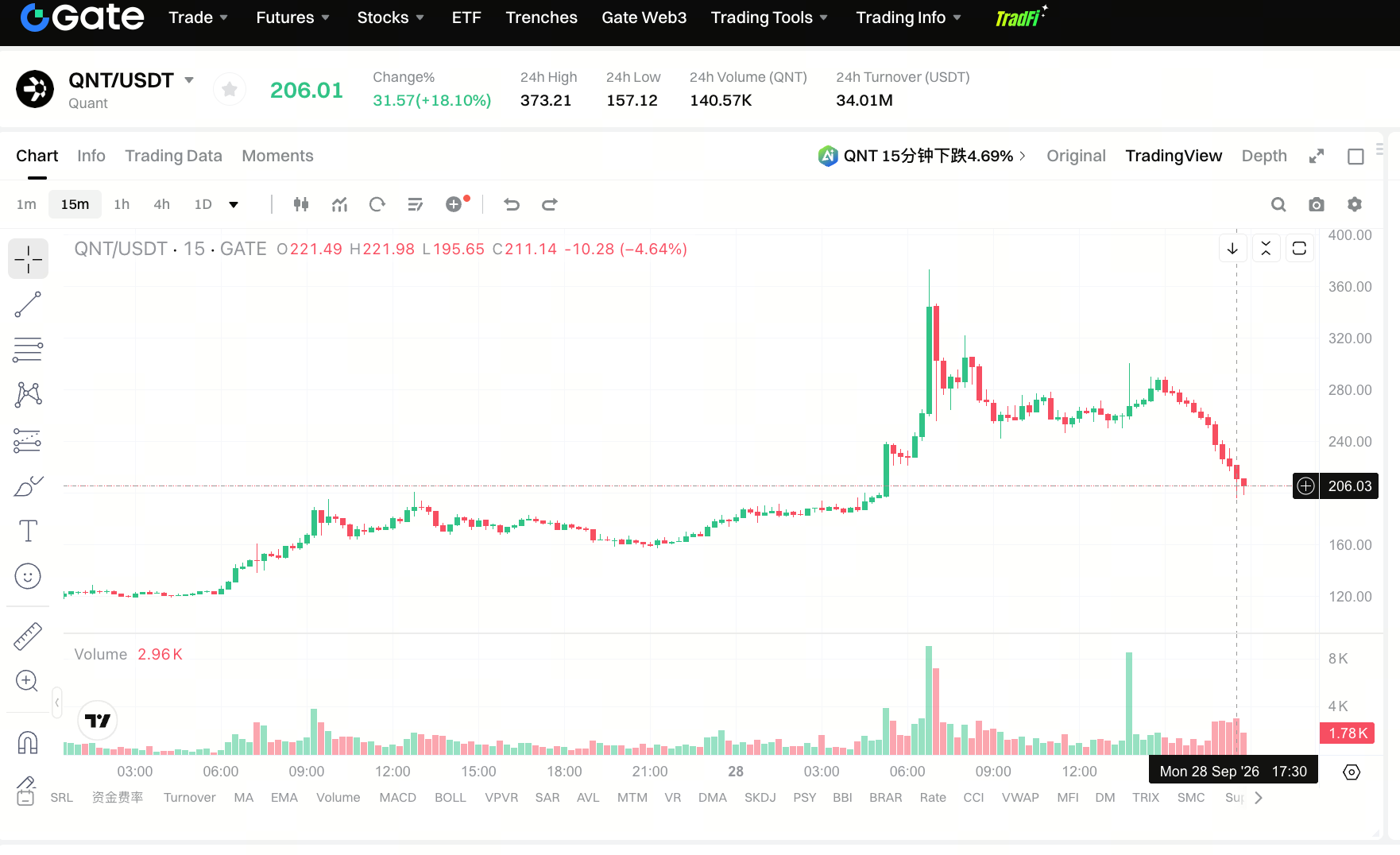
To track a listed asset’s market pages, search Gate for Quant (QNT) pairs and related pages, and verify name, symbol, and contract details alongside publicly shown market data such as circulating supply and trading volume. That path organizes market and product entry information for research only. It is not buy, hold, or sell advice, and it does not guarantee that any infrastructure partnership converts into token returns.
For concept learning, a useful order is: confirm the interoperability problem Overledger addresses → understand tokenized deposits and cross-bank burn–mint → then review how QNT is described in licensing and platform fees. Layering those readings helps avoid an “announcement → price” shortcut.
Summary
Overledger is Quant’s multi-ledger interoperability and orchestration platform: Gateway, Connectors, Flow, and policy layers reach many DLT types and can work with bank cores and fiat payment rails. It is not an independent public chain and should not be reduced to a retail bridge. Tokenized deposits expose the real institutional problem: syncing value across banks, heterogeneous ledgers, and coexisting fiat rails. Initiatives such as Clearing House On-Chain Money sample who runs the clearing network, who supplies the interoperability layer, and who provides bank-side capability. After the platform is clear, a separate look at QNT utility and boundaries keeps middleware knowledge distinct from token narratives.
FAQ
Is Overledger a blockchain?
No. Overledger is Quant’s multi-DLT platform and gateway stack for unified access and orchestration across ledgers and workflows. It does not replace base consensus ledgers such as Bitcoin or Ethereum; it is software and services above those ledgers.
How does Overledger work?
After clients authenticate at the Overledger Gateway, requests route to the matching DLT Connector or into multi-ledger execution environments such as Fusion. Multi-step business can run as Flow Application sessions, with firewall policy constraining reachable networks, apps, and operations.
How is Overledger different from a cross-chain bridge?
Bridges usually focus on lock/mint of assets or cross-chain messaging, with risk often concentrated in bridge contracts and validator sets. Overledger is closer to a unified API, connectors, and workflow orchestration for permissioned networks and institutional integration; bank initiatives may also connect fiat rails such as RTP and CHIPS.
Are tokenized deposits the same as stablecoins?
No. Tokenized deposits are generally ledgered representations of commercial bank deposit claims, with issuance and liability remaining inside the banking system. Stablecoins are commonly crypto-native payment instruments backed by an issuer liability or reserves, with different regulatory and balance-sheet attribution. Both may transfer on-ledger, but legal and risk structures differ.
Why do banks need middleware like Overledger?
A single bank can pilot issuance, but cross-institution clearing needs synchronized confirmation across heterogeneous ledgers and often links to fiat payment networks still in daily use. Middleware lowers point-to-point integration cost and places orchestration, policy, and settlement coordination on an operable shared layer.