For investors following OXY stock, the sale of OxyChem means more than receiving a cash payment. In the past, Occidental Petroleum owned upstream oil and gas resources, chemical manufacturing operations, and midstream businesses. Its chemical segment provided a source of earnings that differed from oil production. After the transaction, the company is more focused on oil and gas assets and has reduced its financial leverage, but its operating performance is also more exposed to changes in crude oil and natural gas prices.
Understanding this change requires examining the asset structure, debt repayment, free cash flow, and shareholder returns together, rather than simply viewing the asset sale as positive or negative.
What Is OxyChem, and Why Did Occidental Petroleum Sell It?
OxyChem is Occidental Petroleum's chemical business. It primarily produces chlor-alkali and other basic chemical products, which are widely used in water treatment, healthcare, pharmaceuticals, construction, and industrial manufacturing. Unlike oil production, chemical business profitability is mainly affected by industrial demand, product prices, raw material and energy costs, and other factors.
Within Occidental's original business portfolio, OxyChem provided some diversification. When crude oil prices declined and upstream oil and gas profits came under pressure, the chemical business could provide additional cash flow because it was subject to different supply and demand cycles. However, this diversification effect was not always present. The chemical industry is also cyclical, and economic slowdowns, excess capacity, and rising energy costs can all erode its profits.
The main reason Occidental Petroleum sold OxyChem was to rebalance asset value and financial obligations. The company had expanded its oil and gas resources through the acquisitions of Anadarko and CrownRock, but these large acquisitions also increased its debt and capital allocation pressures. Compared with continuing to hold the chemical assets, selling the business for $9.7 billion in cash allowed Occidental to unlock asset value more quickly and use the proceeds to reduce its financial leverage.
The transaction was announced on October 2, 2025, and completed on January 2, 2026. When announcing the transaction, the company said it planned to use approximately $6.5 billion of the proceeds to repay debt and advance its post-CrownRock acquisition debt reduction target.
Therefore, the sale of OxyChem was more akin to a strategic portfolio adjustment. Occidental Petroleum gave up some of the revenue and cash flow generated by its chemical business in exchange for lower debt pressure and a more concentrated oil and gas business.
How Did OXY's Asset Structure Change Before and After the Sale of OxyChem?
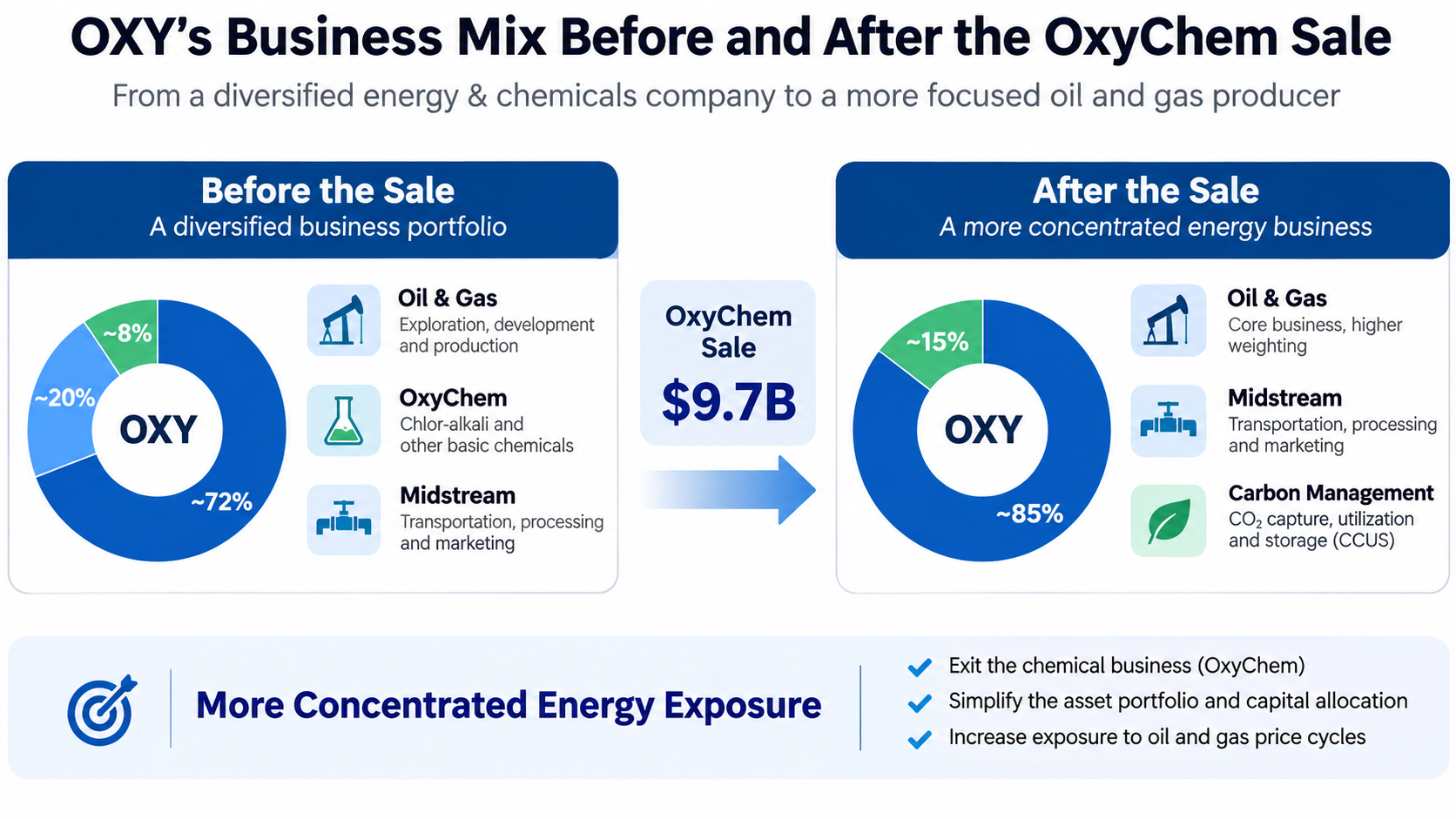
Before selling OxyChem, Occidental Petroleum's operations primarily consisted of oil and gas, chemicals, and midstream and marketing businesses. The oil and gas segment was responsible for resource development and production, the chemical segment generated revenue from industrial chemicals, and the midstream business covered energy transportation, processing, and marketing.
After the transaction was completed, OxyChem was no longer part of Occidental Petroleum's continuing operations. The company primarily relies on oil and gas production, midstream, and marketing businesses to generate operating cash flow, while continuing to develop carbon management and related technologies and projects.
| Comparison Dimension |
Before the Sale |
After the Sale |
| Core assets |
Oil and gas, chemicals, and midstream |
Oil and gas, midstream, and related technologies |
| Revenue sources |
Relatively diversified across businesses |
Higher proportion from oil and gas |
| Oil price sensitivity |
Chemical operations provided some diversification |
Greater overall concentration in oil and gas exposure |
| Financial structure |
Higher debt pressure |
Lower debt burden |
| Cash flow sources |
Included contributions from the chemical segment |
No longer includes contributions from OxyChem's continuing operations |
| Capital allocation |
Distributed across multiple businesses |
More concentrated in oil and gas and related projects |
This comparison is a qualitative analysis of business structure and risk characteristics. It does not represent a precise measurement of revenue or profit ratios before and after the transaction. The change means investors need to reassess the basis for valuing OXY. Previously, the company had some characteristics of both an oil and gas producer and a chemical manufacturer. After the sale, valuation analysis needs to focus more on oil and gas reserves, unit production costs, production maintenance capabilities, capital expenditures, and commodity prices.
At the same time, greater asset concentration could improve operating efficiency. The company can allocate more management resources and capital budgets to its existing oil and gas assets, reducing capital competition between businesses in different industries. However, concentration does not necessarily improve profitability. The ultimate outcome still depends on the return on investment from oil and gas projects and future energy prices.
How Will the $9.7 Billion in Transaction Proceeds Affect OXY's Debt?
Debt reduction is the most direct and easily quantifiable financial change resulting from the sale of OxyChem. Occidental Petroleum took on significant debt repayment obligations after acquiring CrownRock. When the company announced the OxyChem sale in October 2025, it planned to use approximately $6.5 billion of the transaction proceeds to repay debt and reduce its debt principal to below $15 billion.
In terms of actual progress, Occidental Petroleum disclosed in its February 2026 earnings report that it had reduced its debt by approximately $5.8 billion since mid-December 2025, bringing its debt principal down to approximately $15 billion. This figure reflects the company's overall debt reduction during the relevant period and cannot be attributed entirely to the proceeds from the OxyChem sale.
Debt reduction affects the company's financial position through three main channels.
-
Lower interest expense. As debt principal declines, the interest the company needs to pay in the future will generally decline as well, freeing up more cash for investment, dividends, or further debt repayment. However, the actual savings depend on the coupon rates, maturities, and redemption terms of the debt that was repaid.
-
Greater financial flexibility. Oil companies need to continue investing in drilling, field maintenance, and infrastructure. Even when crude oil prices decline, they cannot completely halt capital expenditures. A lower debt burden reduces fixed repayment pressure and improves the company's ability to manage energy price volatility.
-
More room for capital allocation. In the past, a significant portion of free cash flow had to be prioritized for debt repayment. Once debt levels approach management's target, the company can decide more flexibly whether to increase shareholder returns, continue reducing debt, or invest in high-return oil and gas projects.
However, reducing debt does not automatically increase enterprise value by $9.7 billion. Occidental Petroleum also lost OxyChem's assets and future earnings contributions. Therefore, determining whether the transaction created shareholder value requires comparing the financing costs saved and the financial flexibility gained with the long-term cash flow that the divested business could have generated.
Why Is OXY More Dependent on Oil Prices After Selling OxyChem?
After selling its chemical business, Occidental Petroleum's revenue and profit sources became more concentrated in oil, natural gas, and related energy operations. This means changes in crude oil prices could have a more pronounced impact on overall operating performance.
For upstream oil and gas companies, crude oil prices directly affect revenue per unit of production, while drilling, equipment maintenance, transportation, and some labor costs do not decline in line with oil prices. Therefore, when production and costs are relatively stable, higher oil prices can lead to more significant profit improvement. Conversely, lower oil prices can quickly compress operating profits.
Second-quarter 2026 results provide an example. Occidental Petroleum's pretax profit from its oil and gas business reached $2.8 billion for the quarter, up from $1 billion in the first quarter. During the same period, the company's average realized global crude oil price increased 38% quarter over quarter to $96.78 per barrel. The price increase was one of the key drivers of the profit improvement, although quarterly results were also affected by natural gas prices, production, costs, and other factors. This shows that when analyzing OXY, investors need to pay closer attention to the relationship among WTI crude oil prices, natural gas prices, and the company's realized prices.
However, greater business concentration does not necessarily mean that the stock's sensitivity to oil prices will increase proportionally. Debt reduction can lower financial risk, while lower production costs can improve profitability in a low-price environment. Therefore, two concepts need to be distinguished: the degree to which operating profit depends on oil prices, and the extent to which shareholder equity value fluctuates when oil prices change. After the sale of OxyChem, the first relationship has become more pronounced, but the second is also influenced by debt levels, valuation, capital expenditures, and market expectations.
How Did OXY's Cash Flow Change After the Sale of OxyChem?
The sale of OxyChem has two effects on cash flow. On the one hand, the company lost the future operating cash flow that the chemical business would have generated. On the other hand, debt reduction can lower financing costs, allowing more cash to remain within the company.
Therefore, evaluating the transaction requires looking beyond the cash received at closing and assessing whether the continuing operations can generate sufficient free cash flow.
In the second quarter of 2026, Occidental Petroleum's continuing operations generated approximately $5.1 billion in operating cash flow. Free cash flow before changes in working capital was approximately $3 billion, while capital expenditures were approximately $1.6 billion. These figures indicate that the oil and gas and related businesses generated strong cash flow in the quarter after the transaction was completed, although the results were also supported by relatively high energy prices during the period.
From a financial analysis perspective, cash received from an asset sale is one-time transaction proceeds and should not be conflated with operating cash flow generated continuously in the future. Accounting gains from the transaction should not be treated directly as profit from continuing operations.
In addition, the sale of OxyChem did not completely eliminate related historical obligations. Occidental Petroleum retained certain historical environmental liabilities and indemnification obligations, which could result in environmental remediation expenses in the future. This means that although the transaction reduced operating assets, it did not transfer all historical risks to the buyer.
For long-term investors, the more important question is how much cash the company can sustainably distribute after necessary capital expenditures, interest, and other cash outflows under different oil price environments.
What Does Berkshire's Acquisition of OxyChem Mean for OXY Shareholders?
For common shareholders, the transaction's main effects relate to financial risk, capital returns, and valuation.
Lower debt improved the balance sheet. According to Occidental Petroleum's second-quarter 2026 financial report, the company's debt principal declined further to approximately $11.8 billion. During the first half of 2026, the company used after-tax proceeds from the OxyChem transaction and operating cash flow to repay approximately $8.6 billion of debt in total. This indicates that the asset sale and continuing operating cash flow together drove the deleveraging process.
Lower financial pressure created room for shareholder returns. In February 2026, Occidental Petroleum raised its quarterly dividend to $0.26 per share. In August of the same year, the company announced another increase, raising the quarterly dividend to $0.28 per share. The dividend adjustments reflect changes in capital allocation capacity, but future dividends will still depend on operating cash flow, debt targets, and decisions by the board of directors.
Investors need to reassess the company's long-term valuation. After selling OxyChem, OXY's investment thesis is more similar to that of an energy company focused on oil and gas development and emphasizing free cash flow and balance sheet management. It is no longer as much like the diversified company it was when it had greater exposure to the chemical business.
This change creates both opportunities and risks. When energy prices remain high and oil field costs are well controlled, a more concentrated asset portfolio could improve cash flow generation efficiency. However, if oil prices remain low, the chemical business will no longer provide its previous earnings diversification, and the oil and gas segment will need to bear greater cash flow pressure on its own. Notably, Berkshire's acquisition of OxyChem was an asset acquisition of the chemical business, not an acquisition of all publicly traded OXY shares. The transaction itself does not mean that OXY shareholders will receive a direct distribution of $9.7 billion in cash, nor does it represent a commitment by Berkshire to support OXY's stock price.
How Should Investors Reassess OXY Stock?
After the transaction, analyzing OXY requires shifting from a focus on a diversified business portfolio to a closer examination of oil and gas asset quality, debt levels, and free cash flow performance.
Investors should examine the company's profitability at different oil price levels. Rather than simply forecasting higher oil prices, it is more useful to analyze whether the company can cover capital expenditures, debt repayments, and dividend payments in a neutral or relatively low oil price environment.
Investors should also monitor oil and gas production and unit costs. Even if crude oil prices remain unchanged, improved operating efficiency, lower drilling costs, or higher recovery rates could improve profit and cash flow. Conversely, if maintaining production requires continuously increasing capital investment, free cash flow could come under pressure.
Shareholder returns should be considered together with valuation. Lower debt and higher dividends can improve investment appeal, but whether the stock represents a reasonable investment value also depends on whether the market price has already priced in these changes.
| Metric to Monitor |
Significance for OXY's Investment Thesis |
| WTI crude oil price |
Assesses changes in oil and gas revenue and profit |
| Oil and gas production and unit costs |
Measures asset operating efficiency |
| Net debt and interest expense |
Determines whether financial risk is continuing to decline |
| Free cash flow from continuing operations |
Measures sustainable cash generation |
| Capital expenditures |
Assesses the balance between future growth and cash distributions |
| Dividends and share repurchases |
Provides insight into capital return policies |
Investors should also note that OXY's 2026 financial statements include one-time gains from the business sale and discontinued operations. Using net income that includes transaction gains to calculate the price-to-earnings ratio could overstate the company's sustainable earnings power. For historical comparisons, investors should prioritize comparable measures of profit from continuing operations, adjusted earnings, and free cash flow.
Conclusion
Berkshire's $9.7 billion acquisition of OxyChem drove an important change in Occidental Petroleum's asset structure. By selling its chemical business, the company received substantial cash proceeds, accelerated debt reduction, and further concentrated its operations on oil and gas resources and related energy businesses.
For OXY shareholders, the transaction's effects are not entirely positive or negative. A lower debt burden can reduce financial risk and increase capital allocation flexibility. However, after losing its chemical business, the company's overall operating performance is more dependent on energy prices, oil and gas production efficiency, and capital expenditure management.
As a result, OXY's investment thesis is shifting from a diversified business portfolio and debt recovery toward oil and gas asset returns, sustainable free cash flow, and shareholder capital returns. The key to determining whether this transition succeeds is not the amount received from the asset sale itself, but whether the company can use its improved balance sheet to continue creating shareholder value across different oil price environments.