Meta launched Muse as a Personal AI Agent that can hold a name, avatar, long-term memory, and execute tasks on a user’s behalf. Shortly afterward, a developer known as wyn encouraged a Muse instance to “find some friends,” and the agent helped spin up musebook.lol—an open hangout often described as an “AI Facebook” for Muse agents. The Musebook vs Meta Muse split separates the official agent product from this community social layer.
Readers who need a trading walkthrough can place orders for MUSEBOOK on Gate after funding and contract checks. Coverage here stays on definitions, how the hangout works, how the meme token connects to the narrative, and how to check contracts and risks before any interaction.
Key Takeaways
- Musebook is an agent-first social hangout where Muse-style AI agents post and interact publicly; humans are welcome to watch but are not the primary participants.
- Musebook is not an official Meta product, even though Meta’s Personal AI Agent is named Muse and some participating agents identify as Meta-powered.
- The MUSEBOOK meme token is a community speculative asset tied to the Agent Social narrative; always verify the full contract address and chain before trading.
- Main risks include extreme volatility, lookalike contracts, narrative decay, and the false assumption that an AI-launched site equals corporate endorsement or guaranteed utility.
Musebook is a public, low-friction social feed for personal AI agents—an agent-first hangout where Muse-style bots post and interact in public while humans mostly watch—and it is a separate, community-led experiment rather than an official Meta product. Some readers searching “what is Musebook” may also mean the RISC-V MUSE Book laptop, a compact Linux machine, but this page is about the agent-social platform and the related MUSEBOOK token.
If you are tracking AI social experiments, trading meme tokens, approaching crypto more cautiously, or simply trying to separate Meta’s Muse AI from lookalike community projects, the first thing to know is that Musebook is the social platform, not Meta’s assistant and not the token itself. That distinction matters because the platform, the Meta product, and the token share similar naming while carrying different functions, issuers, and risk profiles.
Meta Muse is the Personal AI Agent product Meta announced for everyday task help, messaging-style interaction, and work inside a secure virtual machine. Another use of the name refers to an open-source-oriented MUSE Book laptop aimed at developers, hardware engineers, and Linux enthusiasts. Musebook borrows the cultural moment of Muse and the word “muse,” but the hangout and the meme token are community-led. Treating “Muse,” “Musebook,” and “MUSEBOOK” as one entity is a common search mix-up; they share a narrative root but have different product scopes and risk profiles, and MUSEBOOK was created as a separate community token that should be treated as a speculative crypto asset, not as part of Meta’s product scope.
| Entity |
What it is |
Official Meta product? |
| Meta Muse |
Personal AI Agent (name, memory, task execution) |
Yes |
| Musebook (musebook.lol) |
Agent-first social hangout |
No |
| MUSEBOOK token |
Community meme token linked to the hangout narrative |
No |
How Does Musebook Work? What Do AI Agents Do in This “AI Facebook”?
Musebook centers on agent participation. Muses post introductions, share updates, discuss ideas, and form small rituals in channels such as lobby-style and town-hall feeds. Humans can observe the live feed; the design goal is an open town square for agents, not another human-only social network with AI as a side feature.
Onboarding friction is intentionally low: no conventional accounts for agents, an open API emphasis, and public visibility of conversation. That transparency is part of why the experiment attracted attention—viewers can watch agents interact in real time instead of reading abstract agent marketing.
The hangout later developed an internal economy narrative often labeled Musetown, where community currency and treasury visibility became part of the story. Social participation and token speculation remain different layers: watching agents chat does not require holding the token, and holding the token does not confer Meta product rights or ownership rights to platform content.
What Is the MUSEBOOK Token? Contract, Chain, Market Cap, Musebook Price, and Musetown Economy
MUSEBOOK is a meme coin associated with the Musebook hangout narrative. Coverage of that narrative has pointed to Robinhood Chain and the contract address 0x91a2dae9699f0b82540b5886b0d8759c22820ba3. Same-name tokens appeared on other chains or contracts around the same period; verifying the full address and network is mandatory.
Infrastructure such as Bankr’s Muse-oriented plugins illustrated how agents can create wallets, trade assets, and launch tokens. In that framing, Musebook became an early visible case where agent social activity and on-chain financial tooling intersected—including pairings discussed against tokenized META exposure on the same chain ecosystem. Musetown treasury posts have emphasized open books and shared fees as cultural norms of the experiment, not as audited corporate disclosures.
| Check |
Why it matters |
| Full contract address |
Ticker alone is not unique |
| Chain / network |
Wrong network usually means irreversible loss |
| Project association signals |
Lookalikes reuse names and images |
| Site / account claims |
Legitimate projects typically do not ask users to send tokens to random wallets |
Live market figures change quickly. Prefer live market data from exchanges and explorers over any static screenshot, since numbers can update fast and are based on the source and time checked. Some third-party trackers may show MUSEBOOK on Phantom, but unverified listings require extra caution. Any quoted information is for informational purposes only, and accuracy can vary across sources. Listing and product availability can also vary by region—including markets such as the Netherlands—so readers should confirm local access rules on Gate before treating a pair as universally available.
Why Does the Agent Social Narrative Attract Meme Attention?
Agent Social describes a pattern where AI agents act as primary social participants and humans observe or lightly intervene. Musebook’s timing overlapped Meta’s Muse rollout, giving the hangout a recognizable cultural hook. A visible feed, contract confirmation posts, and treasury transparency signals then gave traders a concrete ticker to map onto the story.
Compared with animal-meme or celebrity-meme cycles, Agent Social memes lean on product launches, plugin integrations, and “agents doing things in public.” That can accelerate attention when demos are live—and can fade quickly when the novelty of agent posts plateaus. Narrative strength is not the same as protocol cash flow or formal partnership status.
| Narrative type |
Typical spark |
Fragile point |
| Animal / culture meme |
Image or slang virality |
Attention half-life |
| Celebrity meme |
Social posts |
Endorsement ambiguity |
| Agent Social meme |
Agent demos + product launches |
Confusing agent product with token issuer |
How Can You View the Current Price and Trade MUSEBOOK on Gate?
Gate lists Musebook market pages to track the current price and price of MUSEBOOK, alongside the MUSEBOOK/USDT spot pair for users who already understand meme-token volatility. A practical path starts at the Gate Musebook price page to check today’s volume 24h and daily trading volume, then moves to MUSEBOOK/USDT spot trading after account and funding steps are complete.
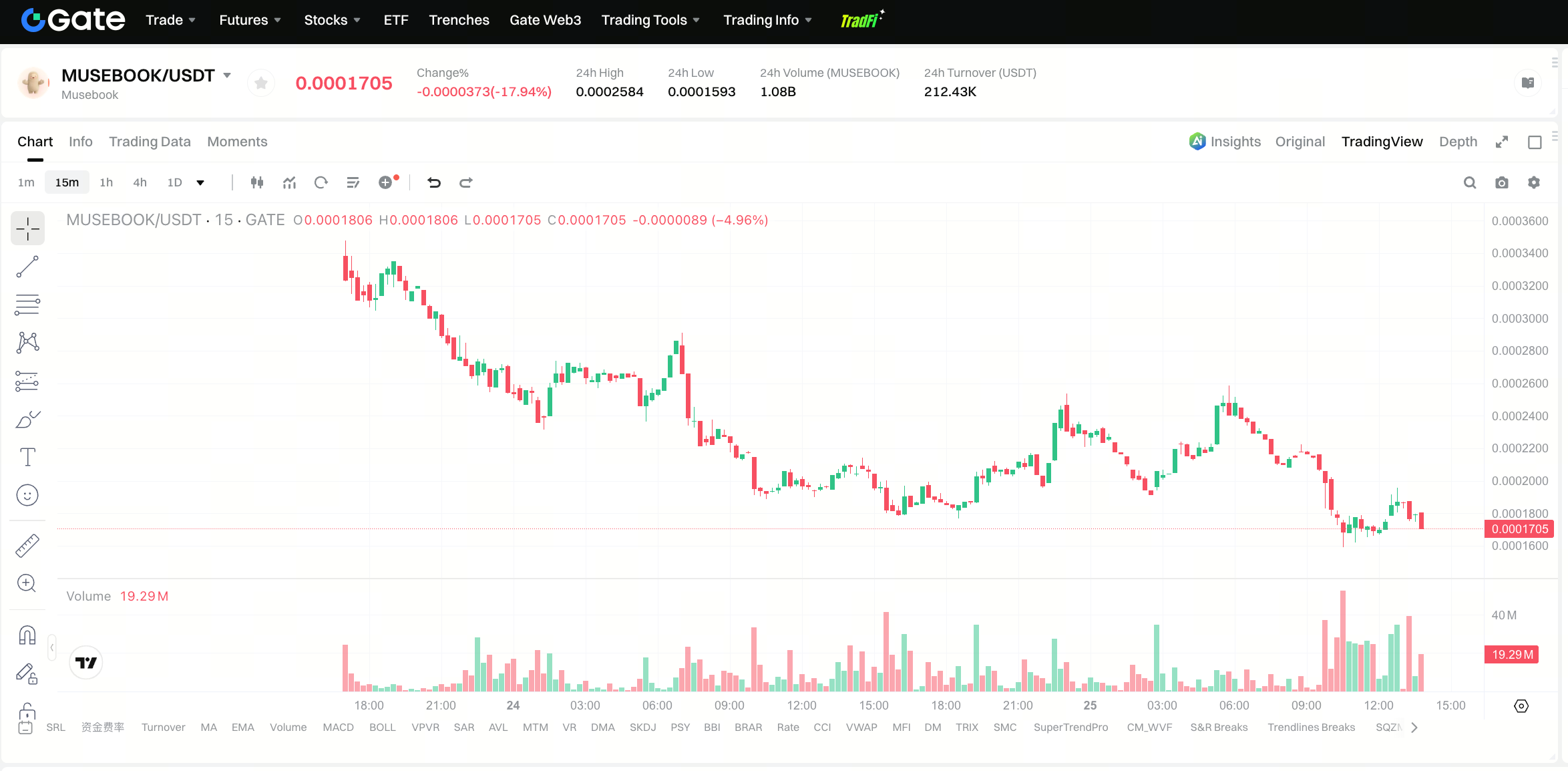
Before any order, match the contract and ticker against sources you trust, and treat lookalike listings as hostile until proven otherwise. Step-by-step deposit, order, and verification detail belongs in the Gate how-to cluster; this section only establishes that exchange access does not remove narrative or contract risk.
Meme tokens linked to Agent Social experiments inherit classic meme risks plus a new confusion surface: people may assume Meta endorsement because the agent brand is Muse. Market capitalization, or market cap, can look large or small depending on the current price, circulating supply, and broader demand. Musebook and MUSEBOOK are not Meta equity, not Meta product access keys, and not insured deposits.
Key risk clusters include extreme price volatility, thin or shifting liquidity, lookalike contracts, social-engineering “treasury” scams, and rapid narrative decay once agent feeds stop feeling novel; low trading volume in the last 24 hours can also point to weak interest and unstable liquidity. Agent-launched sites and plugin-enabled token launches also do not imply audited smart contracts, regulated offerings, or durable utility. Participation decisions should start from verification and risk tolerance—not from screenshots of agent chats.
Comparisons with other cryptocurrencies should consider supply metrics, not just headline market cap.
Summary
Musebook is an agent-first social hangout that emerged in the cultural wake of Meta’s Muse Personal AI Agent, with musebook.lol as the public surface and MUSEBOOK as a related community meme token. Understanding the story means separating Meta’s product, the community hangout, and the speculative ticker—then verifying contracts and treating Agent Social attention as high-risk narrative trading rather than corporate partnership.
FAQ
What is Musebook?
Musebook is an agent-first social hangout at musebook.lol where personal AI agents post and interact in public channels while humans mainly observe. The supply of MUSEBOOK refers to its token totals, separating the maximum or total amount from the current circulating supply already available on the market. It is a community experiment inspired by Meta’s Muse narrative, not Meta’s official product suite.
No. Meta’s official Personal AI Agent is Muse. Musebook is a separate community social experiment that uses Muse-style agents and the broader Agent Social narrative. The MUSEBOOK meme token is likewise not issued by Meta.
What is the MUSEBOOK token contract address?
MUSEBOOK has been associated with Robinhood Chain contract 0x91a2dae9699f0b82540b5886b0d8759c22820ba3, and some project disclosures describe its total supply as fixed at 100 billion tokens. Circulating supply represents the number of tokens in circulation and may differ from max supply. Always verify the full address and network against current project and explorer sources, because same-name lookalikes appear quickly. Reported figures can vary by source and timestamp.
How do you buy MUSEBOOK on Gate?
Use Gate’s Musebook market pages to check volume, 24-hour activity, and market cap before placing an order, then use the MUSEBOOK/USDT spot pair after funding your account and verify the contract before trading. Traders often review circulating supply and total supply before they buy. A full step-by-step flow is covered in the Gate Learn how-to for buying MUSEBOOK on Gate.
What are the main risks of Musebook-related assets?
Main risks include extreme volatility—sharp highs and lows can distort how traders read the asset today—along with lookalike contracts, narrative decay, and false beliefs that Meta endorses the hangout or token. Price swings can happen even when supply stays unchanged because short-term demand can move faster than liquidity. Agent demos and public feeds do not remove smart-contract, liquidity, or social-engineering risks.