Stage 2
As generative AI, virtual idols, digital humans, and metaverse applications gain traction, the digital entertainment industry is undergoing a profound transformation. MEET48 has adopted Web5 architecture as its core infrastructure, building a complete AI idol economy through AI creation tools, social networks, virtual entertainment, and on-chain economic models. Understanding its Web5 architecture is essential to grasping the project's operational logic.
What Is Web5?
The Web1 era solved the challenge of information browsing. Web2 drove the rise of social networks and user-generated content. Web3 introduced blockchain and digital asset ownership. Building on these foundations, Web5 integrates AI technology and digital identity systems, empowering users not only to own assets but also to control their data, content, and digital personas.
As a new internet paradigm centered on artificial intelligence, digital identity, and user-driven collaboration, AI in the Web5 ecosystem is no longer just a supporting tool—it is a key participant in content generation, interactive collaboration, and digital experiences.
How Does Web5 Differ from Web3?
Web3’s core objective is decentralization and digital asset ownership.
Blockchain, smart contracts, and crypto assets form its primary infrastructure, focusing on value transfer and open network development.
Web5, by contrast, prioritizes intelligent interaction and user experience. While retaining the concepts of digital identity and ownership, Web5 emphasizes AI-native applications, content generation, digital personas, and personalized engagement.
| Comparison Dimension |
Web3 |
Web5 |
| Core Focus |
Assets and Decentralization |
AI and Digital Identity |
| Technical Foundation |
Blockchain and Smart Contracts |
AI + Blockchain + Identity System |
| User Role |
Asset Owner |
Creator and Collaborator |
| Main Applications |
DeFi, NFTs |
AIUGC, Digital Persona, Metaverse |
| Content Generation |
User-Driven |
AI and User Co-Creation |
For MEET48, the value of Web5 lies in its ability to seamlessly combine AI creation capabilities, social collaboration mechanisms, and on-chain economic systems.
What Core Layers Make Up MEET48’s Web5 Architecture?
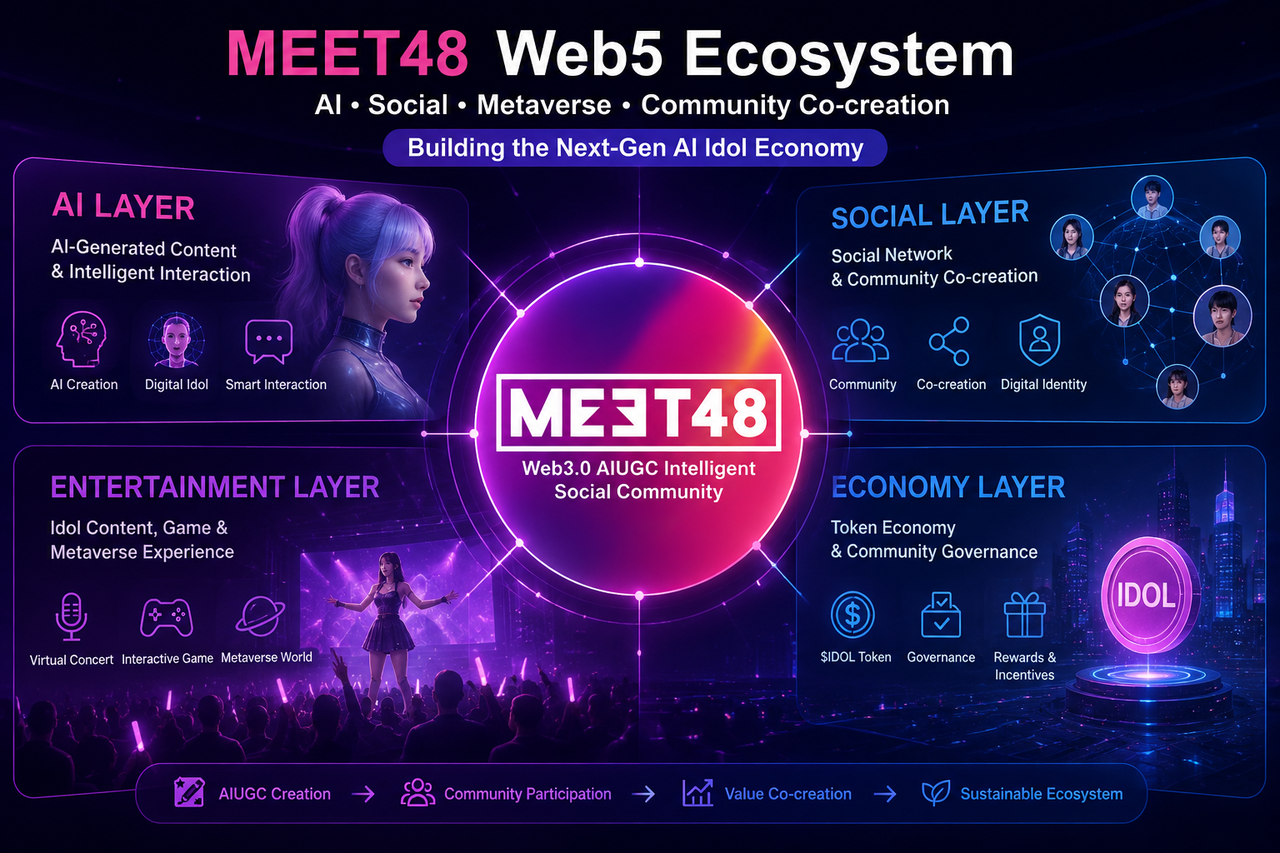
MEET48’s Web5 architecture can be understood as a four-layer collaborative system: AI Layer, Social Layer, Entertainment Layer, and Economic Layer.
The AI Layer handles content generation and digital character creation. The Social Layer connects creators with users. The Entertainment Layer supports virtual idols and metaverse applications. The Economic Layer manages governance, incentives, and value flow.
These four layers work in synergy, creating a complete closed loop of content creation, community interaction, and economic incentives.
How Does the AI Layer Support the MEET48 Ecosystem?
The AI Layer is MEET48’s most critical technological foundation.
Through generative AI, users can create virtual characters, generate image content, and interact with AI digital personas. AI not only produces content but also handles character operations and interactive functions.
For example, virtual idols can continuously refine their content style and interaction methods based on user feedback, resulting in an ever-evolving digital character ecosystem.
How Does AIUGC Transform Content Production?
Traditional content production typically requires coordinated teams of designers, producers, and operators.
AIUGC lowers the barrier to content creation, enabling more everyday users to engage in digital character design, story creation, and content generation. This expands the creator base and boosts content production efficiency.
The Importance of AI Digital Personas
Digital personas are a vital component of the AI entertainment ecosystem.
Through continuous learning and interaction, AI characters can develop relatively stable behavioral traits and expression patterns, thereby deepening user immersion and engagement.
What Role Does the Social Layer Play in the Ecosystem?
The Social Layer connects users, creators, communities, and AI characters.
Traditional social platforms revolve primarily around user-to-user communication. The Web5 social ecosystem goes further by enabling user interaction with AI characters and fostering community co-creation and collaboration.
This structure transforms users from mere content consumers into active contributors to the content ecosystem.
Community Co-Creation Mechanism
Community members can participate in virtual idol development, content creation, and event planning.
Certain content directions and community activities can be determined by users collectively, fostering a more open creative ecosystem.
Digital Identity System
Digital identity helps users build long-term reputation records and contribution histories.
It also serves as a key infrastructure for future community governance and value distribution.
The Entertainment Layer hosts MEET48’s core applications.
This layer encompasses virtual idols, digital performances, interactive activities, gamified experiences, and metaverse spaces. By combining digital characters with immersive environments, it creates a continuously engaging entertainment experience.
The Entertainment Layer not only offers content consumption but also emphasizes user participation and community collaboration.
Virtual Idol Ecosystem
Virtual idols serve as crucial bridges between AI technology and entertainment content.
Users can take part in idol shaping, content production, and community activities, collectively driving the growth and operation of digital IP.
Metaverse Social Scenarios
Metaverse scenarios deliver a more immersive interactive experience.
Digital identity, virtual assets, and AI characters together form the foundational elements of a virtual community.
How Does the Economic Layer Enable Value Circulation?
The Economic Layer sustains the incentive mechanisms of the entire ecosystem.
Using the IDOL token, MEET48 connects content production, community participation, and governance activities. Users receive rewards when they contribute content, engage in interactions, or promote ecosystem growth.
This mechanism fosters long-term ecosystem development and encourages greater participation in content co-creation.
Community Governance Mechanism
Community members can engage in proposals, voting, and ecosystem decision-making.
The governance system boosts community involvement and progressively opens the direction of ecosystem development to users.
Creator Incentive System
Creators earn rewards based on their content contributions.
This model helps build a more sustainable creator economy.
Why Is Web5 Architecture Ideal for the AI Idol Economy?
The AI idol economy spans content production, user interaction, digital identity, and value distribution.
Traditional internet architectures struggle to address all these needs simultaneously. Web5, however, integrates AI technology, social networks, and on-chain economic systems—enabling virtual idols to grow continuously while allowing users to deeply engage in content creation and governance.
Thus, Web5 provides more complete and flexible infrastructure for the AI entertainment industry.
Summary
Web5 is a new internet architecture concept that fuses artificial intelligence, digital identity, user ownership, and community collaboration. Compared to Web3, which focuses primarily on digital assets and decentralized networks, Web5 emphasizes intelligent interaction, content co-creation, and the evolution of digital personas.
Within the MEET48 ecosystem, the Web5 architecture comprises the AI Layer, Social Layer, Entertainment Layer, and Economic Layer. The AI Layer drives content production, the Social Layer connects the community, the Entertainment Layer hosts virtual idols and metaverse experiences, and the Economic Layer enables value circulation and governance collaboration.
Through this architecture, MEET48 unifies AIUGC, digital identity, virtual entertainment, and community governance into a single ecosystem, paving a new practical path for the AI idol economy and next-generation digital entertainment.
FAQs
What is the biggest difference between Web5 and Web3?
Web3 primarily focuses on decentralization and digital asset ownership, while Web5 emphasizes AI applications, digital personas, intelligent interaction, and user collaboration. Their developmental priorities are distinctly different.
Why does MEET48 adopt Web5 architecture?
MEET48 needs to simultaneously support AI content generation, virtual idol operations, community interaction, and on-chain economic systems. Web5 architecture integrates all these capabilities into a unified ecosystem.
What role does the AI Layer play in MEET48?
The AI Layer handles digital character generation, content creation, intelligent interaction, and digital persona construction. It serves as the core technological foundation of the entire AI entertainment ecosystem.
What function does the IDOL token serve in the Web5 architecture?
The IDOL token connects the ecosystem’s incentive, governance, and value circulation systems. It is a vital component of the creator economy and community collaboration.