
(Source: hyperion_xyz)
Hyperion is a high-performance platform powered by the Aptos parallel execution engine, integrating exchange aggregation, market maker models, and treasury strategies into a seamless on-chain experience. Hyperion is building a unified liquidity and trading layer for Aptos.
Integration and Innovation of Trading and Liquidity
Traditional AMM models mostly spread liquidity evenly across the entire price range, resulting in a large amount of capital being inefficiently idle. Hyperion introduces the concept of concentrated liquidity, allowing users to provide liquidity for specific price ranges, maximizing capital utilization.
For example, in stablecoin pairs, LPs can concentrate liquidity within the price range of (0.995, 1.005). This type of strategy is especially suitable for low-volatility assets, as it can generate higher fee income and capital efficiency. Furthermore, Hyperion's upcoming DLMM model will further expand the flexibility of market-making logic, allowing LPs to establish multiple strategy positions and simulate more complex price behavior curves, paving the way for future financial products.
The capital background of Hyperion
Hyperion is incubated by BlockBooster and included in the Ankaa Accelerator program. In the strategic round of financing in May 2025, Hyperion received leading investment from OKX Ventures, with participation from Aptos Labs, Mirana Ventures, Maelstrom, and others, demonstrating that Hyperion not only has a strong technical foundation but also solid resources and networks.
The core advantages of Hyperion
Hyperion's AMM model addresses the pain points of previous liquidity fragmentation and wastage. Through CLMM (Concentrated Liquidity Market Maker) and DLMM (Dynamic Liquidity Market Maker, under development), providers can:
- Custom price range, focusing on effective trading range
- Set multiple liquidity positions to implement a diversified curve strategy.
- Increase capital utilization and fee income potential
For traders and LPs, this is not just a simple swap platform, but a highly elastic, efficient, and modular capital operation environment.
The tokenomics of Hyperion
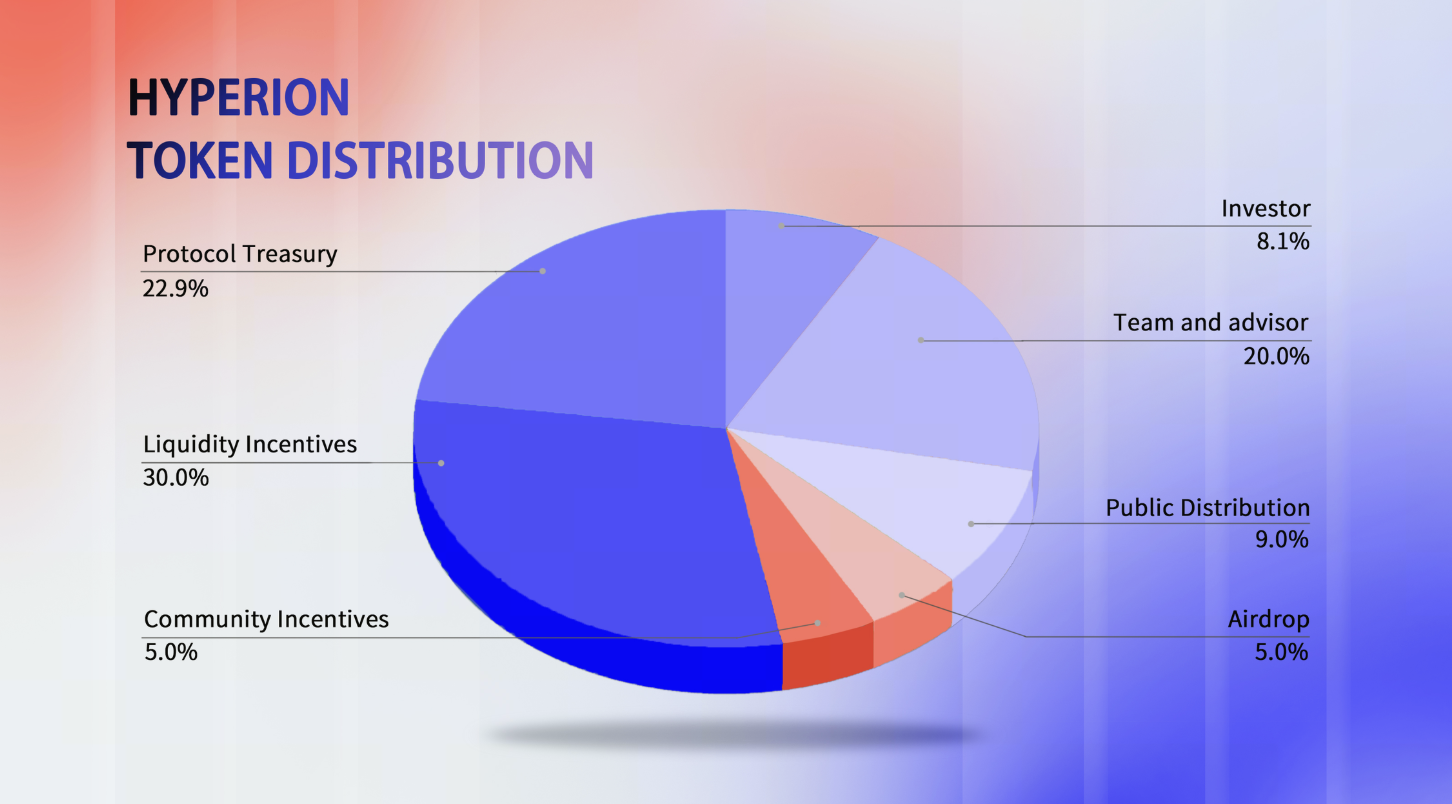
RION is the native token of the Hyperion platform, featuring transferability, cryptographic security, and full functionality. Its positioning is not as a universal medium of exchange, but rather as the primary tool for internal protocol interaction, incentives, and governance within the platform. The token distribution is as follows:
- Liquidity Incentives (30.0%): Used to provide ongoing incentives for LPs, trading contributors, etc., supporting the core TVL of the protocol.
- Protocol Treasury (22.9%): Reserved for the long-term development and sustainability of the Hyperion protocol, kept for future community proposals.
- Team and Advisors (20.0%): Allocated to the founding team and contributors, with expected lock-up and unlock timelines to ensure long-term commitment.
- Investors (8.1%): Including seed round, strategic round, and strategic partnership capital, responsible for promoting Hyperion's expansion and ecological development.
- Public Offering (9.0%): It will be conducted through Launchpad, IEO, and other forms for public sale in the market, expanding community participation.
- Community Incentives (5.0%): Used for organizing events, content promotion, and contribution incentives, enhancing community engagement.
- Airdrop (5.0%): Returned to early participants and specific user groups to increase early traffic and usage of the platform.
(Source: docs.hyperion)
This distribution design takes into account platform operations, security, community governance, and capital support, creating a clear and sustainable model.
RION token functionality
- User Engagement Rewards (such as trading contributions, strategy participation)
- Governance Voting and Proposal Participation (xRION)
- Platform services and Launchpool whitelist eligibility
- Staking and pledging to participate in the token economic cycle.
xRION: Governance Core and Platform Participation Proof
xRION is a non-transferable token representing governance weight on the Hyperion platform. Users can stake RION based on a self-selected locking period (up to a maximum of 52 weeks) to obtain xRION. The calculation method is as follows:
- xRION = RION locked amount × locked weeks
The three main functions of xRION
Governance Participation: After the establishment of the Hyperion DAO in the future, xRION holders can vote to participate in protocol upgrades, proposal management, and allocation decisions.
Launchpad / Launchpool Qualification: xRION will serve as one of the eligibility thresholds for participating in the platform's token issuance programs, affecting the subscription quota.
Staking Rewards: The platform will periodically distribute rewards to xRION holders as a return for governance participation and loyalty to the platform.
RION spot trading will begin on July 16, 2025, at 19:30 (UTC+8). If you want to learn more about Web3 content, click to register:https://www.gate.com/
Hyperion's roadmap
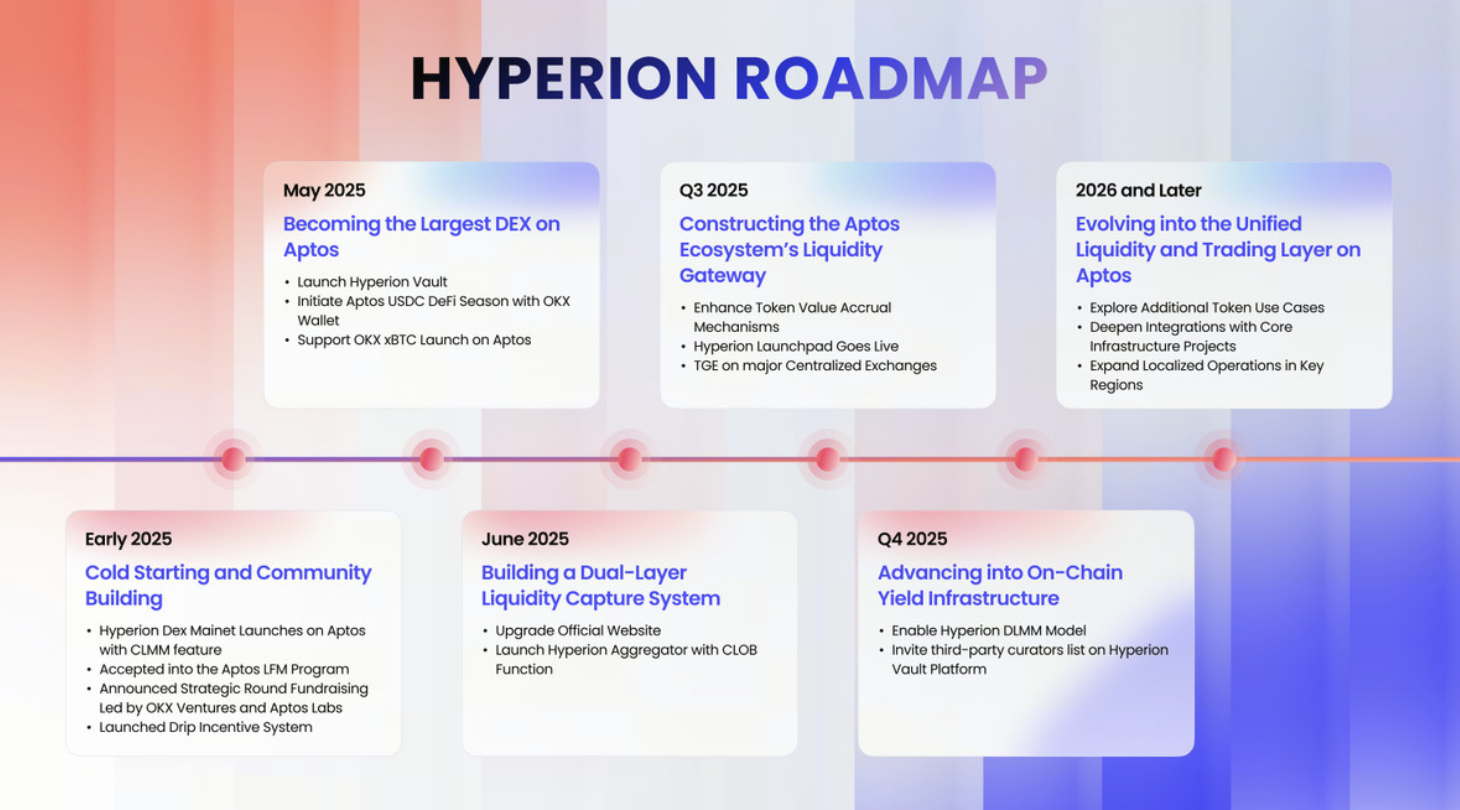
Hyperion is focused on building the largest DEX on the Aptos chain as its core goal, gradually expanding its infrastructure and ecosystem integration. By early 2025, Hyperion will complete the mainnet launch and start community building; in May, it will focus on cooperation with OKX to promote the application of USDC and xBTC, striving to become the largest DEX on Aptos. Then, in June and the third quarter, it will launch a dual-layer liquidity capture system and Hyperion Launchpad, while strengthening the token value capture mechanism. In the fourth quarter, it will further introduce the DLMM model and third-party curators to enhance on-chain yield infrastructure.
Looking ahead to 2026, Hyperion will evolve towards a unified liquidity and trading layer, deepening infrastructure integration and regional expansion, to create a more complete Aptos decentralized finance ecosystem.
(Source: docs.hyperion)
Summary
Hyperion is not only an emerging DeFi protocol on Aptos, but also a pioneer in the innovation of on-chain liquidity structures. By combining innovative liquidity design, flexible token economics, and governance models, RION takes on a role that is not just as a medium of exchange, but also as a proof of participation in the entire Hyperion ecosystem.







