As generative AI expands from model training into large-scale commercial applications, the focus of competition in the AI computing market is also changing. Enterprises need not only to train more powerful models, but also to process user requests continuously at a controlled cost, run AI Agents, generate voice, and provide real-time interactive services. Against this backdrop, the specialized inference acceleration architecture represented by Groq has attracted increasing attention. This article examines Groq's corporate positioning, LPU technology, GroqCloud's business model, and industry competition to analyze its role in AI inference infrastructure, as well as the technical and commercial challenges facing the specialized chip approach.
Key Takeaways
- Groq is a computing technology company focused on AI inference. Its core technologies include LPU chips, compilers, and supporting inference infrastructure.
- AI training and inference have different computing requirements. Real-time inference places particular importance on time to first token, generation speed, and service stability.
- Groq LPUs optimize specific AI inference workloads through on-chip SRAM, deterministic execution, and hardware-software co-design.
- GroqCloud packages underlying computing capabilities into cloud APIs, enabling developers to call supported AI models.
- LPUs and GPUs differ in architecture and applicable scenarios. Overall performance cannot be evaluated based solely on single-token generation speed.
- Groq's long-term commercial competitiveness depends on chip scalability, its software ecosystem, inference costs, customer demand, and the return on infrastructure investment.
What Is Groq? What Role Does It Play in the AI Computing Value Chain?

Groq is a technology company focused on AI inference computing. It was founded in 2016 by Jonathan Ross, who previously participated in the Google TPU project. The company primarily develops specialized AI acceleration chips, compilers, and inference computing systems, and provides model inference capabilities to developers and enterprises through services such as GroqCloud.
It is important to note that Groq and Grok are not the same product. Groq is a technology name related to AI computing infrastructure, while Grok is an artificial intelligence model and assistant product developed by xAI. Although their names are similar, they belong to different companies and have different technical positioning and business models.
In the AI value chain, Groq is primarily positioned at the computing infrastructure layer. A complete generative AI application typically involves model development, training compute, inference deployment, application interfaces, and end-user services. Groq's primary business is not developing general-purpose chat models for consumers. Instead, it aims to provide high-performance inference environments for different models.
For example, when building a real-time AI assistant, developers can select a model that has already been trained and use an inference service to process user input. The model understands questions and generates content, while the underlying computing platform determines how quickly the model can run and how many computing resources each request consumes.
Optimizing this computing process is at the heart of Groq's value proposition. Through specially designed processors and software systems, Groq reduces execution overhead for certain inference tasks, enabling models to generate responses more quickly.
This positioning means that Groq's market opportunity depends not only on whether a particular AI model becomes popular, but also on inference demand across the generative AI industry, model architectures, and changes in computing costs.
Why Is the AI Industry Paying More Attention to Inference Compute?
AI computing can generally be divided into two stages: training and inference. Training involves using large amounts of data to adjust model parameters so that the model can acquire capabilities such as language understanding and image recognition. Inference refers to a trained model receiving new input and generating output based on its existing parameters.
Both require computing resources, but their workloads differ significantly. Model training typically involves processing large datasets, calculating gradients, and updating parameters. It emphasizes large-scale parallel computing, memory capacity, and coordination across multiple devices. Inference, by contrast, needs to generate results quickly in response to user requests. This is particularly important in chat, voice, and automation applications, where response times directly affect the user experience.
For large language models, the inference process generally includes two stages: Prefill and Decode. Prefill processes the input prompt and establishes the relevant computational state, while Decode generates subsequent Tokens one at a time. Because autoregressive language models typically need to predict the next Token based on the content already generated, the continuous generation process places significant demands on memory access efficiency and computing schedules.
Users of ordinary chat applications may tolerate a brief wait. However, in real-time voice assistants, automated customer service, and interactive AI scenarios, response latency can directly affect how natural a conversation feels. If a model takes too long to generate the first part of a response, or if its output speed is insufficient for real-time communication, it may struggle to meet practical business requirements even if the model itself is highly capable.
The development of AI Agents has further increased demand for inference. Unlike one-time question-and-answer interactions, an AI Agent may need to call multiple models, analyze external data, execute tool operations, and verify results. A single user task may generate multiple rounds of internal reasoning and multiple API requests, increasing total computing consumption.
As a result, competition in AI infrastructure is expanding beyond simply pursuing greater model training capabilities. It now also focuses on delivering inference services with lower latency, higher throughput, and more reasonable costs.
However, growing inference demand does not mean that training compute is becoming less important. Training new models, fine-tuning models, and providing inference services may all continue to grow simultaneously. The difference is that the hardware requirements for different computing tasks are becoming more specialized.
What Are the Key Characteristics of Groq's LPU Technology Approach?
LPU is the technical term Groq uses to describe its specialized inference processor. Compared with general-purpose GPUs designed for a broad range of computing tasks, LPU design is more focused on computation, data movement, and latency control for specific AI workloads.
Groq LPU technology can be understood through three aspects: on-chip memory, deterministic execution, and compilers.
How Does On-Chip SRAM Affect Data Access Efficiency?
Modern AI computing is limited not only by a chip's arithmetic capabilities, but also by the speed of data access and transfer. During large language model inference, computing units must continuously access model weights and intermediate data. If data cannot be delivered in time, the processor may be unable to fully utilize its resources even if it has high theoretical computing capacity.
One important feature of Groq LPUs is their emphasis on on-chip SRAM (static random-access memory). SRAM generally provides lower access latency and can help processors quickly read the required data. Compared with designs that rely on larger-capacity external high-bandwidth memory, this architecture attempts to reduce data access overhead for certain computing tasks.
SRAM also has cost and capacity limitations. Given the same chip area, SRAM generally cannot provide the same storage scale as external high-capacity memory. Therefore, deploying models with larger parameter counts may require multi-chip coordination, model partitioning, and system-level optimization to meet capacity requirements.
This means that on-chip SRAM is not inherently superior to every other memory architecture. Its value depends on the specific model and workload, as well as whether the computing system can effectively coordinate data storage and transfer.
Why Is Deterministic Execution Important?
Another key element of Groq's design is deterministic execution. Under this architectural approach, the compiler can plan a large number of computing operations and data transfers in advance, allowing the processor to operate according to a predetermined execution schedule.
Traditional GPUs generally need to support a variety of computing tasks, dynamic scheduling, and complex software environments, giving them strong versatility. Groq, by contrast, attempts to reduce some of the uncertainty associated with runtime scheduling and resource coordination through more explicit execution plans.
For low-latency inference, predictable execution time has practical value. When enterprises provide real-time AI services, they care not only about average response speed, but also about latency variation between different requests. If a service occasionally experiences significant response delays, the user experience may be affected even if average performance is high.
Deterministic execution does not mean that every request will have exactly the same response time. Actual latency may still be affected by factors such as input length, output length, batching strategies, system load, and network conditions.
How Does the Compiler Contribute to LPU Performance Optimization?
Groq's technology approach does not rely solely on hardware to improve performance. It emphasizes hardware-software co-design. The compiler needs to analyze the model's computational graph and map relevant operations to the chip's computing and storage resources.
In this process, the compiler is responsible not only for converting the model into executable instructions, but also for arranging data transfers, computation sequences, and resource usage so that different computing units can operate together according to a predetermined plan.
This design enables deep optimization for supported models, but it also places significant demands on the software toolchain. When model structures, operator types, or inference requirements change, the platform needs to continuously improve its compiler and runtime environment.
Therefore, Groq's technological competitiveness comes not only from the LPU chip itself, but also from its compiler, model adaptation capabilities, and the coordinated efficiency of its overall inference system.
How Does GroqCloud Turn LPU Compute into a Commercial Service?
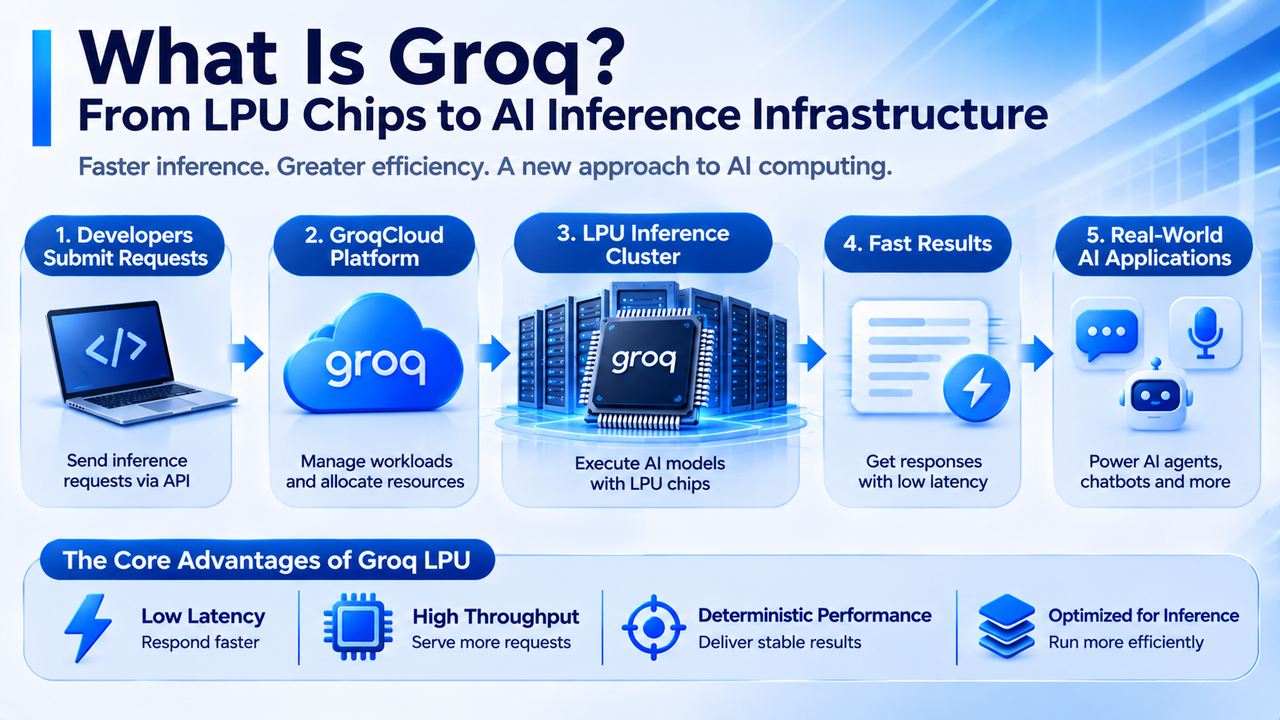
GroqCloud is Groq's cloud-based AI inference service for developers and enterprises. It integrates underlying chips, computing clusters, and model runtime environments into services accessible through APIs. This allows customers to use Groq's inference infrastructure without purchasing and deploying specialized chips themselves.
In a typical application, developers first select a model supported by the platform and then send text or other types of input through an API. GroqCloud receives the request, assigns the relevant computing task to the underlying inference system, and returns the generated result to the application. This process involves request scheduling, model execution, resource management, and result transmission.
For enterprise customers, the primary value of using a cloud inference service is a lower barrier to infrastructure deployment. Building an AI computing cluster independently typically requires purchasing hardware, configuring networks, deploying models, and maintaining the runtime environment. Using an inference service through an API converts some fixed infrastructure investment into service spending that varies with business usage.
Groq's platform is also expanding from a single inference API toward more comprehensive enterprise infrastructure services. Its product portfolio includes specialized computing infrastructure, an inference software stack, and enterprise-level governance and control capabilities to meet different customer requirements for performance, deployment methods, and management permissions.
However, the commercial value of a cloud inference service does not depend entirely on chip speed. Enterprises must also consider model support, API stability, service availability, data security, and per-request costs. If a platform supports only a limited range of models or operators, it may not meet all enterprise application requirements even if it provides low latency for specific tasks.
In terms of revenue models, inference cloud services can typically charge based on model usage, the number of Tokens processed, or reserved computing capacity. Different pricing methods create different resource management requirements. Usage-based billing depends more heavily on actual request volume, while reserved-capacity services require attention to customer contracts, resource delivery, and equipment utilization.
Therefore, GroqCloud's ability to commercialize its technology ultimately depends on whether it can turn the underlying performance advantages of LPUs into stable, scalable, and cost-competitive inference services.
How Does Groq's Partnership with NVIDIA Change Its Industry Positioning?
Groq's relationship with NVIDIA is important background for understanding its current industry positioning.
In December 2025, Groq and NVIDIA entered into a non-exclusive AI inference technology licensing agreement. According to disclosures from both parties, NVIDIA obtained a license to Groq's relevant inference technology, while Groq founder Jonathan Ross, then-President Sunny Madra, and some team members joined NVIDIA. Groq continued to operate as an independent company under CEO Simon Edwards, and its GroqCloud business remained operational.
This transaction means that Groq's technology value is reflected not only in the independent sale of inference services, but also in its entry into the broader AI computing ecosystem through technology licensing.
In March 2026, NVIDIA further introduced the Groq 3 LPX inference acceleration architecture and combined it with the Vera Rubin platform. The related solution attempts to assign workloads between GPUs and LPUs based on the computing characteristics of different stages of AI inference, with the aim of improving low-latency inference efficiency. This development reflects the increasing complexity of competition in the AI chip market. In the past, specialized inference chips were often viewed as potential substitutes for GPUs. In heterogeneous computing architectures, however, different types of processors can also perform complementary tasks.
For example, GPUs can handle large-scale parallel computing and some attention computations suited to their architecture, while LPUs can handle computing tasks that are more sensitive to execution time and data transfer latency. Through system-level scheduling, the two types of processors may work together on the same inference workload.
However, heterogeneous architectures also introduce additional engineering complexity. Systems need to coordinate data transfers, task allocation, and memory management across different devices. If cross-device communication overhead is too high, theoretical hardware advantages may not fully translate into practical performance.
In August 2026, Groq also announced that it had joined the NVIDIA Cloud Partner program, further strengthening its positioning as an AI cloud infrastructure operator. Therefore, Groq can no longer be simply described as a chip company completely independent of the NVIDIA ecosystem and focused solely on challenging GPUs. Its current business includes independent inference cloud services, specialized chip technology, and infrastructure cooperation with NVIDIA.
How Is Groq's Business Model Adapting to the Growth of the AI Inference Market?
Commercial demand in the AI inference market primarily comes from enterprise applications, developer services, and AI products that operate continuously. Unlike model training, which is generally project-based and occurs in stages, inference services need to provide computing capacity continuously as user traffic changes. They therefore place greater emphasis on resource utilization, unit costs, and service stability.
Groq's business model can be understood at three levels.
-
Inference infrastructure construction. Groq needs to build usable computing capacity through chips, servers, networks, and data centers. These assets can support customer requests and generate revenue only after equipment deployment, model adaptation, and service launch are complete.
-
Cloud inference services. GroqCloud converts computing capacity into APIs that developers can call, without requiring customers to manage the underlying chips directly. For the service provider, revenue growth depends on the number of customers, request volume, service pricing, and customer retention.
-
Enterprise infrastructure services. Some enterprises may require dedicated computing resources, specific deployment methods, or stricter governance requirements. These needs may create more stable long-term customer relationships, but they also require greater investment in engineering, operations, and customer support.
In June 2026, Groq announced that it had secured $650 million in growth funding to expand its global AI inference cloud business, with a target of reaching approximately 200 MW of infrastructure capacity by 2027. At the time, the company disclosed that it operated 13 data centers across multiple regions, served more than 5 million developers, and processed tens of trillions of AI Tokens each week.
These figures can be used to observe the pace of business expansion, but they do not directly demonstrate profitability. The number of developers, Token volume, and number of data centers reflect user reach, service activity, and infrastructure scale, respectively. They do not equal actual revenue, profit, or free cash flow.
For example, suppose the number of Tokens processed by an inference platform each month increases by 100%, but the price per Token declines by 40% due to market competition. Its revenue growth could then be lower than its usage growth. If infrastructure construction and operating costs also increase during the same period, profit margins could be affected further.
Therefore, analyzing Groq's commercialization potential requires simultaneous consideration of inference demand growth, service pricing, equipment utilization, and capital expenditures. Market value cannot be assessed solely based on model execution speed.
What Technical and Scaling Challenges Does Groq Face?
Although specialized inference chips can be optimized for specific workloads, Groq still faces challenges arising from changes in models, hardware scaling, and market competition.
Model adaptation. AI model architectures continue to evolve rapidly. Different models may use different attention mechanisms, parameter scales, computational precisions, and inference strategies. If a specialized processor is to support more models, its compiler, runtime environment, and related software tools must be updated continuously.
This also means that a performance advantage achieved by one generation of chips on a specific model may not carry over directly to every new model. As long-context inference, mixture-of-experts models, and multimodal computing develop, underlying computing systems need to continually adapt to new workloads.
Multi-chip scaling. Groq LPUs emphasize on-chip SRAM and deterministic execution, but large models often require storage and computing resources beyond the capacity of a single chip. When a model is distributed across multiple chips, the system needs to coordinate data transfers and computation sequences between devices.
If multi-chip communication is inefficient, the low-latency advantage of a single chip may be reduced. Therefore, chip interconnects, system bandwidth, and compiler scheduling capabilities are important factors in determining whether a specialized inference architecture can scale.
Infrastructure construction costs. Even if chips offer high computing efficiency, building an AI data center still requires power connections, facility space, cooling systems, and network infrastructure. As its inference services expand, Groq will also need to bear the corresponding capital and operating costs.
Market competition. NVIDIA GPUs, AMD GPUs, Google TPUs, and other specialized AI accelerators are all competing for inference computing demand. Different platforms may each have advantages in model compatibility, throughput, latency, cost, and software ecosystems.
For enterprise customers, the final choice is generally not determined by a single performance metric. It depends on total service costs, application compatibility, and long-term operational reliability. Therefore, whether Groq's technology approach can establish sustained competitiveness depends not only on the LPU architecture itself, but also on whether the company can continue expanding software support, improve computing resource utilization, and control the cost of infrastructure expansion.
What Does Groq Mean for AI Chips and the Computing Industry?
The technology approach represented by Groq reflects the AI computing industry's gradual shift from architectures centered on general-purpose accelerators toward heterogeneous computing systems optimized for different workloads. In the early stages of generative AI development, training capabilities were an important driver of industry progress. As more models enter practical applications, inference services are beginning to create ongoing computing demand, increasing enterprise requirements for low latency, cost efficiency, and service stability.
This creates room for specialized inference chips to develop. By optimizing hardware and software for specific computing processes, specialized architectures may achieve performance or cost advantages in certain tasks.
However, this does not mean that GPUs will be completely replaced by specialized inference chips. GPUs have broad software ecosystems, extensive model support, and general-purpose computing capabilities, allowing them to adapt to various training and inference workloads. Specialized accelerators may instead play a role in specific models, computing stages, or low-latency scenarios.
The technology cooperation between NVIDIA and Groq further suggests that future AI data centers may deploy different types of computing devices simultaneously and coordinate them through software scheduling systems. This approach could improve computing resource utilization, but it would also increase the complexity of system design and management.
For the AI infrastructure industry, the focus of competition may gradually expand from the theoretical performance of individual chips to the ability to deliver complete computing systems. Chip performance, memory bandwidth, device interconnects, compilers, energy efficiency, and cloud service operations may all affect the ultimate commercial return.
Groq's development also shows that AI inference infrastructure is not merely a chip manufacturing issue. It is an integrated industry encompassing hardware architecture, software optimization, data center construction, and commercial service delivery.
Conclusion
Groq is a technology company focused on AI inference computing. Its LPU architecture uses design elements such as on-chip SRAM, deterministic execution, and compiler scheduling to improve execution efficiency for specific AI workloads. GroqCloud converts underlying computing capabilities into cloud inference services, enabling developers and enterprises to use the relevant infrastructure through APIs.
As AI applications expand beyond model training into real-time interaction, AI Agents, and continuously operating enterprise services, inference latency, throughput, and cost are becoming increasingly important technical metrics. The specialized inference architecture represented by Groq offers the AI computing industry an alternative approach to general-purpose GPUs.
At the same time, Groq's technology licensing and infrastructure cooperation with NVIDIA show that specialized inference chips and GPUs do not have to be purely competitive. Future AI data centers may increasingly adopt heterogeneous computing architectures in which different processors handle tasks suited to their respective characteristics.
However, technical advantages in specialized chips do not automatically translate into commercial success. Groq still needs to address model adaptation, multi-chip scaling, infrastructure costs, and cloud service profitability. Its long-term development will depend on whether it can turn its inference performance advantages into stable customer demand, sustainable revenue, and reasonable returns on capital.
FAQ
What Kind of Company Is Groq?
Groq is a technology company focused on AI inference computing. Its main business areas include LPU specialized processors, inference computing systems, and GroqCloud cloud inference services.
Are Groq and Grok the Same Product?
No. Groq is a technology company related to AI inference infrastructure, while Grok is an artificial intelligence model and assistant product developed by xAI.
What Is the Groq LPU?
The LPU is a specialized AI inference processor designed by Groq. It emphasizes on-chip SRAM, deterministic execution, compiler scheduling, and low-latency computing.
How Does the Groq LPU Differ from an NVIDIA GPU?
LPUs place greater emphasis on optimizing computing and data transfer for specific inference tasks, while GPUs offer broader parallel computing capabilities and software ecosystems. Actual performance depends on the model, batch size, latency requirements, and deployment environment.
Was Groq Acquired by NVIDIA?
As of November 2026, Groq continues to operate as an independent company. The two parties entered into a non-exclusive technology licensing agreement in December 2025, and some Groq team members joined NVIDIA. This does not mean that NVIDIA completed an overall acquisition of Groq.
What Is GroqCloud?
GroqCloud is Groq's cloud-based AI inference service. It allows developers to call models supported by the platform through APIs without purchasing and deploying the underlying computing hardware themselves.
Why Has Groq Attracted Attention in the AI Computing Market?
Groq's technology approach optimizes latency, data transfer, and execution efficiency in AI inference. This aligns with the computing efficiency requirements of real-time AI applications, AI Agents, and enterprise inference services.
Does Groq Have Its Own Cryptocurrency?
Groq is an AI computing infrastructure company. Its LPU and GroqCloud businesses do not rely on a native cryptocurrency token. Third-party tokens with similar names should not be treated directly as assets issued or endorsed by Groq.