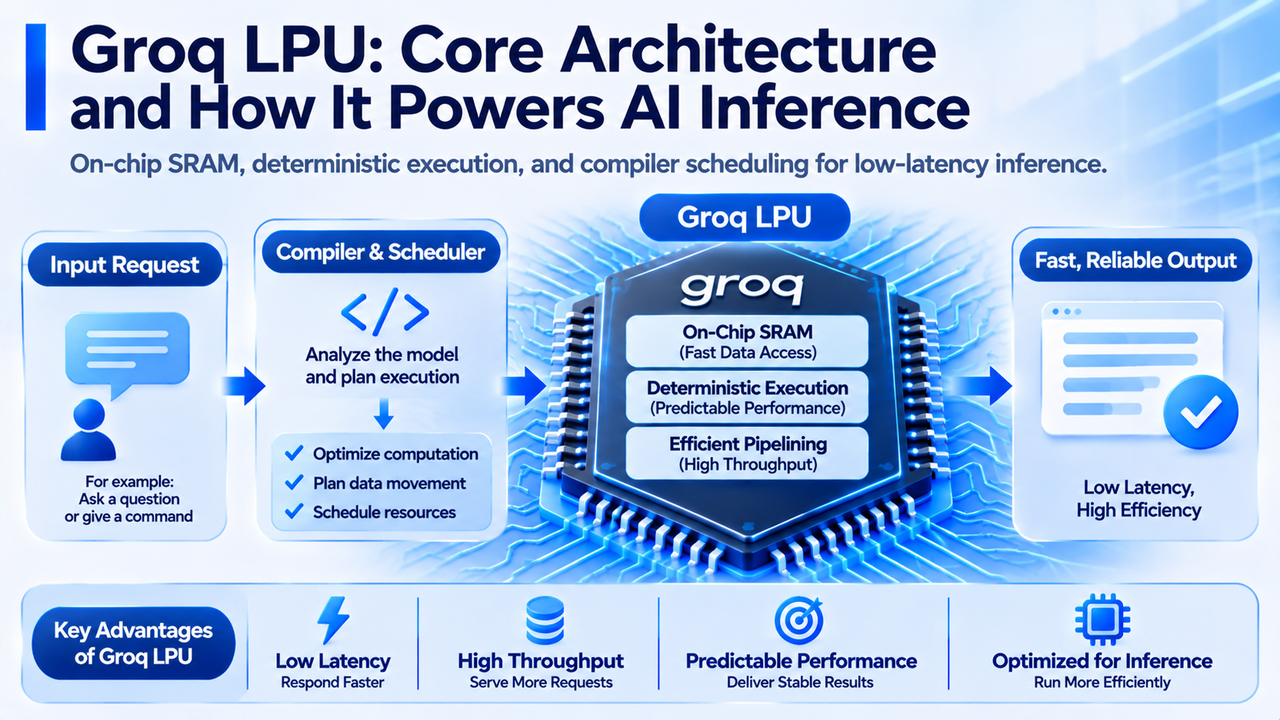
Unlike GPUs, which are designed for a broad range of massively parallel computing tasks, Groq LPUs use an architecture that emphasizes on-chip SRAM, static compiler scheduling, and deterministic execution. This approach aims to reduce data transfer and runtime scheduling overhead during inference, providing more targeted computing capabilities for real-time AI applications.
As large language models are increasingly used in intelligent customer service, voice interactions, AI Agents, and enterprise automation, inference requirements are expanding beyond simply maximizing processing speed to include response latency, service stability, and per-unit computing costs. The dedicated accelerator approach represented by Groq LPUs provides AI infrastructure with a technical option distinct from traditional general-purpose computing architectures. This article provides an in-depth introduction to how Groq LPUs work, analyzes how SRAM, deterministic execution, and compilers affect inference performance, and discusses their applicable scenarios and technical limitations.
Key Takeaways
-
Groq LPU is a dedicated processor designed for AI inference workloads, with an emphasis on low latency, predictable execution, and efficient data transfer.
-
Large language model inference generally consists of two stages: Prefill and Decode. These stages have different requirements for computing power and memory bandwidth.
-
Groq LPUs use on-chip SRAM to shorten certain data access paths, but their relatively limited on-chip storage capacity also creates requirements for model deployment and multi-chip scaling.
-
Deterministic execution and static compiler scheduling can reduce some runtime scheduling overhead, but they do not mean that every request will have exactly the same response time.
-
LPUs have potential advantages in low-latency applications such as real-time text generation and voice interactions. Their actual performance still depends on the model, workload, system configuration, and service pricing.
What Is Groq LPU? How Is It Different from Traditional AI Accelerators?
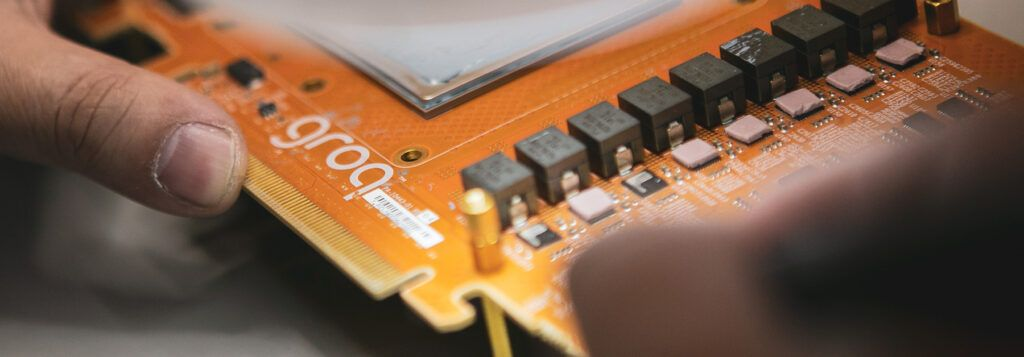
Groq LPU is a dedicated AI inference processor designed by Groq. LPU stands for Language Processing Unit. Its design is intended to optimize data movement, computation execution, and latency control in language model inference rather than provide general-purpose computing capabilities for every type of task.
To understand the technical positioning of LPUs, it is first necessary to recognize the different design approaches used by AI accelerators. GPUs were originally designed primarily for graphics processing. They were later widely adopted for deep learning training and inference because of their large-scale parallel computing capabilities and mature software ecosystem. Dedicated accelerators such as TPUs improve the execution efficiency of specific computing tasks by optimizing operations for machine learning.
Groq LPUs place further emphasis on coordination between the compiler and hardware. Their architecture aims to plan computation and data transfer before a model is executed, enabling the chip to complete tasks according to a predetermined schedule and thereby reduce some of the overhead generated by dynamic scheduling.
This design approach is closely related to the Tensor Streaming Processor (TSP) technology direction introduced by Groq in its early development. By organizing computing resources, on-chip storage, and data transfer paths, the processor enables model operations to execute in the sequence arranged by the compiler.
It is important to note that LPU is not a standardized industry category for all language model processors. It is a technical name used by Groq. Different manufacturers may use different chip designs or achieve low-latency inference through GPUs, ASICs, or other dedicated accelerators.
Therefore, assessing the technical value of Groq LPUs requires more than considering the processor name. It requires analyzing how they handle data access, computation scheduling, and multi-chip communication during inference.
Why Do Large Language Models Need Low-Latency Computing?
Large language model inference refers to the process in which a model receives input and uses its trained parameters to generate an output. For common autoregressive language models, inference generally consists of two stages: Prefill and Decode. The Prefill stage primarily processes the user's prompt and establishes the computational state required for subsequent generation. Because this stage can process multiple input Tokens simultaneously, it generally has strong parallel computing characteristics.
The Decode stage generates output Tokens one at a time. The model typically needs to predict the next Token based on the existing input and previously generated content, so dependencies exist between multiple generation steps. As a result, these steps cannot be fully parallelized as easily as some training computations.
This distinction means that inference performance cannot be measured using a single metric.
Time to First Token (TTFT) measures the time from the start of a request to the generation of the first output Token. It primarily affects how long users perceive they must wait for a response.
Token generation speed measures how many Tokens a model can generate per unit of time after it begins producing output. It directly affects the smoothness of continuous text generation. Throughput focuses on how many requests or Tokens a system can process within a given period and reflects the overall processing capacity of an inference service under relatively high concurrent load.
For example, two inference platforms may both be able to run the same language model, but Platform A may offer faster Token generation for a single user request, while Platform B may achieve higher overall throughput when processing hundreds of requests simultaneously.
This means that low latency and high throughput are not exactly the same performance objective. A system optimized for real-time interaction with a single user may not have the same advantages in every batch-processing or high-concurrency scenario.
For voice assistants, real-time translation, and interactive AI applications, TTFT and continuous generation speed are particularly important. Users generally expect the system to begin responding quickly and continue producing natural, fluent content.
For tasks such as offline document analysis and batch data processing, the immediate response time for an individual request may be less important. Enterprises may instead focus more on overall throughput and per-unit processing costs.
One of the design priorities of Groq LPUs is to optimize execution efficiency for inference workloads that are sensitive to response time.
How Do Groq LPUs Use SRAM to Improve Data Access Efficiency?
The performance of modern AI processors depends not only on how many operations their computing units can perform, but also on whether data can reach those computing units in time.
During large language model inference, processors repeatedly read model weights, access intermediate results, and maintain context-related data. If data cannot be read quickly enough, even a chip with high theoretical computing power may fail to perform at full capacity because it is waiting for data.
This issue is commonly known as the memory bottleneck.
One of the key architectural characteristics of Groq LPUs is their emphasis on using on-chip SRAM (Static Random-Access Memory) for data storage and access.
SRAM generally offers low access latency and can be directly integrated into the processor chip. Compared with data accessed through an external memory interface, on-chip storage can shorten data transfer paths and reduce some access overhead.
To understand this design, it is useful to compare the basic characteristics of SRAM and high-bandwidth memory (HBM).
| Comparison Dimension |
SRAM |
HBM |
| Typical Location |
Inside the processor chip |
An independent memory stack within the processor package |
| Main Advantages |
Low access latency and tight integration |
Larger capacity and high aggregate bandwidth |
| Main Limitations |
High area cost and limited capacity |
Data access still requires a memory interface |
| Typical Uses |
Cache and on-chip working memory |
Large-scale data such as model weights and activations |
| Significance for Inference |
Optimizes certain data access paths |
Supports larger models and computational states |
However, it cannot be simply assumed that SRAM is faster than HBM in every situation or that using SRAM eliminates the memory bottleneck. Actual performance also depends on data layout, parallel access patterns, memory bandwidth, and model architecture.
The main limitations of SRAM are its storage density and chip area cost. For language models with a large number of parameters, the SRAM on a single processor is generally insufficient to hold all model weights and runtime states.
Groq therefore needs to use multi-chip coordination and system-level data allocation to run models on larger computing systems. This means that the advantages of LPUs do not come entirely from the SRAM on an individual chip. Instead, they result from the overall design of on-chip storage, computing pipelines, chip interconnects, and compilers.
How Do Deterministic Execution and Compiler Scheduling Affect Inference Performance?
Deterministic Execution is another key concept for understanding the Groq LPU architecture. Its core idea is to determine the execution order of computing operations, data transfer paths, and resource allocation as much as possible before a program runs, reducing the need to make temporary scheduling decisions during execution.
In traditional general-purpose computing architectures, processors must adapt to different types of programs and workloads. To improve resource utilization, systems typically include dynamic task scheduling, cache management, and other runtime mechanisms. These designs provide considerable flexibility but may also introduce additional scheduling overhead.
Groq LPUs use a different design approach. Before a model is executed, the compiler analyzes its computational graph and creates an execution plan for computing operations and data movement. The processor then runs according to this plan, enabling data to move between different computing units in an orderly manner. For example, a language model may need to continuously perform matrix operations, activation functions, and other computations. The compiler can arrange in advance when these tasks will run on different computing resources and coordinate the required data transfers.
This approach is similar to planning each step on a production line in advance so that different stages can work together according to a predetermined rhythm.
For AI inference, deterministic execution has two primary implications.
-
It can reduce some runtime scheduling overhead. The processor does not need to redetermine the execution order of every task at each computing stage, which can help improve execution efficiency for specific workloads.
-
It can make computing execution times more predictable. For real-time AI services, consistent response performance is as important as low average latency. Deterministic execution does not mean that the response time of actual API requests will be completely fixed. Input length, output Token count, request queuing, network transmission, and service load can still cause differences in end-to-end latency.
-
Static scheduling may also reduce the flexibility of some computing tasks. If a model has complex dynamic control flow or the execution path must frequently change based on real-time results, the compiler may need to use additional processing strategies.
Therefore, the value of deterministic execution is not that it eliminates all uncertainty. Rather, for suitable computing tasks, it improves the efficiency of hardware resource utilization through more explicit execution planning.
Why Are Groq LPUs Suitable for Low-Latency AI Inference?
The low-latency design of Groq LPUs does not depend on any single technology. It results from the combined effects of on-chip SRAM, deterministic execution, compiler optimization, and system-level interconnects. During large language model generation, the model must continuously perform computations and generate subsequent Tokens based on existing results. If a processor can reduce some data access delays and runtime scheduling overhead, it may shorten the time required for successive generation steps.
This is particularly relevant to the Decode stage. Because autoregressive models generally need to generate Tokens one at a time, the latency of each generation step accumulates and ultimately affects the text output speed perceived by users. However, the performance bottlenecks of different inference tasks are not always the same. Processing long prompts may depend more on large-scale parallel computing capabilities, while continuous generation may be more affected by memory access and step-by-step execution latency.
Therefore, the actual performance of Groq LPUs must be evaluated in combination with the model type, input length, output length, and number of concurrent requests.
From an application perspective, the following types of services are particularly sensitive to low-latency inference.
Real-time voice interactions. A voice assistant needs to convert a user's speech into text, call a language model to generate a response, and then produce the result through speech synthesis. If the language model generates responses slowly, the conversation may experience noticeable pauses.
Interactive AI Agents. When performing tasks, an AI Agent may need to call a language model multiple times to determine the next action. Each inference delay affects the overall task completion time, so reducing the waiting time for individual inferences may improve the user experience.
Intelligent customer service and real-time applications. Online services serving large numbers of users need not only to respond quickly but also to control latency fluctuations between requests in order to maintain stable service quality.
However, low latency does not necessarily mean the lowest per-unit computing cost. For example, an inference platform may process an individual request at a high speed, but if its hardware acquisition cost is high or significant resources remain idle under low load, its actual service cost per million Tokens may still exceed that of other solutions. Conversely, another platform may generate Tokens more slowly for individual requests but serve many users simultaneously through batch processing, ultimately achieving a lower average cost.
Therefore, when selecting an inference platform, enterprises need to balance latency, throughput, cost, and model compatibility rather than making a decision based solely on Tokens per second.
What Are the Technical Limitations of Groq LPUs?
Although Groq LPUs are specifically optimized for AI inference, a dedicated architecture does not mean they will outperform other solutions in every computing task. Their main technical limitations involve memory capacity, multi-chip scaling, model compatibility, and system cost.
On-chip SRAM capacity limitations. Because SRAM has relatively low storage density, the amount of on-chip storage available on a single chip is limited. When model parameters and runtime states exceed the capacity of a single chip, computation and data must be distributed across a multi-chip system.
For example, a large language model may require tens of gigabytes or more of storage. It is generally difficult to store all of this data using only the on-chip SRAM of a single chip. The system must therefore distribute the model across multiple processors and use chip interconnects to perform the necessary data exchanges.
This approach can increase the size of models that can be deployed, but it also increases system design complexity.
Multi-chip communication overhead. Even if an individual LPU can execute computations quickly, overall inference speed may still be affected by interconnect bandwidth, communication latency, and data allocation strategies when the model requires frequent cross-chip data transfers. In large-scale inference systems, performance depends not only on the computing power of an individual processor but also on the coordinated operation of the entire chip cluster.
Model compatibility. Groq LPUs rely on compilers to map model computations to dedicated hardware and therefore require corresponding software support. When new AI models introduce different computing operators, attention mechanisms, or dynamic execution methods, the platform may need to update its compiler and runtime environment. Compared with general-purpose GPUs, which have broad software ecosystems, dedicated inference processors require ongoing software development to adapt to rapidly changing model technologies.
Infrastructure and commercial costs. The performance advantages of LPUs require a complete computing system. Actual deployment still involves costs for chip manufacturing, servers, networking, power, and cooling facilities. For cloud inference service providers, equipment utilization and customer demand also determine the return on investment.
Therefore, Groq LPUs should be evaluated together with their actual deployment conditions. High Token generation speed in a particular test does not directly demonstrate greater cost efficiency across all models and commercial scenarios.
What Do Groq LPUs Mean for the Future of AI Inference Infrastructure?
The development of Groq LPUs reflects the increasing specialization of the AI computing market. As generative AI applications expand, enterprises are beginning to select more specialized computing architectures based on different workloads rather than focusing solely on the theoretical peak performance of a single processor.
In model training, large-scale parallel computing, memory capacity, and communication between multiple devices remain important. In inference, TTFT, continuous generation speed, concurrent throughput, and per-Token cost have become more direct commercial metrics.
The differences between computing tasks create room for dedicated inference chips to develop. At the same time, dedicated processors and GPUs do not necessarily have a purely substitutive relationship. In March 2026, NVIDIA introduced an inference architecture that combines Groq 3 LPX with the Vera Rubin platform, exploring how different types of computing devices can handle inference tasks suited to their respective characteristics.
This direction reflects the development trend of Heterogeneous Computing. In the future, AI data centers may deploy GPUs, dedicated inference accelerators, and other computing devices simultaneously, with software systems coordinating the execution of different tasks.
For example, suitable GPU resources can be used for workloads that require large-scale parallel processing, while dedicated inference processors may offer advantages for certain generation tasks that are highly sensitive to latency. However, heterogeneous computing does not mean that simply adding more types of chips will improve efficiency. Systems must also address cross-device communication, task scheduling, software compatibility, and infrastructure costs.
For the AI chip industry, this means competition is expanding from the performance of individual hardware components to the efficiency of complete computing systems. Processor architecture, compilers, memory systems, interconnect technologies, and cloud service operations may all become factors that determine final performance and commercial value.
The technology approach represented by Groq LPUs provides a specific example of this shift. Their long-term value will depend not only on the inference speed of a particular chip generation but also on whether they can continue to adapt to model evolution and convert technical performance into stable, scalable computing services.
Conclusion
Groq LPU is a dedicated processor designed for AI inference. It uses technologies such as on-chip SRAM, deterministic execution, and static compiler scheduling to optimize data access and computation execution for certain large language model workloads.
Compared with general-purpose GPUs, Groq LPUs place greater emphasis on low latency and execution predictability for specific inference tasks. This design is suitable for exploring performance optimization in applications such as real-time text generation, voice interactions, and AI Agents, but it does not mean that LPUs can replace GPUs in every model and computing scenario.
At the same time, SRAM capacity, multi-chip communication, model adaptation, and infrastructure costs remain important issues that dedicated inference architectures must address.
As the AI industry expands from model development to large-scale applications, competition in inference computing is shifting from simply maximizing computing power to optimizing latency, throughput, cost, and overall system efficiency. The development of Groq LPUs shows that dedicated accelerators may play a more important role in future AI infrastructure, but their actual value still needs to be validated through specific workloads and commercial deployment results.
FAQ
What Is Groq LPU?
Groq LPU is a dedicated AI inference processor designed by Groq. It primarily uses technologies such as on-chip SRAM, deterministic execution, and compiler scheduling to optimize specific language model inference tasks.
What Are the Main Differences Between LPUs and GPUs?
LPUs place greater emphasis on optimizing execution and data transfer for specific inference tasks, while GPUs offer broad parallel computing capabilities and a mature software ecosystem. Their performance differences depend on the specific model and runtime environment.
Why Do Groq LPUs Use SRAM?
SRAM provides low-latency on-chip data access, which can help reduce data-reading overhead in certain inference tasks. However, SRAM capacity is limited, so deploying large models generally requires multi-chip coordination.
What Does Deterministic Execution Mean?
Deterministic execution means planning the computation order, data transfers, and resource allocation as much as possible before a program runs. This can reduce some runtime scheduling overhead and make computing execution more predictable.
Can Groq LPUs Be Used for AI Model Training?
Groq LPUs are primarily designed for inference workloads and are not mainly intended for general-purpose large-scale model training. Their actual support depends on the hardware architecture and software toolchain.
Are Groq LPUs Always Faster Than NVIDIA GPUs for Inference?
Not necessarily. Different models, input lengths, output lengths, concurrency levels, and test environments can all affect the results. A higher Token generation speed for a single user does not necessarily mean better overall throughput or lower per-Token costs.
Why Are Groq LPUs Suitable for AI Agents?
AI Agents may need to perform multiple inference calls in sequence. Reducing the response latency of each request may shorten the execution time of the overall task, but the final result also depends on tool calls, network transmission, and other processing stages.