Buying gold bullion usually serves one of two goals: wealth held outside the banking system, or a divisible, transferable form of gold exposure. The sequence of priorities changes the buying decision. The first turns on storage and buy-back terms; the second on per-ounce premiums and liquidity, while both follow the conventions that gold and commodities established in the over-the-counter market.
Under LBMA rules, gold bars delivered in London contain 350–430 fine troy ounces and are at least 995.0 fine. That standard covers wholesale gold bars only; retail bars and gold coins trade under commercial conventions.
Key Takeaways
- Gold bullion is priced by metal content, not craft or rarity.
- Fineness is quoted in parts per thousand; 999 and 9999 differ by 0.09 points.
- LBMA Good Delivery covers wholesale gold bars only.
- The holding method decides the legal claim and the storage options available at the time of purchase.
What Is Gold Bullion and How Does It Differ From Jewelry and Commemorative Coins?
The term gold bullion refers to investment-grade gold valued by weight and purity rather than design or face value, and the same bullion concept also applies to silver and other precious metals. Weight, purity, and the gold price drive the price, which makes bullion a transparent form of gold whose value is tied directly to the current spot price; design, brand, and mintage do not. That is the standard to refer to when comparing a one-ounce gold coin with a cast bar of the same fineness.
Gold jewelry and commemorative coins are a different category. Jewelry pricing includes fabrication, design, and channel costs, and buy-backs settle on scrap value after deductions. Commemorative coins carry value from mintage, grade, and theme, with gold content acting only as a floor. The difference between gold and bullion is mostly form and pricing: bullion is the investment-grade subset produced for investment purposes, while fabricated gold carries craft and brand costs.
Gold bullion coins sit between the two. A sovereign mint issues them with legal tender status, yet the price still follows gold and the face value is not the transaction price. The test is whether the buyer pays for metal content rather than craft. Gold bullion bars and gold coins come in a range of sizes, with gram bars from 1 g to 100 g at the retail end and 1 kg and Good Delivery units at the wholesale end.
| Type |
Pricing basis |
Main cost |
Buy-back |
| Investment bar |
Weight × purity × gold price |
Casting, packaging, logistics |
Metal value minus spread |
| Bullion coin |
Gold price plus mint premium |
Striking, legal tender status |
Gold value; part of premium may be lost |
| Commemorative coin |
Scarcity, grade, theme |
Mintage, grading, packaging |
Secondary market |
| Gold jewelry |
Gold price plus fabrication and brand |
Design, labor, storefront |
Scrap value after deductions |
What separates these products is not gold content but how much of the price sits outside the metal; separating the two makes unit costs comparable and is the first step when you choose a form, since bullion typically carries lower premiums than jewelry or commemorative products.
Large, long-term holdings that prioritize unit cost usually point to gold bars; smaller amounts, staged exits, or standardized legal tender products point to gold coins. Premiums also vary by quantity, and larger bars often come with lower premiums, so the choice follows the amount involved.
A premium is the part of the price above the spot price, covering minting, packaging, shipping, insurance, and channel costs. At the same purity, smaller weights spread fixed costs across fewer ounces, so premiums run higher; larger gold bars trade closer to the metal price and offer a low premium per ounce.
Gold coins can be sold one at a time, which suits staged exits and buying in smaller amounts for smaller transactions. Gold bars usually trade as one piece, and dividing one damages packaging and certificate, affecting buy-back terms and re-testing. A small gold coin can involve a low outlay but a high premium, so the buying price per ounce deserves a separate look, and low liquidity can widen the exit spread.
| Dimension |
Bars |
Coins |
| Unit premium |
Lower as weight rises |
Higher at small sizes |
| Divisibility |
Sold whole |
Sold coin by coin |
| Legal tender |
Usually absent |
Granted by a sovereign mint |
| Buy-back |
Serial, certificate, packaging |
Standardized identification |
| Typical use |
Large, long-term holdings |
Small amounts, staged exits |
This table is not a recommendation; it maps the trade-off between cost and flexibility. Rank cost, divisibility, and custody by importance and compare the options before you choose.
999, 9999, and 24K: How Should You Read Gold Purity?
Purity is quoted in parts per thousand. A 999 mark means 99.9% gold and 9999 means 99.99%, a gap of 0.09 points. Investment gold bars typically carry 999.9, a minority 999.99, while gold coins may use alloys such as 916.7 (22K).
Karat is a separate scale. 24K usually means at least 99.5% gold, 22K is 91.67%, and 18K is 75%. 24K is neither 100% pure nor the same as 9999, and mixing karat values with fineness marks is a common conversion error.
Purity is not authenticity. A bar marked 999.9 can still be plated or built around an alloy core; the fineness mark refers only to what the seller claims, and verification returns to the serial, certificate, and testing. Gold coins use 22K alloys for wear resistance, which does not put them below investment standard.
| Mark |
Gold content |
Common form |
| 995.0 |
99.50% |
Minimum for Good Delivery bars |
| 999 |
99.90% |
Investment bars, some coins |
| 999.9 |
99.99% |
Mainstream investment bars |
| 916.7 (22K) |
91.67% |
Circulating coins |
| 750 (18K) |
75.00% |
Jewelry |
Before you choose a purity, confirm whether buy-back terms settle on the stated fineness, and compare the marks so the choice matches the buy-back terms. Higher purity does not automatically mean better liquidity; dealer acceptance matters, and a low-premium bar is not necessarily easier to sell.
What Is London Bullion Market Association (LBMA) Good Delivery and Why Does It Define Liquidity?
LBMA Good Delivery is the settlement standard the London Bullion Market Association sets for wholesale gold bars. A bar has to meet it to settle a Loco London contract physically and enter interbank clearing and resale in a 24-hour market.
The rules cover fine gold content, purity, dimensions, bar marks, and surface quality: gold bars produced by an accredited refiner must contain 350–430 fine troy ounces, be at least 995.0 fine, and come from a refiner on the Good Delivery List that meets production and net-worth requirements.
Retail gold bars from 1 gram to 1 kilogram, along with gold coins, fall outside the list, so a buyer who wants wholesale terms should refer to the list rather than the stamp. Treating "LBMA-compliant" as "Good Delivery" is a common conflation: the first may describe purity alone, the second is a full set of deliverability credentials with global recognition.
| Item |
Good Delivery bar |
Retail bars and coins |
| Weight |
350–430 fine troy ounces |
1 gram to 1 kilogram |
| Minimum purity |
995.0 fine |
Commonly 999–999.9 fine |
| Producer |
Refiner on the GD List |
Mint or refiner |
| Purpose |
Wholesale settlement |
Retail holding |
| Circulation |
Interbank market |
Dealers and individuals |
The table explains why a retail bar with higher purity still cannot settle at wholesale terms: deliverability and purity are separate. The first depends on producer accreditation, bar marks, and vault arrangements, which is why dealers refer to the Good Delivery List. That framework supports a world market. Participants range from individual investors to central banks, and the gold standard once tied currency values to metal; the modern market keeps the vaulting and settlement conventions rather than the fixed parity.
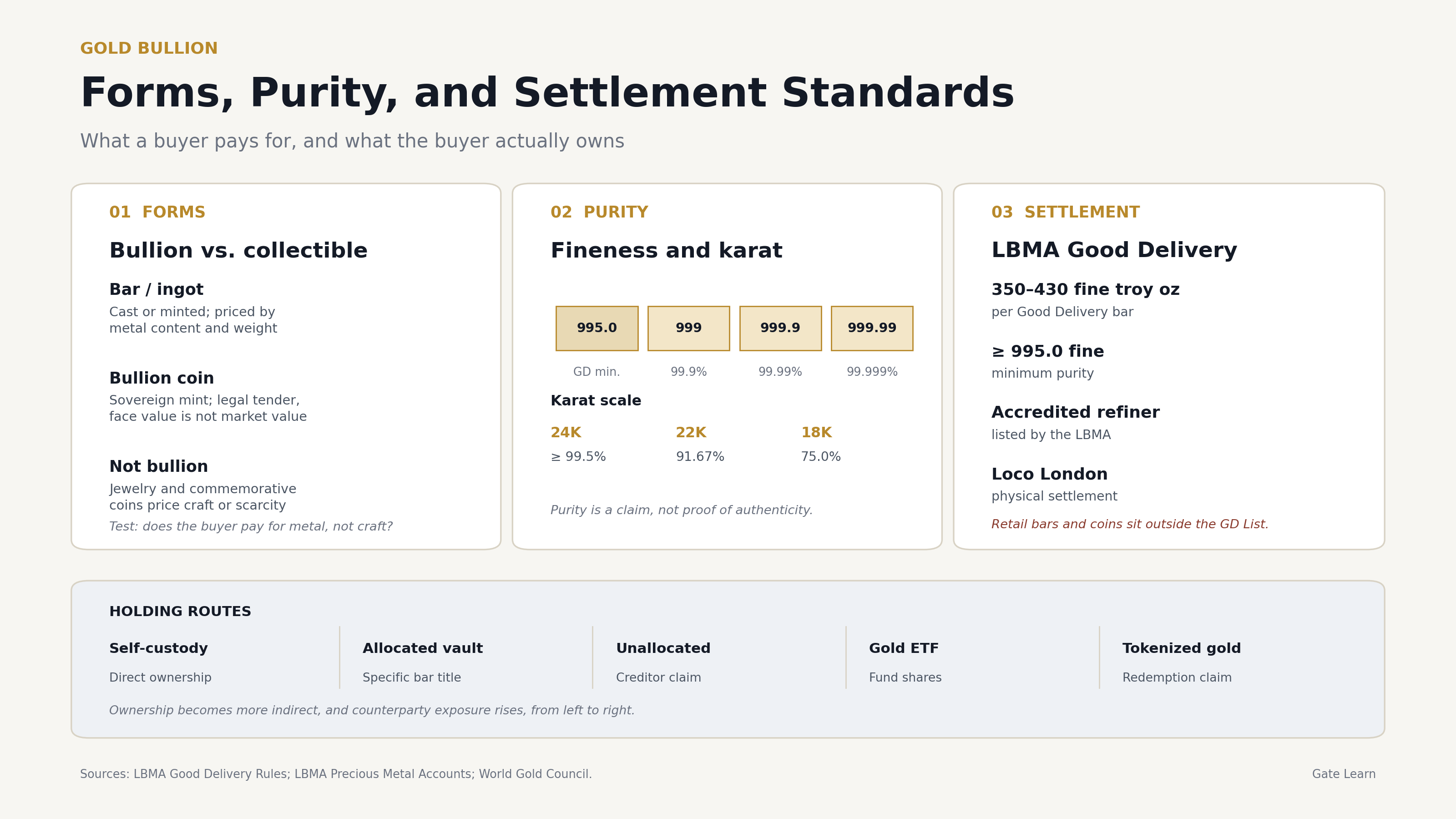
Figure 1. Gold bullion forms, purity marks, and LBMA Good Delivery specifications.
How Is Gold Bullion Priced? Spot Price, Premium, and Bid-Ask Spread
A bullion price has three parts: the current spot price, a premium covering production and distribution, and the buy-back spread absorbed on exit. The current spot price is the current market price of unworked gold, quoted per troy ounce, typically in US dollars, and it anchors gold prices before premiums and spreads in the over-the-counter market where gold trades alongside other safe-haven assets. The bullion market also includes a futures market, where contracts set a price for later delivery and the curve reflects financing, storage, and delivery timing. What gold bullion is worth at any moment is that gold bullion bars are tied directly to the current spot price multiplied by fine weight, plus any premium, before the exit spread.
The premium is not fixed. Casting, packaging, shipping, insurance, inventory turnover, and channel layers feed into it. Smaller weights spread fixed costs across fewer ounces, so premiums are more visible, while a larger purchase usually earns a low per-ounce quote.
The bid-ask spread is the gap between the buying price and the buy-back price, a transaction cost rather than volatility. Dealers differ in what they require for packaging, certificates, serials, and testing. The OTC market has no central exchange; quotes form bilaterally, transactions can be settled in various currencies, and spreads move with purchase size. Comparing products means adding premium and spread, not reading the list price alone, and the options should be compared at the time of sale.
| Price component |
Meaning |
Changes with holding period |
| Spot price |
OTC reference per troy ounce |
Continuously |
| Premium |
Production, packaging, logistics, insurance |
Stable; varies by size |
| Bid-ask spread |
Purchase vs buy-back price |
Set by channel |
| Storage cost |
Vault or custody fee |
Accrues over time |
Only the sum of these four is the real cost of holding gold bullion, and that total is what a position is worth comparing against. Comparing purchase prices alone ignores buy-back discounts and storage fees.
How Should You Hold Gold Bullion? Physical, Vault Accounts, ETF, and Tokenized Gold
Self-custody and allocated vaulting are both physical holding, but the legal structure differs. Physical bullion is a tangible asset, unlike ETF shares or tokenized claims that represent exposure rather than direct possession. An allocated account lists the specific bar numbers, weights, and purities belonging to the client, and those gold bars stay off the custodian's balance sheet. An unallocated account records only a metal claim; it offers a lower-cost alternative but owns no specific bar.
ETFs and tokenized gold offer another route. An ETF is an exchange-traded fund share that tracks gold after management fees, so buying a share is a claim on the fund rather than a specific bar. ETF shares or mining stocks may offer investors exposure at a lower price, but they do not provide direct ownership of the final product. Tokenized gold represents a claim through on-chain tokens, is divisible, and moves at any time; XAUT is one design backed by LBMA-standard bars and a low minimum unit size.
Tokenized gold also trades as spot pairs on centralized venues, where the XAUT spot market prices against a stablecoin.
These routes differ on three questions: who owns the metal, how costs accrue, and whether it can be recovered in a stress event. Many investors use physical bullion for wealth preservation, as a hedge against inflation and currency risks, and as part of a diversified portfolio because gold has often moved independently of stocks and bonds. The sequence matters, because direct ownership settles the first while custody and issuer terms settle the rest. Allocated holding is the most direct; unallocated accounts and tokenized products depend on the issuer or custodian performing, while ETFs depend on fund structure and redemption. Ranked by directness, self-custody comes first and fund shares come last.
| Holding method |
Legal claim |
Cost |
Main risk |
| Self-custody |
Direct ownership |
Safe, insurance |
Theft, damage, authentication |
| Allocated vault |
Specific bars |
Storage and insurance |
Custody operations |
| Unallocated account |
Claim on custodian |
Lower fees |
Counterparty, liquidity |
| Gold ETF |
Fund shares |
Management fee, brokerage |
Tracking error, discount |
| Tokenized gold |
Redemption claim |
Network fees, issuance terms |
Reserve transparency, redemption limits |
Before you choose a route, confirm who legally owns the metal, compare fees across the options, and decide how long you plan to hold the position and how to hold it. The more indirect the ownership, the more the reserve audits, custody arrangements, and redemption terms matter, and the longer the time in custody, the more those terms are worth checking.
What Are the Advantages and Limits of Gold Bullion, and How Do You Verify It?
Gold bullion offers direct ownership, no issuer credit risk, and global resale, which can appeal to investors seeking easier access to buyers and sellers than jewelry or collectible products. Its global recognition also supports broad dealer acceptance and resale across markets. Its limits are specific: no interest or dividend, ongoing storage, insurance, and authentication costs, and buy-backs that depend on channel and re-testing. Those who hold bullion should keep original packaging because re-testing takes time. Tax treatment, including capital gains tax, varies by jurisdiction. Gold bullion can be bought from dealers, banks, and vault providers, and some also let customers buy, sell, store, and arrange delivery, with each channel quoting its own premium and buy-back terms.
The main risks are counterfeits, unclear provenance, storage loss, and restricted buy-backs. Counterfeits include gold plating, cores of tungsten or other metals with similar density, and forged serials or assay certificates.
Verification starts with the bar: the refiner mark, a unique serial, and the purity and weight stamps should match the certificate, and the serial should be checkable through a public lookup. A gold bar produced by a known refiner with a verifiable serial is easier to resell. Weighing and measuring catch obvious mismatches at the time of purchase, not sophisticated fakes.
Non-destructive testing relies on X-ray fluorescence (XRF) and ultrasound. XRF reads surface composition, while ultrasound can reveal internal voids or a different core. Destructive tests such as cutting or fire assay are reserved for large trades or disputes. Dealers generally require original packaging, certificates, and unopened seals, and some offer a low buy-back spread when those are intact.
| Risk |
Warning sign |
Common check |
| Gold plating |
Uniform color, layered edges |
XRF, density |
| Tungsten or alloy core |
Near-correct weight |
Ultrasound, drilling |
| Forged serial |
Serial mismatch |
Public refiner lookup |
| Fake certificate |
Poor print, missing fields |
Verify with issuer |
| Unclear provenance |
No invoice or record |
Transaction records, compliance |
Verification should move from low cost to high cost: compare the bar with its certificate, weigh and measure, then run instrument tests. Any mismatch is a reason to pause the transaction, preserve evidence, and refer the case to the refiner or issuer.
Summary
As investment-grade gold priced by metal content, gold bullion's key differences sit in unit premium, divisibility, and buy-back terms. A larger gold bar usually carries a low premium per ounce, while a small gold coin trades at a higher one. Purity is expressed in parts per thousand, while Good Delivery standards govern wholesale gold bars only. Holding routes become progressively more indirect, so the sequence in which you weigh them decides the net result.
FAQ
What is the difference between 999 and 9999 gold?
A 999 mark means 99.9% gold and 9999 means 99.99%, a gap of 0.09 points. Investment gold bars typically carry 999.9, and buy-backs settle on the stated fineness, so the practical difference lies in standards and premiums rather than a meaningfully higher worth for everyday buying.
Why does gold bullion cost more than the spot price?
The spot price is the current market price of unworked gold, while gold bullion bars usually cost buyers the current spot price plus premiums for refining, fabrication, minting, and shipping, which form the premium. Buy-backs add a bid-ask spread, and smaller orders with lower quantity usually mean higher per-ounce premiums. Whether gold bullion is expensive depends on the premium and spread relative to the metal.
Is gold bullion legal tender, and does face value equal the gold price?
Gold bars generally are not legal tender. Gold coins may carry a face value from a sovereign mint, but that value is a legal marker, not metal value or market price, which still follows gold and the mint premium.
How can you tell whether a gold bar is real?
Check the refiner, serial, purity, and weight against the certificate, then weigh and measure, and use XRF or ultrasound where needed. A serial verifiable through a public lookup is an important sign of traceable provenance, especially before buying from a private seller.
Is physical gold bullion the same as a gold ETF?
No. Physical gold bullion is a tangible asset directly owned by the holder under self-custody, unlike an ETF share, which gives a claim on a fund rather than a specific holding. ETFs may offer investors gold exposure at a lower price, but they are not tied to a specific bar in the holder’s name and do not provide the same role in direct wealth preservation. A gold ETF provides indirect exposure to the fund's gold and carries management fees, tracking error, and market discounts. Liquidity, costs, and counterparty structure differ, and only physical holders can hold a specific bar.