Clearpool is an institutional credit protocol that matches approved borrowers with on-chain lenders across permissioned and permissionless markets. Its product set spans Credit Vaults, Treasury Pool, X-Pool, Prime, and XRPL Vaults. CLEAR is the protocol token after the 1:1 CPOOL migration; it supports staking, governance, incentives, and fee-funded buybacks. The migration period changes token identity and market routing, while the comparison page breaks down credit underwriting and market structure.
Key Takeaways
-
Clearpool brings institutional borrowers and on-chain lenders into transparent credit markets with borrower-specific terms and monitoring.
-
CLEAR replaced CPOOL through a 1:1 migration starting November 17, 2026; the migration window runs through February 17, 2027.
-
Official Clearpool data reports more than $965M in cumulative loans, more than $10M in interest paid, and more than $30M TVL as of November 23, 2026.
-
The product line includes Credit Vaults, Treasury Pool, X-Pool, Prime, and XRPL Vaults with Ripple and Cicada collaboration and RLUSD settlement support.
-
CLEAR supports staking, governance, and incentives; Clearpool uses protocol fees for CLEAR buyback-and-burn activity.
What Is Clearpool?
Clearpool CLEAR is the native token of Clearpool, a decentralized institutional credit protocol and crypto lending venue where approved borrowers access on-chain liquidity and lenders deploy capital under defined terms, with returns designed to compound on every block. For institutional borrowers, lenders, DAOs, treasury managers, fintechs, funds, and sophisticated crypto traders, Clearpool separates credit underwriting from settlement execution: borrower approval and credit limits are set at the market or vault level, while blockchain rails handle funding, repayment, and position tracking. Protocol updates appear on the official X account.

The protocol grew from unsecured lending pools into a broader credit ecosystem. Clearpool products now span institutional credit markets, Credit Vaults, Treasury Pool, cross-chain liquidity, institution onboarding, and RLUSD settlement, with public materials naming Jane Street, Flow Traders, and Wintermute among historical borrowers to illustrate the platform’s institutional focus. That makes Clearpool relevant to readers evaluating transparent, borrower-specific decentralized credit options in crypto, especially as DeFi credit infrastructure expands.
Clearpool operates on a fee-driven token model. CLEAR replaced CPOOL as the protocol token through a 1:1 migration beginning November 17, 2026, and protocol fees fund CLEAR buyback-and-burn activity. This guide explains how CLEAR works across staking and governance, what the CPOOL-to-CLEAR migration changes, how to assess trading or participation opportunities, and the main risks tied to using or investing in Clearpool’s tokenized credit markets.
How Does Clearpool Work?
Clearpool’s lending model starts with borrower eligibility. A market defines who can borrow, at what limits, and under what credit terms. Lenders then supply liquidity to that market and earn interest generated by borrower demand. Clearpool exposes borrower-specific market data so lenders can evaluate risk before allocating capital.
Interest is generated when approved borrowers draw liquidity. Repayments and interest flow back into the market. The model uses dynamic rates and borrower-specific risk pricing rather than treating every borrower as interchangeable collateralized liquidity. This makes Clearpool an unsecured credit venue: underwriting, limits, and borrower reputation matter alongside on-chain settlement.
Clearpool’s architecture emphasizes transparency. Lenders can review borrower identity information, loan activity, utilization, and credit terms through protocol interfaces. Governance controls protocol parameters and market permissions, giving token holders a role in how the system evolves.
What Products Make Up the Clearpool Ecosystem?
Credit Vaults
Credit Vaults provide managed institutional credit access. As part of Clearpool’s tokenized credit approach, a vault operator or protocol process defines eligible borrowers, credit limits, and lending terms. Lenders receive exposure to a curated borrower set while the vault abstracts some borrower-selection complexity. These structures help create a more transparent institutional lending environment within decentralized finance.
Treasury Pool
Treasury Pool lets DAOs, foundations, and institutions deploy idle treasury assets into Clearpool credit markets. It gives treasury managers a structured way to earn yield while retaining visibility into borrower terms and protocol risk.
X-Pool
X-Pool extends Clearpool’s liquidity model across supported chains. It targets cross-chain credit liquidity so institutional borrowers can access capital through a shared credit framework rather than isolated single-chain pools.
Clearpool Prime
Prime is the institutional interface for onboarding regulated entities, funds, fintechs, and trading firms. It packages Clearpool’s credit infrastructure with institutional workflows, and its future growth will depend on adapting to the needs of both traditional finance and DeFi participants, helping approved borrowers access liquidity and lenders allocate to vetted counterparties.
XRPL Vaults
XRPL Vaults extend Clearpool’s credit model to the XRP Ledger ecosystem in collaboration with Ripple and Cicada. The design supports RLUSD settlement and brings XRP Ledger participants into Clearpool’s underwriting and lending framework.
What Is the CLEAR Token and Clearpool Price Today?
CLEAR is the native token of Clearpool. The token migrated from CPOOL at a 1:1 ratio beginning November 17, 2026. Clearpool set a migration window through February 17, 2027, giving CPOOL holders time to exchange legacy tokens for CLEAR. The cpool token was Clearpool’s legacy ERC-20 ecosystem token for the project and its community.
CLEAR has four core functions:
-
Staking: CLEAR holders can stake to participate in protocol incentives and align with network security and growth; in the legacy model, staking CPOOL was required for borrowers to propose whitelisting.
-
Governance: CLEAR supports voting on protocol decisions and parameter updates, while legacy CPOOL holders voted on whitelisting new borrowers.
-
Incentives: CLEAR can reward participation, liquidity provision, and ecosystem adoption.
-
Buyback-and-burn: Clearpool uses protocol fees to buy CLEAR and remove purchased tokens from circulation.
Clearpool reports a total supply of approximately 1.429 billion CLEAR. At migration, circulating supply was approximately 1.125 billion tokens. For comparison, legacy CPOOL had a market cap of $22 million as of November 23, 2026, with a total supply of 1 billion tokens. CPOOL’s all-time high price was $0.50 as a historical reference of token value. These figures give users a reference for token float and future unlock capacity, though token schedules should always be checked against current official disclosures. As a legacy reference point, CPOOL had 20,682 holders as of now.
How to Trade CLEAR on Gate and Understand Trading Volume
Gate lists CLEAR, a crypto asset, for spot trading, so choose the correct market after checking whether you want the migrated CLEAR pair rather than legacy CPOOL exposure. The CLEAR price page shows current price, market data, and trading history, while the CLEAR/USDT market provides live order book, depth, and order entry.
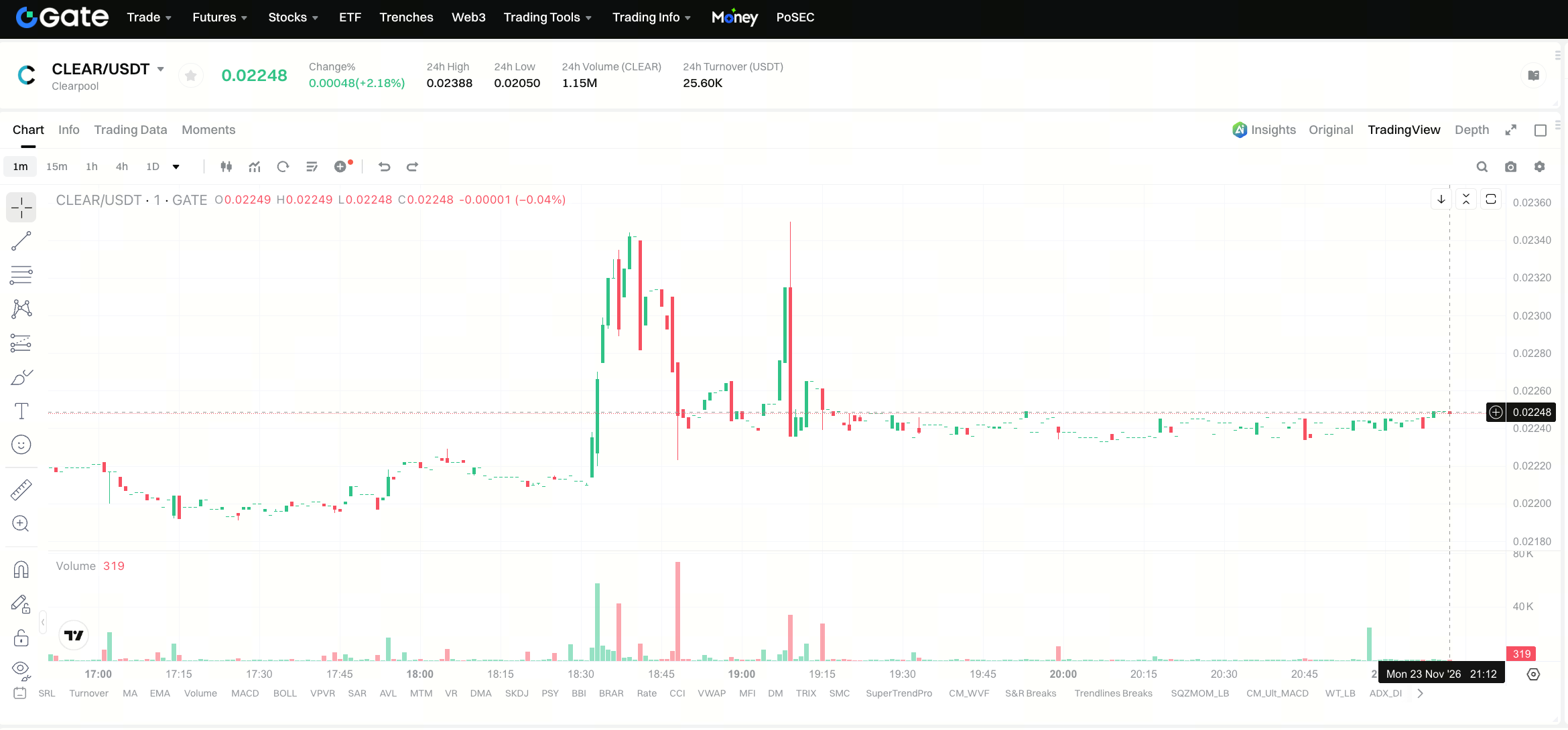
A practical trading workflow includes four checks:
-
Confirm the token ticker is CLEAR and the trading pair is CLEAR/USDT.
-
Review current price, 24-hour volume, order-book depth, and spread before placing a trade; when comparing liquidity around the migration, legacy CPOOL’s 24-hour trading volume was $95,000 as of November 23, 2026.
-
Decide whether the order should be market execution or a limit order at a specified price.
-
Monitor migration-related announcements, because token contract changes can affect liquidity and routing during the migration window.
The best time to invest or trade is based on current market conditions rather than a fixed rule.
What Makes Clearpool Different? Market Cap and Unique Features
Clearpool focuses on institutional credit rather than generic overcollateralized borrowing. Its competitive position comes from three layers:
-
Borrower-specific credit markets: Terms reflect individual borrower risk instead of a single pooled collateral parameter.
-
Product breadth: Credit Vaults, Treasury Pool, X-Pool, Prime, and XRPL Vaults serve different user groups while sharing a credit infrastructure.
-
Fee-linked token design: Protocol fees feed CLEAR buyback-and-burn, linking platform activity to token supply.
This structure aims to solve a specific DeFi problem and represents a form of innovation in decentralized finance: many protocols can settle loans on-chain, but fewer provide a transparent institutional underwriting framework with borrower-level terms and institutional onboarding. Clearpool vs Maple compares unsecured DeFi lending across borrower-level markets and pooled loan books.
Clearpool Use Cases
For Institutions and Trading Firms
Approved institutions can use Clearpool to access on-chain liquidity while maintaining defined credit terms. Prime and Credit Vaults support workflows where borrower eligibility, limits, and reporting matter.
For DAOs and Treasury Managers
Treasury Pool gives organizations a route to deploy idle assets into structured credit markets. Managers can compare borrower terms and monitor utilization rather than relying on opaque private arrangements.
For Lenders
Liquidity providers can allocate to borrower-specific Clearpool markets, earn interest from borrowing demand, and evaluate credit exposure through public market data. CPOOL also provides rewards to liquidity providers through additional token incentives. X-Pool and XRPL Vaults add additional ecosystem and chain-level access points.
CLEAR Tokenomics and Migration
Clearpool replaced CPOOL with CLEAR through a fixed 1:1 conversion based on a migration ratio set by Clearpool. The migration began November 17, 2026, and runs until February 17, 2027. During that period, CPOOL holders migrate legacy balances to CLEAR according to official instructions.
The token migration matters for three reasons:
-
Contract and ticker changes: DEX routing, wallets, and contracts must point to the CLEAR token address.
-
Staking and governance participation: Legacy CPOOL functionality transitions to CLEAR.
-
Market liquidity: Trading venues and liquidity providers may move liquidity from CPOOL markets to CLEAR/USDT or other CLEAR pairs.
Clearpool publishes the step-by-step process, deadline, risks, and troubleshooting on its official migration pages.
Clearpool Risks
Clearpool’s core risk is credit risk. A borrower may fail to repay according to agreed terms, and unsecured lending does not have the same collateral liquidation mechanism as overcollateralized lending. Smart-contract risk, oracle and data risk, liquidity risk, and market risk also apply. Any decision to invest should reflect your personal risk tolerance.
The migration period introduces operational risk. Users must verify official CLEAR contract addresses, use official migration interfaces, and confirm network details before transferring tokens. Gate users should also confirm they hold CLEAR rather than CPOOL before participating in CLEAR markets. The crypto world changes quickly, so research carefully before investing.
Summary
Clearpool is an institutional credit protocol with borrower-specific lending markets, institutional onboarding, treasury deployment, cross-chain liquidity, and XRPL expansion. CLEAR is the protocol token after the 1:1 CPOOL migration, used for staking, governance, incentives, and fee-funded buybacks. Its model combines transparent on-chain settlement with structured credit underwriting.
FAQ
What is Clearpool?
Clearpool is an institutional credit protocol that connects approved borrowers with on-chain lenders. It provides transparent credit markets, borrower-specific terms, and products including Credit Vaults, Treasury Pool, X-Pool, Prime, and XRPL Vaults.
What is CLEAR?
CLEAR is the native token of Clearpool. It replaced CPOOL through a 1:1 migration beginning November 17, 2026. CLEAR supports staking, governance, incentives, and fee-funded buyback-and-burn.
How does Clearpool make money?
Clearpool earns protocol fees from credit-market activity. Those fees are used for CLEAR buyback-and-burn, according to Clearpool’s token design.
How do I migrate CPOOL to CLEAR?
Use Clearpool’s official migration process during the window that runs through February 17, 2027.
How do I buy CLEAR on Gate?
Sign up on Gate, complete any required verification, and fund your account. Review price and liquidity on Gate’s CLEAR/USDT market, then place a market or limit order. The CLEAR price page provides market context during the migration period.
Educational content only. Digital assets and DeFi credit protocols involve smart-contract, liquidity, market, and loss risk.