An order book is a live, price-sorted list of open buy orders (bids) and sell orders (asks) for one trading pair. The best bid is the highest price buyers will pay, the best ask is the lowest price sellers will accept, and the gap between them is the bid-ask spread.
For spot traders, the book matters most when order size meets a thin market. A market order does not execute at the price printed on a chart; it consumes whichever levels are available, so the average fill can be worse than the quote. Reading spread and depth before sending an order is a practical way to measure that slippage risk.
Order books reveal intent rather than certainty: in crypto order book data, resting orders can be filled, canceled, or replaced within milliseconds, which is why a large wall at a round number is evidence about liquidity, not a promise that the level will hold.
Key Takeaways
An order book lists resting bids and asks; the best bid, best ask, and spread describe the executable market at a glance.
Matching engines apply price priority first and time priority second, so the earliest order at a price fills first.
Market orders prioritize speed and can slip across price levels; limit orders control price but may never fill.
Displayed depth is not committed liquidity, and spoofing that creates false depth is treated as market manipulation.
What Is an Order Book?
An order book is an exchange's record of unmatched limit orders, grouped into price levels. It shows buy orders and sell-side interest at every level: bids are at or below the last traded price, and asks, also called offers, are at or above it. An ask is an offer to sell at a stated price, while a bid is a commitment to buy if that price is met. Each row reports the total size resting at that price rather than the identity of a single trader. Stock exchanges use the same structure to track shares, while crypto venues use it to track tokens, and the same format can track any tradable asset or security.
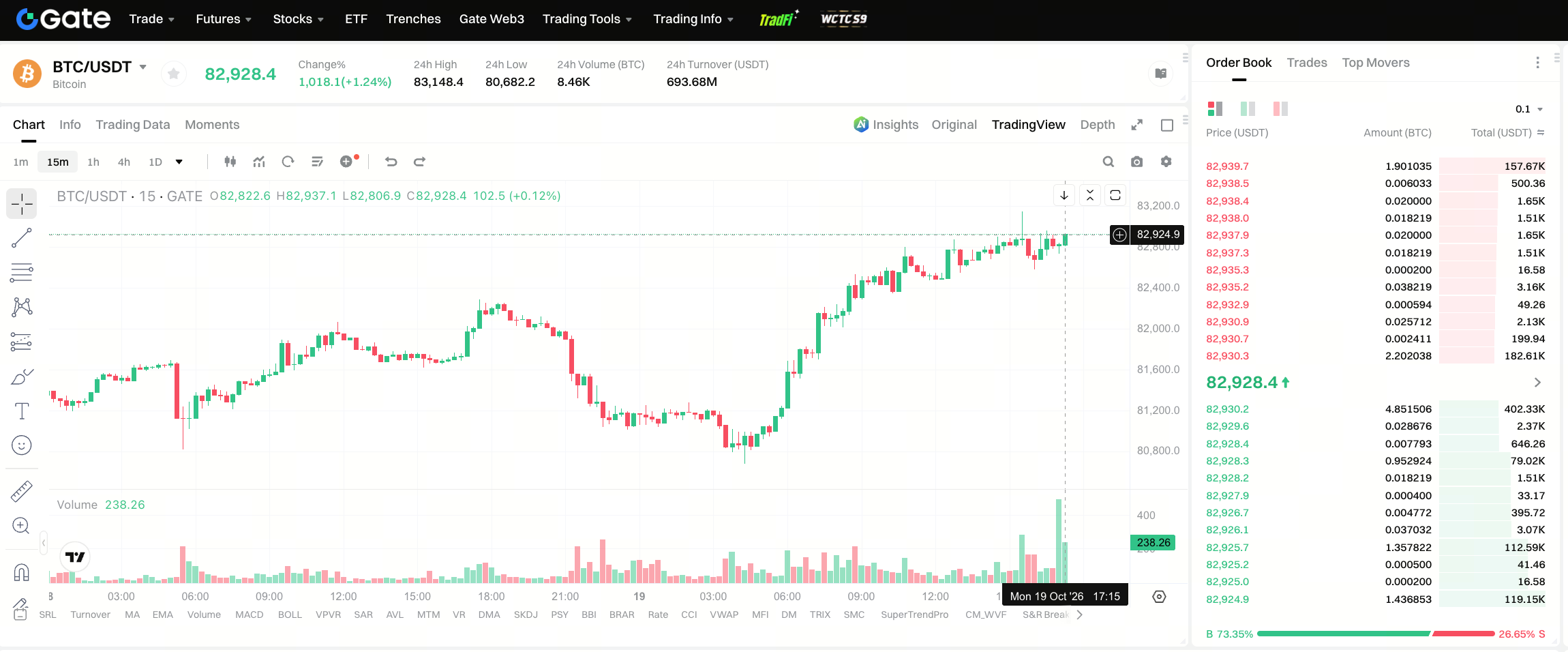
Every trading pair has its own book, and exchanges maintain separate books for different assets and pairs. BTC/USDT and BTC/USDC can show different spreads and depth even though both reference BTC, because they are separate markets with different liquidity providers, inventory, and fee schedules. The information in each book is public, but it reports resting orders rather than completed trades. Each resting offer represents a seller's minimum acceptable price, and each bid represents a buyer's maximum. On Gate, the spot book for a pair is the reference point for its executable price range. The live BTC/USDT book shows that structure directly: bids, asks, and depth update as orders arrive.
The four fields that matter are price, size, side, and time. A bid that sits higher than the rest of the queue can signal stronger buying interest when nearby liquidity is thin. Most retail interfaces show an aggregated view, known as Level 2 data, where all bids or asks at one price are merged into a single row. Some venues also expose individual orders, or Level 3 data, which helps market participants judge queue position and available liquidity at a specific price.
How Does an Order Book Work?
Figure 1. The live BTC/USDT order book beside the price chart on Gate.
An order book runs on a continuous double auction. The matching engine compares incoming orders against the best resting order on the opposite side, and a trade is executed when a buyer will pay at least the lowest ask or a seller will accept at least the highest bid. Resting orders are filled only when a counterparty accepts the price.
Price priority comes first: a buy at 60,100executesbeforeabuyat60,100 executes before a buy at 60,100executesbeforeabuyat60,000. Time priority comes second: if two bids sit at the same price, the one that arrived first is filled first. A limit buy at $60,000 therefore rests in the book and is executed only if the market price reaches that limit or better; if the best ask is already below the limit, the order fills immediately at the better available price. On the sell side, a limit order sets the lowest price a seller will accept.
Fills can be partial. Part of a transaction may fill at one level, with the remainder resting in the book or filling later, which changes the visible size on that row. Replacing an order also resets its time priority, so a trader who keeps adjusting a quote moves to the back of the queue at that price. A partially filled order keeps its remaining size visible until it is fully filled or canceled.
Some venues accept iceberg or hidden orders that display only a fraction of their total size. In that case, the displayed offer size may not determine the full liquidity actually available at that level, which is one reason a level can look small and still absorb a large trade. On Gate, an iceberg order's hidden portion fills first and pays a 0.2% fee while the visible portion pays the standard rate, as set out in the spot trading rules. An immediate-or-cancel (IOC) order fills whatever is available at once and cancels the remainder, so it never rests in the book.
Cryptocurrency Exchanges That Use Order Books
Centralized exchanges (CEXs) such as Gate run order books in the same broad way as traditional stock markets: a matching engine, price-time priority, maker and taker roles, and a public feed of resting orders submitted and matched through an electronic system. Order-book decentralized exchanges use a central limit order book as well, but settle trades on-chain or through a hybrid of off-chain matching and on-chain settlement. Unlike shares, which trade during exchange hours, crypto tokens trade continuously, so the book updates around the clock.
Automated market makers (AMMs) replace the book with liquidity pools. Instead of matching a buyer against a resting seller of shares or tokens, an AMM prices each trade against a bonding curve whose pool holds two assets and whose changing balances determine the exchange rate after every swap. The visible inputs become pool reserves and the quoted price impact, not bid and ask rows. Traders who use AMMs therefore read price impact instead of depth, and the economics of AMM pricing and fees follow from those pool mechanics.
Feature
Order book exchange
AMM exchange
Pricing source
Resting bids and asks
Pool reserves and a pricing formula
Liquidity providers
Market makers and limit order traders
Depositors into liquidity pools
What traders see
Best bid, best ask, spread, depth
Reserves, quoted price, price impact
Execution risk
Slippage across levels, non-fill on limits
Slippage from pool depth, network fees
Typical strength
Tight spreads on liquid pairs
Permissionless listing and simple swaps
The table separates the two models by mechanism rather than by quality. A deep order book usually offers tighter spreads and better size capacity on major pairs, while an AMM can quote a new token without waiting for market makers. The trade-offs between order book DEX and AMM design, and between CEX and DEX custody models, follow from those structural differences.
How to Read an Order Book
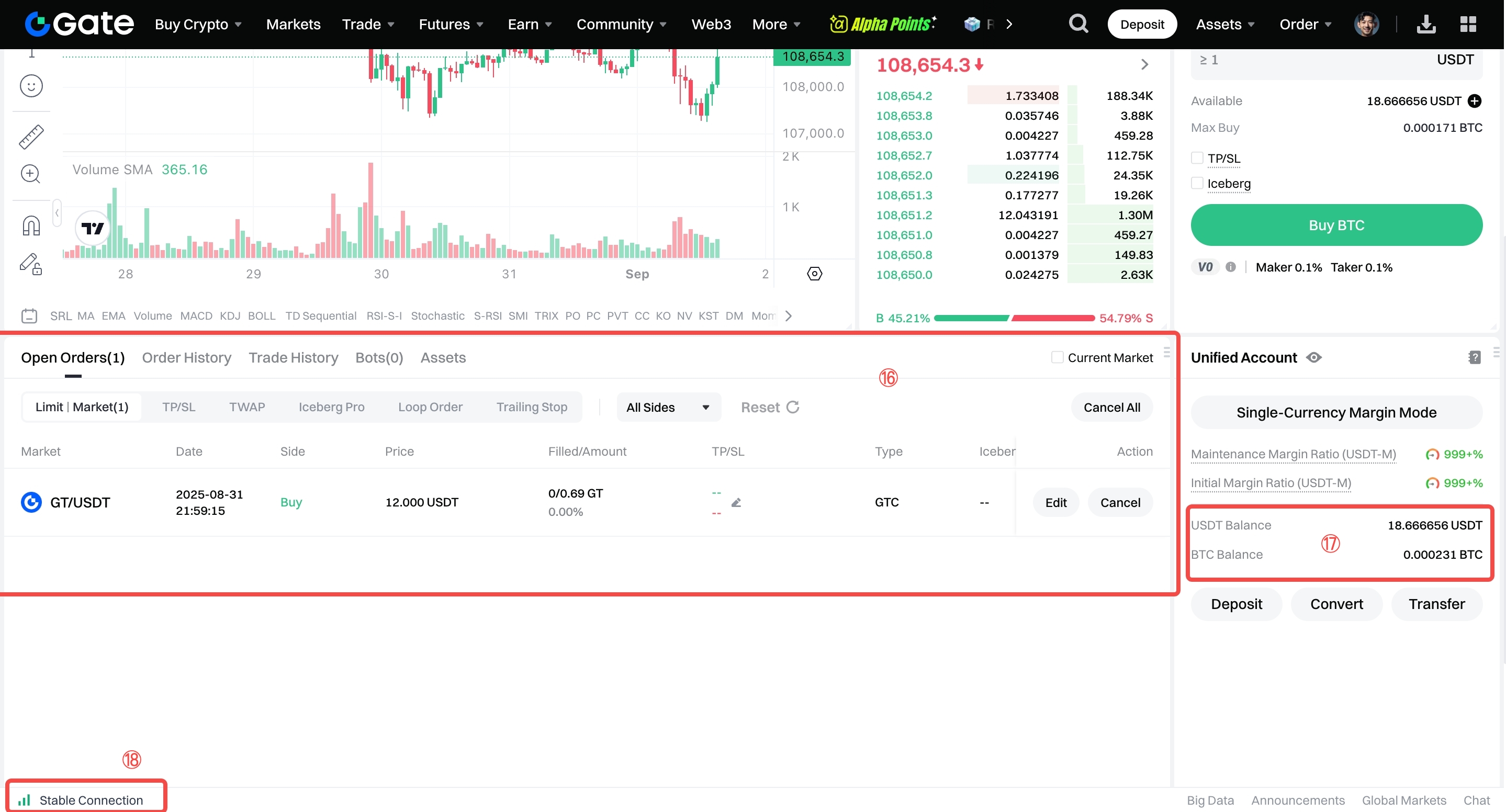
Figure 2. Bid and ask levels with sizes and totals, plus a limit order still resting in open orders.
Reading an order book starts with three numbers: the best bid, the best ask, and the spread between them. If the best bid is 99.90andthebestaskis99.90 and the best ask is 99.90andthebestaskis100.10, the absolute spread is 0.20,andrelativetothe0.20, and relative to the 0.20,andrelativetothe100.00 midpoint it is 0.20%. The lowest offer is the best ask, and resting asks above it form the visible supply ladder. A narrow spread generally means competing quotes; a wide spread means fewer participants, thinner size, or higher uncertainty.
Depth describes how much volume is available at each price, not just at the top. A book can show a one-cent spread and still be thin 1% away from the midpoint, which matters for anyone trading more than the size displayed on the first row. Depth is the most useful information for sizing an order.
The ask ladder below is a simplified example. This kind of display shows what is happening at nearby price levels. It excludes fees and assumes the displayed orders stay in place while the trade executes.
Ask price
Size available
Cumulative size
$100.10
2 tokens
2 tokens
$100.20
3 tokens
5 tokens
$100.40
5 tokens
10 tokens
A market buy for 4 tokens fills 2 tokens at 100.10and2tokensat100.10 and 2 tokens at 100.10and2tokensat100.20. The volume-weighted average price is (2 × 100.10+2×100.10 + 2 × 100.10+2×100.20) ÷ 4 = 100.15,whichis100.15, which is 100.15,whichis0.05 worse than the best ask. That difference is slippage, and it grows with order size and shrinks with depth.
Four checks turn the raw ladder into a usable read:
Compare the spread as a percentage of the midpoint, not only in absolute currency terms.
Sum the size within 0.5% and 1% of the midpoint to estimate capacity for your order.
Note where large levels sit relative to the last traded price; a large sell order can act as resistance if price approaches it.
Watch whether levels persist across several updates or disappear when price approaches them.
A depth chart plots cumulative size against price, with price on the x axis and cumulative size on the y axis, which makes those distances easier to see. Traders also compute a simple imbalance ratio, such as (bid size − ask size) ÷ (bid size + ask size) within a fixed band around the midpoint. If bids outweigh asks in that band, the reading can signal buying pressure. A higher reading means more visible buying interest in that band, but it is a heuristic about displayed intent, not a directional forecast; canceled orders can reverse the reading within seconds.
How to Use an Order Book for Trading
Market Orders and Limit Orders
The book supports two basic execution choices. A market order is usually executed quickly at the best available market price and any deeper levels needed to fill, prioritizing speed over price. A limit order sets the worst price the trader will accept, letting the trader seek a specific execution price or better on the buy side, or place a sale at a chosen level on the sell side, though it may not fill if the market never reaches that level. Each order type changes how the book is consumed, and both behaviors follow directly from the trading orders available on an exchange.
Order size relative to depth is the key comparison. Traders use the size within 0.5% of the midpoint to estimate capacity for their order. If the intended size is small relative to that total, traders compare depth to determine whether a market order is efficient for the size being traded. If the size is larger than the first few levels, the order will walk the book, and the average fill will be higher than the quoted best ask for a buy, or lower for a sell. The same order type can behave very differently in a thin book.
A limit order placed at or inside the best quote can avoid paying through multiple levels, but it may sit unfilled because it caps the maximum a buyer will pay or sets the minimum a seller will accept, without guaranteeing execution. Traders place a limit order for price control, and it also joins the queue behind existing orders at that price, so a passive quote at the top of the book has no guaranteed priority over earlier size.
Stop and Stop-Limit Orders
Stop and stop-limit orders add another layer of mechanics. Once triggered, a stop order becomes a market order and can consume several levels, while a stop-limit order may fail to execute if price gaps past the limit. Investor.gov's overview of order types sets out those definitions in traditional markets. On Gate, pair-specific limits on market order size and slippage constrain how far a single market order can execute: the part that would exceed the slippage limit is canceled. Limit prices are capped against the two-minute average fill price, so no single order can consume unlimited depth, and the order type and size rules should be checked before submitting.
Why Are Order Books Important for Market Participants?
Order books concentrate the information needed for price discovery: who is willing to trade, at what price, and in what size through visible quotes. That is why the spread and depth of a pair are more useful than the last traded price alone when judging execution conditions. The book provides information about near-term liquidity, not a forecast.
The book also defines the maker and taker roles. A limit order that rests on the book supplies liquidity and may qualify for a lower maker fee, while a market order removes liquidity and typically pays the taker fee. This fee structure is why some participants quote both sides of a pair continuously instead of waiting for a single entry, and why fees and liquidity affect the result of any strategy.
Large levels are often described as buy walls and sell walls. A buy wall is a cluster of bids that may provide short-term support, while a sell wall is a cluster of asks that may cap price temporarily at a higher price level. Traders sometimes read them as short-term support and resistance, but the comparison is only as reliable as the orders themselves, and those orders can be canceled before price arrives.
Manipulation is the main reason to treat displayed depth with caution. Spoofing means submitting bids or offers with the intent to cancel them before execution, which can create a false impression of supply or demand. The U.S. Commodity Futures Trading Commission describes that conduct and its intent requirement in its guidance on disruptive practices. Layering, wash trading, and coordinated walls are related tactics that exchanges and regulators monitor. Sellers can cancel an offer before it is filled, which is why a wall is not a contract.
A practical defense is to verify rather than assume. Traders use the book to compare the same pair across venues, watch whether a wall survives several updates, and treat the technical analysis of price alongside the book rather than as a substitute for it. No single snapshot can prove that displayed liquidity will still be there when an order arrives.
Summary
An order book is a price-sorted record of unmatched bids and asks, maintained by a matching engine that fills orders by price priority and then time priority. The best bid, best ask, and spread describe the current executable market, while depth describes how much size sits at each price level. The same logic applies to shares, futures, and tokens.
For execution, the book answers a narrow but useful question: how far will this order move before it fills? Market orders trade speed for slippage, limit orders trade certainty for price control, and displayed walls can disappear. Traders use the book as a liquidity map, not as a prediction, which keeps its information in the right proportion.
FAQ
What is the difference between a bid order and an ask order?
A bid reflects what buyers are willing to pay, and an ask states the minimum price a seller will accept. The best bid and best ask sit on opposite sides of the spread; a trade occurs when an incoming order accepts one of them.
What does the bid-ask spread tell you?
The bid-ask spread is the difference between the lowest ask and the highest bid. A narrow spread usually indicates competing quotes and lower immediate trading costs, while a wide spread points to thinner liquidity, wider inventory risk for market makers, or higher short-term uncertainty.
What is market depth and a depth chart in an order book?
Market depth is the total size of resting buy and sell orders at each price level, often measured within a fixed distance from the midpoint. Traders use depth to judge how much of a particular stock or other asset can be traded without moving the market price too much. Deeper books can absorb larger orders with less price movement, while thin books force market orders to consume several levels and accept a worse average price.
Why do market orders slip in a thin order book?
A market order executes against available liquidity level by level, filling the best available orders first and then continuing into deeper levels until the requested size is complete. The order type determines whether the trader accepts that slippage or sets a limit. When the book is thin, each additional level is further from the quoted price, so the volume-weighted average fill is worse than the best bid or ask at the moment of submission.
Can order books be manipulated?
Yes. Spoofing, layering, and wash trading can create a misleading impression of supply, demand, or activity, and regulators treat intentional false-depth tactics as prohibited conduct. Because resting orders can be canceled at any time, traders should verify whether large levels persist instead of assuming they represent committed liquidity. Comparing the live book with order history helps market participants judge whether apparent depth is genuine.
Author: Paul
Translator: cedar
Reviewer(s): Ashely、Jayne
Disclaimer
* The information is not intended to be and does not constitute financial advice or any other recommendation of any sort offered or endorsed by Gate.
* This article may not be reproduced, transmitted or copied without referencing Gate. Contravention is an infringement of Copyright Act and may be subject to legal action.
DEX aggregators integrate order data, price information, and liquidity pools from multiple decentralized exchanges, helping users find the optimal trading path in the shortest time. This article delves into 8 commonly used DEX aggregators, highlighting their unique features and routing algorithms.
In the Web3 ecosystem of 2026, Non-Fungible Tokens (NFTs) have evolved far beyond basic digital art into multi-chain dynamic assets, tokenized Real-World Assets (RWAs), cross-chain gaming items, and Bitcoin Ordinals. Navigating today’s hyper-connected market requires real-time data precision, algorithmic anti-wash trading filtering, and sophisticated cross-chain intelligence.
The report shows that in Q1 2026, the crypto market will reach a stage of structural maturity, with Derivative trading making up more than 90% of total trading volume, exceeding $20 trillion. As Spot demand weakens, liquidity will become even more concentrated in top exchanges, reflecting a more cautious market sentiment and a shift toward leveraged and institutional trading.