MEV (Maximal Extractable Value) is the process by which block producers, validators, searchers, and other transaction-ordering participants extract additional value from block space by reordering transactions, combining transactions, or submitting transactions ahead of others.
MEV bots are automated programs designed to operate around this process. They continuously monitor the mempool, analyze transactions submitted by users and protocols, assess potential post-execution price movements, liquidation opportunities, and asset transfers, and then decide whether to submit their own transactions.
In normal market conditions, MEV bots can perform DEX arbitrage, lending liquidations, and liquidity rebalancing. During security incidents, they may also identify exploit transactions and move at-risk assets before the attacker. Yoink’s recent activity falls into this latter category.
It is important to distinguish Yoink’s role from that of a formally established white-hat organization. Yoink remains, at its core, an MEV bot. Its conduct in this incident showed the characteristics of attack interception and loss mitigation, but whether it qualifies as a full security rescue depends on whether the funds were sent to a custody address recognized by the victims and whether they were subsequently returned.
Key Takeaways
-
MEV bots monitor the mempool, analyze transactions, and compete for ordering to capture arbitrage, liquidation, or asset-interception opportunities.
-
Yoink is fundamentally an Ethereum MEV bot, not a formally designated specialized white-hat organization.
-
In the recent incident, Yoink front-ran an attack involving approximately $7.7 million worth of rsETH.
-
Public information indicates that the operation involved approximately 2,900 rsETH, with approximately 2,882.37 rsETH transferred.
-
Successful front-running does not mean the funds have been returned, nor does it automatically establish that the bot had authority to dispose of the assets.
-
MEV bots can support security response, but they can also misclassify transactions, abuse permissions, or introduce new custody risks.
-
Evaluating the credibility of asset interception requires reviewing authorization, fund flows, the custody address, and the return plan.
-
Protocols should mitigate risk through multisigs, timelocks, emergency pauses, and pre-agreed automated response mechanisms.
What Are MEV Bots?
An MEV bot generally includes a transaction monitoring module, a strategy analysis module, a transaction construction module, and a broadcasting module. The monitoring module reads pending transactions in the public transaction pool and retrieves the target contract, called function, parameters, Gas fee, and sender address. The analysis module simulates execution and assesses potential changes in asset balances or prices.
When a bot identifies a potentially profitable arbitrage transaction, it builds a transaction path—for example, buying and selling the same asset across different DEXs. When it detects a liquidatable position in a lending protocol, it submits a liquidation transaction and earns the liquidation reward. When it identifies an ongoing vulnerability exploit, it may construct a competing transaction to execute ahead of the attacker.
Once the transaction has been constructed, the bot broadcasts it through public nodes, private relays, or block builder networks. It may raise the Gas fee or use sophisticated transaction-bundling methods to improve the chance that block producers will prioritize its transaction.
Accordingly, an MEV bot is not a single type of program. It may function as an arbitrage bot, liquidation bot, sandwich bot, front-running bot, or, during a special security incident, an asset-interception bot.
How Yoink Front-Ran the $7.7 Million Attack
Recently, an attacker attempted to exploit the permission or verification logic of a Safe wallet-related module to transfer a substantial amount of rsETH. Public reports estimated the potential loss at approximately $7.7 million.
Safe is widely used infrastructure for digital asset custody and multisig wallets. It allows users to extend wallet functionality through modules, but a module with overly broad calling permissions can become an attack vector. Attackers generally begin by constructing a call transaction intended to bypass existing signature or permission controls.
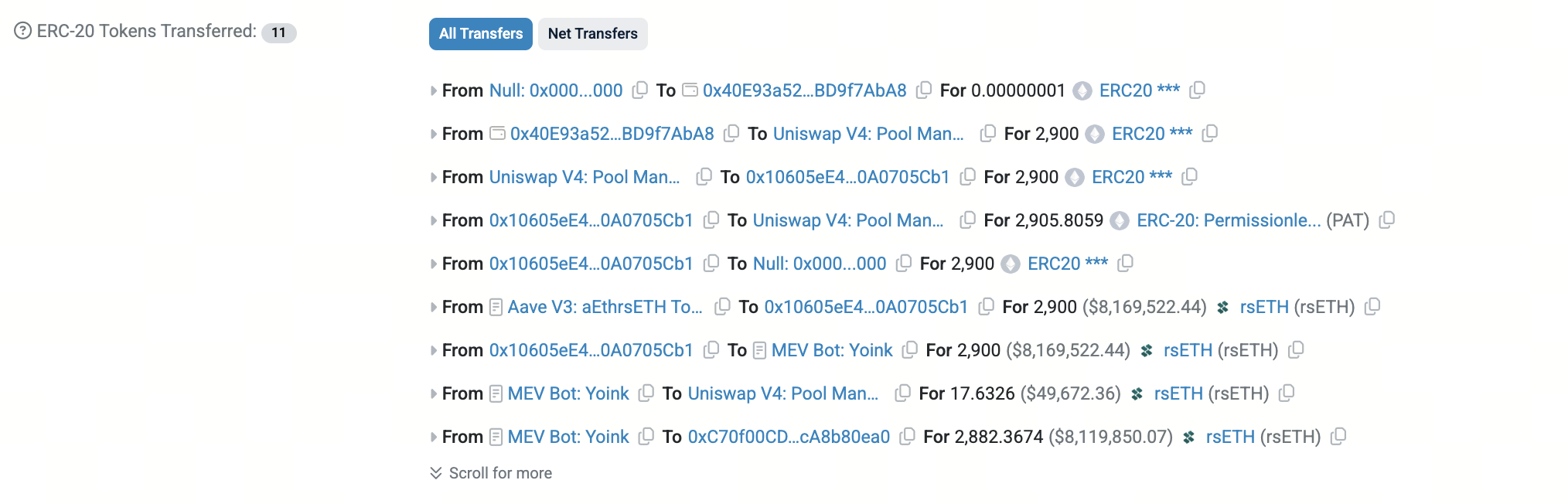 Image Source: Etherscan
After detecting the relevant transaction, Yoink did not wait for the attacker to complete confirmation. It rapidly analyzed the transaction parameters and asset state and submitted a competing transaction. Because Ethereum’s execution order determines whether assets can be transferred, Yoink had to parse the transaction, simulate it, modify the parameters, and broadcast a response within an extremely narrow window. The operation involved approximately 2,900 rsETH, with approximately 2,882.37 rsETH transferred to an address. The project team then implemented measures such as freezing assets, restricting transfers, and taking other emergency actions to reduce the risk of further movement.
Three amounts must be distinguished: the attack amount, the amount intercepted by the bot, and the amount ultimately recovered. The amount the attacker attempted to transfer is not necessarily the amount controlled by the bot. Likewise, a transfer to another address does not mean that the funds have been returned to the victims. The final disposition depends on project announcements, on-chain fund flows, and custody arrangements.
How Yoink Discovered and Front-Ran the Attack Transaction
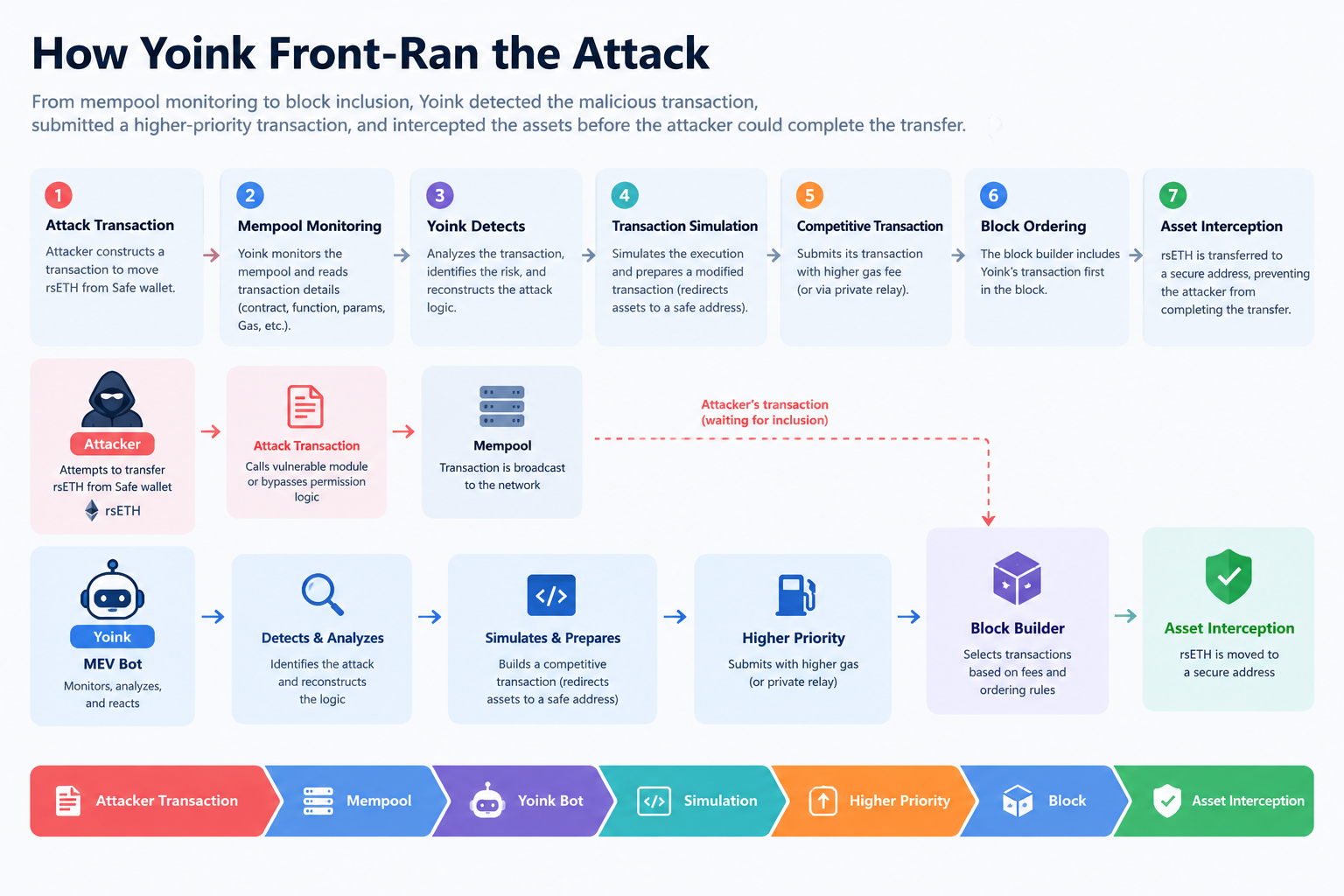
Yoink’s operation can be divided into five broad steps.
The first is mempool monitoring. After a user submits a transaction and before it is confirmed in a block, the transaction generally enters a node’s pending transaction pool. A bot can read the contract address, function selector, parameters, and Gas settings of public transactions.
The second is identifying the transaction’s intent. The bot must determine whether the transaction involves an abnormal asset transfer, a dangerous module call, or a known vulnerability. It may use address labels, balance changes, transaction simulation, and rule databases in combination.
The third is reconstructing the attack logic. For a complex exploit, the bot must understand which functions the attacker called, which parameters were used, and where the assets would go if the transaction succeeded. The bot can construct an effective competing transaction only after reconstructing that logic.
The fourth is generating and broadcasting a transaction. The bot may copy selected parameters from the original transaction and replace the recipient with a secure address. It may also call pause, freeze, or transfer functions to move the assets beyond the attacker’s control.
The fifth is competing for block position. The bot may adjust the Gas fee or transmit the transaction directly to a block builder through a private channel, reducing the chance that other searchers will copy it.
The available time is extremely limited. If the attacker uses private transactions, transaction bundles, or a higher priority fee, the bot may not be able to see or front-run the transaction. At the same time, bots may compete against one another, causing several searchers to copy the same attack transaction simultaneously.
How MEV Bots Use Transaction Ordering to Capture Value
MEV is fundamentally about changing the distribution of value through transaction ordering, not simply about predicting prices.
-
In DEX arbitrage, a bot observes a price movement in one liquidity pool and executes the opposite trade in another. By executing before ordinary users, it can capture the spread.
-
In lending liquidations, a bot monitors collateral ratios. When a borrower’s position falls below the liquidation threshold, the bot submits the liquidation transaction first and receives the liquidation reward paid by the protocol.
-
In a sandwich attack, a bot buys before the user’s transaction, sells after that transaction moves the price, and passes the resulting price impact on to the user. This generally worsens the user’s execution price.
-
In asset interception, the bot focuses on the attacker’s transfer transaction. Its objective may not be traditional arbitrage; instead, it changes control of the funds by executing first. The Yoink incident shows that this can technically stop an attack, but it also creates new questions about who owns the assets.
The ultimate recipient of MEV proceeds depends on the transaction-ordering chain. Searchers identify opportunities, construct transactions, and pay the costs. Block builders assemble the transactions. Validators or block proposers select the final block. These roles may cooperate through order flow, private relays, or revenue-sharing arrangements.
What Is the Difference Between Front-Running Attacks, Arbitrage, and Asset Interception?
Arbitrage and asset interception can both use front-running techniques, but they pursue different objectives.
-
Arbitrage bots exploit price differences between markets by buying assets cheaply and selling them at a higher price. The transactions generally interact with public-market liquidity pools, and the bot does not directly change ownership of a particular user’s account.
-
Front-running bots act on the basis of a user’s pending transaction, buying or selling in advance to profit from the price movement caused by that transaction. A sandwich attack is a classic example.
-
Exploit bots directly call vulnerable contracts, bypass permissions, forge verification, or extract protocol assets. Their typical objective is to move funds to an address they control.
-
Asset-interception bots may copy or rewrite an attack transaction and transfer the assets before the original attacker. This can reduce the victim’s losses, but without explicit authorization, it remains a technical operation that changes control of the assets.
A transaction should therefore not be labeled a security rescue solely because it stopped a hacker. Likewise, a bot should not automatically be labeled malicious solely because it obtained the assets. The decisive factors are the transaction’s purpose, the authorization relationship, and the subsequent handling of the funds.
Why the Yoink Incident Sparked Controversy
The first issue is ownership. Yoink’s successful front-running proves only that it won the competition for transaction ordering. It does not establish that the operator owns the transferred assets.
The second issue is authorization. Traditional security teams usually perform pauses, freezes, or fund transfers with the protocol team’s authorization. An MEV bot may act directly on on-chain data without waiting for the project team to confirm. A benevolent motive is not the same as full authorization.
The third issue is custody. If the intercepted rsETH is sent to a multisig or independent custody address publicly designated by the project team, the community can more easily verify the rescue purpose. If the funds are sent to an anonymous address or a wallet controlled by the bot, it becomes difficult for outside observers to determine whether the funds are safe.
The fourth issue is compensation. The bot operator must cover node, server, Gas, and failed-transaction costs. Whether the operator should be compensated and how that compensation should be calculated require transparent rules. Without a prior agreement, ex post charges can create another dispute.
The fifth issue is liability. If the bot mistakenly identifies a normal transaction as an attack and transfers the assets first, or causes additional losses during the transaction, there is no universally accepted answer regarding who should be held liable.
The Role of MEV Bots in On-Chain Security
MEV bots can serve as part of an on-chain security framework in three main ways.
First, they can shorten response times. Smart contract attacks are often completed within seconds or minutes, leaving human teams insufficient time to analyze the incident, coordinate a response, and deploy a fix. Automated bots can act before confirmation.
Second, they can provide continuous monitoring. Bots can monitor large approvals, unusual calls, contract upgrades, and cross-chain transfers around the clock, identifying risk signals before they escalate.
Third, they can automatically execute emergency strategies. A protocol can design security functions in advance so that, when a specific attack pattern is detected, a bot can trigger a pause, impose transfer limits, or move funds into secure custody.
Bots cannot, however, replace protocol governance. They are usually controlled by a limited number of operators and face risks such as private key compromise, strategy errors, server failures, and malicious changes to their logic. A safer design is to restrict the bot to calling a permission-limited rescue contract and require funds to be sent to a custody address controlled by multiple parties.
How Protocols Can Prevent Automated Front-Running and Exploits
Protocols should first reduce the attack surface of privileged modules. Custom modules, plugins, and upgradeable contracts should undergo independent audits, with explicit restrictions on asset transfers, signature verification, and administrator privileges.
Second, high-risk operations should use timelocks. Module activation, permission changes, large transfers, and contract upgrades should not all take effect immediately. A delay gives monitoring systems and security teams time to respond.
Third, protocols should establish emergency pause mechanisms. Pause permissions should be controlled through multisig or tiered governance. The scope of the pause, activation conditions, and restoration process should all be clearly defined to prevent a single account from abusing emergency powers.
Fourth, protocols should define automated response rules in advance. They can publish security contacts, emergency multisig addresses, custody addresses, and bug bounty programs so that MEV bots have a clearly specified destination for funds during an incident.
Fifth, protocols should use transaction simulation and on-chain monitoring. They should continuously track unusual approvals, bulk transfers, unknown module calls, and sudden balance changes and assign risk scores before transactions enter a block.
Sixth, protocols should minimize the reuse of addresses and permissions. Using multisigs, capped accounts, and segregated wallets for high-value assets can limit losses if a single module or key is compromised.
How to Determine Whether an MEV Asset Interception Is Trustworthy
When reviewing a similar incident, users and communities can assess its credibility using the following information.
First, check whether the bot has published the transaction hash, attack path, call parameters, and fund flows. The more complete the information, the easier it is for third parties to conduct an independent review.
Second, verify whether the assets entered a multisig, freeze contract, or independent custody address previously published by the project team. Merely seeing assets leave the hacker’s address does not prove that the funds are secure.
Next, determine whether the protocol team has confirmed the action or announced a return plan. Project announcements, governance proposals, and multisig signatures can help establish whether the bot’s conduct has been formally recognized.
Also check whether the bot transferred only the assets necessary for the response and whether it exchanged, split, or moved them to an anonymous address. Complex fund flows after interception make the risk harder to assess.
Finally, distinguish technical results from governance results. A successful transaction is a technical outcome. Returning funds, providing compensation, and determining responsibility are subsequent governance and legal matters.
Summary
The Yoink incident illustrates a new application of MEV bots in on-chain security. In addition to arbitrage and liquidations, they can monitor attack transactions and compete for transaction ordering to move at-risk assets first.
Yoink’s core identity, however, remains that of an MEV bot. Its conduct in this incident had the characteristics of attack interception and potential loss mitigation, which led observers to view it as rescue-oriented. That alone does not establish Yoink as a specialized white-hat MEV operation or demonstrate that vulnerability rescue is its long-term business.
The incident is especially significant because it highlights the distinction between blockchain consensus and asset governance. The blockchain can determine which transaction executes first, but it cannot automatically determine whether that transaction was authorized or decide who should hold and return the transferred assets.
MEV bots may become part of protocol security infrastructure, but only if they operate with restricted permissions, clear custody rules, and verifiable return procedures. Automated asset interception can evolve from an ad hoc response into a more reliable on-chain security service only when its speed advantage is combined with multisig governance, timelocks, public audits, and accountability mechanisms.
FAQ
Is Yoink a White-Hat MEV Bot?
The most accurate description at present is that Yoink is an Ethereum MEV bot. In the rsETH incident, it executed a front-running transaction with characteristics of a security rescue, but one incident alone is not enough to classify it as a specialized white-hat MEV operation.
How Much Money Did Yoink Front-Run?
Public reports estimated the potential attack size at approximately $7.7 million. The operation involved approximately 2,900 rsETH, of which approximately 2,882.37 rsETH was transferred. Potential losses, the amount intercepted, and the amount ultimately recovered should be considered separately.
How Do MEV Bots Detect Attack Transactions?
Bots monitor the mempool, parse the target contract, function, and parameters, and then use transaction simulation, balance changes, and rule databases to determine whether an exploit or abnormal asset transfer may be occurring.
Why Can MEV Bots Act Before Hackers?
They can see pending transactions in advance and use higher Gas fees, transaction bundles, private relays, or cooperation with block builders to increase the likelihood that their transactions will be included in a block first.
Is It Legal to Transfer an Attacker’s Funds First?
The outcome of the transaction alone does not establish whether the conduct was lawful. The answer may depend on authorization from the protocol team or victims, whether the funds entered a trusted custody address, and how the applicable jurisdiction treats unauthorized asset transfers.
Are All MEV Bots Harmful?
No. Arbitrage, liquidations, and liquidity rebalancing are common MEV activities. Sandwich attacks, malicious front-running, and exploits, however, may harm ordinary users or protocols. The specific strategy and its outcome must be considered.
How Can Protocols Prevent Yoink-Like Bots or Malicious Front-Running?
Protocols can use transaction simulation, anomaly monitoring, timelocks, multisigs, capped accounts, emergency pauses, and segregated permissions. They should also publish automated security response and custody plans in advance.
Do Assets Intercepted by a Bot Count as Recovered?
No. Assets count as recovered only when they have entered a custody address recognized by the victims and have been returned or used for compensation. A transfer from the attacker’s address to another address is only an interception or a transfer of control.