Zero-knowledge proofs allow one party to prove that a computation is correct without requiring every blockchain node to re-execute the full computation. This has made ZK technology important for Rollups, privacy applications, interoperability, and verifiable computation. However, Ethereum’s EVM was not originally designed for large-scale ZK proof verification, and complex proofs can consume significant Gas while competing with other applications for blockspace. Aligned was initially built to address this limitation through a dedicated verification layer.
As its product roadmap expanded, Aligned moved beyond a single ZK verification service. In 2025, the project broadened its positioning toward a vertically integrated Ethereum infrastructure stack, and in January 2026 its Proof Aggregation Service entered Ethereum Mainnet Alpha. The aggregation service is also integrated with Ethrex and serves as a foundational component for Aligned’s broader Rollup infrastructure.
Key Takeaways
-
Aligned began as a ZK proof verification project and has expanded into a broader Ethereum infrastructure stack covering proof verification, proof aggregation, Rollup services, wallet infrastructure, and interoperability.
-
Aligned offers two core ZK verification approaches: the Proof Verification Layer prioritizes throughput and low latency, while the Proof Aggregation Service recursively combines multiple proofs into a single proof that can be verified on Ethereum.
-
The Proof Verification Layer uses EigenLayer restaking and a decentralized operator network for economic security, while the Proof Aggregation Service relies more directly on Ethereum L1 for final proof verification.
-
ALIGN is the native ERC-20 token of the Aligned ecosystem, with a fixed total supply of 10 billion tokens and an initial circulating supply of approximately 16%.
-
Aligned primarily targets developers, Rollup teams, enterprises, and institutions that want to build Ethereum-based products without integrating every infrastructure component independently.
What Is Aligned?
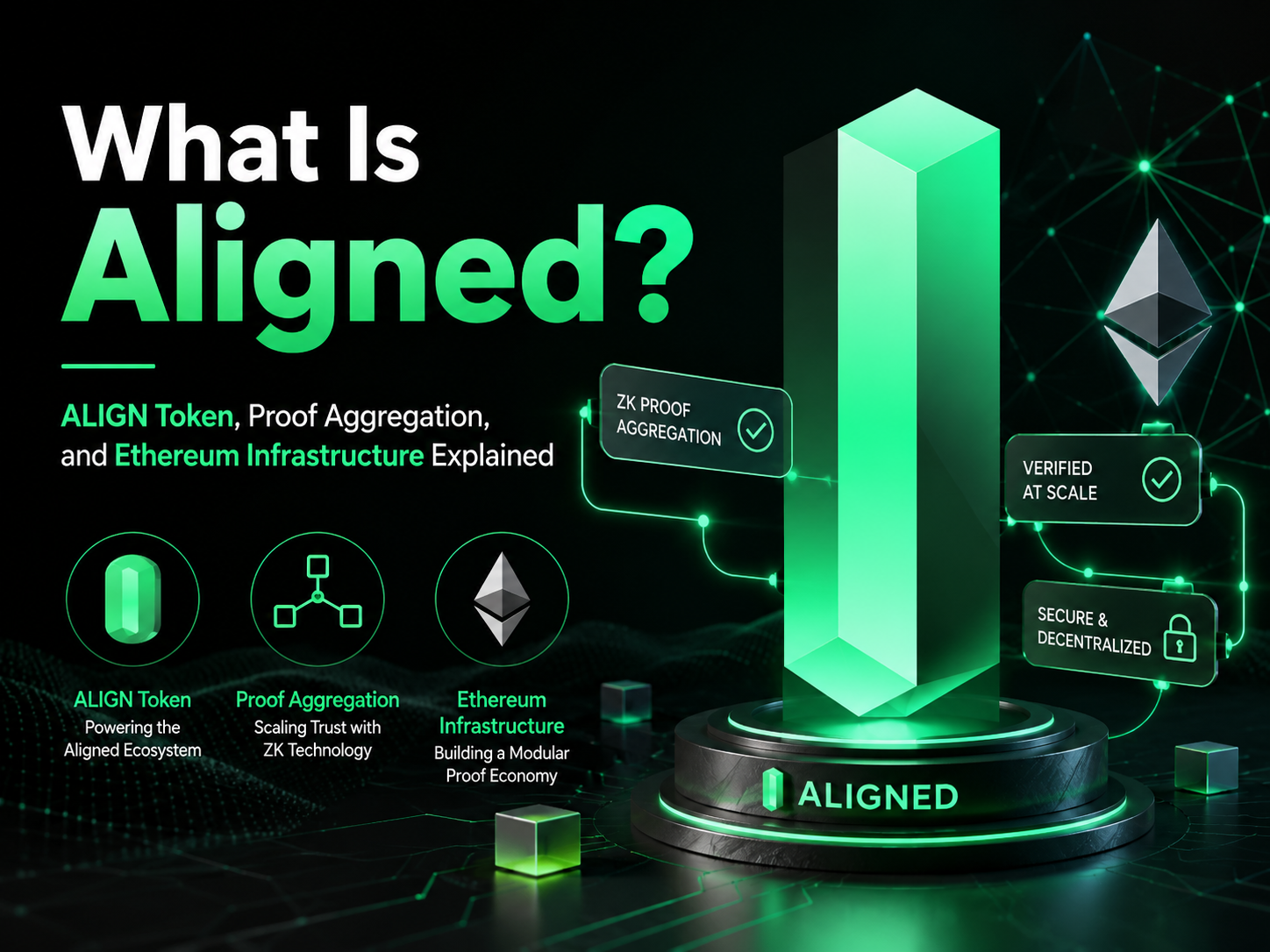
Aligned originally developed under the name Aligned Layer and focused on providing dedicated ZK proof verification infrastructure for Ethereum. The central problem was that although zero-knowledge proofs reduce the need to re-execute computation, those proofs still need to be verified, and directly verifying large numbers of complex proofs on Ethereum can be expensive and constrained by blockspace.
To address this, Aligned built a Proof Verification Layer designed to operate outside the EVM while still connecting back to Ethereum. Rather than launching a completely independent Layer 1, the network runs as an actively validated service on EigenLayer, where restaked operators verify ZK proofs and submit aggregated verification results to Ethereum.
Aligned has since expanded beyond this original role. Its current strategy is to provide a vertically integrated Ethereum infrastructure stack that includes proof verification, proof aggregation, Rollup deployment, wallet services, and interoperability.
For developers and enterprises, Aligned can therefore be viewed as a backend infrastructure layer for Ethereum. Instead of separately integrating proof systems, Rollup deployment tools, wallet infrastructure, and interoperability components, teams can potentially use multiple services within the same Aligned stack.
Why Did Aligned Expand Beyond ZK Proof Verification?
Aligned’s expansion builds on the infrastructure it developed for ZK proof verification. Once the project had established a dedicated verification layer, it began extending the same foundation toward proof aggregation, Rollup infrastructure, wallets, and interoperability.
The reason is largely practical. A company building an Ethereum-based application usually needs more than a proof verifier. A Rollup team may also require an execution client, proving infrastructure, Ethereum settlement, account infrastructure, liquidity connections, and cross-Rollup interoperability. Integrating these components separately increases development and operational complexity.
Aligned therefore moved toward a vertically integrated model in which ZK verification remains the technical foundation, while additional services are layered on top. Its 2025 roadmap positioned Ethereum as a financial backend and described Aligned as infrastructure designed to make enterprise adoption of Ethereum easier.
By early 2026, the Proof Aggregation Service had entered Mainnet Alpha and was integrated with Ethrex, strengthening the connection between Aligned’s ZK infrastructure and its Rollup-as-a-Service direction.
This shift means Aligned is no longer addressing only one narrow question, such as how to make ZK verification cheaper. It is increasingly focused on a broader challenge: how to reduce the complexity of building enterprise-grade products that use Ethereum for security, settlement, and liquidity.
What Core Products and Services Does Aligned Provide?
Aligned’s product stack is built around ZK verification and has expanded into Rollup, wallet, and interoperability infrastructure. The two most mature components are the Proof Verification Layer and Proof Aggregation Service, while other products continue to develop around them.
| Product or Service |
Main Function |
Positioning |
| Proof Verification Layer |
Batch verifies ZK proofs through a decentralized operator network |
Designed for low-latency, high-throughput verification |
| Proof Aggregation Service |
Recursively aggregates multiple proofs before final Ethereum verification |
Designed to reduce per-proof verification costs while using Ethereum L1 |
| Rollup-as-a-Service |
Helps teams deploy ZK Rollups with integrated execution, proving, and settlement infrastructure |
Enterprise and institutional Rollup deployment |
| Wallet-as-a-Service |
Provides wallet and account infrastructure for applications and Rollups |
User-facing infrastructure layer |
| Interoperability Protocol |
Connects Rollups and Ethereum to support cross-ecosystem liquidity and state movement |
Interoperability layer |
| RISC-V zkVM |
Supports verifiable computation and proving for ZK applications |
Lower-level proving infrastructure |
The Proof Verification Layer and Proof Aggregation Service are designed for different requirements. The verification layer is better suited to applications that prioritize fast responses and high proof throughput, while the aggregation service is designed for use cases that can tolerate some batching time in exchange for direct Ethereum verification of the final aggregated proof.
The Proof Aggregation Service has also become an important component of Aligned’s Rollup stack. Its Mainnet Alpha uses a multi-stage aggregation process in which many user proofs are first combined into intermediate chunks and then compressed further into one final proof for Ethereum verification.
How Does Aligned Connect Proof Aggregation and EigenLayer to Ethereum?
Aligned does not aim to replace Ethereum. Instead, its architecture is designed to help applications use Ethereum’s security and settlement more efficiently.
The Proof Verification Layer and Proof Aggregation Service take different but complementary approaches. In the verification layer, EigenLayer provides the economic security model. Restaked operators verify proofs, sign the result, and collectively reach the quorum needed to submit verification outcomes back to Ethereum. The original whitepaper emphasizes that this allows Aligned to reuse Ethereum’s economic security instead of bootstrapping an entirely new proof-of-stake network.
The Proof Aggregation Service follows a more direct cryptographic route. Multiple ZK proofs are recursively compressed into one final proof, which is then verified on Ethereum. Because the cost of the final on-chain verification is shared across all proofs in the batch, the effective verification cost per proof can decline as batch size grows.
For most users, the distinction can be simplified: the Proof Verification Layer emphasizes speed and throughput, while Proof Aggregation emphasizes direct Ethereum verification and batch-based cost reduction.
What Is the ALIGN Token Economy and What Is ALIGN Used For?
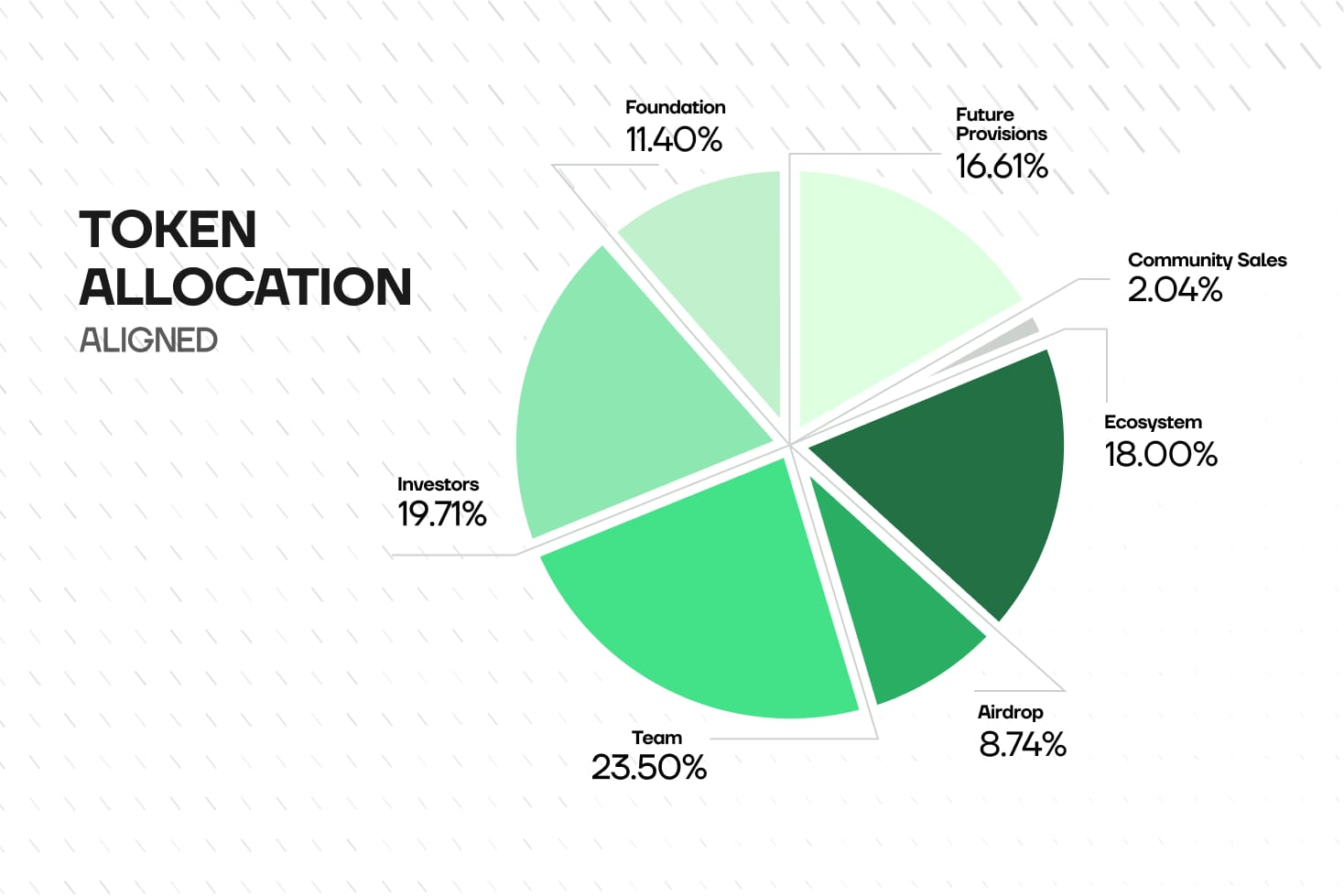
ALIGN is the native ERC-20 token of the Aligned ecosystem. The token has a fixed total supply of 10 billion ALIGN, and the updated tokenomics indicate that approximately 16% of the supply was intended to be circulating at TGE.
The latest allocation structure is:
| Allocation |
Share of Total Supply |
| Team |
23.50% |
| Investors |
19.71% |
| Ecosystem |
18.00% |
| Future Provisions |
16.61% |
| Foundation |
11.40% |
| Airdrop |
8.74% |
| Community Sales |
2.04% |
Team and investor allocations have no unlock at TGE and include a 12-month cliff. At month 12, 40% of those respective allocations unlock, with the remaining portion vesting linearly over the following 18 months. The ecosystem allocation has a six-month cliff followed by 24 months of linear vesting.
The role of ALIGN has also evolved as Aligned’s product stack expanded. The earlier whitepaper proposed a dual-staking model in which the network would initially bootstrap security through ETH restaking on EigenLayer and later introduce a native token for governance, sovereignty, and stronger economic security.
Under the updated token model, ALIGN is also connected to the broader Aligned product ecosystem, including services such as Proof Verification, Proof Aggregation, Rollup-as-a-Service, and future Wallet-as-a-Service infrastructure.
This means ALIGN should be evaluated from two perspectives: token supply and vesting on one side, and real demand for Aligned’s infrastructure services on the other. A sustainable token economy ultimately depends on whether those products attract recurring usage.
What Are the Main Use Cases and Business Cases for Aligned?
Aligned’s use cases now extend beyond simple ZK proof verification and cover multiple areas of Ethereum infrastructure.
Rollups are one of the clearest use cases. ZK Rollups must repeatedly generate and verify state proofs, and verifying every proof separately on Ethereum can be costly. Aligned can reduce this burden through either its verification layer or aggregation service, while its Rollup-as-a-Service product brings deployment, proving, and settlement into a broader infrastructure package.
Interoperability is another important area. The Aligned whitepaper describes how generic proof verification can support ZK bridges, settlement layers, and cross-chain state verification by allowing applications to prove the correctness of another chain or account state without requiring every proof system to be adapted individually for the EVM.
The whitepaper also describes potential uses in verifiable machine learning, ZK oracles, identity protocols, zkTLS, ZK coprocessors, encrypted mempools, misinformation verification, and on-chain gaming. These examples illustrate the broader reach of general-purpose proof verification and aggregation, although not all of them should be treated as mature commercial Aligned products today.
How Is Aligned Different From Other Ethereum Infrastructure Projects?
Aligned does not have a single direct competitor because its current product stack spans several infrastructure categories. Different projects overlap with different parts of Aligned’s business.
zkVerify is more specialized around ZK proof verification. Succinct focuses on zkVMs, prover infrastructure, and programmable proof generation. Caldera and Conduit operate more directly in Rollup-as-a-Service and Rollup infrastructure, and teams building end-customer applications may need to stitch together multiple infrastructure resources across those layers.
Aligned’s differentiation lies in attempting to vertically integrate verification, aggregation, Rollup infrastructure, wallets, and interoperability within one Ethereum-focused stack.
| Category |
Representative Project |
Primary Focus |
Main Overlap With Aligned |
| ZK Proof Verification |
zkVerify |
Dedicated proof verification infrastructure |
ZK proof verification |
| ZK Proving Infrastructure |
Succinct |
zkVM and prover network |
Proof and ZK infrastructure |
| Rollup-as-a-Service |
Caldera |
Rollup deployment and operations |
RaaS |
| Rollup Infrastructure |
Conduit |
Rollup deployment, sequencers, and supporting infrastructure |
RaaS |
| Integrated Ethereum Infrastructure |
Aligned |
Verification + Aggregation + RaaS + WaaS + interoperability |
Multi-layer infrastructure stack |
The advantage of vertical integration is that components can be designed to work together rather than being assembled from unrelated providers. The trade-off is that Aligned must compete across several markets at once, including against more established specialists in each individual category.
Its long-term differentiation therefore depends not only on Proof Aggregation technology but also on whether the broader RaaS, wallet, and interoperability products gain meaningful enterprise adoption. That difference could help organizations reach deployment goals with less integration overhead than assembling separate tools from competitors.
How to Trade ALIGN on Gate
Users can search for ALIGN on Gate and select an available spot trading pair to buy or sell the token. Before trading for the first time, users need to create a Gate account, complete the required identity verification, and fund the account with USDT or another supported asset.
On the Gate Spot trading page, search for “ALIGN” and select an available pair such as ALIGN/USDT. Users can then choose between a limit order and a market order. A limit order allows users to set their preferred buy or sell price, while a market order executes against the best available prices in the current order book.
After the trade is completed, the purchased ALIGN tokens will be credited to the corresponding Spot account. Users can then hold, sell, or manage ALIGN using the functions currently supported by Gate. Since ALIGN’s market price can be affected by liquidity, project developments, token unlocks, and broader crypto market conditions, users should review the latest price, order-book depth, and trading rules before placing an order.
What Are the Advantages, Limitations, and Success Criteria of Aligned?
Aligned does not have a single direct competitor because teams often evaluate it alongside other competitors in adjacent infrastructure categories. One of Aligned’s main advantages is its clear Ethereum-focused positioning. Rather than attempting to launch a new Layer 1, the project builds around Ethereum’s settlement, liquidity, and security, using EigenLayer restaking for one security model and direct Ethereum L1 verification for another.
A second advantage is that the Proof Verification Layer and Proof Aggregation Service provide different options for different needs. Applications requiring fast feedback and high proof throughput can use the verification layer, while applications that prioritize direct Ethereum verification can use the aggregation service.
Aligned is also attempting to combine Proof Aggregation with Ethrex, Rollup-as-a-Service, wallet infrastructure, and interoperability. That integration is a key difference versus more specialized providers. If these components develop into a cohesive stack, enterprises may be able to reduce the complexity involved in deploying Ethereum-based Rollups or other verifiable applications.
The main limitation is execution risk. Several newer products remain under development, and the Proof Aggregation Service entered Mainnet Alpha only in 2026. Rollup deployments, Wallet-as-a-Service, and other parts of the stack still need to demonstrate sustained production use.
Competition is another consideration. Aligned faces specialized ZK infrastructure providers on one side and mature Rollup infrastructure companies on the other.
Finally, the Proof Verification Layer’s economic security relies on EigenLayer restaking, which introduces different assumptions from direct Ethereum proof verification. This is one reason Aligned also offers Proof Aggregation for applications that prioritize Ethereum L1 as the final verifier.
Summary
Aligned has evolved from a project focused primarily on ZK proof verification into a broader Ethereum infrastructure stack. Its core objective remains reducing the cost and complexity of verifiable computation on Ethereum, but its product scope now includes Proof Aggregation, Rollup-as-a-Service, wallet infrastructure, and interoperability.
The Proof Verification Layer uses EigenLayer restaking and a decentralized operator network to deliver high-throughput, low-latency verification. The Proof Aggregation Service takes a different approach by recursively aggregating multiple proofs and submitting a final proof to Ethereum, allowing verification costs to be distributed across a batch.
ALIGN serves as the native token of this ecosystem, with a fixed supply of 10 billion tokens and an updated allocation model covering the team, investors, ecosystem, foundation, airdrop, community sales, and future provisions.
As Aligned moves from a single technical service toward a broader B2B infrastructure model, its future development will increasingly depend on whether Proof Aggregation, RaaS, wallet infrastructure, and related services attract sustained real-world usage.
FAQ
Was Aligned previously known as Aligned Layer?
Aligned originally developed under the Aligned Layer name and focused primarily on ZK proof verification before expanding into a broader Ethereum infrastructure stack.
Is Aligned’s Proof Aggregation Service already live?
Aligned’s Proof Aggregation Service entered Ethereum Mainnet Alpha in January 2026 and is live at the mainnet stage while continuing to undergo product development and optimization.
When do ALIGN tokens begin to unlock?
ALIGN token unlock schedules vary by allocation, with team and investor allocations subject to a 12-month cliff before the first scheduled unlock and subsequent linear vesting.
Is Aligned mainly designed for retail users or developers?
Aligned primarily targets Rollup teams, developers, enterprises, and institutions that need Ethereum infrastructure for proof verification, Rollups, wallets, and related services.
Can Aligned’s Proof Verification Layer and Proof Aggregation Service be used for different needs?
Aligned provides the two approaches for different requirements, with the verification layer emphasizing throughput and latency while aggregation emphasizes Ethereum L1 verification and shared batch costs.
Which blockchain is the ALIGN token issued on?
ALIGN is an ERC-20 token issued on Ethereum, matching Aligned’s broader focus on building infrastructure around the Ethereum ecosystem.