Sigma Protocols (Σ-protocols) are cryptographic proof protocols that let a prover show a verifier that they know a secret or satisfy a mathematical relation without revealing the secret itself. Ergo integrates Sigma Protocols deeply into ErgoScript and ErgoTree, making them a core foundation for transaction verification, privacy applications, multisig, and sophisticated financial contracts.
As blockchain applications have progressed from basic asset transfers to DeFi, on-chain identity, cross-chain transactions, and privacy-preserving computation, finding the right balance between “verifiability” and “minimal disclosure” has become a major technical challenge. Traditional digital signatures can prove that a private key holder authorized a transaction. In more complex applications, however, signature verification alone cannot express conditions such as “any one of several conditions is satisfied,” “at least N participants approve,” or “the same secret lies behind two public values.”
Sigma Protocols extend the range of what can be proven. Instead of treating them solely as an off-chain privacy system, Ergo incorporates these proofs directly into its smart contract language, enabling developers to combine different cryptographic conditions within on-chain scripts.
Key Takeaways
-
Sigma Protocols let users prove that they know a secret without revealing it.
-
ErgoScript treats Sigma proofs as first-class cryptographic primitives within smart contracts.
-
Privacy transactions can use mechanisms such as discrete logarithm proofs and Diffie-Hellman Tuple proofs to conceal portions of identity-linkage information.
-
ErgoMixer uses Sigma Protocols to create a non-custodial mixing mechanism and supports privacy features such as Stealth Addresses.
-
Sigma 6.x continues to advance Ergo’s scripting, compiler, verifier, and cryptographic capabilities, creating a foundation for future applications.
What Are Sigma Protocols?
Sigma Protocols are cryptographic protocols for “proving knowledge without revealing the knowledge.” A typical example involves Alice, who knows a secret x and a corresponding public value y. Alice wants to prove to Bob that she knows x without sending x to him. In the discrete logarithm setting, this can be represented as y = g\^x, where g is a public parameter and x is the secret. The prover must show that they know the x that produces y, while the verifier does not need to learn x itself.
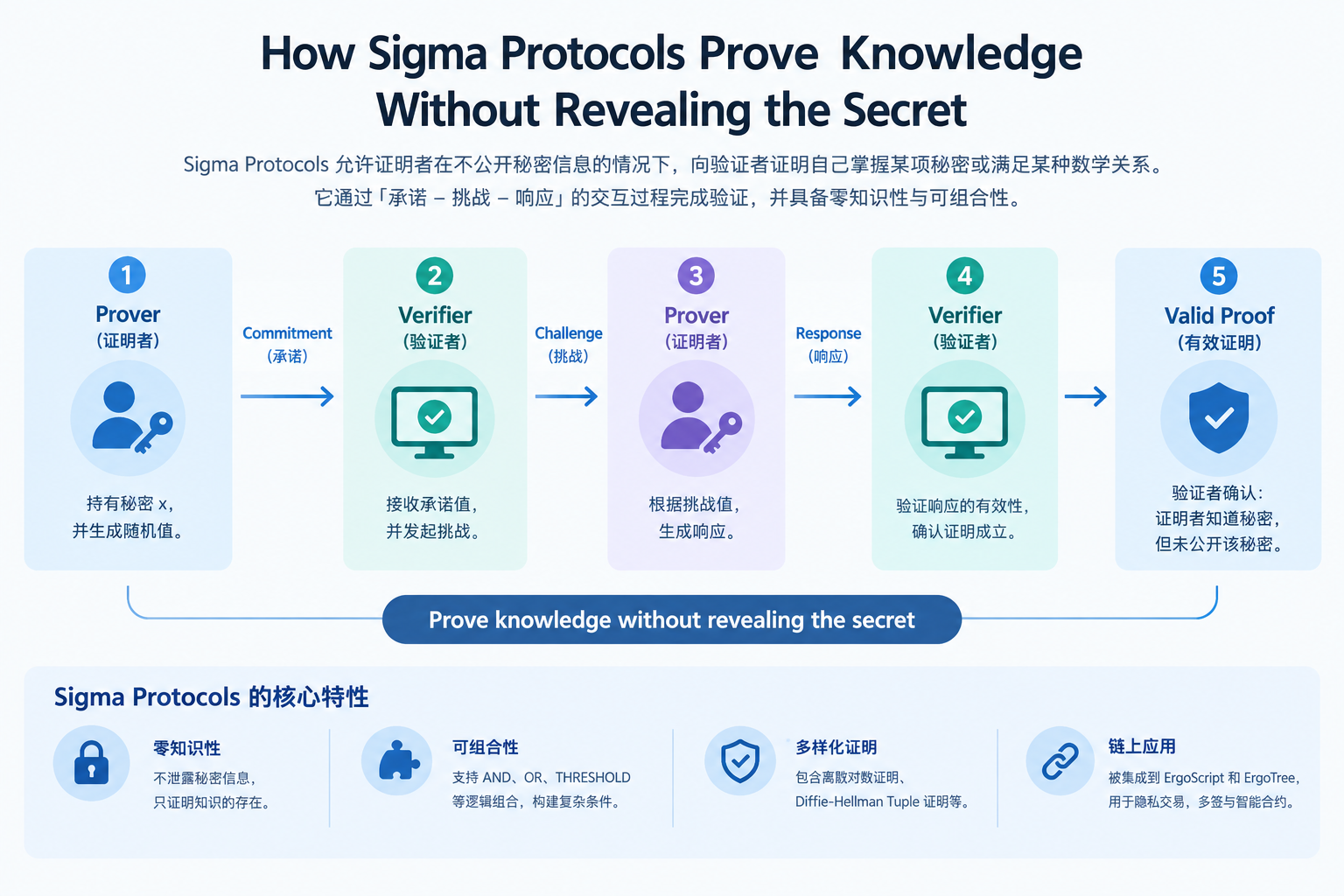
Sigma Protocols typically involve three core steps: Commitment, Challenge, and Response. The prover first generates a random commitment, then receives or produces a challenge value, and finally generates a response based on the secret. The verifier uses the resulting public information to determine whether the proof is valid.
In a blockchain environment, this structure can be transformed into a non-interactive proof. Ergo documentation indicates that the core proofs currently used in its Sigma framework include discrete logarithm proofs and Diffie-Hellman Tuple proofs. These proofs can be combined through logical structures such as AND, OR, and THRESHOLD to build more complex proofs.
Sigma Protocols therefore represent more than a single privacy feature. They are a set of composable cryptographic building blocks. Multisig, threshold signatures, ring signatures, and certain privacy transaction schemes can all be built on this foundation.
What Is the Relationship Between Sigma Protocols and Traditional Zero-Knowledge Proofs?
Sigma Protocols are closely related to zero-knowledge proofs, but the two concepts are not identical.
Zero-knowledge proofs are part of a broader cryptographic proof paradigm. Their goal is to convince a verifier that a statement is true without revealing additional secret information. Sigma Protocols are one type of interactive proof protocol within the zero-knowledge proof framework, generally used to prove knowledge of a secret or the validity of a relationship.
The more precise way to understand the distinction is: Sigma Protocols can provide one concrete route to implementing zero-knowledge proofs, but zero-knowledge proofs are not the same as Sigma Protocols.
This distinction is particularly important when examining Ergo. Ergo’s official documentation describes Sigma Protocols as a cryptographic proof system related to zero-knowledge proofs and highlights their ability to prove knowledge of a secret without exposing it. At the same time, Ergo’s cryptographic framework also includes other components, such as Schnorr signatures, Diffie-Hellman Tuples, ring signatures, and threshold proofs.
Technically, Sigma Protocols are especially well suited to structured knowledge proofs. A user might prove, for example, “I know a particular private key,” and then go further by proving, “I know the same discrete logarithm associated with two public values.” Combining multiple proofs with logical operations creates more complex verification conditions.
How Does Ergo Integrate Sigma Protocols into Smart Contracts?
A notable difference between Ergo and many other blockchains is that Sigma Protocols are not confined to an underlying cryptographic library. They are part of the smart contract execution environment itself.
ErgoScript is Ergo’s smart contract language, while ErgoTree is the on-chain representation generated after script compilation. Within ErgoScript, SigmaProp can be understood as a data type describing “which cryptographic conditions a transaction must satisfy.” An ErgoScript contract must ultimately return a SigmaProp, representing all conditions required to spend the current Box.
A simple contract might require a private key holder to sign. It could then be extended so that “either of two addresses can spend the funds,” or further extended to require that “at least 3 of 5 participants approve.”
Sigma Protocols express this structure without requiring all of the logic to be written as conventional Boolean conditions.
Ergo’s official examples include a 3-of-5 Threshold Signature, in which funds can be spent only after at least 3 of 5 participants complete the proof. A more advanced Ring Spending Contract can authorize spending without explicitly revealing the actual spender’s identity.
Sigma Protocols therefore play a role in Ergo that goes beyond privacy tools. They are also a mechanism for expressing smart contract logic, allowing developers to embed cryptographic proofs directly into asset-spending conditions.
How Do Zero-Knowledge Proofs Protect On-Chain Transaction Privacy?
The transparency of conventional blockchains means that transactions are generally available for public inspection. User addresses and the relationships among transaction amounts, inputs, and outputs create a persistent data trail that can be analyzed over time.
Zero-knowledge proofs cannot make an entire blockchain “completely anonymous,” but they can reduce the information that must be disclosed within specific transaction structures.
For example, a user can prove ownership of a private key without revealing the key itself. They can also prove that they satisfy a contract condition without directly disclosing the secret underlying that condition.
In Ergo, SigmaProp and related Sigma proofs bring these capabilities into transaction scripts. Schnorr signatures are sufficient for basic authorization in ordinary transactions. More sophisticated Sigma structures can be used when a transaction requires stronger identity concealment, threshold authorization, or ring-based proofs.
It is important, however, to distinguish the zero-knowledge properties of a cryptographic proof from the anonymity of an entire transaction system. Even when a transaction uses a zero-knowledge proof, factors such as transaction amounts, timing, network behavior, and address reuse may still reveal some connections.
Actual privacy therefore depends not only on the proof algorithm, but also on transaction design, anonymity-set size, wallet practices, and the ability to analyze on-chain and off-chain data.
What Is ErgoMixer’s Privacy Mechanism?
ErgoMixer is one of the most representative privacy applications in the Ergo ecosystem. Its core approach is to reduce the direct connection between fund inputs and final outputs through a mixing mechanism.
ErgoMixer uses Sigma Protocols to create a non-custodial, programmable mixer and supports ERG and Ergo native Tokens. Its privacy design incorporates technologies such as Ring Signatures, Diffie-Hellman Tuple Proofs, Covert Addresses, and Stealth Addresses.
Diffie-Hellman Tuple Proofs are a key component. Users prove that they possess a secret relationship associated with public data without revealing the secret itself. The Mixer can then verify that participants have the required spending authority while limiting the amount of identity-linkage information exposed directly.
Stealth Addresses further weaken the connection between a recipient address and a public identity. The basic approach uses Diffie-Hellman-type cryptographic mechanisms to generate one-time payment addresses or key relationships, making it more difficult for external observers to connect a payment directly to the recipient’s public address.
Privacy tools, however, do not provide absolute anonymity. ErgoMixer’s official documentation also notes that real-world privacy depends on factors such as correct usage, transaction timing, address management, and anonymity-set size.
The more accurate description is that ErgoMixer uses Sigma Protocols and mixing to make transaction-linkage analysis more difficult—not that it makes all on-chain information inherently invisible.
How Do Sigma Protocols Support Complex Financial Contracts?
Sigma Protocols provide DeFi with more than transaction-identity concealment. Another important function is the ability to express complex asset-control conditions.
For example, a financial contract may require:
-
“User A or User B can execute the operation”;
-
“At least 3 of 5 governance members must approve before the operation can be executed”;
-
“Only someone who knows a particular secret can claim the assets”;
-
“Funds can be unlocked only after two distinct cryptographic conditions are satisfied.”
These conditions can be combined through logical structures such as AND, OR, and THRESHOLD. Ergo’s official documentation explicitly states that Sigma proofs can be combined into more sophisticated proof structures.
For DeFi applications, this means that asset-control logic can be embedded directly in a Box. Lending, custody, DAO governance, atomic swaps, and multiparty fund management may all take advantage of this model.
From this perspective, Sigma Protocols are cryptographic building blocks for Ergo smart contracts. Developers are not restricted to a single predefined privacy transaction template. They can combine different proof conditions to meet the needs of a specific application.
This is the significance of combining ErgoScript with Sigma Protocols: privacy, permission management, and financial logic do not have to exist as isolated functions. They can be composed within one scripting framework.
How Does Ergo’s Privacy Design Differ from ZK Rollups?
Sigma Protocols and ZK Rollups both use zero-knowledge proofs, but they solve different problems.
Sigma Protocols primarily address how to prove knowledge of a secret or the validity of a mathematical relationship while minimizing the disclosure of secret information. In Ergo, they primarily support smart contract verification, privacy transactions, multisig, and complex permission controls.
ZK Rollups primarily address blockchain scalability. A Rollup executes a large number of transactions off-chain, generates a zero-knowledge validity proof, and submits it to Layer 1. The main chain then verifies whether the batch was executed correctly according to the protocol rules.
The two technologies may draw on similar cryptographic ideas, but they operate at different application layers.
They can be summarized as follows:
| Technology |
Core Problem |
Typical Uses |
| Sigma Protocols |
How to prove knowledge of a secret or satisfaction of a particular relation |
Privacy, signatures, multisig, smart contracts |
| ZK Rollup |
How to compress execution proofs for a large number of transactions |
Layer 2 scaling |
| zk-SNARK / zk-STARK |
A broader zero-knowledge proof technology framework |
Privacy, scaling, computational verification |
| ErgoMixer |
How to reduce transaction linkability |
Asset mixing and privacy transactions |
It is therefore inaccurate to call Ergo’s Sigma Protocols “ZK Rollup technology.” Ergo’s privacy design focuses mainly on smart contracts and transaction proofs, not on Rollup-based batch execution.
How Has Ergo’s Technical Roadmap Evolved from Sigma Protocols to Sigma 6.0?
Ergo’s Sigma roadmap is expanding from early cryptographic primitives into a comprehensive developer toolchain.
Sigma 6.0 is an important milestone in this evolution. The release entered the Ergo mainnet through a soft fork and introduced UnsignedBigInt, richer scripting capabilities, and other protocol-level improvements. It also laid the groundwork for future mechanisms such as Sub-blocks. According to official materials, Sigma 6.0 was activated on the mainnet in October 2025.
In 2026, the Sigma SDK continued progressing through the 6.0.x series. The latest roadmap materials indicate that the Sigma SDK has reached version 6.0.6, while AppKit 6.0.1 has also been updated on the basis of Sigma SDK 6.0.6. Related development work includes the compiler, interpreter, serialization, test coverage, and cross-implementation compatibility testing.
Ergo is also researching more advanced cryptographic directions, including Bulletproofs and Curve Trees. Official materials indicate that Bulletproofs range-proof verification has entered related development for the SigmaState Interpreter 6.0.4 candidate. Curve Trees research is exploring how the UnsignedBigInt modular arithmetic capabilities introduced in Sigma 6.0 can support more complex on-chain verification.
Ergo’s Sigma roadmap is therefore evolving from “providing cryptographic proofs” toward “providing a composable cryptographic development environment.” The key question going forward is not simply whether a particular proof algorithm exists, but whether these capabilities can reduce development complexity and translate into privacy-focused DeFi, DAOs, cross-chain protocols, and other on-chain applications.
Conclusion
Sigma Protocols are a core cryptographic component of Ergo’s architecture. At their essence, they are proof protocols that demonstrate knowledge of a secret or the validity of a mathematical relationship. They are closely related to zero-knowledge proofs, but they do not represent every type of zero-knowledge proof technology.
Ergo’s distinctive approach is to embed Sigma Protocols directly into ErgoScript and ErgoTree, making cryptographic proofs a foundational capability that smart contracts can invoke. Through SigmaProp, discrete logarithm proofs, Diffie-Hellman Tuple Proofs, and logical combinations such as AND, OR, and THRESHOLD, developers can build multisig, threshold authorization, ring signatures, privacy transactions, and other applications.
ErgoMixer is a representative privacy application built on this design. It uses Sigma Protocols, Ring Signatures, and Diffie-Hellman Tuple Proofs to reduce direct links between transactions, while technologies such as Stealth Addresses provide additional privacy protection.
In 2026, Ergo’s focus has expanded beyond Sigma Protocols as an isolated cryptographic capability to include Sigma SDK 6.x, compilers, verifiers, and more advanced cryptographic research. Sigma 6.0, Bulletproofs, and Curve Trees together form part of the platform’s ongoing technical evolution. For Ergo, the long-term value of Sigma Protocols lies not only in “anonymous transactions,” but in turning verifiable cryptographic proofs into native components of smart contracts and providing flexible infrastructure for privacy-preserving computation and complex on-chain financial logic.