In November 2026, an on-chain research case study involving Wintermute, BitGo, and Robinhood-related tokens drew attention. By tracking market maker wallets, custody infrastructure, and public code updates over an extended period, a trader gradually identified potential market developments involving cashcat and PONS and stated that they had generated approximately $6 million in cumulative gains from related trades. Although these gains and the attribution of some addresses remain the trader's personal claims and cannot be treated as independently verified facts, the case demonstrates a research approach worth examining: connecting scattered public information to observe whether institutional activity is changing.
For ordinary investors, the value of on-chain monitoring does not lie in copying high-risk preemptive trades. Instead, it lies in understanding how blockchain data reflects fund flows, liquidity changes, and smart contract operations. This article examines wallet address identification, address clustering, market maker fund flows, contract approvals, and automated monitoring. It analyzes how to build a research framework using multiple public signals while distinguishing genuine market changes from information noise that can easily lead to misjudgments.
Key Takeaways
- On-chain market maker monitoring uses wallet transactions, contract interactions, and fund flows to observe market activity that institutions may be carrying out.
- Address labels and wallet clustering provide a foundation for research, but fund transfers do not necessarily mean that two addresses belong to the same institution.
- When market makers transfer tokens to trading platforms, the activity may involve inventory adjustments, liquidity management, or client services. It cannot be equated directly with an upcoming listing.
- Smart contract deployments, token approvals, and whitelist changes may reflect technical preparations, but they do not mean that a trade will definitely occur.
- GitHub updates, custody support information, and on-chain transactions can be cross-validated, but they cannot independently prove an undisclosed business decision.
- Automated monitoring can improve information-processing efficiency, but research quality still depends on the accuracy of address attribution, transaction context, and signal interpretation.
- On-chain analysis should account for false positives, liquidity risks, and compliance boundaries. Public data changes should not be converted directly into definitive trading decisions.
Why Is On-Chain Market Maker Activity Worth Monitoring?
A market maker is a market participant that provides liquidity for trading activity by continuously providing buy and sell quotes, managing trading inventory, and assuming a certain degree of market risk. In crypto markets, market-making institutions may serve trading platforms, token issuers, proprietary trading firms, and other institutional clients at the same time. Their business activities may involve multiple blockchain networks, trading venues, and wallet accounts.
Because blockchains provide publicly verifiable transaction records, some market-making activities leave observable data. For example, a known institutional address may transfer tokens to a trading platform, interact with a decentralized exchange liquidity pool, or configure token spending permissions for a specific contract. These actions may be related to liquidity preparation, inventory allocation, or trade execution.
Compared with price indicators, on-chain data provides a different perspective. Price and trading volume mainly reflect market transactions that have already occurred, while wallet fund transfers and contract operations can sometimes reveal infrastructure changes before and after a trade. For example, a market-making institution may prepare settlement funds, deploy a contract, or adjust trading permissions before beginning to provide liquidity.
However, market maker activity does not inherently indicate a clear price direction. Tokens transferred to a trading platform may be intended for selling, but they may also be used to provide two-sided liquidity, settle client transactions, or adjust internal inventory. Because market makers quote on both the buy and sell sides, each transfer should not be interpreted simply as a bullish or bearish signal.
What truly deserves attention is whether behavior deviates from historical patterns and whether multiple changes have a reasonable business connection. If an institution has long used fixed wallets to manage liquidity but suddenly introduces new addresses, contracts, or asset-support arrangements, these changes may warrant further investigation. However, they cannot directly support a definitive conclusion about a market outcome.
How Can You Identify Market Maker Wallets and Build an Address Monitoring List?
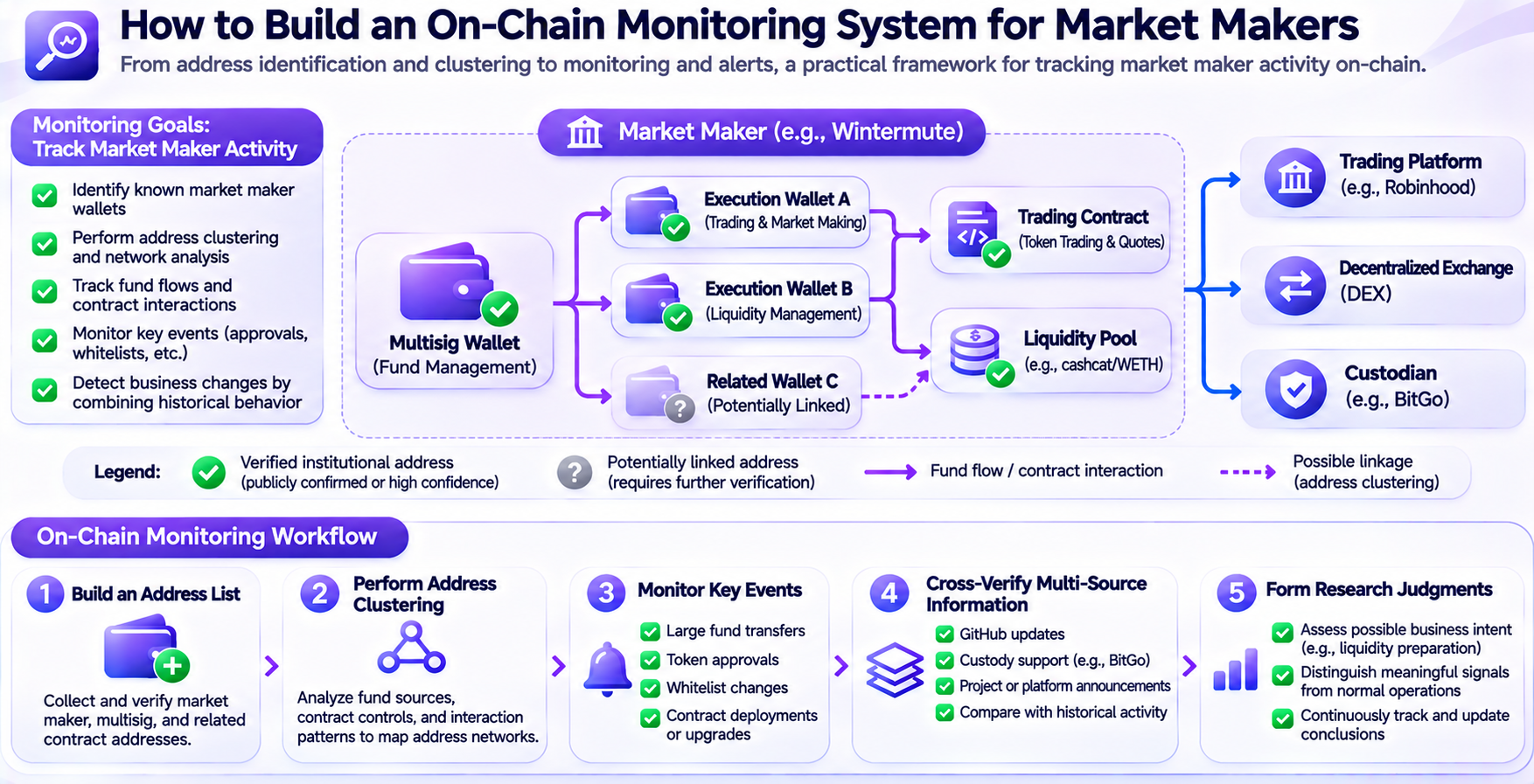
The first step in tracking market makers is to build a wallet address list with a reasonable degree of reliability. Blockchain addresses generally do not contain real-world identities, so researchers need to gradually assess the relationship between an address and a specific entity using public disclosures, block explorer labels, verified contracts, historical transactions, and publicly available institutional information.
The most direct approach is to start with publicly confirmed addresses. For example, addresses that an institution has publicly disclosed, verified multisig contracts, and institutional labels with clear sources provided by block explorers can all serve as initial research subjects. Compared with unverified social media rumors, these addresses are more suitable as a foundation for subsequent analysis.
After obtaining initial addresses, researchers can examine their historical counterparties, sources of funds, primary assets, and active periods. They need to distinguish between externally owned accounts (EOAs), smart contract wallets, multisig accounts, and trading contracts, because different account types correspond to different operating logic.
For example, an institution may manage funds through a multisig wallet and authorize multiple trading contracts to perform specific operations. If researchers monitor only the multisig wallet's direct transfers, they may miss subsequent activity by the trading contracts. Conversely, if they classify every address that has transacted with the multisig wallet as belonging to the same institution, they may mistakenly identify clients, partners, and external service providers as the institution's own wallets.
Therefore, an address list should include the address source, labeling basis, date first identified, primary function, and confidence level. Addresses whose attribution remains unclear can be retained as subjects pending verification rather than immediately assigned a definitive institutional identity.
Researchers can also use block explorers such as Etherscan and Blockscout to review address transactions, internal calls, token transfers, and contract events. For institutions that require long-term monitoring, manually reviewing pages in a block explorer is relatively inefficient. Researchers can further use public APIs or on-chain data platforms to establish automated monitoring.
How Can Wallet Address Clustering Help Reconstruct an Institution's Fund Network?
Address clustering refers to associating multiple addresses that may belong to the same entity or business system based on transaction relationships, control structures, and behavioral characteristics. Its purpose is not simply to expand the number of addresses but to identify the specific role each wallet plays in an institution's business operations.
On EVM-compatible networks, an institution may use fund management wallets, execution wallets, multisig accounts, trading contracts, and liquidity management contracts. Some addresses receive assets, some authorize operations, and others are active only in specific transaction scenarios. By analyzing the interactions among these addresses, researchers can gradually reconstruct fund flow paths.
For example, a confirmed institutional multisig wallet may transfer funds to a new address. The new address may then deploy a trading contract, with the original multisig account managing the contract's operating permissions. This control relationship is more analytically valuable than an ordinary token transfer because it involves contract management and operating authorization rather than merely the movement of funds.
However, address clustering cannot rely on a single transfer. Trading platforms, custodians, and market makers may have extensive normal business interactions, and funds entering an address do not necessarily mean that control of the address has changed. Addresses with similar fund sources, similar transaction times, or the same contracts also require analysis that rules out misattribution caused by shared services and automated infrastructure.
A more cautious approach is to examine multiple dimensions at the same time: whether the addresses are managed by the same multisig, whether clear contract-role authorization exists, whether specific execution paths are reused, and whether the behavior is consistent with known business patterns.
By continuously updating the address network, researchers can identify new wallets and business activities. However, address clustering is always an evidence-based attribution judgment. Unless there is clear public confirmation, inferred relationships should not be presented as confirmed institutional identities.
What Market Signals Can Market Maker Fund Transfers Reveal?
Fund transfers are among the easiest on-chain activities to observe, but they are also among the easiest signals to misinterpret. When a market maker address transfers a large amount of tokens to a trading platform, the market may become concerned about potential selling pressure. Assets transferred out of a trading platform may be interpreted as an institution accumulating tokens. However, these interpretations often overlook the complexity of market-making operations.
Market makers need to allocate assets among different trading venues to maintain their quoting capabilities and manage inventory. When liquidity demand on a trading platform increases, a market-making institution may transfer the relevant tokens or stablecoins in advance. Such transfers may be related to new trading business, but they may also simply represent normal inventory rebalancing.
Therefore, fund flows should be analyzed together with trading pairs, historical behavior, and transaction timing. If a wallet has consistently provided liquidity to multiple trading platforms, a new transfer may simply be routine activity. If a previously inactive address suddenly receives funds and interacts with a trading contract that it has never used before, its background may warrant closer examination.
Transaction size also needs to be considered in the context of liquidity. For large-cap assets, a transfer worth several million dollars may represent normal inventory management. For a low-liquidity token, a change of the same size may significantly affect market depth. However, the transfer amount does not equal the actual purchase or sale amount and cannot be used to calculate market demand directly.
Researchers should also examine the timing relationship between transfers and public events. Some institutions may complete technical and fund preparations before a business launch, but a timing correlation cannot directly prove causation. Even if a similar pattern has appeared in the past, it does not guarantee that every future transfer will correspond to the same type of event.
For ordinary investors, market maker fund flows are more suitable as leads for further investigation than as standalone trading instructions. Only by combining them with contract behavior, liquidity changes, and other public information can researchers form a relatively complete assessment of their practical significance.
Why Are Smart Contract Approvals and Whitelist Changes Worth Monitoring?
Smart contract approvals are an important category of information concerning on-chain institutional activity. Unlike ordinary asset transfers, approval operations may change the range of actions that an address or contract can perform, reflecting the permission configuration and infrastructure preparation of a trading system.
Under the ERC-20 token standard, approve is generally used to allow a designated address to use tokens within a specified allowance. Related approval events can be observed through contract logs, but an approval does not equal an actual transfer. Even if an address receives permission to use tokens, it may not execute any transactions for an extended period.
In addition, an institutional trading contract may maintain a separate asset whitelist to limit the tokens that the system can process. This whitelist is different from an ERC-20 token approval. The former generally controls the range of assets supported by a business system, while the latter controls spending permissions at the token-contract level.
For example, a trading contract may include a getAllApprovedTokens() function for querying approved assets. When the list of tokens supported by the contract changes, researchers can compare the newly added assets with previous transaction records to assess whether the system is expanding its trading scope.
In a Wintermute-related research case, a trader found that certain contracts were controlled by the same multisig wallet and continuously monitored changes to their asset whitelists. The contracts first added WETH and USDG, after which trading activity appeared. Later, approval operations involving the cashcat/WETH liquidity pool became a key event that the trader monitored. These details came from the trader's review of public on-chain activity. The specific control relationships should still be verified through the original transaction records.
The focus of contract approval analysis is not to treat every new permission as a major signal, but to determine whether a permission change has a clear business purpose. An approval may support testing, deployment, liquidity adjustments, or other operations, and it may ultimately be followed by no trading activity.
Researchers can continuously monitor changes to contract administrators, token approvals, asset whitelists, contract upgrades, and liquidity pool interactions. However, they need to distinguish between on-chain operations that have been executed, potential business preparations, and market expectations that have not yet been confirmed.
How Do the Wintermute and BitGo Cases Demonstrate Cross-Validation of Multiple Sources?
The research value of the Wintermute and BitGo-related cases lies in showing how market maker wallets, public code updates from a custodian, and trading infrastructure activity can be connected, rather than relying on a single isolated on-chain record.
In a trader's review published in November 2026, the researcher described how they tracked Wintermute's activity on Robinhood-related networks over an extended period while also monitoring BitGo's GitHub updates. They first looked for recurring business patterns in historical wallet activity and then compared new contracts and asset-support information with existing leads.
The key points in the case were as follows:
| Date |
Public Research Lead |
Observable Information |
| July 27 |
A BitGo-related GitHub update included hoodeth:cashcat |
An asset-support configuration had changed |
| July 29 |
cashcat appeared in the update together with 99 related stock tokens |
Multiple asset configurations may have had a business connection |
| August 3 |
The researcher detected Wintermute approval activity involving the cashcat/WETH liquidity pool |
A new permission configuration appeared in the relevant trading infrastructure |
| The following three days |
cashcat experienced a related launch event |
The timing between earlier signals and the actual event could be reviewed |
| Late August to early September |
Changes appeared in PONS custody support and market-making activity |
A similar monitoring approach was used to observe another asset |
The timeline above was compiled from the trader's public review and does not constitute an independent audit of each on-chain record. The trader claimed to have earned more than $4 million from cashcat and approximately $2 million from PONS. However, the profit amounts, complete trading costs, and identities of the relevant wallets cannot be independently confirmed solely from the review article.
Observing a custodian add support for a particular asset is not enough to confirm that a specific business event is about to occur. A custodian may serve multiple clients, and the same asset may be used by multiple platforms at the same time. Only by combining market maker fund preparations, contract interactions, and other public business information can researchers develop a more complete understanding of potential connections.
However, cross-validating signals from multiple sources does not mean that an event is certain. Multiple signals may come from the same internal test that has not yet been launched, or they may reflect related technical preparations with no trading significance. Researchers also need to consider alternative explanations rather than looking only for evidence that supports an existing conclusion.
It is worth noting that the trader in the case also mentioned that the original information advantage gradually diminished as more market participants identified similar behavior patterns. This reflects the competitive nature of public-data research: once a historical pattern is widely used, its predictive value may change.
Cross-validating information from multiple sources can help researchers develop a more comprehensive understanding of institutional on-chain activity. Wallet transfers, contract approvals, and public code updates can provide clues from different perspectives, but no single signal is sufficient to prove that a business event is about to occur. Even when multiple signals align, researchers need to cautiously assess their practical significance in light of historical behavior, market liquidity, and other public information.
How Can You Build an Automated On-Chain Wallet Monitoring System?
The primary value of automated monitoring is that researchers do not need to continuously refresh block explorers manually and can instead identify predefined data changes in a timely manner. A basic on-chain monitoring system can consist of an address list, a data acquisition module, event identification rules, and a notification system.
-
Establish clearly defined monitoring targets. Researchers can begin with verified institutional wallets, multisig contracts, and trading contracts, recording the source, function, and confidence level of each address. Addresses without sufficient supporting evidence should remain pending verification to prevent speculative labels from being used directly in subsequent analysis.
-
Select a data acquisition method. EVM networks generally provide access to transaction data through block explorer APIs, RPC nodes, and event log interfaces. For ordinary token transfers, researchers can monitor ERC-20 Transfer events. For approval changes, they can monitor Approval events. For custom trading contracts, they need to use the ABI to parse specific functions and events.
-
Establish event-filtering rules. Not every transfer or contract call warrants a notification. For example, monitoring can focus on the first activity of a new address, changes to contracts controlled by known multisigs, an asset entering a specific contract's supported-asset range for the first time, or a previously inactive wallet suddenly showing significant fund flows.
-
Connect on-chain information with other public sources. GitHub code updates, publicly disclosed product interface changes, and project announcements can help researchers understand the context of on-chain operations. However, different data sources vary in update time, reliability, and business significance. Temporal proximity alone cannot establish a direct connection.
-
Maintain traceable monitoring records. Each alert should preferably include the transaction hash, block height, timestamp, contract address, event type, and a link to the raw data. Researchers can use this information to review whether an alert was accurate rather than relying solely on conclusions generated by a bot.
AI tools can also assist in organizing this data, such as by summarizing historical wallet behavior, comparing contract events, and generating summaries of unusual activity. However, AI-generated address labels and business inferences still require verification. In particular, a model's guess about an institutional identity must not be treated as an established fact.
Automated monitoring improves the efficiency of data collection and organization; it does not automatically ensure signal accuracy. Whether a system produces valuable research results ultimately depends on data quality, analytical rules, and the researcher's understanding of the business context.
How Can You Distinguish Genuine On-Chain Signals from Market Noise?
On-chain data is public and traceable, but public availability does not mean that every record has clear market significance. A large number of transactions result from ordinary transfers, internal exchange movements, contract testing, and automated operations. Without sufficient business context, researchers can easily mistake normal activity for a significant event.
-
Treating an address label as a confirmed identity. Frequent interaction between an address and a market maker wallet does not prove that the market maker controls the address. Similarly, institutional labels on block explorers may be outdated or inaccurate and need to be verified using public disclosures and control relationships.
-
Equating technical preparations directly with business execution. Contract deployments, asset whitelist updates, and expanded custody support do not mean that an asset will definitely be listed on a trading platform. Technical teams may deploy multiple candidate solutions in advance, or cancel an existing plan because of testing results, risk controls, or changes in commercial arrangements.
-
Ignoring sample-selection bias. Researchers are more likely to notice cases that successfully predicted a market event while overlooking the many contract operations that had no corresponding event. Analyzing only successful cases may overstate the effectiveness of a particular type of on-chain signal.
To reduce misjudgments, researchers can establish a tiered evaluation framework:
| Signal Category |
Primary Observation |
Questions Requiring Further Verification |
| Address Activity |
New wallet funding, unusual transfers |
Is the address attribution reliable? |
| Fund Flows |
Assets transferred to trading venues or contracts |
Is this normal inventory management? |
| Contract Operations |
Approvals, whitelists, contract upgrades |
Is this testing or actual business preparation? |
| Infrastructure Changes |
Custody support, public code updates |
Are there other clients or uses? |
| Market Behavior |
Liquidity changes, increased trading volume |
Is there independent buying support? |
| Public Confirmation |
Official project or platform announcement |
Does the announcement align with the earlier assessment? |
Researchers can also record the actual results following the appearance of each type of signal and calculate its historical false-positive rate. For example, if a contract previously added support for 10 assets but only two ultimately corresponded to new trading business, the addition of a whitelist entry alone should not receive excessive predictive weight.
More importantly, on-chain monitoring should be used to propose and test hypotheses rather than continually seek evidence supporting a predetermined conclusion. For any unusual activity, researchers need to consider normal business operations, technical testing, and other possible explanations.
What Are the Risks and Compliance Boundaries of On-Chain Market Maker Monitoring?
On-chain research is based on public data, but the public nature of data does not mean that all trading strategies are free from legal or compliance risks. When research involves potential listings, institutional trading preparations, or suspected insider activity, it is important to distinguish between analyzing public information and using improperly obtained material nonpublic information.
Observing public transactions through block explorers, analyzing verified contracts, and researching public code updates generally fall within the scope of public-data research. However, if information comes from an unauthorized internal system, confidential materials, or a disclosure that violates a duty, the manner in which it was obtained and used may raise different legal issues.
The risk of market manipulation also requires attention. In low-liquidity token markets, large purchases, concentrated holdings, and social media distribution can significantly affect prices. Even if a research assessment ultimately proves correct, trade execution may still face slippage, price impact, and insufficient exit liquidity.
In addition, inferring the identities behind on-chain addresses may create reputational and privacy risks. Publicly identifying a wallet as belonging to a trading platform employee, insider, or misconducting trader without sufficient verification may result in false accusations. Researchers should therefore clearly distinguish between verifiable on-chain behavior and unconfirmed speculation about identity.
For ordinary investors, on-chain monitoring is better suited to market research, liquidity observation, and risk identification than to supporting highly leveraged or concentrated positions. Even when multiple public signals align, there is no guarantee that the price will move as expected.
On-chain data can improve market transparency, but it cannot eliminate uncertainty in information interpretation, trade execution, or compliance assessments. Establishing clear data sources, verification standards, and risk boundaries is an important prerequisite for conducting on-chain research over the long term.
Conclusion
On-chain market maker monitoring is a research method that combines blockchain transaction records, wallet addresses, smart contract interactions, and public infrastructure information. By observing institutional wallet fund flows, address control relationships, contract approvals, and whitelist changes, researchers can understand market activity from perspectives beyond price and trading volume.
The Wintermute and BitGo-related cases demonstrate the potential value of researching multiple public sources. An individual wallet transfer or code update may provide limited information, but multiple business-related signals that corroborate one another can help researchers develop more specific market hypotheses. However, a trader's successful experience does not prove that a method produces consistent returns, nor can historical patterns be treated as definitive predictions of future events.
For ordinary investors, the focus of on-chain monitoring should be on cross-validating data authenticity, address attribution, contract behavior, and business context. Automated tools can improve the efficiency of information collection, but they cannot replace independent judgment. Only by combining public on-chain data with market liquidity, institutional business logic, and risk management can investors more accurately understand the market changes reflected by on-chain activity.
FAQ
What Is On-Chain Market Maker Monitoring?
On-chain market maker monitoring uses public blockchain transactions, wallet addresses, contract events, and fund flows to observe trading and liquidity management activities that market-making institutions may be conducting.
How Can I Find the Wallet Addresses of Market Makers Such as Wintermute?
You can start with institutional disclosures, block explorer labels, verified multisig contracts, and historical transaction relationships, and then cross-validate the address attribution.
What Does It Mean When a Market Maker Transfers Tokens to a Trading Platform?
It may involve inventory adjustments, liquidity preparation, client settlement, or other business activities. It cannot be equated directly with an upcoming token sale or listing.
Does an ERC-20 Approval Event Mean That a Trade Has Already Occurred?
No. Approval is generally used to set token spending permissions. An actual asset transfer requires a separate corresponding operation.
How Can Smart Contracts Reveal Changes in Institutional Activity?
You can monitor contract deployments, administrator changes, token approvals, asset whitelist updates, and liquidity pool interactions, and then assess their significance in light of historical behavior.