In 2026, the most discussed zero knowledge proof projects and tokens are Mina (MINA), ZKsync (ZK), Starknet (STRK), and live zkEVMs such as Linea. They use proofs for privacy, validity, or Layer 2 scaling. Polygon zkEVM has been sunset and is not a current hot L2. Tokens mainly cover staking, fees, or governance.
Zero Knowledge Proof is a cryptographic technology that allows for the verification of information authenticity without revealing any raw data. In the blockchain field, ZKP is typically used to enhance privacy protection and scalability.
Related tokens such as MINA, ZK, and STRK typically cover staking, fees, or governance; they do not prove a circuit is secure. Readers who want the cryptography first can start with this explainer on zero-knowledge proofs and this deeper technical overview. The sections below compare project types, token roles, and what changed after 2024–2026 mainnet and sunset events.
Key Takeaways
Zero-knowledge proofs let a chain verify computation or identity without publishing the raw data used to produce that result.
In 2026, Mina, ZKsync, and Starknet remain active reference projects, while Polygon zkEVM is no longer a live scaling network after its July 2026 sequencer sunset.
zk-SNARKs, STARKs, and zkEVM designs solve different jobs: constant-size proofs, transparent proof systems, and Ethereum-compatible execution.
Tokens such as MINA, ZK, and STRK are mainly used for staking, fees, or governance; they do not by themselves prove that a proof system is secure.
What is Zero Knowledge Crypto?
Zero Knowledge Crypto is a popular label for blockchains and applications that rely on zero-knowledge proofs. A zero-knowledge proof is a cryptographic protocol in which one party proves a claim is valid while keeping the underlying witness, such as a private key, a balance, or a full transaction list, hidden from the verifier.
On a public blockchain, teams use that property in two common ways. Privacy systems use a proof to show that a transfer is valid without exposing sender, receiver, or amount. Scaling systems use a validity proof to show that a large batch of Layer 2 transactions was executed correctly, then post a compact proof to Ethereum instead of replaying every transaction on Layer 1. Both designs still depend on the correctness of the circuit, the prover, and the verifier contract.
A simple analogy is proving knowledge of a password without typing the password into a chat window. The verifier only learns that the prover can satisfy the rule, not the secret itself. Older privacy coins such as Zcash also use zero-knowledge circuits so shielded pools can hide transaction information while still letting the public chain check that no extra coins were created. That is a protocol-design fact, not a reason to buy or spend a coin.
Why is zk-SNARKs the future of cryptographic technology?
zk-SNARKs are not the only zero-knowledge tool, but they are the family most often cited when teams need small proofs and fast on-chain verification. SNARK stands for succinct non-interactive argument of knowledge. In practice, a SNARK lets a smart contract check a short proof instead of re-executing a large computation. What are zk-SNARKs, in one line? They provide a short, non-interactive proof that a computation happened correctly, so a verifier does not need the original private information.
That design shows up in three Web3 settings, and developers use it when they want lower verification time on Ethereum:
Privacy: a shielded transfer or identity check can be validated without publishing the full underlying data.
Scalability: a ZK rollup can compress thousands of transactions into one validity proof and lower the data and gas burden on Ethereum.
Compliance-oriented verification: a protocol can check that a user meets a rule, such as being above a threshold or passing a KYC check, without exposing the supporting documents on-chain.
STARKs, recursive SNARKs, and zkVMs occupy the same map. STARKs avoid a trusted setup and are often used by Starknet. Recursive SNARKs let Mina keep a tiny chain proof. zkEVMs try to prove Ethereum-like execution so existing Solidity contracts can move with less rewriting. Types of zero-knowledge-based solutions therefore include privacy coins, ZK rollups, zkEVMs, zkVMs, and lightweight ZK Layer 1s. The “future” claim is not that one acronym replaces all cryptography, but that validity proofs have become a standard way to scale and to hide selected data.
Why use zero-knowledge-based networks at all? They can increase decentralization reliability when more users can verify the chain themselves, because a node does not need to re-execute hundreds of transactions to accept a new state. They also reduce how much information a sequencer or explorer must publish in the clear. They do not give any party extra control over user funds by themselves; control still sits in the sequencer, the prover, the bridge, and the token’s governance design.
Overview of Popular ZKP Projects
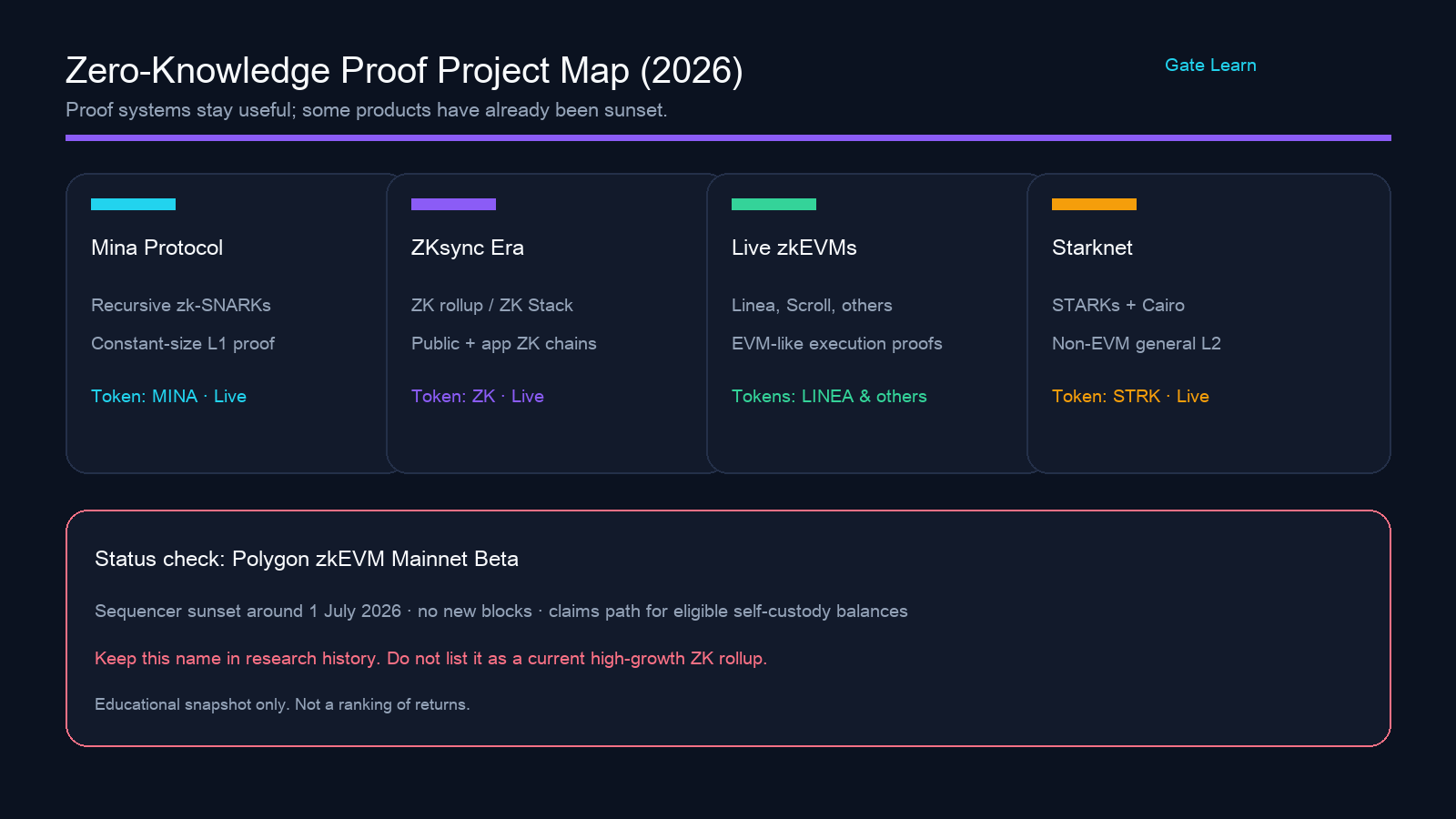
The list below is an educational snapshot of widely discussed ZKP networks, not a ranking of returns. Selection is based on whether the project is still operating, whether it publishes a distinct proof system, and whether a related token is already in circulation. Polygon zkEVM is included only because older articles still treat it as current; the live status changed in 2026.
Project
Proof family
Role in 2026
Related token
Mina Protocol
Recursive zk-SNARKs
Lightweight Layer 1 with a constant-size chain proof
MINA
ZKsync Era
ZK rollup / ZK Stack
Ethereum Layer 2 and Elastic Network of ZK chains
ZK
Linea and other zkEVMs
zkEVM validity proofs
EVM-compatible Layer 2 execution after Polygon zkEVM sunset
LINEA and others
Starknet
STARKs + Cairo
General-purpose Layer 2 with a non-EVM virtual machine
STRK
Figure 1. 2026 snapshot of widely discussed ZKP networks and the Polygon zkEVM sunset.
Mina Protocol
Mina is a Layer 1 that uses recursive zk-SNARKs so nodes can verify the chain with a proof that is commonly described as about 22 KB rather than a growing full-node history. The numbers — hundreds of blocks and many account updates — are rolled up into one constant-sized proof. The protocol’s design goal is to keep verification cheap enough for light clients and privacy-oriented applications. Mina is often described as a ZK blockchain for a secure, private, and verifiable internet, which is a product positioning statement rather than a guarantee.
MINA is the native token used for staking, block production incentives, and governance around the Mina network. Developers who want to build zkApps use Mina’s recursive proofs so a phone-class client can still check the chain. For a fuller protocol walkthrough, see Mina Protocol explained.
ZKsync
ZKsync, developed by Matter Labs, is an Ethereum ZK rollup stack. The flagship public chain is ZKsync Era. Older product names such as zkPorter described a hybrid data-availability path; the 2026 product map is centered on Era, the ZK Stack, and an Elastic Network of interoperable ZK chains. ZKsync Lite, the earlier SNARK-based payments chain, was sunset in 2026. ZKsync’s current documentation describes a network that can connect public chains and private chains into one cryptographically secured set of ZK chains, so teams can build app-specific chains without abandoning Ethereum settlement.
The ZK token is already live. Governance participants use it to vote, and the network can use it in selected fee or incentive designs; it is not a “to be announced” placeholder. Readers comparing rollups can place ZKsync next to other Ethereum scaling options in this Layer 2 overview. DeFi applications that use ZKsync still inherit sequencer and bridge assumptions, even when the proof is valid.
Polygon zkEVM and the zkEVM category
Polygon zkEVM was an Ethereum-compatible ZK rollup. Polygon zkEVM Mainnet Beta: sunset complete. That specific Mainnet Beta is no longer a live execution environment: Polygon Labs sunset the sequencer around 1 July 2026, stopped block production, and opened a claims path for eligible self-custodied balances. It should not be described as a current high-growth Layer 2. Any Polygon zkEVM overview written before that date is historical.
The broader zkEVM category is still active. Linea, Scroll, and similar networks continue to prove EVM-like execution and post validity proofs to Ethereum. Teams that want to build Solidity apps can still use those live zkEVMs. Polygon’s remaining ZK work is better described through CDK-style chains and aggregation, not through the retired zkEVM beta. Moving assets between a zkEVM and Ethereum still depends on a bridge; the trust model of that bridge is covered in this cross-chain bridge explainer.
Starknet
Starknet is a Layer 2 built by StarkWare. It uses STARK proofs and the Cairo virtual machine instead of proving the EVM bytecode directly. That choice favors proving throughput for more complex computation, at the cost of a different developer toolchain than Solidity-first zkEVMs.
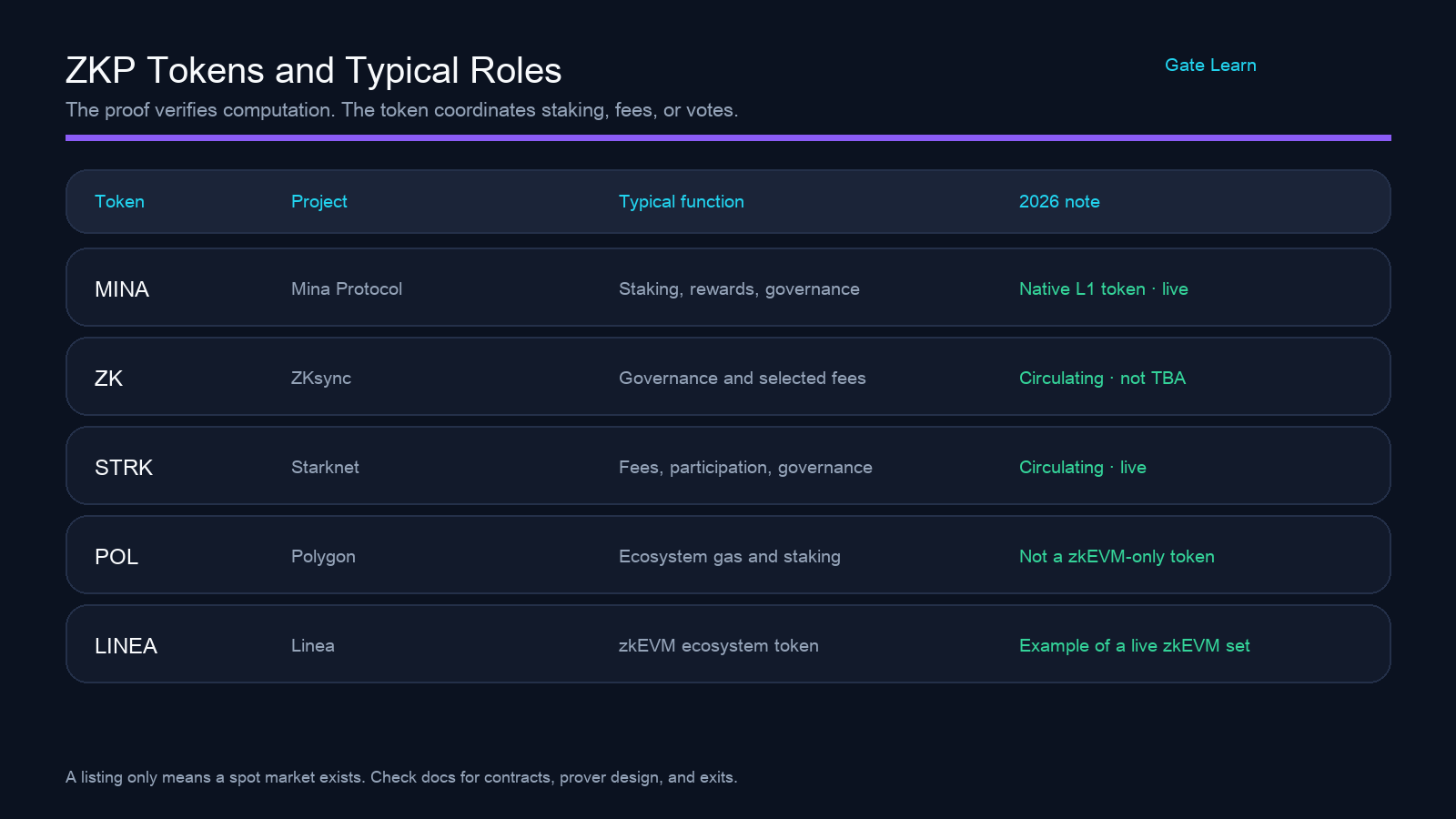
ZKP tokens usually sit one layer above the proof system. The proof verifies computation; the token coordinates staking, fees, or votes. The older screenshot that listed ZK utility as “TBA” and mapped Polygon zkEVM to MATIC is outdated.
Token
Project
Typical function
2026 status note
MINA
Mina Protocol
Staking, rewards, and governance
Native Layer 1 token; chain proof size remains the protocol’s main differentiator
ZK
ZKsync
Governance and selected fee or incentive roles
Circulating; no longer a planned airdrop-only placeholder
STRK
Starknet
Fees, staking participation, and governance
Circulating on Starknet
POL
Polygon
Polygon ecosystem gas and staking
Not a dedicated Polygon zkEVM token after that chain’s sunset
LINEA
Linea
zkEVM Layer 2 ecosystem token
Example of a still-operating zkEVM token set
Figure 2. Typical token roles sit above the proof system and do not replace a security review.
A token listing on a centralized exchange only means a spot market exists. It does not certify the underlying prover, the security council setup, or the withdrawal path. Anyone comparing markets can search the ticker on Gate after checking the project’s own docs for contract addresses and token roles.
How to evaluate ZK projects and future trends
ZKP is still a technology-led category, so the useful questions are operational rather than price-led.
Confirm liveness. A 2023–2024 article may still name Polygon zkEVM or treat ZK and STRK as upcoming. In 2026 those two tokens are live, and Polygon zkEVM is not producing blocks.
Separate proof system from product. SNARK, STARK, zkEVM, and zkVM are implementation choices. A STARK-based chain is not automatically “better” than a SNARK-based one; the trade-off is usually proof size, trusted setup, prover cost, and EVM compatibility.
Read the data-availability and exit path. A rollup that posts proofs to Ethereum still depends on how users withdraw if the sequencer stalls. Layer 2 scoreboards such as L2BEAT classify that path separately from TVL.
Treat Layer 2 ecosystems as changing sets. ZKsync, Starknet, Linea, and Scroll can gain or lose applications without the math of zero-knowledge proofs themselves becoming obsolete.
The durable trend is that validity proofs are being reused beyond a single “ZK coin” narrative: rollups, lightweight clients, private identity, and some bridge verification designs all consume the same cryptographic primitive. Market-cap pages that list “top zero knowledge proofs tokens” change over time and should be treated as screens, not as a research conclusion. Hundreds of tickers can appear in a ZK category filter; only a smaller set still maps to an operating proof system.
How zero-knowledge protocols can increase decentralization, reliability, and security is more specific: they provide a way for many independent verifiers to check the same proof in a short time, which can lower the hardware needed to audit the chain. They do not automatically provide privacy that works for every crypto use case, and they do not remove the need to read audits when teams build DeFi on top of a ZK rollup.
Summary
Zero-knowledge proof projects apply one idea in several products: verify a statement without revealing the witness. Mina uses recursive SNARKs to keep a tiny Layer 1 proof. ZKsync and Starknet use validity proofs to scale Ethereum, with ZK and STRK already in circulation. Polygon zkEVM should be treated as a sunset historical network, while other zkEVMs continue. Tokens around these systems mainly handle staking, fees, and governance, and they are not a substitute for reading the proof system, the bridge, and the withdrawal design.
FAQ
What is a zero-knowledge proof in crypto?
A zero-knowledge proof is a cryptographic method that lets a prover show a statement is true without revealing the secret data behind it. Blockchains use that property for private transfers and for validity proofs that a rollup executed transactions correctly. Developers also use it to prove off-chain computation before a contract accepts a result.
Which zero-knowledge proof projects are still relevant in 2026?
Mina Protocol, ZKsync Era, Starknet, and operating zkEVMs such as Linea remain common reference points. Polygon zkEVM is not a live scaling chain after its 2026 sequencer sunset.
What is the difference between zk-SNARKs and STARKs?
zk-SNARKs produce small proofs and are widely used when on-chain verification cost must stay low, but many SNARK constructions involve a setup phase. STARKs are designed to avoid a trusted setup and can prove larger computations, which is why Starknet is built around them.
What are MINA, ZK, and STRK used for?
MINA is Mina’s native staking and governance token. ZK is used in ZKsync governance and selected network roles. STRK is used for Starknet fees, participation, and governance. None of these tickers is a complete description of the underlying proof system.
Is Polygon zkEVM still a top ZK rollup?
No. Polygon Labs sunset the Polygon zkEVM Mainnet Beta sequencer in July 2026. Research on current zkEVMs should look at still-operating networks and at Polygon’s other ZK products, not at that retired beta.
Do ZK rollups remove all blockchain risk?
No. Validity proofs reduce the need to re-execute every Layer 2 transaction on Ethereum, but users still face smart-contract bugs, sequencer or prover operational risk, bridge risk, and ordinary market risk on any related token.
Author: Max
Reviewer(s): Jayne
Disclaimer
* The information is not intended to be and does not constitute financial advice or any other recommendation of any sort offered or endorsed by Gate.
* This article may not be reproduced, transmitted or copied without referencing Gate. Contravention is an infringement of Copyright Act and may be subject to legal action.
In the field of blockchain investment, the profitability of PoW (Proof of Work) and PoS (Proof of Stake) blockchains has always been a topic of significant interest. Crypto influencer Donovan has written an article exploring the profitability models of these blockchains, particularly focusing on the differences between Ethereum and Solana, and analyzing whether blockchain profitability should be a key concern for investors.
Substrate is a modular blockchain development framework developed by Parity Technologies. It allows developers to quickly build customized blockchains and connect them seamlessly to the Polkadot (DOT) network as parachains. Compared with the traditional smart contract development model, Substrate offers greater flexibility, stronger scalability, and chain level customization at the protocol layer. That is why it has become the core development framework of the Polkadot ecosystem and a key foundation that enables its multi-chain architecture to scale efficiently.
BlackRock has expanded its Web3 presence by launching the BUIDL tokenized fund in partnership with Securitize. This move highlights both BlackRock’s influence in Web3 and traditional finance’s increasing recognition of blockchain. Learn how tokenized funds aim to improve fund efficiency, leverage smart contracts for broader applications, and represent how traditional institutions are entering public blockchain spaces.
Polkadot Parachains are independent blockchains connected to the Relay Chain, capable of processing transactions in parallel under a shared security model while enabling cross-chain communication across the Polkadot network. Compared to traditional single-chain blockchains, Parachains offer greater scalability, lower security setup costs, and stronger interoperability. They are a core component of Polkadot’s multi-chain architecture and a key foundation for achieving cross-chain scalability.
Cysic leverages a Proof-of-Compute consensus mechanism alongside a decentralized task scheduling system to distribute zero-knowledge proof generation across a network of Prover nodes. By integrating GPU and ASIC hardware, it improves computational efficiency and creates a high-performance, cost-effective ZK compute network.
CYS is the core token of Cysic, a decentralized compute network. It connects ZK proof generation and AI computing demand with compute supply through three key functions: governance rights, compute access rights, and financial reward rights. As the ComputeFi ecosystem evolves, CYS is becoming a critical value carrier for verifiable on-chain computation markets.