On November 16, 2026, DBS and Kinexys by J.P. Morgan announced the launch of an interbank tokenized deposit interoperability solution, enabling eligible institutions to transfer U.S. dollar funds around the clock between permissioned-chain accounts in the United States and Singapore. Ant International became the first customer to use the service. Meanwhile, Swift is advancing blockchain-ledger-based cross-border payment infrastructure, while the Bank for International Settlements' Project Agorá is exploring the combination of commercial bank tokenized deposits and central bank reserves to improve the efficiency of cross-border wholesale payments. These developments show that banks are gradually moving blockchain technology from early proof-of-concept projects into practical fund management scenarios.
However, 24/7 cross-border settlement does not mean that all international payments arrive immediately, nor does it mean that tokenized deposits will completely replace stablecoins. The two forms of digital money differ significantly in terms of their issuers, legal rights, network accessibility, redemption mechanisms, and compliance management. Understanding these differences helps explain why banks need new cross-border settlement infrastructure and how different forms of digital money may jointly serve the global payments market in the future.
Key Takeaways
- Traditional cross-border payments involve bank operating hours, correspondent banking accounts, liquidity arrangements, and compliance reviews. Funds availability and final settlement may occur at different times.
- Tokenized deposits typically represent a deposit claim against a commercial bank. Through programmable ledgers, they can improve the efficiency of fund transfers, reconciliation, and liquidity management.
- Stablecoins are typically backed by reserve assets held by the issuing institution. They circulate on public blockchains or other blockchain networks and use issuance and redemption mechanisms that differ from those of bank deposits.
- The latest solution from DBS and J.P. Morgan supports around-the-clock U.S. dollar transfers between the United States and Singapore for eligible institutions, although connections with traditional banking systems remain subject to certain limitations.
- Tokenized deposits and stablecoins do not necessarily compete as substitutes. They may serve different use cases, including institutional fund management, cross-border payments, digital asset trading, and programmable finance.
Why Is It Difficult for Traditional Cross-Border Payments to Achieve True 24/7 Settlement?
Cross-border payments involve more than transmitting information between a payer and a payee. They also include bank account posting, fund clearing between financial institutions, foreign exchange conversion, compliance reviews, and final settlement. Even if users can submit transfer instructions through online banking at any time, the actual movement of funds may still be constrained by bank operating hours, payment system availability, and the processing procedures of intermediary institutions.
Under the traditional correspondent banking model, a bank without direct access to the payment system in the recipient's country may need to transfer funds through other banks. Different institutions must confirm account information, perform compliance checks, update correspondent account balances, and coordinate with payment systems in different countries. Because countries operate in different time zones and have different holiday schedules and settlement windows, a cross-border payment may need to wait for subsequent processing even after the originating bank has initiated it.
This structure affects not only the speed at which funds become available but also the complexity of corporate treasury management. Multinational companies typically need to maintain bank accounts in multiple countries or regions and arrange local-currency or U.S. dollar liquidity in advance to cover payroll, supplier settlements, and daily operating expenses. If funds cannot be moved between markets promptly, companies may need to maintain higher cash buffers, increasing the cost of tied-up capital.
In recent years, real-time payment systems and cross-border payment networks have addressed some of these issues. However, the speed of payment information transmission, the time when funds become available, and the time of final settlement must still be distinguished. The core goal of banks exploring 24/7 tokenized settlement is to further reduce the time constraints and operational steps between different systems, enabling eligible funds to be transferred and used across a wider range of hours.
What Are Tokenized Deposits? How Do They Represent Bank Account Funds on a Blockchain?
Tokenized deposits are a digital representation of commercial bank deposits. Their foundation remains the deposit relationship between a customer and a bank. Funds held by users at a bank can be mapped through a specific technical architecture to a programmable ledger, allowing the corresponding balance to be transferred, recorded, and managed according to predefined rules. Unlike cash or central bank digital currencies held directly by users, tokenized deposits typically continue to represent a holder's claim against a commercial bank. Their legal characteristics, deposit protection, and applicable rules must be assessed based on the relevant jurisdiction and product structure.
For example, if a company holds $1 million in deposits at a bank, the bank may, subject to internal and regulatory requirements, link part of that balance to a tokenized deposit system. The company can then transfer funds through a permissioned network to other eligible participants, while the bank ledger and on-chain records must remain consistent under the system's rules. In this model, the blockchain does not create new U.S. dollars out of nothing. Instead, it provides a new way to record and transfer existing bank deposits.
Tokenized deposits typically operate on networks with access controls. Banks can restrict participants based on customer identity, business eligibility, and regulatory requirements, and incorporate compliance checks, transaction permissions, and account management mechanisms into the payment process. This design helps banks connect new technology with existing risk management systems. It also means that tokenized deposits typically cannot be received or transferred freely by any wallet in the same way as stablecoins on an open public blockchain.
The technical structures used by different banks are not necessarily the same. Some solutions use blockchain deposit accounts to transfer balances, some use transferable deposit tokens, and others rely on coordination mechanisms across systems. Tokenized deposits are therefore not a single, fully standardized product category. Specific rights and transfer rules depend on the actual banking service arrangement.
How Do DBS and J.P. Morgan Enable 24/7 Interbank U.S. Dollar Transfers?
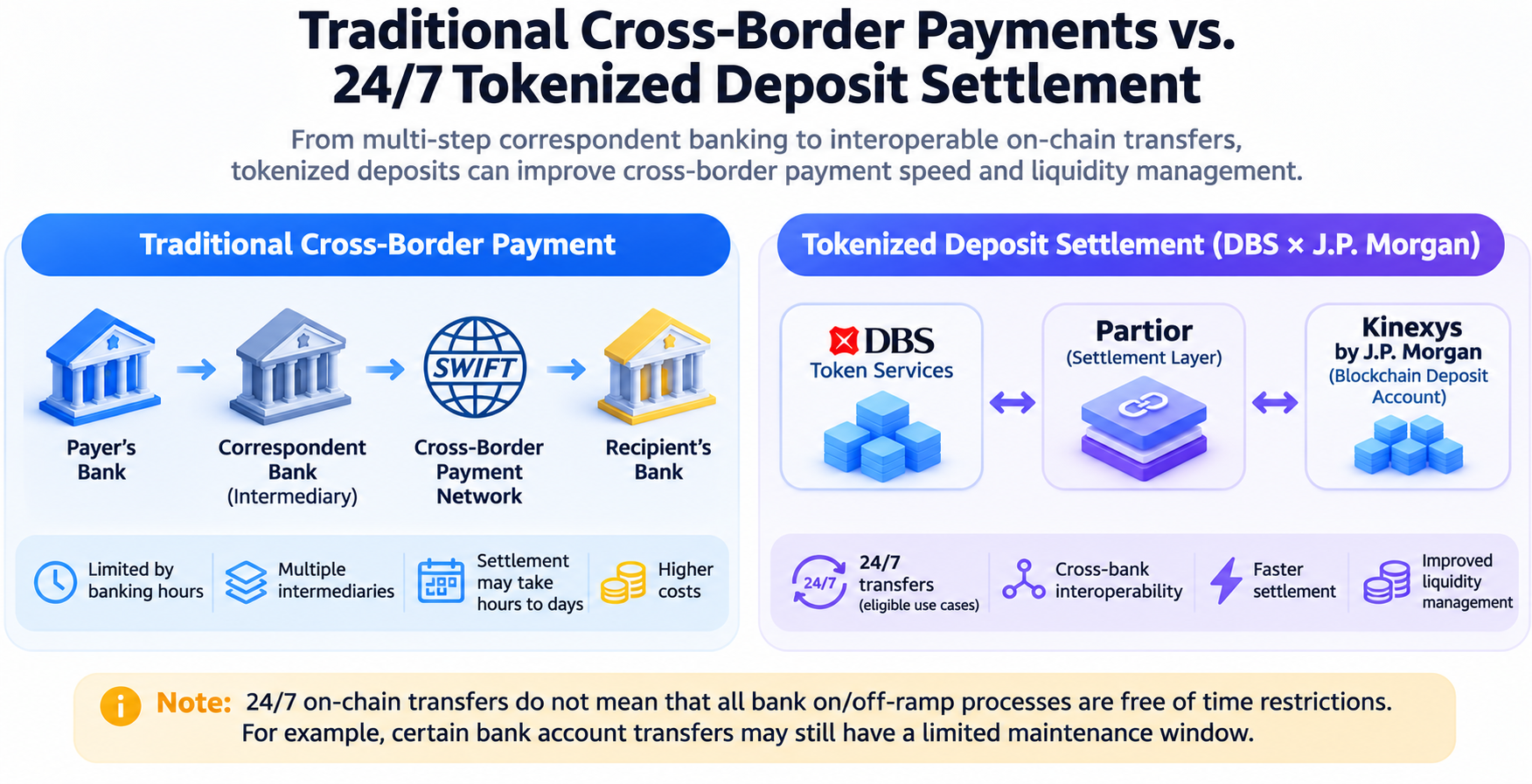
On November 16, 2026, DBS and Kinexys by J.P. Morgan announced the launch of an interbank tokenized deposit interoperability solution, enabling institutional customers to transfer U.S. dollar funds between the two banks' respective permissioned-chain account systems in the United States and Singapore. The solution connects DBS Token Services with Kinexys' Blockchain Deposit Account network and uses settlement coordination capabilities provided by Partior, advancing the previously proposed interoperability framework to the commercial-use stage.
The significance of this solution is that it does not merely address fund transfers between accounts within the same bank. Instead, it attempts to connect the tokenized deposit systems of two different banks. For multinational companies, the ability to move funds around the clock between different banking networks could reduce some of the waiting caused by time zones and traditional bank operating hours and improve global cash position management. Ant International became the first customer to use the solution, primarily for real-time global treasury management.
For example, a company operating in both Singapore and the United States may need to adjust the distribution of its U.S. dollar funds based on payment requirements in different markets. Under the traditional model, some cross-border fund transfers must wait for the relevant banking systems and payment windows to open. A tokenized deposit network can allow eligible accounts to transfer funds on weekends or outside normal business hours, providing greater flexibility for fund allocation.
However, the service's around-the-clock capabilities still have clear boundaries. Kinexys' Blockchain Deposit Account network operates 24/7/365, but transfers into and out of traditional demand deposit accounts and Blockchain Deposit Accounts are still subject to an approximately three-hour system maintenance window every Saturday from 3:00 p.m. to 6:00 p.m. U.S. Eastern Time. Therefore, around-the-clock transfers between on-chain accounts should not be interpreted as meaning that all bank funding and withdrawal processes operate continuously without interruption.
In addition, the current solution is primarily designed for eligible institutional customers and specific account networks. It does not mean that ordinary retail users can already use the service to freely complete global cross-border transfers. Its initial value lies in institutional fund transfers, corporate treasury management, and interbank liquidity coordination rather than directly replacing all channels for personal cross-border payments.
How Do Tokenized Deposits Differ From Stablecoin Payments?
Both tokenized deposits and stablecoins can use blockchain or distributed ledger technology to transfer value, but they represent different financial rights. Tokenized deposits typically correspond to commercial bank deposits, creating a deposit claim between the holder and the bank. Stablecoins, by contrast, are typically issued by specialized issuers and supported by cash, short-term government securities, or other eligible reserve assets. They maintain a price relationship with a reference currency according to their issuance and redemption rules.
USDC, a U.S. dollar stablecoin, is intended to maintain a 1:1 relationship with the U.S. dollar. Eligible customers can mint and redeem it under the conditions set by the issuer, while other users may obtain it through trading platforms or on-chain markets. Bank tokenized deposits, in comparison, are generally more closely linked to a specific bank account system and customer eligibility requirements. Their transfer and redemption processes are governed by bank account rules.
| Comparison Dimension |
Tokenized Deposits |
Stablecoins |
| Issuer |
Commercial banks |
Stablecoin issuers |
| Underlying financial right |
Typically a bank deposit claim |
Determined by the applicable issuance and redemption terms |
| Value support |
Bank deposits and the bank's balance sheet |
Reserve assets and issuance and redemption mechanisms |
| Network type |
Typically a permissioned chain or controlled ledger |
May operate on public blockchains or permissioned networks |
| Participant scope |
Bank customers and eligible institutions |
Depends on issuance rules, the network, and regulatory requirements |
| Primary uses |
Corporate treasury, interbank payments, and institutional settlement |
Digital asset trading, cross-border payments, and on-chain finance |
| Key risks |
Bank credit, system interoperability, and liquidity risks |
Issuer, reserve asset, redemption, and network risks |
The differences in accessibility and usage are particularly important. Stablecoins can be transferred on supported blockchain networks and used through wallets, trading platforms, and smart contracts in various financial activities, giving them strong cross-platform composability. Tokenized deposits place greater emphasis on consistency with bank accounts, regulatory identities, and financial institutions' internal control systems. They are suitable for institutional businesses with stringent compliance and account relationship requirements.
However, it cannot simply be assumed that tokenized deposits are always safer than stablecoins or that stablecoins are always more efficient than bank deposit transfers. The safety of each product depends on its issuer, legal structure, asset backing, network design, and risk controls. Actual payment efficiency is also affected by funding and withdrawal processes, foreign exchange conversion, compliance reviews, and the recipient's ability to connect to the relevant system.
Why Are Banks More Focused on Tokenized Deposits Than on Using Stablecoins Directly?
One important reason banks are exploring tokenized deposits is that they want to improve payment efficiency while preserving existing deposit relationships and financial service capabilities. Bank deposits are not only the foundation of customers' daily payments and fund management but also an important part of commercial banks' asset and liability management. If large amounts of corporate funds move outside the banking system into stablecoins, banks' deposit structures and liquidity management could change. Banks therefore have an incentive to develop a form of digital money that can provide similar on-chain transfer efficiency while remaining based on the bank account system.
For large multinational companies, fund management involves more than making payments quickly. It also includes account permissions, fund pooling, internal approvals, liquidity forecasting, and compliance records. Tokenized deposits can be integrated with banks' existing corporate treasury services, allowing companies to use programmable payment functions within familiar banking relationships. For example, a company could arrange fund transfers based on predefined conditions or automatically execute transfers between affiliated entities under authorized rules.
At the same time, banks do not necessarily reject stablecoins. Some banks and financial institutions are also researching stablecoin issuance, reserve management, custody, and related payment services. Tokenized deposits and stablecoins may serve different customer groups and could even be connected through interoperability infrastructure in the future. Stablecoins may offer more flexible usage for users who want to access open on-chain financial ecosystems. Tokenized deposits may better suit companies that need to preserve bank account management and institutional compliance processes.
Therefore, the goal of developing tokenized deposits is not simply to replicate stablecoins' transfer functionality. It is to integrate programmable payment capabilities into existing banking services while allowing banks to continue providing account management, credit intermediation, and liquidity services within new digital financial infrastructure.
How Are Swift and Project Agorá Upgrading Cross-Border Payment Infrastructure?
Beyond cooperation between individual banks, upgrading cross-border payment infrastructure also requires addressing interoperability between different banks, networks, and jurisdictions. In July 2026, Swift announced that its blockchain ledger was ready to enter an initial-use phase, with 17 banks from six continents planning to conduct a pilot of cross-border payments using tokenized deposits. The ledger primarily coordinates different banks' tokenized deposit systems, allowing participating institutions to transfer funds outside traditional business hours and complete subsequent final settlement through existing systems.
Swift's exploration shows that future cross-border payments may not require all bank funds to be moved to a single blockchain. Another approach is to allow different banks to retain their own account and ledger systems while using a shared coordination layer to enable fund transfers and synchronize states. This model can leverage existing financial infrastructure, but it must also address cross-system data consistency, failed transactions, legal finality, and the allocation of compliance responsibilities.
Project Agorá, promoted by the Bank for International Settlements, further explores the integration of commercial bank tokenized deposits with central bank reserves. Its goal is to establish a programmable platform capable of supporting multicurrency wholesale cross-border payments, allowing commercial bank deposits and central bank money to operate in coordinated ledger structures while studying mechanisms such as atomic settlement, compliance checks, and cross-border liquidity management.
In 2026, Project Agorá completed its prototype validation and began testing transactions involving real value in a controlled environment. The July test involved 28 financial institutions and central banks from Asia, Europe, and North America. It covered 17 transaction scenarios and had a total transaction value of approximately 800,000 Swiss francs. The average time from payment initiation to settlement was approximately 80 seconds. This demonstrated the feasibility of the architecture under specific conditions, but the test's scale and controlled environment do not mean that global commercial payment networks already have the same capabilities.
These two types of projects represent different technical approaches. Swift places greater emphasis on connecting existing bank ledgers and payment networks, while Project Agorá examines how tokenized commercial bank money and central bank reserves can coordinate settlement within a shared architecture. Both indicate that the focus of competition in cross-border payments may gradually shift from the transfer speed of a single network to the ability to connect different currencies, banks, and settlement systems.
How Can 24/7 Cross-Border Settlement Improve Corporate Liquidity Management?
For multinational companies, the value of 24/7 cross-border settlement lies not only in shortening payment times but also in improving fund availability. Traditional treasury management often requires companies to arrange account balances in advance according to the operating hours of different markets. For example, a company may need to maintain a certain amount of funds in the United States, Europe, and Asia to meet local payment needs. When funds cannot be transferred across borders promptly, these cash buffers may increase the company's overall cash requirements.
If a company can transfer funds around the clock between eligible accounts, it may be able to dynamically adjust cash positions based on actual business needs. For example, a company operating in multiple countries could transfer some idle U.S. dollar funds to a U.S. account after business operations in Asia end, using them for local supplier payments or other operating needs without relying entirely on the traditional banking processing window on the next business day.
Programmable payments may further reduce manual operations. A company could link fund transfers to predefined conditions, such as triggering a top-up when an account balance falls below a specified threshold or executing a payment after both parties to a transaction satisfy agreed conditions. These functions can improve the automation of treasury management, but their actual availability depends on bank product capabilities, customer authorization, and applicable regulatory rules.
It is important to note that around-the-clock fund transfers do not mean companies can eliminate liquidity buffers entirely. Cross-border funds may still be subject to foreign exchange conversion, market liquidity, payment limits, regulatory requirements, and the recipient's ability to connect to the relevant system. For companies operating in multiple currencies, the ability to transfer U.S. dollar funds quickly does not mean that other currencies can always be exchanged at the same cost. The more accurate meaning of 24/7 settlement is improved fund allocation efficiency, not the elimination of all cross-border liquidity management costs.
Can Tokenized Deposits and Stablecoins Interoperate?
As tokenized deposits and stablecoin payment networks develop, interoperability has become an important issue for digital financial infrastructure. Different banks may use different permissioned-chain systems, while stablecoins may operate on different blockchain networks such as Ethereum and Solana. If these systems remain isolated, users may still need additional exchange, custody, or bank account operations to transfer funds across networks, even if an individual network supports fast transfers.
The goal of interoperability is to enable different forms of digital money to exchange value under clearly defined rules. For example, a company may hold tokenized U.S. dollar deposits at a bank while needing to pay a supplier that uses stablecoins. In theory, a compliant exchange or settlement mechanism could convert the value of the bank deposits into a stablecoin accepted by the recipient and complete the payment through a supported blockchain network. However, this process would need to address asset redemption, identity verification, anti-money laundering reviews, and settlement risks between different networks.
Atomic settlement is an important area of related technical research. Its basic goal is to ensure that interdependent fund transfers in a transaction are completed simultaneously under agreed conditions, preventing one party from paying while the other fails to perform. In cross-border foreign exchange transactions, this mechanism can be used to study synchronized exchanges between different currencies. In tokenized asset transactions, it can also coordinate asset delivery and payment.
However, technical interoperability does not mean full legal recognition across jurisdictions. Different forms of digital money may grant different holder rights and be subject to different issuance rules and regulatory restrictions. Even when they can be connected through technical interfaces, transaction finality, default handling, and the allocation of liability must still be clearly defined. Therefore, whether tokenized deposits and stablecoins can achieve broad interoperability in the future will depend on technical standards, commercial cooperation, and regulatory coordination.
What Risks Do Tokenized Deposits and Stablecoin Payments Face?
One of the main risks of tokenized deposits is bank credit risk. Because they typically continue to represent a deposit claim against a commercial bank, holders need to consider the bank's financial condition, deposit terms, and applicable protection regime. Tokenization can change the way deposits are recorded and transferred, but it does not automatically eliminate bank credit risk or mean that all tokenized deposits receive the same level of deposit insurance protection.
Technology and operational risks are equally important. Banks must ensure consistency between on-chain records and their core banking systems and establish robust mechanisms for identity management, transaction permissions, cybersecurity, and business continuity. If communication failures, inconsistent states, or processing errors occur between different bank networks, fund availability may be affected. Cross-border operations must also address regulatory requirements and legal finality in different jurisdictions.
Stablecoins face risks related to their issuers, reserve assets, and redemption mechanisms. Even if a stablecoin targets a 1:1 value against the U.S. dollar, its market price may be affected by the quality and liquidity of its reserve assets, market confidence, and liquidity on trading platforms. Users who buy or sell stablecoins in secondary markets may also incur trading spreads, network fees, and market volatility. In addition, the blockchain networks, smart contracts, and custody services supporting stablecoins may create additional technology risks.
For actual cross-border payments, both models must address compliance reviews, foreign exchange conversion, and the recipient's ability to receive usable funds. The ability to transfer a form of digital money quickly on-chain does not mean that the recipient can immediately convert it into available funds in a local bank account. Therefore, when comparing tokenized deposits and stablecoins, it is not enough to consider on-chain transaction confirmation speed. The entire process, from payment initiation to the recipient's actual access to usable funds, must also be assessed.
Will Tokenized Deposits or Stablecoins Lead Future Cross-Border Payments?
The future cross-border payments market may not be completely dominated by a single form of digital money. Tokenized deposits, stablecoins, and traditional bank payment networks have different institutional foundations and advantages and may complement one another in different business scenarios. For large multinational companies and financial institutions, tokenized deposits can be integrated with existing bank accounts, treasury management, and compliance systems, making them suitable for fund transfers that require clear participant identities and banking support.
Stablecoins, by contrast, offer cross-platform circulation and integration with on-chain applications. They may have applications in digital asset trading, open payment networks, and certain cross-border commercial scenarios. For users who need to interact directly with smart contracts, digital assets, or on-chain financial protocols, stablecoins may provide a more flexible payment method, although their use remains subject to issuance, redemption, network, and local regulatory conditions.
From the perspective of bank infrastructure development, the truly important issue may not be simple competition between tokenized deposits and stablecoins but whether different forms of money can be connected through reliable interoperability mechanisms. The interbank cooperation between DBS and J.P. Morgan, Swift's blockchain ledger, and Project Agorá's research into multicurrency settlement are all attempting to address coordination issues between different accounts, banks, and settlement networks within the traditional financial system.
Therefore, future cross-border payments may involve multiple forms of digital money operating alongside one another, with the appropriate settlement method selected according to the customer type, regulatory requirements, and payment scenario. The ability to operate around the clock, reduce the amount of capital tied up, improve transaction transparency, and maintain legal and operational reliability will be important criteria for evaluating the long-term value of this infrastructure.
Conclusion
Banks are exploring 24/7 cross-border settlement primarily to address the limitations of traditional cross-border payments related to operating hours, fund transfers, system coordination, and liquidity management. By bringing the value of bank accounts onto programmable ledgers, tokenized deposits allow financial institutions to explore more flexible ways to transfer funds while preserving existing deposit relationships and compliance frameworks.
The interbank U.S. dollar transfer service launched by DBS and J.P. Morgan in November 2026 indicates that tokenized deposits have begun moving from proof-of-concept projects into practical applications for specific institutional scenarios. Developments related to Swift and Project Agorá further demonstrate the possibility of interoperability between different bank ledgers, forms of money, and settlement infrastructure. However, these projects remain subject to limitations related to participation scope, connections with traditional systems, and commercial scale. They should not be interpreted as evidence that global cross-border payments have already achieved comprehensive real-time settlement.
The difference between tokenized deposits and stablecoin payments lies not only in whether they use blockchain technology but also in the financial rights they represent, their issuance mechanisms, and their network structures. In the future, both may develop alongside one another in areas such as institutional treasury management, open payments, and digital asset settlement. Cross-network interoperability, compliance management, and the final availability of funds will be key to the next stage of cross-border payment infrastructure upgrades.
FAQ
What Is 24/7 Cross-Border Settlement?
24/7 cross-border settlement means that the relevant payment or settlement network can operate around the clock, including weekends and traditional bank non-business hours. However, specific services may still be subject to limitations related to funding and withdrawals, foreign exchange conversion, and processing windows for other banking systems.
How Do Tokenized Deposits Differ From Stablecoins?
Tokenized deposits typically represent a customer's deposit claim against a commercial bank and are linked to the bank account system. Stablecoins are typically issued by an issuer that maintains their value through reserve assets and redemption mechanisms. The two differ in their legal rights, participant scope, and network structures.
Have DBS and J.P. Morgan Already Enabled Real-Time Cross-Border Payments?
In November 2026, the two banks launched an interbank tokenized U.S. dollar transfer service for eligible institutions, supporting around-the-clock fund transfers between relevant permissioned-chain accounts in the United States and Singapore. However, this does not mean that all traditional bank funding and withdrawal processes are free of time restrictions.
Are Tokenized Deposits Covered by Deposit Insurance?
There is no single answer. Whether deposit insurance applies depends on the product's legal structure, the holder's eligibility, the issuing bank, and the rules of the relevant jurisdiction. The name "tokenized deposit" alone is not enough to determine coverage.
Will Tokenized Deposits Replace Stablecoins Such as USDC?
Not necessarily. Tokenized deposits may be more suitable for certain bank account and institutional fund management scenarios, while stablecoins can be used on supported blockchain networks, in digital asset trading, and in other payment scenarios. The two may develop together through compliant interoperability mechanisms in the future.