Tesla’s second-generation Roadster (Roadster 2) is not only a high-performance electric sports car but also an important case study in how technological innovation can influence a brand, commercialization, and financial markets. The 2026 demonstration brought this long-awaited vehicle back into the spotlight, but whether its extraordinary engineering performance can translate into a mature product still depends on technical validation, regulatory compliance, production capacity, and customer demand. At the same time, the market attention surrounding Roadster 2 has extended to Tesla stock and the crypto market, showing how the same real-world event can generate different trading narratives. Understanding the vehicle’s true value requires examining the product itself, its commercialization progress, and the market reactions it has generated.
Tesla announced plans for the second-generation Roadster in 2017, positioning it as a high-performance electric sports car focused on acceleration, speed, and range. After years of waiting, the new version showcased in 2026 brought the vehicle back into the public eye. Unlike mass-market models, high-performance flagship products typically serve a relatively small customer base, but they can concentrate and demonstrate a company’s design philosophy, engineering capabilities, and technological direction.
Highlights of the demonstration included special inverted driving and aerial maneuvers, as well as engineering solutions related to SpaceX propulsion technology. These demonstrations expanded the public’s imagination of what an electric sports car could be and increased Roadster 2’s visibility. However, demonstration footage does not mean that all showcased functions have become final production features, nor does it justify directly defining the vehicle as a car capable of flying freely on public roads. The applicable conditions of use, safety limits, and regulatory requirements for these systems still need to be assessed based on subsequent technical documentation and actual certification.
Roadster 2 therefore has two positions at the same time: It is a premium vehicle that must undergo market validation, and it is also a flagship project that demonstrates Tesla’s engineering capabilities. The former depends on performance, price, reliability, and delivery experience; the latter depends on whether the technology can create sustained brand impact or deliver verifiable technical results for other products. These two types of value are related, but they cannot simply be treated as equivalent.
From Technical Demonstration to Production Delivery: The True Test of Engineering Capability
The performance of a high-performance electric vehicle comes from the coordination of multiple systems, including the motors, battery, thermal management, tires, chassis, body structure, and control algorithms. Even if a vehicle can complete extreme maneuvers in a demonstration, its reliability under different temperatures, road conditions, and load levels still needs to be verified. If special functions depend on additional propulsion devices or specific operating environments, the engineering team must also address issues involving weight, maintenance, failure protection, and regulatory compliance.
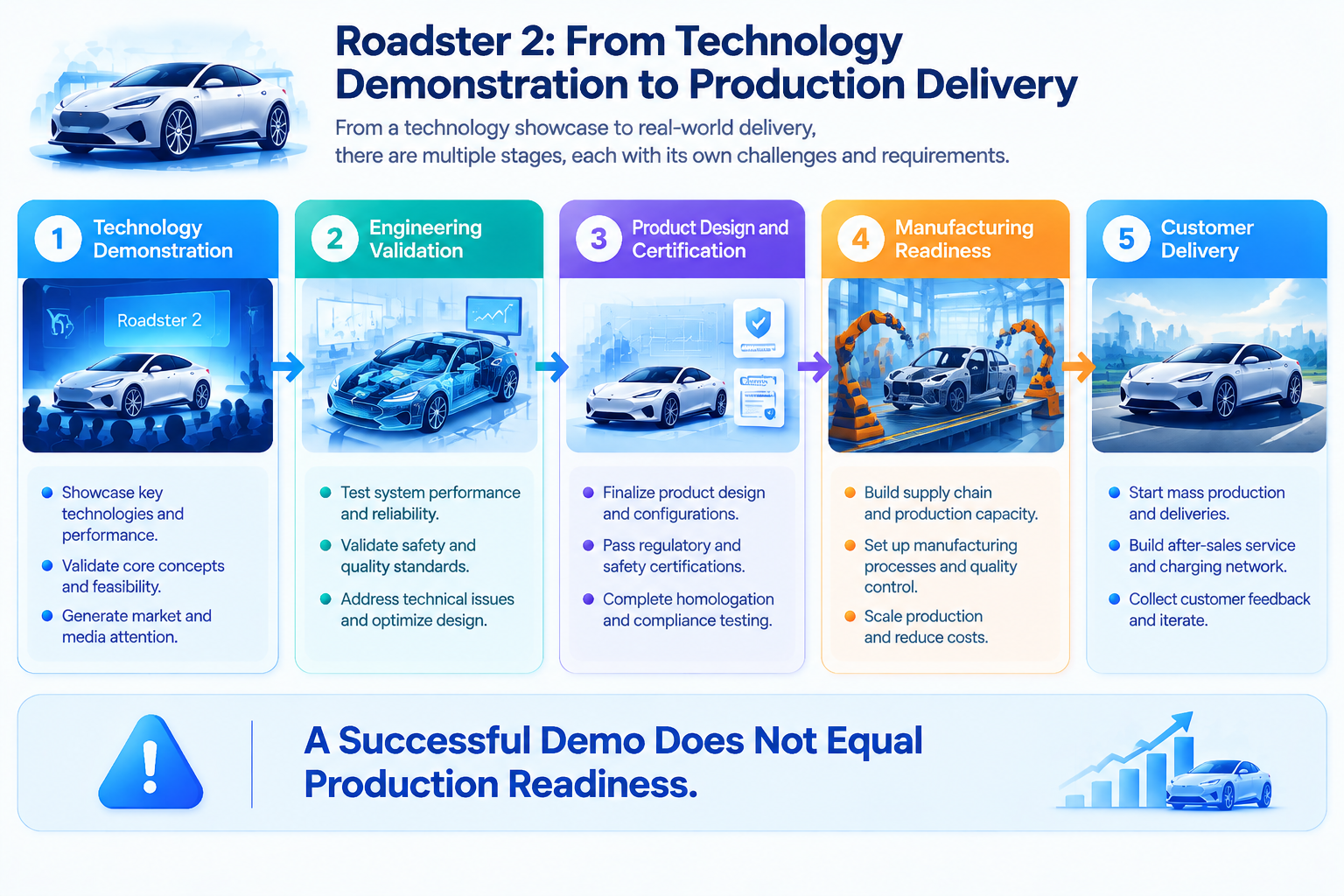
The challenge of production development lies in converting technical results achieved in a controlled environment into a stable, repeatable, and manufacturable product. The company needs to complete engineering finalization, durability testing, supply chain preparation, production process validation, and required safety certifications. When a prototype vehicle implements a function, it demonstrates that a particular technical solution may be feasible. Enabling consumers to use that function safely and over the long term requires much more comprehensive evidence.
Roadster 2’s current production target is 2028, but a planned timeline does not guarantee actual delivery. Given the project’s multiple previous delays, the developments that warrant greater attention going forward include the specifications of the production version, testing and certification progress, production preparations, and verified delivery information. For consumers, what configuration they can ultimately purchase, whether any functions will be restricted, and how pricing and maintenance costs will be structured are far more practically meaningful than the visual impact of a single demonstration.
The Brand Value and Commercialization Challenges of a Flagship Product
The significance of a flagship product is not necessarily reflected only in its own sales. It can showcase a company’s technological capabilities, attract the attention of the public, potential customers, and engineering talent, and potentially strengthen consumers’ perception of the entire brand. Roadster 2’s special demonstration made the connection between electric vehicles and aerospace engineering more tangible, creating a new topic of discussion for Tesla.
However, brand attention does not automatically translate into commercial returns. The potential customer base for a high-end sports car is relatively limited, and special engineering configurations may increase research and development, manufacturing, testing, and maintenance costs. Whether consumers ultimately choose to buy the vehicle will still depend on its actual performance, price, reliability, ease of use, and delivery timeline. If the product cannot be delivered for an extended period or the actual version differs significantly from public expectations, its initial popularity may not develop into sustained demand.
Another potential value of Roadster 2 lies in whether its technological achievements can be applied to other products. For example, control technologies, materials expertise, or manufacturing methods accumulated during development may benefit other vehicle models. However, such technology spillover must be supported by actual applications. The mere appearance of a technology in a flagship model does not mean it can be extended to mass-market models at a low cost. The project’s long-term value will ultimately depend on whether its investment and results form a reasonable relationship.
From Product Innovation to Multi-Asset Market Analysis: Gate’s Trading Perspective
The Roadster 2 demonstration sparked discussion not only in the automotive industry but also generated different reactions across financial markets. The Stock Market may focus on the impact of product innovation on Tesla’s brand, long-term competitiveness, and future revenue expectations, while the crypto market may express short-term sentiment more quickly through themed tokens, social media activity, and derivatives trading. Because the response mechanisms of different markets are not the same, price movements alone cannot determine whether the product is successful.
Through products such as Gate TradFi, Gate provides users with trading channels related to traditional financial assets. For market participants following Roadster 2, a multi-asset perspective can help them observe how the stock market and digital asset market respond differently to the same event. The specific tradable assets and product types are subject to the real-time information displayed on the Gate platform. The trading mechanisms, rights structures, and risks of different products must also be understood separately.
When researching events of this type, the key is to distinguish market expectations from business results. A rise in the stock price does not prove that the new vehicle has entered production or generated profits. Likewise, active trading in the crypto market does not mean that related tokens have any official relationship with Tesla.
From Real-World Trends to On-Chain Narratives: Roadster 2 and Meme Coins
The Roadster 2 demonstration also sparked Meme Coin Trading related to the vehicle and associated topics. When a real-world event enters the crypto market, it typically goes through a process of dissemination: The event attracts attention, social media amplifies the discussion, the community turns the topic into an internet meme or token narrative, and traders then buy and sell based on expectations, liquidity, and market sentiment.
However, Meme coins and Roadster 2 itself have different value foundations. The vehicle’s commercial value needs to be assessed through technical validation, production progress, customer demand, and actual business results. The price of event-driven Meme coins, by contrast, may be influenced primarily by attention, community participation, holder concentration, and liquidity. A token’s use of Tesla- or Roadster-related names and images does not mean that it has received official authorization, nor does it mean that holders own Tesla equity or share in automobile sales revenue.
These assets may also face issues such as concentrated holdings, insufficient liquidity, smart contract risks, and rapidly outdated narratives. Increased trading volume does not mean that large positions can be exited smoothly, and market capitalization on paper does not equal realizable value. Therefore, Roadster 2-related Meme coins are better viewed as case studies for examining the attention economy and crypto market pricing mechanisms, rather than as indicators of the vehicle’s technical or commercial value.
How to Assess Whether Roadster 2 Creates Long-Term Value
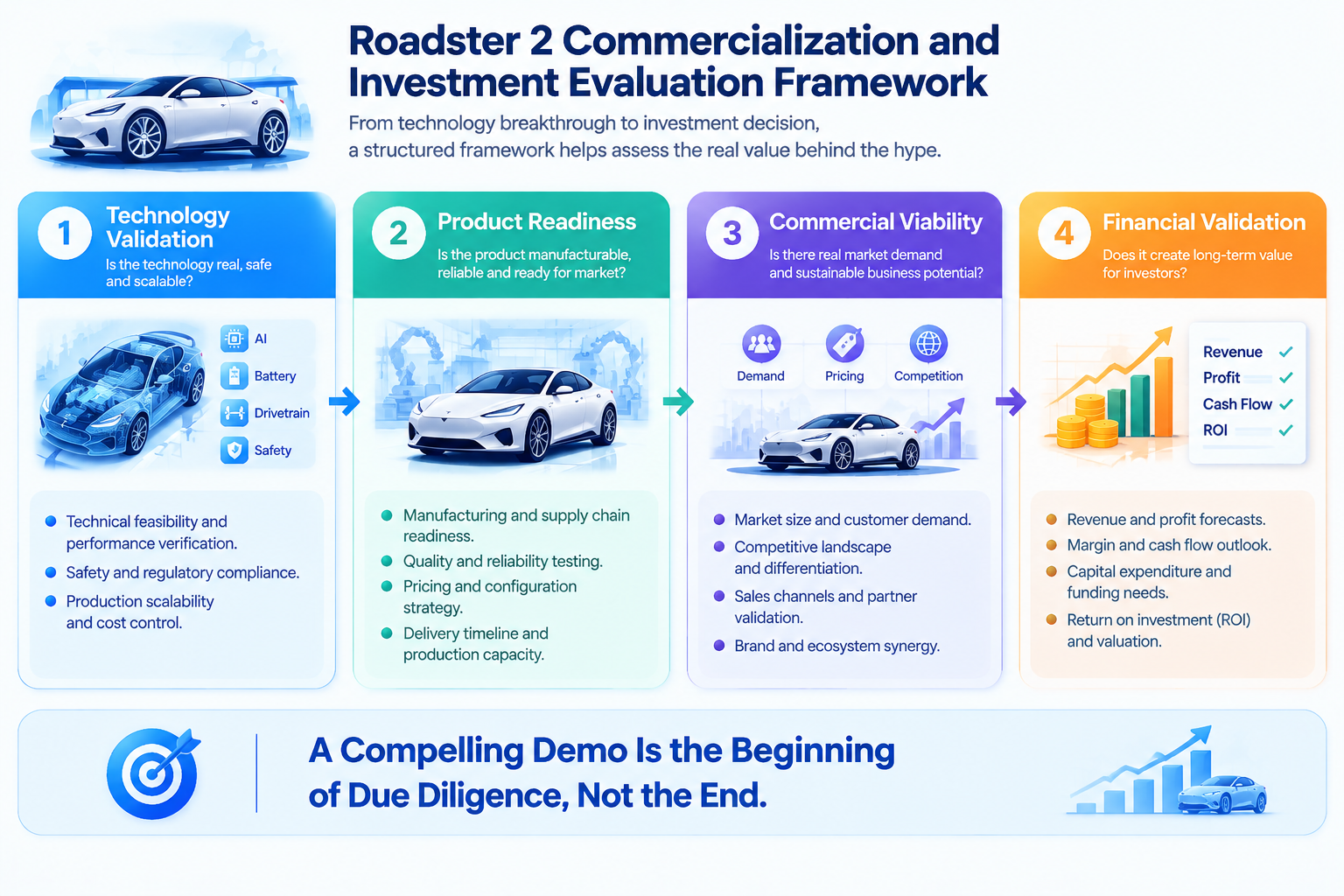
Roadster 2 can be evaluated across four dimensions. The first is technical validation: Can its key functions be implemented repeatedly, and is there sufficient evidence of safety and reliability? The second is product maturity: Are the production specifications, regulatory compliance, production preparations, and delivery timeline becoming progressively clearer? The third is commercial feasibility: Are target customers willing to buy the vehicle, and can its pricing cover manufacturing and service costs? The fourth is financial validation: Do actual revenue, profit margins, cash flow, and capital efficiency reflect the project’s economic results?
These dimensions cannot replace one another. A technological breakthrough can increase a product’s appeal without necessarily creating a profitable market. The existence of customer demand does not mean that the company can deliver the product at a reasonable cost. Even sales growth accompanied by substantial investment and low profit margins may fail to generate the expected returns. Even if Roadster 2’s direct sales are limited, the project may still have strategic significance if its technological achievements can be reused in other products or generate verifiable long-term benefits for the brand.
For industry observers, the most prudent approach is to distinguish between facts that have already occurred, targets announced by the company, and assessments that still require verification. A demonstration proves performance under specific conditions, a production target represents a plan, and market popularity reflects attention levels. Only by combining subsequent engineering information, actual deliveries, and business results can the long-term value of Roadster 2 be assessed more accurately.
FAQ
What is Roadster 2?
Roadster 2 is a common name for Tesla’s second-generation Roadster. It refers to the high-performance electric sports car project announced in 2017 and represented by the new version showcased in 2026. Roadster is the name of the vehicle line and is also used when discussing the model’s history and overall positioning.
Does the Roadster 2 demonstration mean that it is already ready for production?
No. Production still requires engineering validation, reliability testing, regulatory compliance, supply chain preparation, and production process development. The special functions demonstrated may also not appear in the same form in the final delivered version.
Does the value of Roadster 2 depend only on sales?
No. It may also have value as a brand showcase and technology development project, but these indirect benefits need to be verified through brand impact, technology reuse, or actual business results.
Why did Roadster 2 drive Meme Coin Trading?
The event’s visual impact and social media reach may attract token creators and traders. However, the prices of related tokens are influenced by sentiment, liquidity, and holder concentration, and have no necessary connection to the vehicle’s commercial value.
How should the commercial success of Roadster 2 be assessed?
Technical validation, production preparations, actual deliveries, customer demand, costs and profits, and the adoption of its technological achievements in other products should all be considered. A single demonstration and short-term market reaction are not sufficient to prove long-term commercial success.