Introduction
Blockchain security is built on the combined effects of multiple cryptographic and protocol mechanisms. Users authorize transactions through wallets, the network executes transactions according to predefined rules, cryptographic proofs help verify computational results, and consensus and data availability mechanisms determine how the network state is accepted, propagated, and recovered. Because these mechanisms serve different purposes, understanding the security properties of a given technology requires identifying which layer it protects and which problems it does not address.
Quantum computing adds a long-term technical variable to this issue. Some public-key cryptographic systems in widespread use today may face attack risks that differ from those in classical computing environments once sufficiently powerful fault-tolerant quantum computers become available. However, the actual timeline for quantum threats remains uncertain, and theoretical attack capabilities should not be equated directly with the ability to break systems immediately in practice. For blockchains, the more actionable questions are which cryptographic components may be affected, whether the protocol can replace those components, whether users can migrate safely, and whether the ecosystem has enough time to complete the upgrade.
Starknet’s technical approach provides a useful case study because it uses a STARK proof system while also employing an account model based on smart contract accounts. Analysis must distinguish between the properties of the proof system and those of account signatures, then further examine protocol upgrades, wallet support, and cross-chain dependencies. This article establishes a foundational framework around these areas to help readers understand the technical significance and practical limitations of a quantum-resistant roadmap.
Key Takeaways
- Digital signatures prove transaction authorization, hash functions generate data digests, and STARK proofs support the verification of computational correctness.
- Certain properties of a proof system may offer advantages in quantum-resistant research, but this does not mean that all account signatures and protocol components across the network have the same properties.
- Starknet’s smart account model provides design flexibility for replacing signature verification logic, but actual security depends on the specific implementation and migration process.
- A quantum-resistant upgrade requires more than cryptographic algorithms. It also involves wallets, account contracts, cross-chain mechanisms, protocol permissions, and user experience.
- Experimental technology demonstrations can verify the feasibility of a given approach, but they cannot replace production audits, broad deployment, or long-term security assessments.
- When evaluating related claims, distinguish between theoretical security properties, experimental results, test deployments, and functionality that has been validated in production.
Three Types of Cryptographic Mechanisms in Blockchain
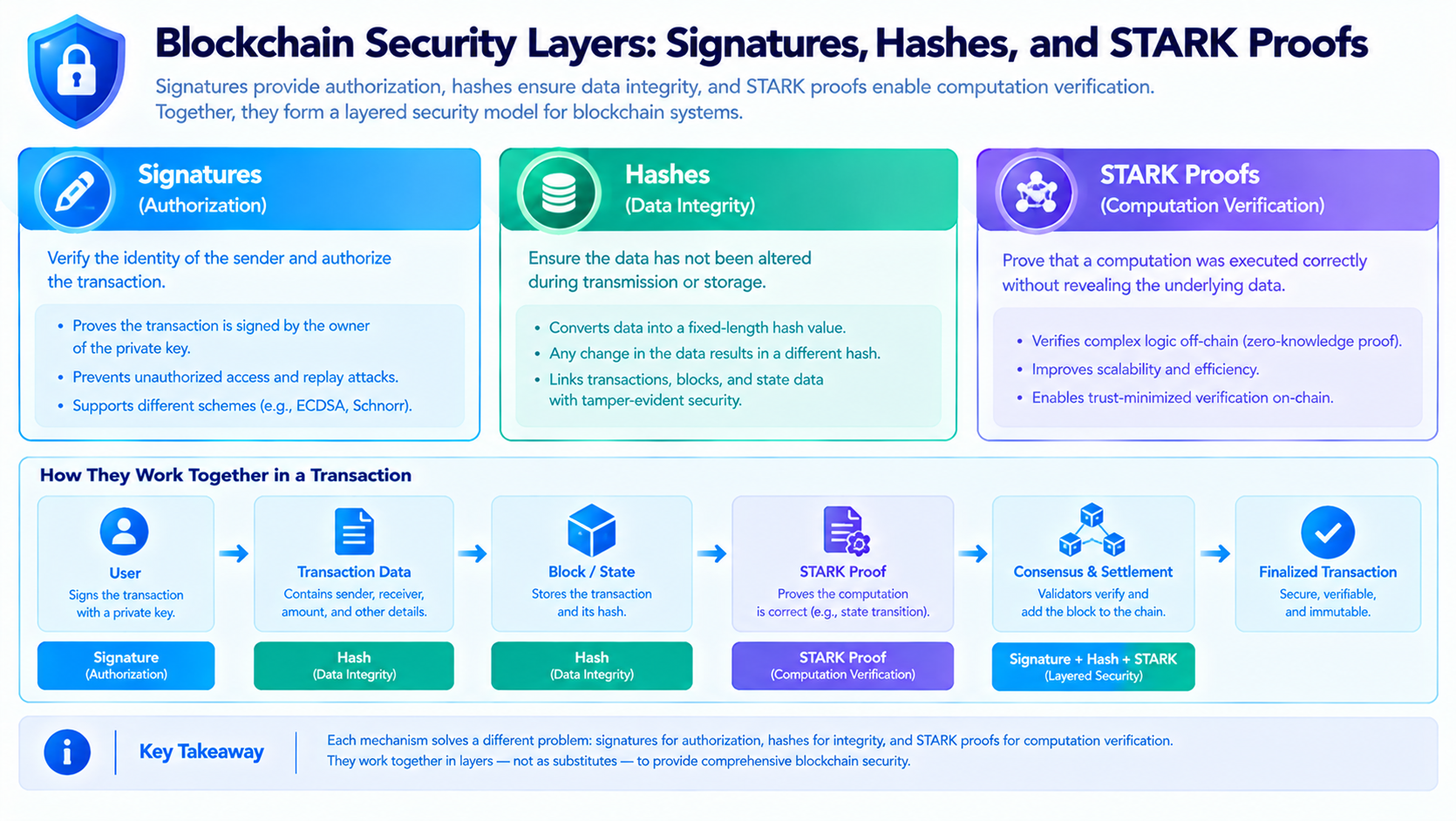
Digital signatures address authorization. When a user initiates a transfer or calls a smart contract, the system needs to determine whether the operation was authorized by the account controller. Wallets typically use private keys to generate signatures, while verifiers check whether the signatures are valid based on the corresponding public keys or account rules. A signature does not prove that a transaction is economically sound or guarantee that a contract is free of vulnerabilities. It primarily answers whether the operation meets the authorization conditions recognized by the system.
Hash functions serve a different purpose. They map input data to fixed-length digests and are commonly used for data integrity checks, commitment structures, Merkle trees, and other cryptographic constructions. A hash function is not the same as an encryption algorithm and does not directly provide account authorization. Hash function security is generally analyzed in terms of collision resistance, preimage resistance, and the security assumptions of related constructions. Even when a hash function has strong security properties, the actual system may still fail because of implementation errors, flawed protocol design, or key management issues.
STARK proofs are used to prove that a computation follows specified rules without requiring the verifier to reexecute the entire computation. Conceptually, the prover provides a proof of the computation process, and the verifier checks whether the proof satisfies the protocol requirements. STARK security designs typically use constructions such as hash functions and feature properties such as transparent setup, giving them an important role in quantum-resistant cryptography research. However, STARK proofs do not automatically replace account signatures. Nor can they independently determine transaction ordering, ensure that all data is available, or eliminate smart contract vulnerabilities. To understand a network’s overall security, it is necessary to examine its signatures, proofs, consensus, and data processing components together.
These three types of mechanisms work together but cannot replace one another. A user’s signature can authorize a transaction, the execution environment runs the transaction according to the protocol, a proof system can support verification of the computational result, and the underlying chain or network consensus mechanism determines how the state is confirmed. Focusing on only one component may overlook the actual point of risk. For example, a sound computational proof does not mean that a malicious account signature cannot be accepted, and a secure signature algorithm does not mean that a cross-chain bridge cannot release incorrect assets because of an error in its verification logic.
Which Security Assumptions Could Quantum Computing Challenge?
Traditional blockchain accounts commonly use public-key cryptographic technologies such as elliptic-curve digital signatures. In classical computing environments, these schemes rely on certain mathematical problems being difficult to solve with available computing resources. If sufficiently powerful fault-tolerant quantum computers can run the relevant algorithms, they could theoretically change the computational difficulty of some problems and affect certain existing public-key cryptographic schemes. The level of risk depends on factors such as the algorithm type, key structure, implementation, and computing power available to an attacker. Therefore, cryptographic systems should not be treated as a single category.
The impact of quantum computing on hash functions requires a different type of analysis. Quantum algorithms may change the complexity of search problems, but this does not mean that all hash functions will face the same type of structural attack as certain public-key cryptographic systems. For systems such as STARKs, research generally focuses on the choice of hash function, parameter settings, proof system construction, and security margins. The claim that a system has “quantum-resistant design advantages” should be understood as a security assessment based on specific assumptions and constructions, not as an absolute guarantee against all future attack methods.
From an engineering perspective, cryptographic migration requires a more comprehensive plan than simply replacing an algorithm. The protocol must determine how new and old signatures will coexist, whether existing accounts can be updated, how users can prove control of their original accounts, and how to prevent attackers from exploiting compatibility logic during the migration. It is also necessary to consider wallet recovery processes, hardware signing devices, smart account verification code, cross-chain messages, and technical support from trading platforms. If any critical component retains its legacy dependencies for an extended period, the overall upgrade may fail to achieve its intended security objectives.
For this reason, quantum risk research is better approached through a layered threat model. First, identify which cryptographic components the system uses, then determine the security responsibilities and potential attack surfaces of each component. Next, analyze whether replacement solutions are mature and deployable, as well as the compatibility issues that may arise during migration. Finally, check whether the project has provided a clear plan for testing, auditing, and upgrades. This framework reflects the complexity of real systems more accurately than simply classifying a network as “quantum-secure” or “quantum-insecure.”
Starknet’s Account Model and Signature Upgrades
In traditional account designs, account addresses and signature verification rules may be closely tied to a specific cryptographic scheme. If the signature algorithm needs to be replaced in the future, the account format, wallet implementation, and protocol compatibility may all need to be adjusted together. Smart accounts allow developers to define transaction verification logic through account contracts, creating room for more flexible authorization mechanisms. In theory, an account can support different signers, verification methods, or rules for gradual migration. Whether this is possible, however, depends on the specific contract design—not on the name “smart account” itself.
The account model of Starknet is worth studying because account verification logic can be executed by a contract. If an account implementation allows verification methods to be updated or combined, it may be possible to explore the integration of new cryptographic components without relying entirely on a single fixed signature scheme. However, whether an account can be updated, who controls the update permissions, whether the upgrade requires an active user action, and whether the new verification logic has undergone sufficient audits are all questions that must be confirmed separately. Different accounts may use different implementations, so it should not be assumed that all accounts support the same migration path.
From a user experience perspective, a quantum-resistant upgrade should minimize operational risks during migration. Users may not understand the differences between public keys, signature formats, and account contracts. Wallets therefore need to clearly explain the upgrade content, authorization scope, potential fees, and recovery process if the upgrade fails. If the migration requires users to submit a special transaction, the system should also prevent phishing websites from exploiting the process to induce users to sign malicious messages. A secure upgrade is not solely the responsibility of the cryptography team. It is also part of wallet product design, risk disclosure, and user education.
When evaluating Starknet’s actual progress, research papers, developer tools, experimental accounts, testnet deployments, and mainnet deployments should be recorded separately. The ability of a signature scheme to complete transactions in an experimental environment is valuable engineering evidence, but it is still necessary to confirm whether the scheme has undergone an independent audit, is suitable for general users, supports mainstream wallets, and performs reliably in a real network environment. Only by clearly distinguishing these stages can the scope of a technology demonstration be accurately understood.
Coordination Between STARK Proofs and Account Signatures
In a blockchain system, account signatures and STARK proofs may appear in the same transaction processing flow, but they address different problems. Signatures express account authorization, while proof systems support the verification of whether a computation or state transition complies with the rules. A system may use STARK proofs to verify extensive computations while using another cryptographic scheme to verify account signatures. Therefore, the mere use of STARK proofs does not mean that the transaction authorization process has also fully transitioned to a quantum-resistant solution.
If a system aims to improve its overall quantum resistance, it must map out its security dependencies from an end-to-end perspective. In addition to account signatures, it must consider protocol upgrade permissions, validators or sequencing mechanisms, signatures and message verification used by cross-chain bridges, oracles, custodial services, and related infrastructure. Even if the core proof system uses a construction with advantages identified in quantum-resistant research, peripheral components may still use other cryptographic schemes. The goal of a security assessment is not to find a single “most secure” component, but to ensure that no obvious security weaknesses exist among the system’s critical components.
Implementation complexity is another important consideration. The theoretical security of a cryptographic scheme does not automatically guarantee that its code implementation is correct. Parameter selection, random number generation, serialization rules, edge cases, and upgrade permissions may all affect the final security outcome. New proof systems or signature schemes may also increase computational overhead, transaction fees, wallet compatibility costs, or development complexity. Protocol design must balance security, efficiency, deployability, and user experience, while controlling risks through audits, testing, and ongoing maintenance.
How to Determine Whether a Quantum-Resistant Roadmap Has Been Implemented
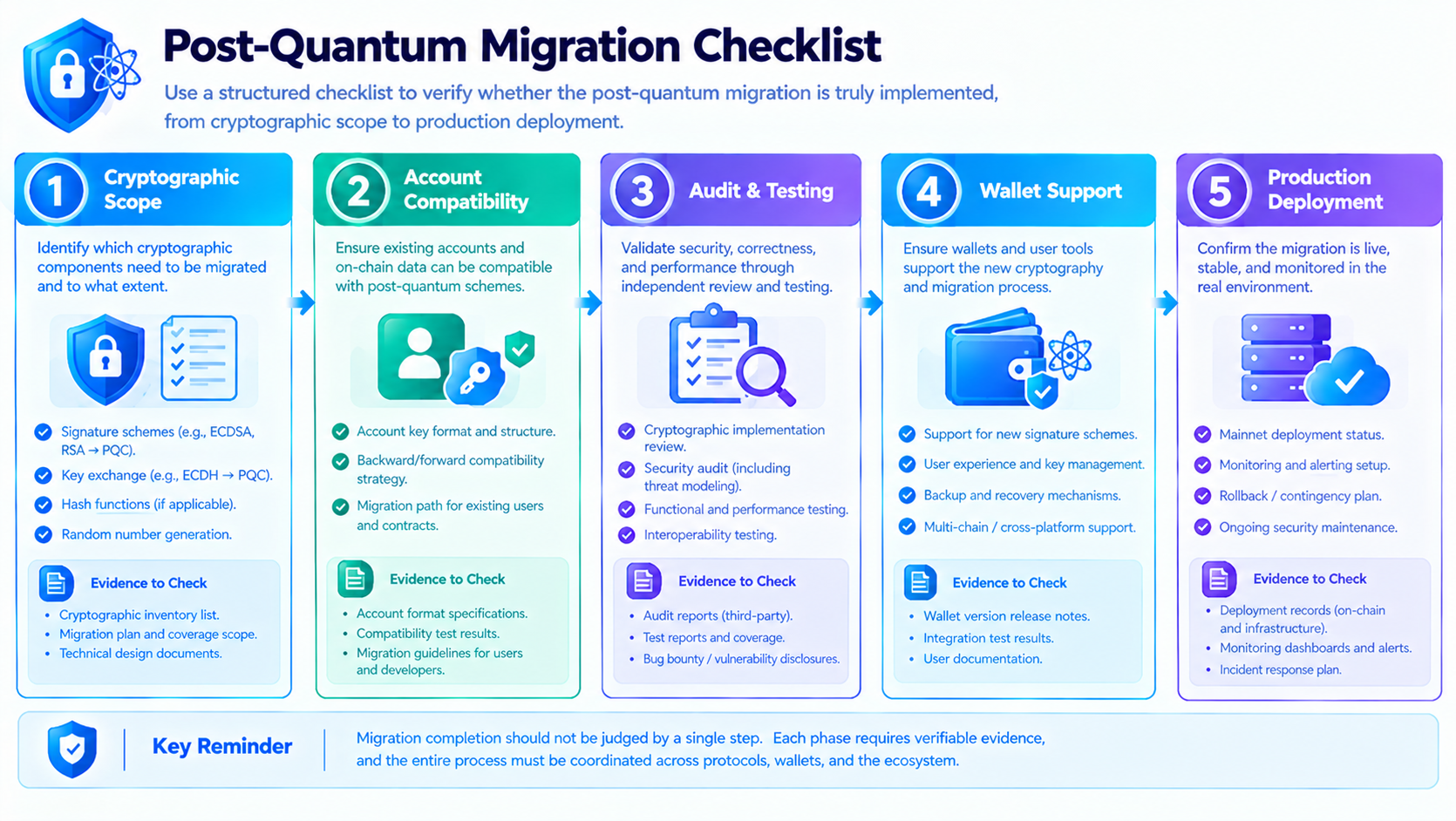
The first area to examine is technical scope. Does the project clearly explain which components have already been upgraded and which remain in the research or planning stage? If it mentions only the proof system without explaining account signatures, wallets, protocol permissions, and cross-chain dependencies, the information should not be treated as a complete system-level security statement. Technical documentation should clearly define the security objectives, threat model, dependency assumptions, and out-of-scope risks whenever possible.
The second area is deployment status. Research reports, proofs of concept, testnet deployments, and mainnet deployments represent different stages. Reviewable technical documentation, code changes, test results, and audit reports should be examined to confirm whether the functionality is actually running, which accounts or contracts support it, and whether known limitations exist. For experimental demonstrations, also check whether the applicable scope and production risks are clearly stated. This helps prevent research results from being mistaken for mature functionality available to all users.
The third area is the migration mechanism. Whether a quantum-resistant roadmap can be implemented ultimately depends on whether users and the broader ecosystem can adopt the new mechanism. Key considerations include whether account upgrades require active user action, how legacy accounts will be handled, whether wallets provide support, whether assets can be transferred safely, and whether a legacy signature path will remain compatible during the upgrade. If a technical solution cannot be deployed safely across a real user base, even a sound theoretical design will have difficulty providing complete system-level protection.
The fourth area is long-term maintenance. Cryptographic research continues to evolve, so protocols need to retain the ability to address vulnerabilities and update parameters. At the same time, upgrades that occur too frequently or are controlled by overly concentrated permissions may create governance risks. Projects should establish an appropriate balance among security response efficiency, transparency, audit procedures, and community participation. Quantum resistance is not a label that can be permanently established through a single release. It is a system property that requires continuous evaluation as cryptography advances.
FAQ
What Is the Difference Between STARK Proofs and Digital Signatures?
Digital signatures are primarily used to prove that an operation was authorized by the corresponding key or account rules. STARK proofs support the verification of whether a computation complies with specified rules. The two can work together in the same system, but they cannot replace each other.
Does Using STARK Proofs Mean That a Blockchain Is Fully Quantum-Resistant?
No. Overall security also depends on account signatures, protocol upgrade permissions, cross-chain verification, infrastructure, and specific implementations. Evaluation must cover the entire system rather than the proof system alone.
Can Starknet’s Smart Accounts Replace Their Signature Schemes?
The programmable verification logic of smart accounts provides design flexibility for supporting multiple signature methods, but the specific capabilities depend on the account contract implementation, upgrade permissions, wallet support, and migration process. It should not be assumed that all accounts can be upgraded automatically.
Can Quantum Computing Break Common Blockchain Wallets Today?
That conclusion cannot be drawn. The potential impact of quantum computing on existing cryptographic systems is an important subject for long-term research and engineering preparation, but theoretical threats, usable attack capabilities, and real-world deployment conditions must be distinguished.
How Can I Verify Whether a Project’s Quantum-Resistant Functionality Has Been Deployed?
Review the official technical documentation, code changes, audit reports, test results, and actual network status, while clearly distinguishing among research, experiments, testnet deployments, and mainnet deployments. A single news article or promotional description is not enough to prove that all security components have been upgraded.