Stablecoins are digital assets designed to maintain a relatively stable value through fiat currency reserves, crypto-asset collateral, or other mechanisms. They are widely used in crypto trading, on-chain payments, cross-border settlement, and decentralized finance. Because USD stablecoins account for the majority of the market, changes in their supply have also become an important indicator for observing liquidity in the digital asset market.
On November 1, 2026, the stablecoin market showed new signs of contraction. According to Sumcap data, the global stablecoin supply fell to approximately $298.5 billion, down about $3.1 billion from October 28, reaching its lowest level since August. Compared with the interim peak of approximately $315.5 billion in May 2026, the supply had declined by approximately $17 billion in total. At the same time, changes in the supply of USDT and USDC, along with the growing market share of other stablecoins, indicate that structural adjustments are taking place within the stablecoin market.
However, does a decline in stablecoin supply mean that investors are leaving the crypto market? Does the issuance of new stablecoins necessarily drive Bitcoin higher? What types of capital activity can changes in exchange stablecoin balances reveal? To understand these questions, it is necessary to first distinguish between stablecoin issuance, redemption, transfers, and exchange capital flows.
Key Takeaways
- In early November 2026, global stablecoin supply fell to approximately $298.5 billion, down about $3.1 billion from October 28, reflecting a recent contraction in the overall stablecoin market.
- Net stablecoin issuance is an important indicator for observing changes in market capital, but a decline in supply does not necessarily mean that an equivalent amount of capital has directly left the crypto market.
- The issuance and redemption of fiat-backed stablecoins such as USDT and USDC change the number of tokens in circulation. On-chain transfers and cross-chain bridge operations, however, do not necessarily change the global supply.
- To assess capital flows, investors need to consider net stablecoin issuance, exchange balances, on-chain capital distribution, trading volume, and market prices together rather than relying on a single indicator.
Why Did Stablecoin Supply Fall to $298.5 Billion?
Stablecoin supply generally refers to the total amount of stablecoins that have been issued and are counted as circulating in the market. For tokens pegged to the US dollar with relatively stable prices, the dollar value of the supply is usually close to the number of tokens in circulation. As a result, the market often uses total stablecoin market capitalization to measure the size of the market.
In 2025, the stablecoin market expanded rapidly, with total supply increasing from approximately $203.2 billion to $303.7 billion, a gain of nearly 49%. After entering 2026, this growth trend changed. Total stablecoin supply reached an interim high of approximately $315.5 billion in May, then gradually declined to approximately $298.5 billion in early November.
This change is worth monitoring, but it cannot simply be interpreted as a synchronized contraction across all stablecoins. According to relevant statistics, since the beginning of 2026, USDT supply has decreased by approximately $5.3 billion and USDC supply has decreased by approximately $4 billion, while the combined supply of other stablecoins has increased by approximately $7.2 billion. This suggests that some demand may have shifted from traditional leading stablecoins to other issuers or different types of stablecoin products.
In addition, stablecoin supply may be affected by institutional capital allocation, user redemption demand, changes in trading activity, conversions between stablecoins, and differences in statistical methodologies. Different data platforms may have different coverage of circulating supply, cross-chain assets, and special types of stablecoins. As a result, their totals for the same point in time may differ.
What Is Net Stablecoin Issuance, and Why Can It Reflect Changes in Capital?
Net stablecoin issuance is the difference between the amount newly issued and the amount redeemed and destroyed over a given period. For major fiat-backed stablecoins such as USDT and USDC, eligible institutional customers can typically exchange fiat currency for stablecoins through the issuer's relevant channels, or return stablecoins to the issuer to request redemption.
When issuance exceeds redemptions, the circulating supply increases, resulting in net issuance. When redemptions exceed issuance, the circulating supply decreases, resulting in net redemption.
For example, suppose a stablecoin has $1 billion in new issuance and $700 million in redemptions in a single day. Its net issuance would be $300 million. If new issuance were only $400 million while redemptions reached $900 million, net issuance would be negative $500 million, indicating net redemption during that period.
Net issuance can reflect the direction in which stablecoin supply is expanding or contracting. For fiat-backed stablecoins, sustained net issuance may indicate increasing market demand for the stablecoin, while sustained net redemption may suggest that some holders want to convert their stablecoins into fiat currency or other assets.
However, on-chain stablecoin minting does not necessarily mean that the tokens have entered the final circulating market. Some issuers may create inventory tokens in advance and release them into circulation based on customer demand. Therefore, when monitoring net issuance, it is best to use the circulating supply confirmed by the issuer and actual redemption data rather than simply adding up all minting events.
What Is the Difference Between Stablecoin Redemption and Ordinary On-Chain Transfers?
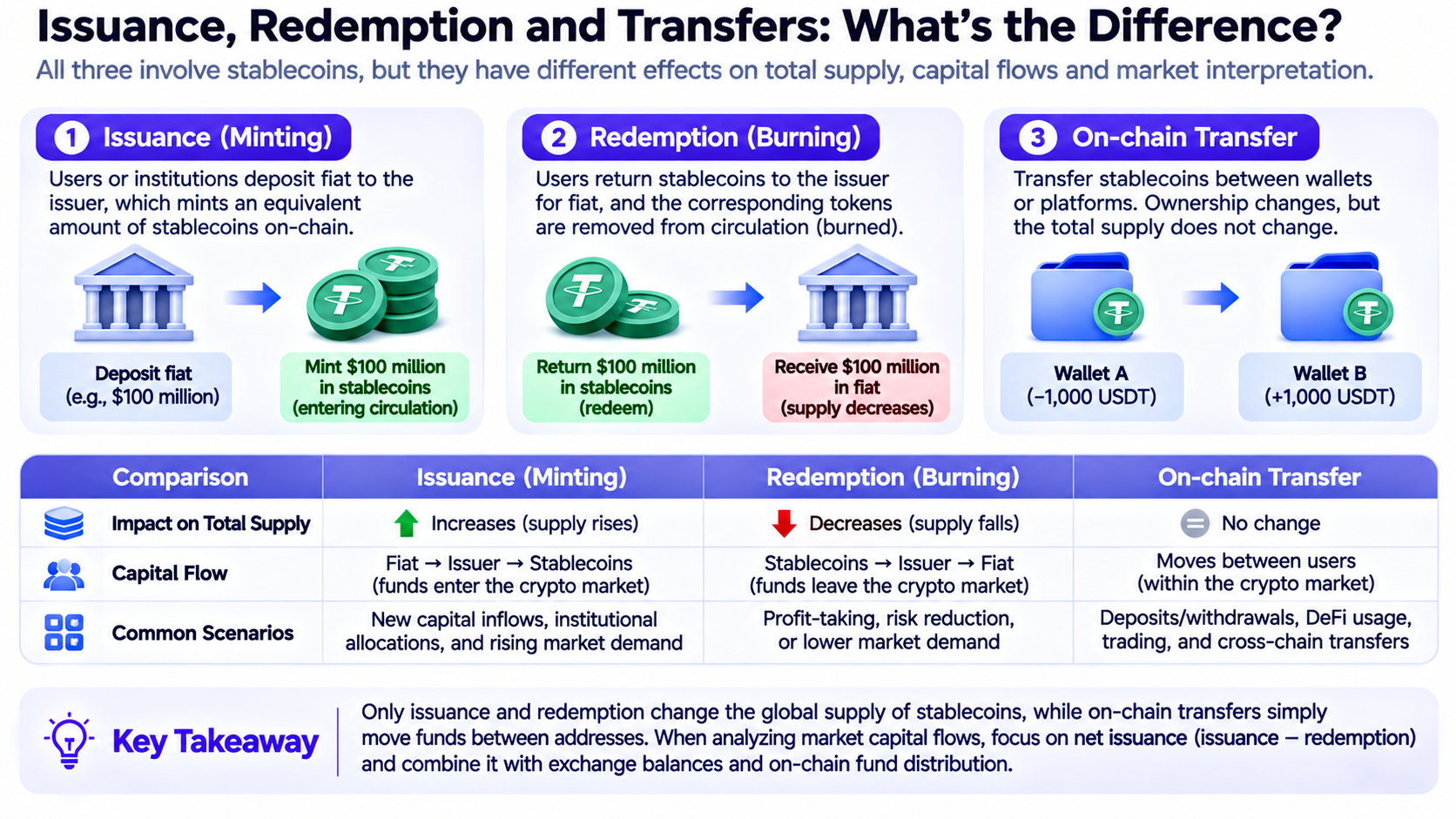
Stablecoin redemption and on-chain transfers are two different concepts. An on-chain transfer generally only moves stablecoins between different addresses. For example, when a user transfers 10,000 USDT from a personal wallet to an exchange, or transfers tokens from one address to another on the Ethereum network, the token holder changes, but the total stablecoin supply generally does not decrease as a result.
Redemption involves stablecoins exiting the circulating supply. For customers that meet an issuer's redemption requirements, the process typically includes submitting stablecoins to the issuer, completing the relevant review, and receiving the corresponding fiat currency. Redeemed stablecoins may be destroyed or removed from circulating supply through other inventory management methods.
The difference can be understood through the following examples:
| Operation |
Change in Capital or Tokens |
Global Supply |
| Issue $100 million in USDC and place it into circulation |
New stablecoins added |
Increases |
| Redeem and destroy $100 million in USDC |
Stablecoins exit circulation |
Decreases |
| User deposits USDC to an exchange |
Transfer between addresses |
Usually unchanged |
| User transfers USDT from Ethereum to Tron |
Redistribution between networks |
Usually unchanged |
| User uses USDT to buy BTC |
Change in stablecoin ownership |
Usually unchanged |
Cross-chain transfers require particular attention to their underlying implementation. Some cross-chain mechanisms lock assets on the original chain and issue corresponding assets on the destination chain, while others use native burning and minting. When analyzing total supply, avoid counting locked assets and their mapped assets twice.
Therefore, when monitoring changes in stablecoin capital, it is essential to distinguish actual increases or decreases in supply from the internal movement of existing funds.
Does a Decline in Stablecoin Supply Mean That Capital Is Leaving the Crypto Market?
A decline in stablecoin supply generally means that the amount of stablecoins in circulation has decreased, but it cannot be directly interpreted as an equivalent amount of capital having left the crypto market as a whole.
- Investors may exchange stablecoins for fiat currency and complete redemptions through the issuer. In this case, the decline in stablecoin supply has a relatively direct connection with fiat currency exiting the stablecoin system.
- Capital may shift from one stablecoin to another. For example, an institution may reduce its USDC holdings while increasing its allocation to other stablecoins. During this process, USDC supply may decline, but if other stablecoins expand at the same time, the overall supply of USD stablecoins may not change significantly.
- Investors may use stablecoins to buy BTC, ETH, or other digital assets. Although such transactions change the investor's asset composition, the stablecoins are generally transferred to the seller rather than disappearing as a result of the trade.
- Some capital may shift to tokenized government bonds, money market funds, or other on-chain yield products. If these products are not counted as stablecoins, changes in capital allocation may reduce stablecoin supply without meaning that the capital has completely exited the on-chain financial system.
- The dollar valuation of supply may also be affected by depegging, data coverage, and changes in asset classification.
Therefore, a contraction in stablecoin supply more accurately reflects a change in the outstanding stablecoin balance rather than the full amount of net capital outflows from the crypto market.
How Can USDT and USDC Net Issuance Be Used to Assess Market Liquidity?
USDT and USDC are major components of the USD stablecoin market. Monitoring changes in their supply can help clarify the demand for stablecoins among different market participants.
As of November 1, 2026, relevant data platforms recorded approximately $179.7 billion in circulating USDT supply and approximately $71.9 billion in USDC supply. Together, they still accounted for the majority of the USD stablecoin market.
However, the user structures, issuance channels, on-chain distributions, and use cases of the two stablecoins are not identical. As a result, the same level of net issuance may not correspond to the same type of market demand.
For example, growth in USDT supply may be related to exchange capital allocation, cross-border transfers, and other use cases. Growth in USDC supply may come from institutional settlement, DeFi applications, or payment demand. None of these uses can be confirmed based on issuance data alone. The actual destination of the funds must also be examined.
Three dimensions can be monitored in particular:
- Time dimension: Distinguish between one-day, 7-day, and 30-day changes to avoid mistaking a short-term large redemption for a long-term trend.
- Asset dimension: Compare changes in the supply of USDT, USDC, and other stablecoins to determine whether capital is shifting between products.
- Network dimension: Monitor changes in stablecoin balances on networks such as Ethereum, Tron, Solana, and Base to determine whether capital allocation across different ecosystems is changing.
For example, if total USDC supply declines while the USDC balance on a particular network increases, this may indicate that the network has received a greater USDC allocation. There is no contradiction because changes in global supply and changes in distribution across networks are two different dimensions.
What Can Exchange Stablecoin Balances Tell Us?
Exchange stablecoin balances refer to the amount of stablecoins held by exchange-related addresses identified by data platforms. This indicator is often used to analyze the amount of stablecoins available on exchanges, but it is fundamentally different from net stablecoin issuance. Net stablecoin issuance measures changes in the total supply of tokens in the market, while exchange balances measure the amount of tokens held by a particular category of addresses. Even if global stablecoin supply remains unchanged, user deposits to or withdrawals from exchanges may cause exchange balances to fluctuate significantly.
For example, if an exchange's stablecoin balance increases from $5 billion to $6 billion, this may indicate increased user deposits, or it may be related to internal fund transfers, institutional custody arrangements, or address consolidation. Similarly, a decline in exchange balances cannot directly prove that investors are buying crypto assets. Users may simply be withdrawing stablecoins to self-custodial wallets, DeFi protocols, or other trading platforms.
To avoid misinterpretation, changes in exchange balances can be analyzed together with spot trading volume, order book depth, net stablecoin issuance, and the prices of major assets.
| Combination of Observations |
What It May Indicate |
Considerations |
| Stablecoin supply increases, and exchange balances increase |
Newly issued stablecoins are entering trading venues |
Does not necessarily mean that buy-side demand has formed |
| Supply remains unchanged, and exchange balances increase |
Existing stablecoins are moving to exchanges |
May simply reflect fund transfers |
| Supply decreases, and exchange balances decrease |
Stablecoin contraction and lower exchange balances are occurring at the same time |
The two changes may not have a direct causal relationship |
| Supply increases, and exchange balances decrease |
Stablecoins may be distributed more widely across non-exchange addresses |
DeFi, payment, and custody use cases require further review |
It is also important to note that third-party platforms may not identify all exchange addresses. Changes in balances cannot be equated with verified net capital inflows or outflows.
Why Can On-Chain Transaction Volume Continue to Grow Even When Stablecoin Supply Declines?
Stablecoin supply and stablecoin transaction volume measure different phenomena. Supply reflects how many stablecoins exist in the market at a given point in time, while transaction volume reflects the amount of capital transferred over a given period. The same units of stablecoins can circulate repeatedly among users, exchanges, payment service providers, and on-chain applications.
For example, suppose the market contains $10 billion in stablecoins. If these stablecoins are transferred multiple times on average over the course of a month, cumulative transaction volume could significantly exceed $10 billion.
A study published by CoinDesk Research on October 30, 2026, showed that during the first nine months of 2026, overall stablecoin supply changed relatively little, while adjusted monthly transfer volume increased from approximately $230 billion in January to approximately $325 billion in September, a gain of approximately 41.4%.
This shows that stablecoin usage activity and supply growth can diverge. Even if new issuance slows, existing stablecoins may support more settlement and capital transfer activity. However, on-chain transfer volume cannot be directly equated with real commercial payment volume. Exchange fund transfers, cross-chain operations, DeFi liquidations, and automated trading can all generate large numbers of transfers. Therefore, determining whether stablecoins are actually seeing greater payment demand requires categorized and adjusted data.
How Can You Build a Framework for Analyzing Stablecoin Capital Flows?
For ordinary investors, analyzing stablecoin capital flows does not require complex models. The process can be conducted gradually, moving from overall supply to specific trading activity.
- Observe changes in global stablecoin supply. Use 7-day, 30-day, and quarterly data to determine whether the overall market is expanding, contracting, or moving sideways.
- Break down the major stablecoins. Monitor changes in assets such as USDT, USDC, USDe, and USDS to determine whether an overall contraction is concentrated in a few stablecoins or whether market share is being redistributed.
- Distinguish actual issuance and redemptions from cross-chain migrations. Combine issuer disclosures, on-chain minting and burning records, and changes in balances across networks to avoid mistaking the movement of existing funds for new capital.
- Analyze the distribution of capital across exchanges and DeFi. Focus on exchange stablecoin balances, decentralized exchange liquidity pools, deposits in lending protocols, and on-chain payment activity.
- Cross-check the data against market prices and trading activity. If stablecoin supply continues to decline while trading volume, market depth, and the prices of major assets all weaken, this may indicate tightening market liquidity conditions. However, if on-chain payment and capital turnover activity continue to grow as supply declines, other explanations, such as improved stablecoin utilization efficiency or changes in asset allocation, should also be considered.
Conclusion
Global stablecoin supply fell to approximately $298.5 billion, indicating that after a period of rapid expansion, the stablecoin market in 2026 entered a phase of slower supply growth and structural adjustment. The simultaneous contraction in the supply of major stablecoins such as USDT and USDC and growth in some other stablecoins also indicate that capital demand within the market is changing.
Net stablecoin issuance and redemptions are important starting points for observing changes in capital, but neither can fully explain capital flows. New issuance does not mean that the funds will immediately be used to buy BTC, and net redemption does not necessarily mean that investors are broadly leaving the crypto market. Exchange balances, cross-chain capital distribution, and on-chain transaction volume also need to be interpreted in context.
For investors, stablecoin data is better suited as a supplementary indicator for assessing market liquidity conditions rather than as a direct trading signal for predicting price movements. Only by analyzing changes in supply together with capital distribution, trading activity, and market prices can investors gain a more accurate understanding of changes in the stablecoin market.
FAQ
Does a Decline in Stablecoin Supply Mean That Bitcoin Will Definitely Fall?
Not necessarily. A decline in stablecoin supply may reflect redemptions by some investors or changes in demand, but Bitcoin's price is also affected by factors such as ETF capital flows, derivatives markets, macroeconomic conditions, and investor expectations.
Does Positive Net Stablecoin Issuance Mean That New Capital Has Entered the Crypto Market?
For fiat-backed stablecoins, positive net issuance generally means that circulating supply has increased, but it does not directly prove that the new capital has been used to purchase crypto assets. Newly issued stablecoins may also be used for payments, settlement, reserves, or other financial activities.
Why Can USDT Supply Decline While Other Stablecoins Grow?
Different stablecoins have different issuers, use cases, regulatory arrangements, and user groups. Capital may shift from one stablecoin to another. Therefore, a decline in the supply of a single asset does not necessarily mean that the entire stablecoin market is contracting at the same time.
Does the Transfer of Stablecoins to an Exchange Mean That the Market Is About to Rise?
Not necessarily. Stablecoin deposits may be used to buy assets, but they may also be used for margin, arbitrage, fund transfers, or other trading activities. Trading volume, the order book, and price movements should also be considered.
Where Can I Check Stablecoin Supply and Capital Flows?
Platforms such as DeFiLlama can be used to view total stablecoin supply, the market share of different stablecoins, and their distribution across blockchains. This information can also be cross-checked against issuer disclosures on issuance and redemptions and on-chain explorer data.