The sections below define the metric, walk through mint and redeem mechanics, list mechanisms that often accompany contraction, separate five common misreads, contrast supply with exchange balances and spot Bitcoin ETF flows, and give a neutral reading checklist. The payment-versus-trading split sits in why payments can rise while supply stalls; stablecoin net issuance and how to read stablecoin liquidity fill in the mint/redeem and exchange-balance layers of the same stack.
Key Takeaways
-
Stablecoin supply contraction is a decline in circulating stablecoin balances, typically when redemptions exceed minting.
-
Net issuance equals minting minus redemptions over a window; negative net issuance shrinks circulating supply for fiat-backed designs.
-
Buying BTC or ETH with stablecoins usually transfers tokens between wallets; it does not by itself destroy circulating supply.
-
Switching from USDC to USDT can shrink one issuer’s float while the combined USD-stablecoin total barely moves.
-
Exchange balances, ETF flows, and stablecoin supply measure related but different capital pipes—read them together, not as one signal.
What Stablecoin Supply Contraction Means
Stablecoin circulating supply is the quantity of tokens counted as outstanding and available in the market. Because most stablecoins are pegged to the US dollar, journalists and dashboards often treat stablecoin market cap as the token’s value in dollar terms, roughly equal to circulating float when it trades near one dollar. Contraction is simply that float getting smaller between two dates.
Analytics providers such as Glassnode, CryptoQuant contributors, and Sumcap-style trackers publish totals with different coverage of chains, bridged wrappers, niche issuers, reserve assets, and how they classify related crypto assets. Two dashboards can disagree on the same day without either being “wrong” in a moral sense—they may include different sets of tokens. Treat the direction and the mint/redeem story as more durable than a single headline number.
Contraction is a stock change (how many tokens exist), not a price change. A period of risk-off trading can coincide with contraction, expansion, or a flat float, depending on whether holders redeem to banks, rotate issuers, or keep cash on-chain. Stablecoin transactions can support payments, trading, and cross border payments without changing supply on their own.
How Stablecoin Issuers, Minting, Redemption, and Net Issuance Move Supply
For major fiat-backed stablecoins, stablecoin issuers typically mint new tokens when authorized participants deliver fiat (or approved collateral processes) into the issuer’s pipeline, and redeem them when those participants return tokens for fiat. Successful redemptions remove tokens from circulation, and they depend on issuers handling redemption requests so holders can redeem stablecoins for fiat currency. Major issuers typically hold reserves in cash and short-term government debt. On-chain transfers between users, deposits to exchanges, and many bridge wrappers move ownership without changing global circulating supply the way a primary redemption does. There is also counterparty risk if custodians fail during bank runs.
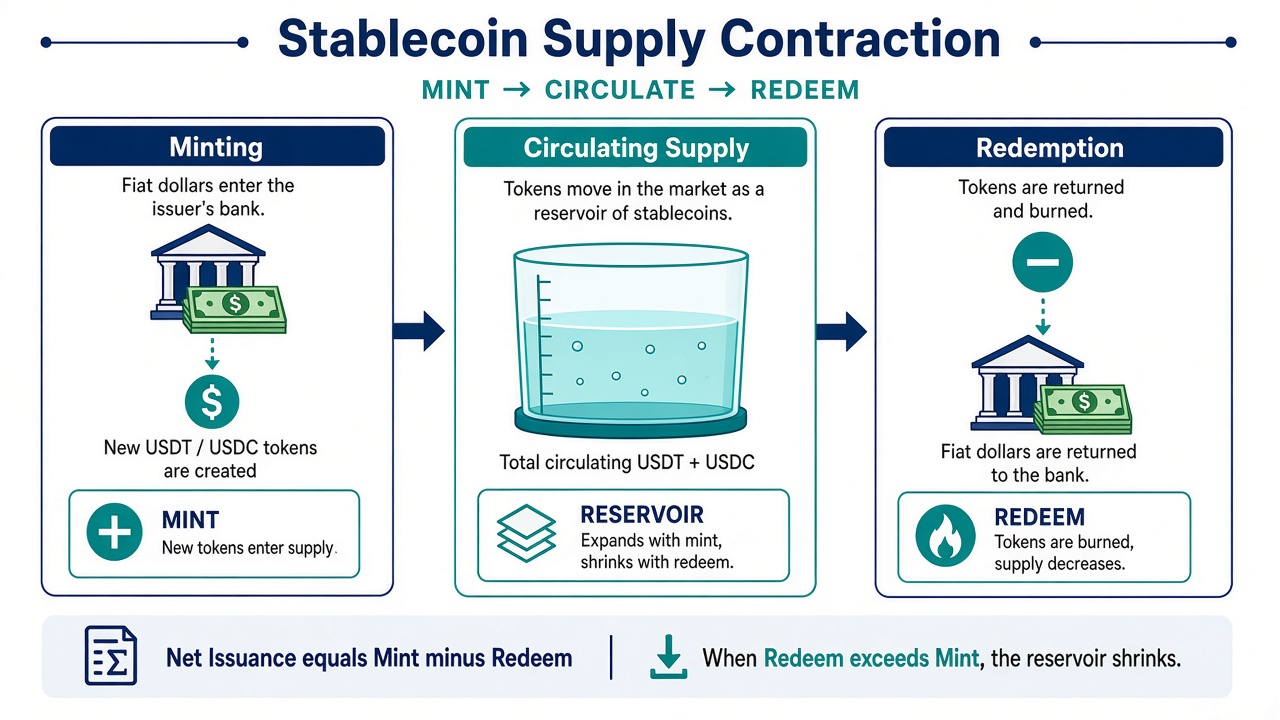
Figure 1. Minting expands float; redemption burns tokens. Net issuance = mint − redeem; supply contracts when redeem exceeds mint.
Cryptocurrency-backed stablecoins use other cryptocurrencies as collateral.
Commodity-backed stablecoins are backed by physical commodities like gold.
Net issuance over a period is minting minus redemptions. Positive net issuance expands circulating supply; negative net issuance contracts it, though large redemption waves can create risks if an issuer cannot meet them promptly. Circle and other issuers sometimes disclose very large gross mint and redeem volumes in the same quarter that nearly offset, leaving little net change even when stablecoin payments or settlement activity stayed high. That pattern shows why gross flow and net float are different questions.
Primary and secondary markets also matter: secondary trading on venues prices the peg, while primary mint/redeem adjusts float—the same split covered under stablecoin primary and secondary markets.
Mechanisms That Often Accompany Contraction
Weaker crypto trading demand reduces the need for fresh exchange-settlement balances. Stablecoins are widely used to move into and out of other cryptocurrencies, especially during periods of stress, because they offer a steadier parking place than volatile cryptocurrencies. By contrast, an algorithmic stablecoin relies more on supply and demand mechanisms than reserve-backed redemption, and this category represents less than 0.2% of total supply. TerraUSD is the clearest example: in May 2022 it lost its peg and wiped out $45 billion. When spot and derivatives volumes cool, authorized demand for new minting can fall even if existing tokens keep circulating among holders.
Risk-off redemptions convert on-chain cash back to bank cash, with potential knock-on effects for the banking system and the broader financial system when funds are pulled back toward deposits and reserves. Holders who want fiat outside crypto rails redeem through eligible channels; those burns shrink float. Significant redemptions may also reduce demand for short-term government debt. This path is closer to “capital leaving the stablecoin system” than a simple wallet-to-wallet transfer.
Opportunity cost and yield alternatives can matter when short-term Treasury yields are attractive relative to holding a non-interest-bearing payment token, especially since many issuers are restricted from paying interest directly while a growing number of external products let holders earn interest elsewhere, even though stablecoins remain useful for 24/7 settlement outside banking hours. Capital can also rotate into tokenized T-bills, money-market-style on-chain products, or other cash equivalents that some dashboards do not count inside “stablecoin supply,” so the stablecoin total can fall while crypto-adjacent cash still exists. They can also be cheaper than traditional remittance methods.
Issuer mix shifts are another mechanism: USDT and USDC may contract while smaller USD stablecoins expand, or the reverse, and the same stablecoin can appear in both standard and yield-bearing versions. Always check whether the headline is “all USD stables” or a single ticker.
Five Common Misreads
-
Supply down equals the same dollars leaving crypto entirely. Only primary redemptions clearly remove tokens from the stablecoin float, and some fiat-backed designs work a bit like money market funds. Rotation into other on-chain cash products can shrink the stablecoin category without a full exit from digital assets.
-
Buying BTC or ETH destroys supply. Spot buys typically transfer stablecoins to sellers. Circulating supply stays until someone redeems or an issuer burns under its rules.
-
One issuer’s decline equals market-wide contraction. USD Coin can shrink while the largest stablecoin, Tether, grows (or other names grow), so issuer-level changes do not automatically signal a market-wide contraction. Read the aggregate and the components.
-
Exchange outflow equals supply contraction. Tokens leaving an exchange wallet still exist on-chain. Exchange balance charts and circulating supply charts answer different questions.
-
Dashboard A’s total must match dashboard B. Coverage of chains, wrappers, and long-tail issuers differs, and differences in market capitalization coverage can also explain mismatches. Prefer consistent series from one methodology when studying trends.
Stablecoin Market Supply vs Exchange Balances vs Bitcoin ETF Flows
Stablecoin circulating supply tracks how many cash-like tokens exist. Exchange stablecoin balances track how much of that float sits on trading venues ready for immediate pair trading, reflecting demand from investors and institutional investors rather than total circulating supply. Spot Bitcoin ETF flows track creations and redemptions in brokerage-wrapped Bitcoin products, a largely separate capital pipe from on-exchange USDT/USDC float. Stablecoin cross-border flow reached $1.4 trillion in 2024.
These series can move together in risk-off months and diverge when payments, DeFi collateral, ETF channels, or market makers dominate active trading flows. In 2025, 26% of U.S. adults used stablecoins for remittances, highlighting real-world stablecoin activity beyond exchange-led trade. A complete reading stack usually combines net issuance, exchange reserves, trading volume, and—when relevant—ETF flow data, instead of treating any one line as a buy or sell instruction.
How to Read the Indicator (Checklist)
-
Pick one data methodology and stick to it for the window you care about.
-
Confirm whether the chart covers aggregate dollar stablecoins or a single issuer, and whether almost all of the tracked supply is still tied to the US dollar.
-
Check net issuance (mint minus redeem) alongside the level of supply, and review liquid assets and reserve assets disclosures when available; in the US, the genius act passed in July 2025 requires one-to-one reserve backing, and algorithmic stablecoins are not covered by that framework.
-
Compare exchange stablecoin balances to see if venue “dry powder” moved differently from global float.
-
Note concurrent ETF flows only as a second pipe—not a substitute for stablecoin mechanics.
-
Write down which misread you might be making (rotation, spot buy, coverage gap) before drawing a market conclusion, and weigh consumer protection and financial stability concerns if contraction follows stress in an issuer or its reserves. Key examples include the european union’s MiCAR becoming applicable on June 30, 2024, hong kong passing its Stablecoins Bill in December 2024, and Australia requiring issuers to comply with ASIC regulations.
This checklist is educational. It does not recommend trading, timing, or position size.
Summary
Stablecoin supply contraction means circulating fiat-referenced stablecoin balances fell, most cleanly explained by redemptions exceeding minting, and the term is often used for tokens designed to hold a stable value. The metric is a float and liquidity-context signal, not a price forecast and not a one-to-one map of every dollar leaving crypto, and it matters not just for trading but also for payments, cross border activities, and broader monetary policy debates. Separating mint/redeem mechanics from transfers, issuer rotation, exchange balances, and ETF flows keeps the reading honest. When payments rise while float stalls, the same payments-versus-supply split applies.
FAQ
What does stablecoin supply contraction mean?
It means the measured circulating supply of dollar stablecoins declined over a period, usually when redemption requests exceed new minting (negative net issuance).
Does falling stablecoin supply mean crypto is crashing?
Not by itself. Contraction describes outstanding cash-like tokens on crypto rails. Prices of other cryptocurrencies can fall sharply while stablecoin supply moves independently, and prices can also rise, fall, or chop while supply contracts, expands, or stays flat.
How do minting and redemption change supply?
Authorized minting adds circulating tokens; authorized users redeem stablecoins through the issuer, and those primary-market flows are what remove tokens via redemption and burn, unlike ordinary wallet transfers. Transfers between wallets usually do not change global circulating supply.
Is fiat backed stablecoin supply the same as exchange stablecoin balances?
No. Circulating supply is the global float; exchange balances are the subset parked on venues, and they can rise or fall with trading transactions even when global circulating supply is unchanged. Tokens can leave exchanges and still remain in circulation.
Can USDT fall while total stablecoin supply holds steady?
Yes. Capital can rotate across issuers, and shifts in market capitalization between the largest stablecoin and USD Coin can offset each other, leaving total supply relatively steady. Always check aggregate totals and major components such as USDT and USDC together.