Stablecoins generally aim to maintain a relatively stable value against fiat currencies, but the promise of price stability must be supported by specific assets and institutional arrangements. The issuer, reserve assets, custodian, fiduciary responsibilities, and redemption mechanism together determine how a stablecoin operates and what risks holders may face under stress. The arrangements involving RLUSD and Ripple National Trust Bank illustrate that different entities may perform functions related to stablecoin issuance and reserves. They also remind market participants that regulatory involvement, reserve disclosures, and on-chain transparency each address different issues and cannot replace one another.
Key Takeaways
-
A stablecoin's value mechanism depends not only on reserve assets, but also on its issuance and redemption processes, liquidity, and market confidence
-
The issuer, reserve manager, custodian, and trustee may be different entities, and their respective responsibilities must be identified separately
-
Ripple announced that RNTB received final approval from the OCC, but RLUSD continues to be issued by Standard Custody & Trust Company
-
The existence of reserve assets does not automatically mean that holders have direct property rights, priority claims, or unconditional redemption rights
-
Reserve disclosures, third-party attestations, asset segregation, and regulatory oversight each serve different purposes and should be considered together
Why Stablecoins Need a Comprehensive Trust Framework
Stablecoins are generally designed to maintain a stable value relative to a fiat currency or another reference asset. For example, users of USD-backed stablecoins often expect to use them for digital asset trading, fund transfers, payments, or asset allocation without having to face the frequent price fluctuations associated with more volatile crypto assets. However, price stability is a market outcome that requires ongoing maintenance. It is not a property guaranteed by a token's name alone. Whether a stablecoin can maintain its peg depends on its issuance and redemption mechanisms, the quality of its reserve assets, asset liquidity, market participants' confidence, and whether the relevant services can continue operating normally under stress.
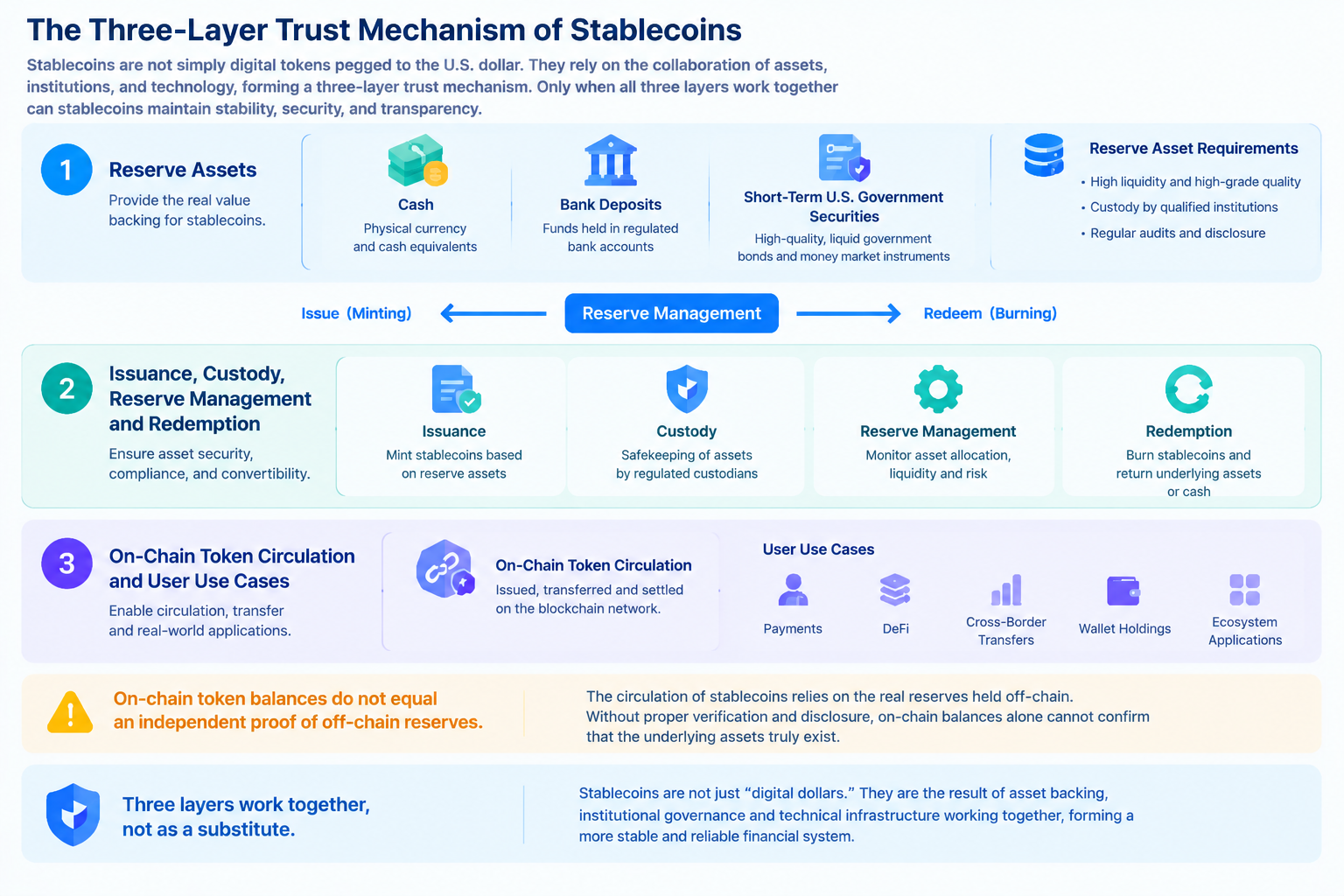
For users, the foundation of trust in a stablecoin includes at least three dimensions. The first is the asset dimension: Does the issuer hold the corresponding reserves as required by the product arrangement? What assets make up the reserves? Can those assets be liquidated promptly? The second is the legal and institutional dimension: Who is responsible for issuing the stablecoin? Who holds or manages the reserves? Under what terms do holders have redemption or other rights? Who bears the corresponding responsibilities if a dispute arises? The third is the operational and market dimension: Can users mint, transfer, and redeem the stablecoin normally? Does the issuer have the capacity to handle substantial redemption demands? Can the relevant systems withstand technical failures and external shocks? These dimensions are interconnected, but strong performance in any one of them alone cannot prove that the overall mechanism is free of risk.
Stablecoins also operate in parallel on-chain and off-chain. The blockchain can record the issuance, transfer, and burning of tokens, and users can query certain transaction information through blockchain explorers. However, reserve assets are often held in bank accounts, custody accounts, or traditional financial systems. On-chain balances alone cannot prove that off-chain reserves are sufficient and available, nor can they directly explain how holders can assert their legal rights. The credibility of a stablecoin therefore needs to be supported jointly by technical records, financial institution arrangements, legal documents, and information disclosures.
From this perspective, the development of stablecoins is not only an evolution of payment technology or trading tools. It is also a process of connecting traditional financial risk management mechanisms with blockchain infrastructure. As institutional use of stablecoins increases, market attention will expand beyond whether tokens can be transferred normally to include how reserve assets are managed, how redemptions are executed, and what protection holders can obtain in extreme situations.
How Stablecoin Reserve Assets Work
For reserve-backed stablecoins that reference the value of the US dollar, reserve assets primarily provide the asset foundation for issuance and redemption mechanisms and help issuers meet holders' redemption demands. Depending on the product arrangement, reserve assets may include US dollar cash, bank deposits, short-term US Treasury securities, or other eligible cash equivalents. These assets differ in credit risk, market risk, liquidity, and liquidation time. Therefore, users should not focus only on the book value of the reserve assets while overlooking their actual availability.
For example, cash generally offers a high level of immediate liquidity, but holding cash still involves banking and account arrangements. Short-term government securities generally have active markets, but selling assets under stressed conditions may still involve price changes, settlement procedures, and market liquidity. If a reserve portfolio includes assets with different maturities or of different types, managers must balance returns, liquidity, and risk controls. A stablecoin's reserve arrangement should not simply seek the highest possible returns. Instead, it should be aligned with its redemption commitments, regulatory requirements, and actual use cases.
Another key issue is the identifiability and segregation of reserves. Users need to understand who holds the reserves, how the legal ownership of the accounts or assets is structured, and how the relevant assets would be handled if the issuer, an affiliated company, or a custodian encountered financial difficulties. Asset segregation cannot be limited to a promise in product materials. It also requires appropriate legal arrangements, account structures, accounting records, and operational controls. Laws differ across jurisdictions. Therefore, even if two stablecoins have similar reserve compositions, holders may not have the same legal rights.
Reserves must also maintain an appropriate relationship with the amount of tokens in circulation. When evaluating a stablecoin, the market often compares the circulating supply, disclosed reserve amount, and composition of the relevant assets. However, these figures must be understood in light of the reporting date, calculation methodology, and scope of disclosure. A reserve report for a particular point in time cannot automatically prove that all redemptions will be completed smoothly at every future point in time. The actual outcome will also depend on whether the assets are available, whether the relevant banks or custodians can process transactions promptly, and whether the market continues to operate normally during concentrated redemptions. Accordingly, evaluations of reserve mechanisms should consider asset size, asset quality, liquidity, verification methods, and emergency risk management arrangements together.
Why Issuance, Reserve Management, and Custody May Be Separate
A stablecoin does not necessarily have to be issued by the institution that actually holds its reserve assets. One entity may be responsible for creating and burning tokens, establishing redemption procedures, and maintaining user relationships. Another institution may hold the reserve assets. A third institution may manage the assets, provide fiduciary services, or deliver related technology services. This division of responsibilities allows specialized institutions to perform the functions they are best suited for, but it also requires clear contractual relationships, information-sharing mechanisms, and allocations of responsibility among the parties.
The issuer is generally the first entity users interact with, making its identity, applicable regulations, token issuance rules, and redemption terms particularly important. However, the issuer may not directly hold all reserve assets. The custodian is primarily involved in asset custody, account control, transaction authorization, and recordkeeping. The reserve manager may be responsible for managing the asset portfolio or related operations as agreed. The trustee performs specific fiduciary duties based on its legal role. In a particular product, these roles may be performed by different entities, or some functions may overlap. Their legal responsibilities cannot be determined from their names alone.
A multi-entity structure can make responsibilities more specialized and reduce certain risks through checks and oversight among different institutions. For example, the issuer may be responsible for the token supply, the custodian may hold the reserves, and an independent attestation provider may review certain reserve information, creating multiple layers of control. However, a multi-entity structure can also create coordination risks. Data may not be updated consistently, contractual terms may conflict, operational procedures may be delayed, or the parties may have different understandings of their respective responsibilities when a dispute arises. If the product documents do not clearly explain these relationships, users may find it difficult to determine how their rights will be enforced.
Accordingly, when evaluating a stablecoin, users should ask not only, "Who issued this token?" but also, "Who holds the reserves? Who manages them? Who is responsible for redemptions? Who bears the legal obligations related to the assets?" Together, these questions determine the stablecoin's actual structure. Institutional users should also conduct due diligence on whether reserve assets are separated from the issuer's own assets, whether the custody relationship can be verified, whether the relevant service providers have the capacity to operate continuously, and whether the remaining functions can continue if one participant encounters problems.
RLUSD and Ripple National Trust Bank: An Example of Functional Separation
Ripple USD (RLUSD) is a USD-backed stablecoin launched by Ripple. According to Ripple's public information, RLUSD's reserve assets include US dollar deposits, US government securities, and other cash equivalents. Ripple has also stated that it will publish monthly independent third-party attestations disclosing information related to the circulating supply and reserve assets. These disclosures can help the market understand the reserve arrangement. However, readers should still distinguish among the issuer's public statements, the scope covered by the third-party attestations, and the scope of regulatory oversight applicable to specific entities and activities.
In October 2026, Ripple announced that Ripple National Trust Bank (RNTB) had received final approval from the Office of the Comptroller of the Currency (OCC). According to the announcement, RNTB's approved activities include managing the segregated reserves supporting RLUSD, serving as the collateral trustee for the reserves, and providing digital asset custodial fiduciary services. Notably, Ripple also made clear that RLUSD continues to be issued by Standard Custody & Trust Company, which is regulated by the New York State Department of Financial Services. In other words, RNTB's involvement does not mean that the issuer of RLUSD has changed.
This structure helps illustrate several key roles in a stablecoin arrangement. The issuer is responsible for functions related to token issuance. Reserve management and fiduciary arrangements are responsible for managing specific assets or related legal obligations. Custody services focus on holding and controlling assets. Assigning different functions to different entities can make the allocation of responsibilities clearer, but the actual level of protection still depends on the legal relationships among the entities, the method of asset segregation, the contractual terms, and the operational mechanisms. The addition of a regulated entity alone cannot support the conclusion that all potential risks have been eliminated.
Regulatory approval should also be distinguished from actual operational status. Ripple's announcement describes its statements regarding RNTB's approval and scope of activities, but users should continue to monitor subsequent official disclosures, including the status of the business launch, specific service arrangements, and applicable terms. For stablecoin holders, the most important issue is not the regulatory announcement itself, but whether the arrangement can sustainably improve the transparency of reserve management, the enforcement of responsibilities, and the ability to handle risks. The RLUSD case shows that stablecoin infrastructure may involve multiple legal entities. Assessing its reliability requires analyzing the structure as a whole.
What Is the Difference Between Reserve Disclosures, Third-Party Attestations, and Regulatory Oversight?
Reserve disclosures are a way for issuers to provide information to the market. They may cover the categories and amounts of reserve assets, the circulating supply, and the relevant reporting date. Disclosures can help users understand a product's asset arrangements, but their value depends on whether the information is complete, clear, and timely, and whether it answers the questions most important to holders. For example, a reserve total without information about asset composition or the calculation methodology may be insufficient to assess liquidity. Data for only one date also cannot fully reflect subsequent changes in the assets.
Third-party attestations and audits should not be treated as interchangeable. The purpose, scope, procedures, and level of assurance may differ among reports. An attestation may verify the reserve assets and token supply at a specific point in time, but it does not necessarily constitute a comprehensive audit of the issuer's overall financial condition, internal controls, or ability to continue operating. Readers should consider who issued the report, which entities and assets it covers, which standards were used, and what the report's conclusions can actually prove.
Regulatory oversight is a separate layer. Regulatory authorities may supervise specific institutions and their approved activities under applicable laws and require them to satisfy relevant organizational, governance, reporting, and risk management requirements. However, regulatory approval does not automatically mean that a stablecoin's market price is guaranteed, nor does it mean that holders receive the same protection as bank depositors. Even when the issuance, reserve management, or custody functions are regulated, the legal rights and risks associated with different tokens still depend on the specific product arrangements.
Accordingly, reserve disclosures, third-party attestations, and regulatory oversight should be viewed as complementary mechanisms rather than interchangeable trust labels. Users should first identify the scope covered by each mechanism and then determine whether they collectively answer three questions: Do the reserve assets exist and are they being managed appropriately? What rights can token holders legally assert? What enforceable procedures are available if an operational failure, concentrated redemption, or institutional bankruptcy occurs? These questions are more useful for understanding the actual risks of a stablecoin than simply comparing whether it is regulated.
Redemption, Liquidity, and Depeg Risk
A stablecoin's redemption mechanism is an important part of its price peg. Ideally, eligible holders can exchange the stablecoin for the corresponding fiat currency or another agreed asset according to the product rules. In practice, however, redemptions often require users to meet specific conditions, such as completing identity verification, meeting a minimum amount, using supported accounts and channels, paying applicable fees, and complying with the laws of the relevant jurisdiction. Therefore, not every token holder in the market necessarily has exactly the same direct redemption channel.
When the market experiences concentrated redemption demand, the liquidity of reserve assets, the operational capacity of banks and custodians, settlement windows, and processing procedures may all affect the speed of settlement. Even if reserve assets are sufficient on paper, it may still take time to liquidate the assets and transfer the funds. If market participants become concerned about the quality of the reserves or the ability to process redemptions, some users may sell the stablecoin at a discount in the secondary market, causing its market price to temporarily deviate from its reference value. A stablecoin's price peg therefore depends not only on its assets, but also on users' confidence that the redemption mechanism can operate normally.
A depeg does not necessarily have a single cause. It may be related to the quality of reserve assets, problems involving banks or custodians, restrictions on redemption channels, insufficient liquidity on trading platforms, market panic, or technical failures. The scope and duration of the impact may differ depending on the cause, and the recovery process will also depend on the reserve arrangement, market-making capacity, and response of the relevant institutions. Users should not assume that a stablecoin can be exchanged unconditionally at face value in all future conditions simply because it has maintained a price close to its peg for an extended period.
For users who trade or manage funds using stablecoins, risk assessments should also consider the intended use case. If a stablecoin is used for short-term trading, secondary-market depth, trading platform support, and transfer fees may be more important. If it is used for long-term fund storage or institutional settlement, the issuer, redemption eligibility, legal rights, reserve disclosures, and custody arrangements deserve closer attention. The convenience of stablecoins comes from their ability to circulate digitally, while their reliability still requires ongoing support from specific assets and institutional mechanisms.
Stablecoins may be used on digital asset platforms for trading denominators, asset conversion, fund transfers, or other supported scenarios. However, users need to distinguish the issuer's responsibilities from the services provided by the trading platform. The issuance and redemption rules for a stablecoin are determined by the relevant issuer and applicable arrangements. The trading platform provides market access, trading, and asset management functions according to its own rules. A platform's support for a particular stablecoin does not automatically mean that the platform is its issuer, reserve custodian, or party responsible for redemption obligations.
For Gate users, understanding the basic structure of stablecoins can support more comprehensive due diligence when selecting assets. In addition to observing whether the price remains close to its peg, users can review the issuer, reserve information, relevant attestations, supported networks, deposit and withdrawal requirements, market depth, fees, and applicable regional restrictions. Identically named or related tokens on different networks should also be checked against the specific asset identifier and the platform's support information. This can help users avoid losses caused by selecting the wrong network or misunderstanding the product structure.
Users should also note that trading availability on a platform and the legal rights associated with a stablecoin are separate issues. Even if a user can trade a stablecoin on the platform, that does not mean the user can directly require the platform to redeem it at face value or claim specific property rights or priority claims against the issuer's reserve assets. These rights must be determined based on the relevant product documents, contracts, and applicable laws. If users transfer stablecoins across platforms or use them for institutional settlement, they should also consider network compatibility, settlement times, fees, and whether the recipient supports the relevant asset.
From an industry perspective, stablecoins are gradually becoming an important tool connecting digital asset trading with traditional financial systems. Their long-term value depends not only on transfer efficiency or trading convenience, but also on whether their issuance, reserve, custody, and redemption mechanisms form a credible whole. Gate and other digital asset platforms provide users with market access as part of this ecosystem. Understanding the division of responsibilities between issuers and platforms is an important prerequisite for managing stablecoin risk.
FAQ
Are Stablecoins Safe Simply Because They Have Reserve Assets?
Not necessarily. Reserve assets are an important foundation of a stablecoin's value mechanism, but safety also depends on asset quality, liquidity, custody arrangements, asset segregation, redemption conditions, information disclosures, and legal rights. Reserve information must also be understood in light of the report's scope and reporting date.
Is RLUSD Issued by Ripple National Trust Bank?
According to Ripple's announcement in October 2026, RLUSD continues to be issued by Standard Custody & Trust Company. RNTB's approved activities involve managing the segregated reserves supporting RLUSD, serving as the collateral trustee for the relevant reserves, and providing digital asset custodial fiduciary services.
Is a Third-Party Attestation the Same as a Comprehensive Audit?
Not necessarily. A third-party attestation may verify reserve assets, the circulating supply, or other limited matters at a specific point in time. Its scope may differ from that of a comprehensive financial audit. Users should review the specific report's objectives, procedures, scope, and conclusions.
Will a Stablecoin Always Recover After a Depeg?
There is no guarantee. A depeg may involve reserves, liquidity, redemption channels, operational failures, or market confidence. Whether and how quickly the stablecoin recovers depends on the product's specific asset arrangements, redemption mechanism, the relevant institutions' ability to respond, and market conditions.