This comparison sits under the broader how to get Bitcoin exposure overview: coins versus fund shares first, then other wrappers. Treasury equities such as Strategy (MSTR) add corporate capital-structure risk on top of BTC beta; MicroStrategy’s Bitcoin strategy explains why those equities can diverge from spot tracking. Common U.S.-listed fund names are listed under Bitcoin ETFs.
Key takeaways
- Self-custodied spot BTC maximizes direct coin control; Bitcoin ETFs maximize brokerage convenience for price exposure without wallets.
- Retail ETF holders generally cannot withdraw bitcoin to a personal wallet, even when the fund holds spot bitcoin.
- ETF costs include ongoing expense ratios and possible premiums or discounts; spot crypto costs center on spreads, trading fees, and custody choices, and ETFs follow exchange calendars.
- Futures-based Bitcoin ETFs differ from spot Bitcoin ETFs and can add roll-related tracking drag versus the bitcoin price.
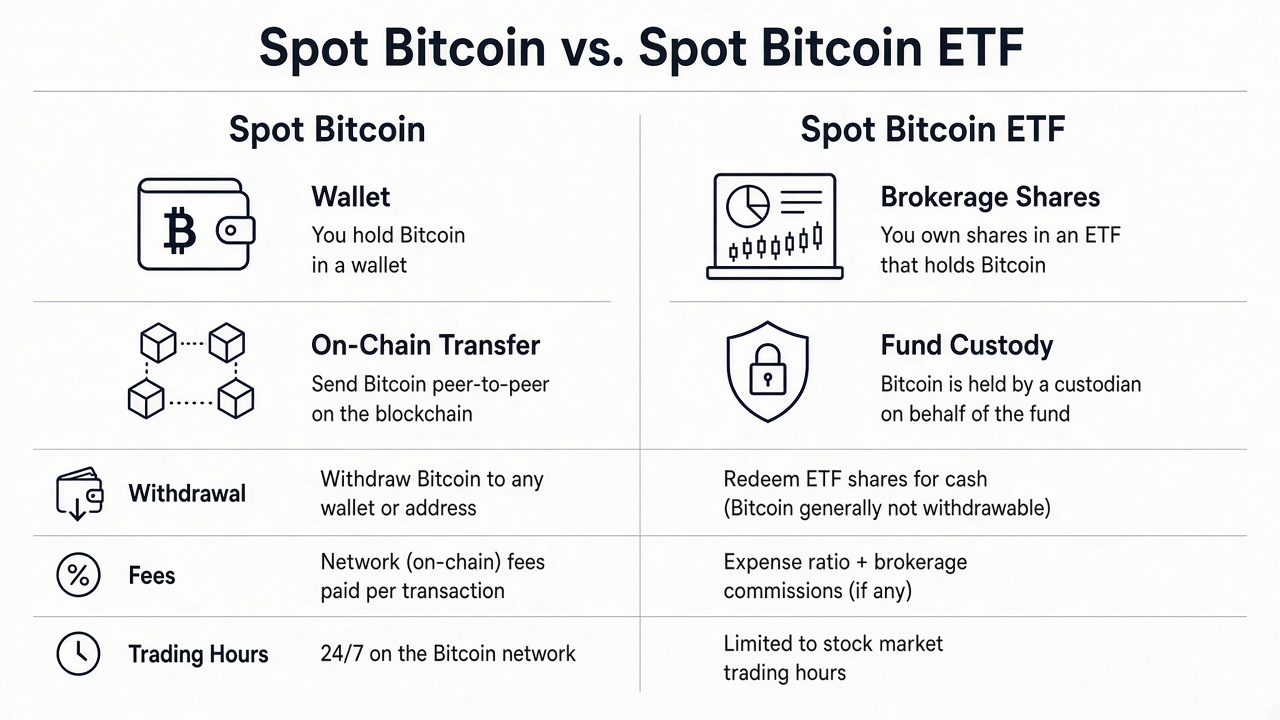 Figure 1. Spot bitcoin vs spot Bitcoin ETF: rights, withdrawal, fees, and trading hours.
What you actually hold
With spot bitcoin bought on a crypto venue, the holder either controls keys (self-custody) or holds a custodial claim against the platform. Transferability depends on withdrawal rails, network congestion, and venue policy. Economically, the object is bitcoin itself—or a direct claim on bitcoin. The Bitcoin whitepaper describes peer-to-peer transfer at the coin layer, not at the fund-share layer.
With a spot Bitcoin ETF or similar ETP, the holder owns fund shares. Shares trade on a securities venue; fund holdings sit with appointed custodians under a prospectus. For spot Bitcoin ETFs, holdings are designed around bitcoin (or bitcoin-linked spot assets) so the share price aims to track bitcoin after fees and market frictions. Economically, the object is a regulated fund interest—not a wallet balance most retail shareholders can move on-chain.
Named products such as the iShares Bitcoin Trust (often discussed under the ticker IBIT) show how large asset managers package digital-asset exposure for brokerage accounts. The ticker and sponsor matter for fees and liquidity, but they do not turn fund shares into withdrawable coins for ordinary investors. Other spot Bitcoin ETFs follow the same claim-type pattern even when brand names differ.
That rights gap is the core difference between buying cryptocurrency directly and investing through cryptocurrency ETFs. Two portfolios can show similar day-to-day percentage moves versus BTC while remaining legally and operationally different. Direct investing emphasizes asset control; ETF investing emphasizes securities-market packaging of price exposure.
How do withdrawal, on-chain use, and custody differ?
Self-custodied spot BTC can be sent to any valid bitcoin address, used as collateral in supported crypto products, or held offline. Custodial spot can still be withdrawn when the platform and network are available, subject to limits and compliance checks. That is why many crypto users treat coins as operational assets, not only as price charts.
Spot Bitcoin ETF shares trade like stocks through a brokerage. Primary creation and redemption usually run through authorized participants, not retail wallet withdrawals. Investor materials from the U.S. Securities and Exchange Commission (SEC) on crypto asset ETPs remind readers to separate securities shares from underlying digital-asset rights. If the goal includes payments, on-chain settlement, or long-term key custody, ETF shares are not a substitute for coins. “Where can you buy cryptocurrency ETFs?” is a brokerage-access question; “Can holdings be withdrawn as bitcoin?” is a product-rights question—and for retail ETF shareholders the answer is usually no.
Custody risk moves; it does not disappear. Self-custody concentrates key-management risk on the holder. Exchange spot concentrates venue risk. ETF structures concentrate sponsor, custodian, and brokerage-stack risk under securities rules. Each stack fails differently; none is risk-free.
How do fees, tracking, and trading hours compare?
Spot trading costs are mostly spreads, trading fees, and optional withdrawal fees. There is usually no annual fund expense ratio, though custody and security practices still matter. Tax reporting for cryptocurrency dispositions may require cost-basis tracking when coins are sold or swapped, depending on local rules.
Spot Bitcoin ETFs publish expense ratios that compound while shares are held. Secondary-market investors also face bid-ask spreads. During stress, ETF share prices can trade at a premium or discount to the bitcoin net asset value implied by holdings. Comparing an ETF with bitcoin therefore includes fee drag, premiums or discounts, and session gaps—not only the headline bitcoin price.
Futures Bitcoin ETFs are a separate structure. A futures-based fund holds bitcoin futures rather than (or not primarily) spot bitcoin. When futures curves sit in contango or backwardation, rolls can create tracking differences versus spot bitcoin. Start any spot-versus-futures ETF comparison from the holdings model in the prospectus: spot-backed funds aim to mirror the asset; futures funds express exposure through derivatives that must be maintained over time.
Hours also change how “tracking” feels. Bitcoin spot markets trade around the clock. Listed ETFs pause with cash equities, so large weekend moves in BTC can appear as gaps at the next equity open. That calendar mismatch is a structural feature of packaging a 24/7 asset into exchange-traded shares.
| Dimension |
Spot Bitcoin |
Spot Bitcoin ETF |
| Typical claim |
Coin or custodial coin claim |
Fund / trust share |
| Retail coin withdrawal |
Often yes (venue + network permitting) |
Generally no |
| Ongoing sponsor fee |
Usually none (venue fees instead) |
Expense ratio |
| Trading calendar |
Often 24/7 |
Exchange session hours |
| On-chain payments |
Possible with coins |
Not via share transfer |
| Common investor goal |
Transferable cryptocurrency asset |
Brokerage-tracked bitcoin price exposure |
| Related lookalike |
Other cryptocurrency holdings |
Futures Bitcoin ETFs and other bitcoin ETPs |
Spot Bitcoin ETFs belong to the wider family of cryptocurrency ETFs and digital-asset funds traded as securities. When asking what a bitcoin ETP is, read whether holdings are spot bitcoin, bitcoin futures, or a mix—because futures rolls change how tightly the fund tracks the bitcoin price.
How to choose between spot BTC and a spot ETF?
Choose spot BTC when the goal includes withdrawal, self-custody practice, or crypto-native products that require coins. Accept responsibility for key security or venue custody reviews. Direct cryptocurrency investing fits users who treat bitcoin as a transferable asset inside a broader digital-asset toolkit.
Choose a spot Bitcoin ETF when the goal is BTC price tracking inside an existing brokerage and tax workflow, and on-chain transfer is not required. Compare expense ratios, liquidity, premium/discount history, and whether the product is spot-backed or futures-based. Cryptocurrency ETFs and related bitcoin ETPs can simplify account consolidation for investors who already hold equities and funds in one brokerage, but they give up coin-level control.
An educational checklist (not personalized advice): (1) confirm whether the goal is coins or price exposure; (2) read whether fund holdings are spot bitcoin or futures; (3) note the expense ratio and how shares trade; (4) review custody and sponsor disclosures; (5) check local eligibility and tax treatment. Products marketed around “bitcoin ETF price” screens still settle as securities, not as wallet bitcoin.
Many portfolios use one path only. Using both can be intentional—for example, coins for utility plus an ETF inside a retirement wrapper where available—but it still stacks BTC price factor across assets. Return to the parent overview’s stacking checklist before treating dual holdings as diversification.
Among U.S.-listed bitcoin ETFs, investors often compare spot Bitcoin ETFs with futures Bitcoin ETFs first. Spot Bitcoin ETFs hold bitcoin as primary holdings; futures Bitcoin ETFs express exposure through futures that roll over time. Both trade as securities, so investors buy and sell fund shares rather than move bitcoin wallets.
Summary
Spot bitcoin and spot Bitcoin ETFs can deliver similar price exposure with different rights. Coins emphasize transferability and custody choices; ETF shares emphasize securities-account convenience, sponsor fees, and exchange hours. Match the structure to whether on-chain control or brokerage packaging matters more, keep futures-based ETFs separate from spot-backed trackers, and remember that cryptocurrency ETF investing is not the same as holding bitcoin as a cryptocurrency.
FAQ
Can investors withdraw bitcoin from a spot Bitcoin ETF to a personal wallet?
Ordinary secondary-market investors generally cannot redeem ETF shares for on-chain bitcoin. They sell shares in the brokerage market instead. Primary creation and redemption typically run through authorized participants against the fund’s bitcoin holdings, not through retail wallet withdrawals.
Is a spot Bitcoin ETF safer than keeping BTC on an exchange?
“Safer” depends on which risks dominate. ETFs shift risk into sponsor and custodian frameworks under securities rules; exchange spot balances concentrate venue risk. Self-custody removes venue risk but adds personal key risk. Compare stacks rather than assuming a universal ranking.
Why might an ETF’s daily move differ from bitcoin’s?
Expense drag, premiums or discounts, liquidity, and the equity-market trading calendar can all create short-horizon differences even when the product aims to track spot BTC. Futures-based funds can add further tracking gaps when contracts are rolled.
Are Bitcoin futures ETFs the same as spot Bitcoin ETFs?
No. Futures-based products hold derivatives rather than (or not primarily) spot coins, and roll dynamics can add tracking differences. Confirm the holdings model in the prospectus before treating a futures ETF as a spot substitute.
What is the difference between buying shares of a cryptocurrency ETF and buying cryptocurrency directly?
Buying cryptocurrency directly targets the asset (or a custodial claim on it) and can support on-chain transfer. Buying cryptocurrency ETF shares targets a fund interest designed to track price, with sponsor fees, exchange hours, and generally no retail coin redemption. Both can create bitcoin-linked exposure; only one typically delivers transferable cryptocurrency. When the only goal is brokerage price exposure, ETFs can reduce the need for wallets; when the goal includes transferring bitcoin or self-custody, they do not replace direct investing.