Tokenized deposits are a financial model in which commercial banks use blockchain or other distributed ledger technology to represent customers’ bank deposits as digital tokens. Unlike traditional stablecoins, tokenized deposits generally do not create a new type of claim independent of bank deposits. Instead, they change how existing deposits are recorded, managed, and used, enabling bank money to connect with digital asset trading, programmable payments, and on-chain settlement infrastructure.
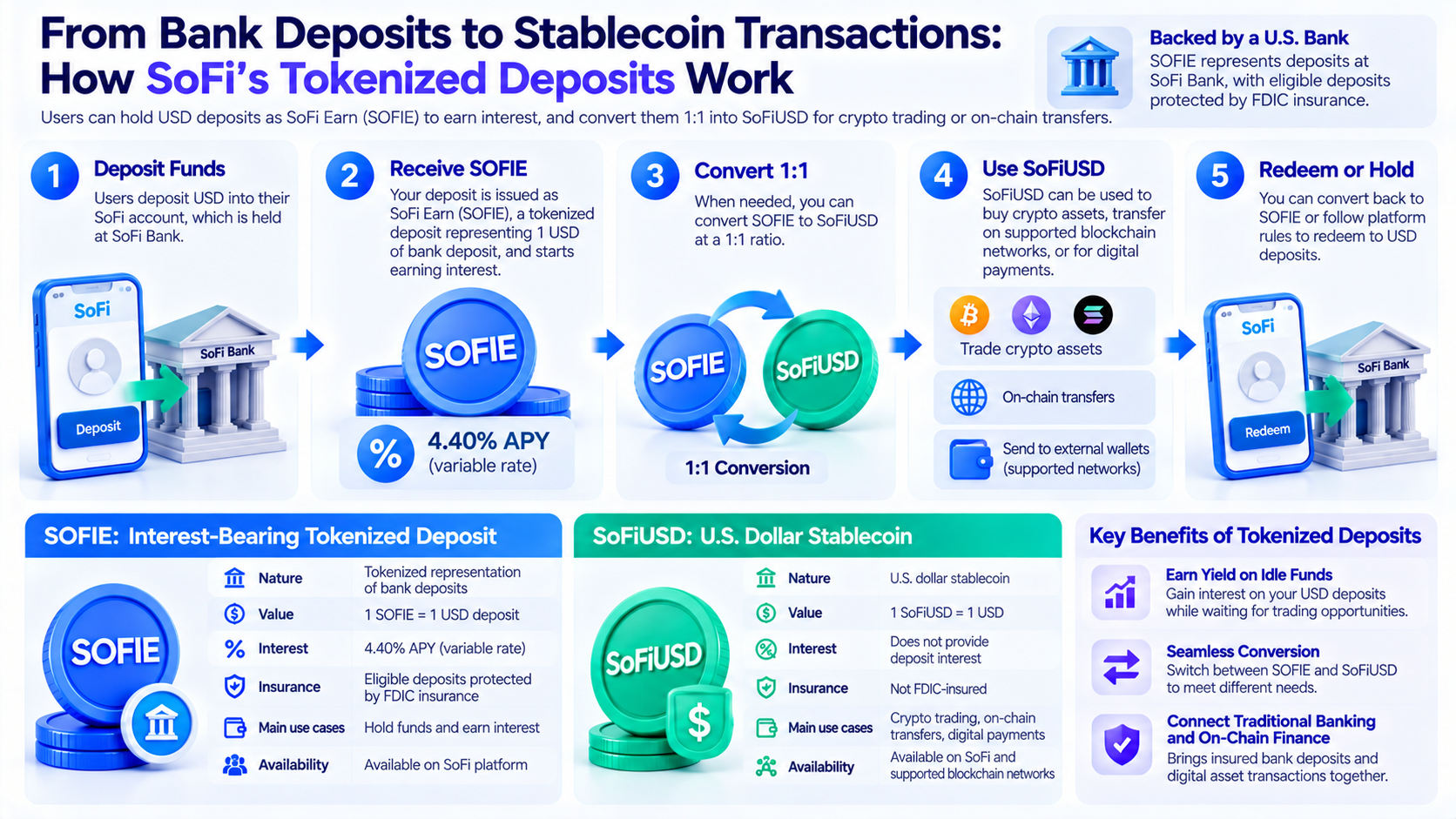
On October 22, 2026, U.S. fintech company SoFi Technologies announced the launch of SoFi Earn (SOFIE), connecting interest-bearing bank deposits with its dollar-pegged stablecoin, SoFiUSD. Under the announced product arrangement, SOFIE offers an initial variable APY of 4.40%. Users can earn deposit interest while holding SOFIE and convert it to SoFiUSD when they need to trade or transfer funds. SoFi positions it as a tokenized deposit product offered to consumers by a U.S. nationally chartered bank.
The significance of this product lies not only in digitizing bank deposits, but also in its attempt to address the functional separation between traditional bank deposits and on-chain stablecoins. Bank deposits can generally provide interest and certain deposit protections, but they have limited cross-platform portability. Stablecoins can support on-chain transfers and digital asset trading, but may not provide deposit interest or deposit insurance. Using SoFi Earn as an example, this article examines how tokenized deposits work, how SOFIE converts to and from SoFiUSD, and the potential impact of this model on the stablecoin market and banks’ digital operations.
Key Takeaways
-
Tokenized deposits are tokenized representations of bank deposits on a digital ledger. Their legal foundation remains the customer’s deposit claim against the bank, rather than an independently issued payment stablecoin.
-
On October 22, 2026, SoFi launched SoFi Earn (SOFIE), a tokenized deposit product for individual users that initially offers a variable annual percentage yield (APY) of 4.40%.
-
Each unit of SOFIE corresponds to a $1 deposit at SoFi Bank. Eligible deposits are protected by the Federal Deposit Insurance Corporation (FDIC), although the scope and amount of coverage remain subject to applicable rules.
-
Users can convert SOFIE to SoFiUSD stablecoins at a 1:1 ratio for crypto asset trading or transfers through supported blockchain networks.
-
SOFIE and SoFiUSD are two different financial products. The former is an interest-bearing bank deposit, while the latter is a payment stablecoin. Once the conversion is completed, the original deposit insurance coverage does not automatically extend to the stablecoins.
-
SoFi’s product design represents a new model: Funds retain their deposit characteristics and earn interest while awaiting use, then convert to stablecoins when they need to circulate on-chain.
What Are Tokenized Deposits? How Do They Relate to Traditional Bank Deposits?
The core of tokenized deposits is converting existing deposit liabilities of commercial banks into asset units that can be represented and processed in digital systems. After a customer deposits funds, the bank remains responsible for the corresponding deposit repayment obligation, while the token or digital ledger record represents the customer’s rights to those funds.
For example, a company holds $1 million in deposits at a bank. Under the traditional model, the funds are recorded in the bank’s account system, and transfers are generally completed through the bank’s internal accounting system, payment networks, or interbank clearing mechanisms. Under a tokenized deposit model, the bank can record the corresponding deposit rights on a digital ledger that complies with applicable rules and complete fund transfers or settlements through digital instructions.
However, this does not mean that all tokenized deposits can be freely transferred on public blockchains like ordinary ERC-20 tokens. Some tokenized deposits operate only within a bank or on a permissioned network, and the participants, recipients, and scope of fund transfers may be strictly limited.
Understanding tokenized deposits therefore requires distinguishing between two layers. The first is the legal nature of the asset: It remains a bank deposit. The second is the asset’s technical representation: The bank uses a digital ledger or tokenization system to manage the relevant rights. Tokenization changes how funds are recorded and used, but adopting blockchain technology does not automatically change the legal nature of the funds.
For banks, this model may improve the flexibility of fund management, making traditional deposits easier to connect with automated payments, institutional fund transfers, and digital asset settlement scenarios.
What Is SoFi Earn (SOFIE)? Why Does It Offer a 4.40% APY?
SoFi Earn is an interest-bearing tokenized deposit product launched by SoFi Bank. The product unit is called SOFIE. Under the arrangement announced on October 22, 2026, each unit of SOFIE corresponds to a $1 deposit held at the bank, and users can access the product through their SoFi Crypto accounts.
At launch, SOFIE offers an APY of 4.40%. This yield comes from the interest-bearing bank deposit arrangement underlying the product, rather than from SOFIE generating returns automatically as a crypto token through staking, liquidity mining, or DeFi lending.
It is important to distinguish APY from a fixed interest rate. The 4.40% rate is the variable APY announced when the product launched. It may change in the future and does not mean that users can lock in this yield for any holding period. The interest actually earned also depends on the holding period, applicable interest rate, account conditions, and relevant fees.
For example, assume that a user holds $5,000 worth of SOFIE for a full year while the annual rate remains at 4.40%, the funds remain deposited continuously, and fees are excluded. Under these simplified assumptions, the annual interest would be approximately $220. If the user holds the funds for only one month, the actual yield would be calculated according to the applicable interest accrual terms for that period.
SoFi launched this product against a backdrop in which many digital asset users hold dollar-denominated assets while waiting for trading opportunities. Ordinary payment stablecoins generally do not pay deposit interest directly to holders, meaning users must choose between liquidity and yield.
SOFIE offers an alternative arrangement: Users can initially keep their funds in an interest-bearing deposit and convert them into a transferable stablecoin when they need to purchase crypto assets or make on-chain transfers.
However, SOFIE itself is not a general-purpose stablecoin that can be freely transferred between all wallets and trading platforms. Its scope of use, conversion methods, and fund withdrawal paths remain subject to SoFi’s product rules and supported channels.
How Does SoFi Convert SOFIE to SoFiUSD Stablecoins?
SoFi’s product architecture assigns interest-bearing deposits and on-chain transfer functionality to different digital assets.
SOFIE represents the interest-bearing deposits that users hold at SoFi Bank, while SoFiUSD handles stablecoin transfers, crypto asset trading, and digital payments. The two are connected through a conversion mechanism provided by the platform, but their equal value of $1 does not make them legally identical products.
The basic process can be divided into four stages.
First, the user allocates funds to SoFi Earn. The corresponding funds are recorded as deposits at SoFi Bank. The user holds SOFIE corresponding to the deposit rights and earns interest according to the product terms.
Second, the user decides to use the funds. When the user needs to purchase crypto assets or make an on-chain transfer, they can use a function provided by SoFi to convert SOFIE to SoFiUSD at a 1:1 ratio.
Third, the funds enter the stablecoin usage stage. Users can use SoFiUSD to purchase crypto assets through channels supported by SoFi or send it to supported external wallets. The transferability of SoFiUSD depends on the specific supported blockchain networks and platform rules.
Fourth, users can choose to continue holding, use, or redeem their SoFiUSD according to the applicable features. Redeeming stablecoins and returning to an interest-bearing deposit are not the same legal process. The relevant account and asset status must be confirmed separately.
SoFi’s product description specifically states that once users use SOFIE to purchase SoFiUSD or other transferable crypto assets, the corresponding funds no longer constitute SOFIE deposits. SoFiUSD is not an FDIC-insured bank deposit.
This design establishes a conversion channel from bank deposits to stablecoins, allowing users to switch between different fund-use requirements rather than requiring a single token to perform all financial functions.
What Is the Difference Between SOFIE and SoFiUSD? Why Can’t They Be Considered the Same Asset?
Although both SOFIE and SoFiUSD maintain a 1:1 value relationship with the U.S. dollar, they differ significantly in their issuance structures, sources of returns, legal rights, and use cases.
| Comparison Dimension |
SOFIE Tokenized Deposit |
SoFiUSD Stablecoin |
| Asset type |
Tokenized representation of a bank deposit |
Dollar payment stablecoin |
| Issuing and responsible entity |
SoFi Bank |
SoFi Bank |
| Corresponding value |
Each unit corresponds to a $1 deposit |
Intended to maintain a 1:1 value with the U.S. dollar |
| Interest yield |
Initial variable APY of 4.40% |
Does not directly provide SOFIE deposit interest |
| FDIC coverage |
Applies to eligible deposits |
Not an FDIC-insured deposit |
| Primary function |
Holding funds and earning deposit interest |
Digital payments, on-chain transfers, and trading |
| Scope of use |
SoFi-supported deposit and account system |
SoFi and supported blockchain channels |
| Core risks |
Bank, account, and operational risks |
Issuer, redemption, network, and circulation risks |
This distinction reflects two different financial models.
The core of a tokenized deposit is a bank liability. The asset held by the user corresponds to a bank deposit, and the relevant rights are determined by the bank deposit agreement and applicable law. A stablecoin is an independent digital asset. The rights of its holders depend on its issuance structure, redemption arrangements, and applicable regulatory rules.
For SOFIE, interest is a characteristic of the bank deposit product. For SoFiUSD, the primary functions are fund transfers and payment settlement. When users switch between the two assets through the conversion feature, the corresponding legal rights and risk structure also change.
Therefore, SOFIE should not simply be viewed as a stablecoin with FDIC insurance. Likewise, the fact that SoFiUSD is issued by a bank does not automatically give it the same insurance coverage as a bank deposit.
How Does FDIC Deposit Insurance Protect SOFIE? What Happens After Conversion to Stablecoins?
The Federal Deposit Insurance Corporation (FDIC) provides insurance coverage for eligible bank deposits. The standard insurance limit is generally $250,000 per depositor, per insured bank, and per ownership category. The specific applicable amount must also take into account other insured deposits held by the depositor at the same bank.
SOFIE corresponds to deposit liabilities of SoFi Bank and may therefore qualify for deposit insurance if applicable FDIC requirements are met. The key factor is not whether the funds are represented by tokens, but whether the underlying assets constitute eligible insured deposits.
For example, assume that a user holds $50,000 in SOFIE at SoFi Bank and also holds other bank deposits under the same ownership category. The insurance limit would generally be calculated on an aggregate basis, rather than each product automatically receiving separate $250,000 coverage.
If the user converts $20,000 of SOFIE into SoFiUSD, those funds have changed from an interest-bearing deposit into a stablecoin. Even if the two assets can be converted at a 1:1 ratio, this does not mean that the original deposit insurance continues to cover the converted stablecoin balance.
In addition, FDIC deposit insurance primarily covers deposit losses in specific situations, such as the failure of an insured bank. It does not protect users against all financial risks. For example, lost wallet private keys, transfers to an incorrect address, irreversible blockchain transactions, and changes in digital asset prices generally fall outside the scope of traditional deposit insurance.
When determining whether a digital dollar asset is protected by FDIC insurance, the key question is not whether it was issued by a bank, but whether it legally qualifies as an eligible insured deposit.
This principle is also an important basis for understanding the difference between tokenized deposits and payment stablecoins.
Why Doesn’t SoFi Pay Interest on SoFiUSD Directly?
From a product design perspective, SoFi separates interest-bearing deposits from payment stablecoins so that the two types of assets can perform different financial functions and comply with their respective regulatory frameworks.
Traditional bank deposits can pay interest under the terms of the deposit agreement. After accepting deposits, banks conduct lending, asset allocation, and liquidity management activities subject to prudential regulatory requirements. Deposit interest is part of a bank’s funding costs.
Payment stablecoins have a different structure. Their primary objective is generally to maintain a stable exchange relationship with fiat currency and provide holders with payment, transfer, and redemption functionality. A stablecoin issuer may generate income from compliant reserve assets, but the returns on those reserve assets are not necessarily distributed directly to stablecoin holders.
The U.S. regulatory framework for stablecoins also places restrictions on the payment of returns by payment stablecoin issuers. Separating SOFIE and SoFiUSD therefore helps address the regulatory requirements for interest-bearing deposits and payment stablecoins separately.
However, this does not mean that SoFi’s design has eliminated all regulatory issues. Bank deposits, payment stablecoins, asset conversions, and digital currency services involve different regulatory obligations. Actual compliance must be assessed based on the product agreement, issuance structure, and applicable law.
From a user experience perspective, the advantage of this two-product structure is that it allows funds awaiting use to earn deposit interest without directly changing the function of the payment stablecoin.
Its limitation is that users must complete an asset conversion, and the funds no longer have the deposit characteristics of SOFIE after conversion. The efficiency, fees, settlement time, and supported scope of transfers between the different assets will also affect the actual user experience.
Which Model Is More Suitable for On-Chain Payments: Tokenized Deposits or Stablecoins?
Tokenized deposits and stablecoins are not necessarily direct substitutes. Both can be used to transfer digital funds, but they offer different advantages in terms of openness, liquidity, and regulatory structure.
Tokenized deposits are better suited to bank-led fund management environments. For users who need to maintain a bank deposit relationship, accept bank account management, and meet institutional compliance requirements, tokenized deposits can provide digital functionality within the existing banking system.
For example, a multinational company could explore using tokenized deposits to manage the fund balances of different subsidiaries and transfer funds through a permissioned network. If the bank system supports automated settlement, the company may reduce some manual processes and limitations associated with traditional banking hours.
Stablecoins are better suited to scenarios that require cross-platform circulation. Stablecoins that comply with relevant technical standards can be transferred between supported blockchain wallets, trading platforms, and DeFi protocols without requiring every recipient to maintain an account at the same bank.
However, the openness of stablecoins also means that users must independently manage risks related to wallet security, smart contracts, network congestion, and third-party platforms.
SoFi’s model attempts to connect these two types of needs. Funds are held as bank deposits while awaiting use and converted into stablecoins when they need to enter crypto trading or on-chain payment channels.
This model does not necessarily mean that tokenized deposits will eventually replace stablecoins. A more likely outcome is the long-term coexistence of bank deposit tokens, payment stablecoins, and traditional payment networks, with each serving different functions in different scenarios.
How Does SoFi’s Model Differ From the Tokenized Deposit Businesses of JPMorgan and Citi?
Tokenized deposits are not a new concept that emerged only in 2026. Before SoFi launched SOFIE, several international banks had already explored using blockchain or distributed ledger technology to manage institutional funds.
For example, JPMorgan has promoted institutional digital payments and tokenized deposit services through its Kinexys-related infrastructure, while Citi Token Services has explored fund management and cross-border liquidity solutions for corporate and institutional clients.
A common characteristic of these businesses is their focus on institutional fund management. Customers are generally large corporations, financial institutions, or eligible professional participants. The products may also operate on permissioned networks or be subject to specific access restrictions.
SoFi Earn differs in that it offers tokenized deposits to individual users and combines them with existing crypto asset trading and SoFiUSD stablecoin functionality.
| Comparison Dimension |
SoFi Earn |
JPMorgan Kinexys |
Citi Token Services |
| Primary customers |
Individual users |
Institutional customers |
Corporate and institutional customers |
| Core function |
Interest-bearing deposits and stablecoin conversion |
Institutional digital payments and settlement |
Fund management and liquidity transfers |
| Primary use of funds |
Crypto trading and digital dollar transfers |
Institutional fund flows |
Corporate fund management and cross-border payments |
| Main characteristic |
Connects retail deposits with stablecoins |
Institutional-grade payment infrastructure |
Integrated with corporate banking services |
SoFi’s model therefore has a degree of significance as a retail financial innovation. It attempts to turn the concept of tokenized deposits, which previously focused primarily on large institutions, into a product that ordinary users can access through a financial application.
However, this change does not mean that SoFi’s tokenized deposits can directly replace the institutional settlement services of JPMorgan or Citi. The customer needs, transaction volumes, compliance requirements, and system architectures faced by different banks remain distinct.
Can Tokenized Deposits Solve the Problem of Idle Stablecoin Funds?
Stablecoins have become important settlement assets in the crypto market, but holding stablecoins does not necessarily generate interest.
Some users keep dollar stablecoins in wallets or trading accounts for extended periods while waiting for trading opportunities. For these funds, liquidity is the primary need. However, if they are held for a long time without generating returns, the user incurs an opportunity cost.
When launching SOFIE, SoFi cited research estimating that approximately $64 billion in stablecoins were held in wallets with limited use, forgotten balances, or inactive status, representing approximately 21.2% of the stablecoin supply under the relevant statistical definition. However, inactive balances do not mean that all of these funds are willing or able to convert into bank deposits.
The commercial logic of SOFIE is to allow users to earn deposit interest while waiting to use their funds, rather than continuously holding non-interest-bearing payment stablecoins.
For example, a user plans to purchase crypto assets in the next few weeks but does not currently have a suitable trading opportunity. If the funds meet the requirements for using SOFIE, the user can hold them in an interest-bearing deposit and convert them to SoFiUSD when ready to trade.
This approach may reduce the opportunity cost during the waiting period, but it also has limitations. Users must be able to access SoFi’s services, and the conversion process must meet the platform’s requirements. If the funds need to be used directly on another trading platform or in a DeFi protocol, the user may still need to convert and transfer the stablecoins first.
In addition, the deposit yield may change, and stablecoin conversion and transfers may involve fees or other operational costs. As a result, whether tokenized deposits can truly improve capital efficiency will depend on the user’s trading frequency, fund size, and specific product terms.
How Does SoFi Use Tokenized Deposits to Build a Fund Cycle Between Banking and Crypto Assets?
From a business model perspective, SOFIE is not simply a standalone yield product launched by SoFi. It is one component of SoFi’s broader digital financial services ecosystem.
SoFi has already established consumer crypto asset trading, the SoFiUSD stablecoin, and corporate digital fund management services. The addition of SOFIE creates a more complete path for using funds across these products.
Users can keep funds in an interest-bearing deposit, convert them to stablecoins as needed, and then use them for crypto asset trading or on-chain transfers. This structure connects traditional bank accounts with digital asset services and reduces the need for users to switch between different financial services.
For SoFi, this model may create value in three areas.
-
Deposit attraction. By offering interest-bearing deposits connected to digital asset use cases, SoFi can attract customers who want to use both banking and crypto asset services.
-
Customer retention. If users can complete deposits, stablecoin conversions, and crypto trading on the same platform, they may have less need to move funds to other financial platforms.
-
Product synergy. SoFiUSD is already used in certain settlement arrangements for SoFi’s card businesses, while SOFIE can further provide the deposit stage before funds enter the relevant digital payment system.
However, these potential commercial benefits are analyses based on the product structure and do not mean that SOFIE has already significantly increased SoFi’s deposit base or profits. The actual results will depend on user adoption, average deposit balances, fund conversion frequency, and subsequent financial disclosures.
Can Tokenized Deposits Become Important Infrastructure for RWA and On-Chain Finance?
The long-term potential of tokenized deposits is not limited to stablecoin trading. As tokenized Treasuries, funds, and other RWA products develop, on-chain markets will need digital currency tools that can settle transactions involving these assets. Stablecoins are one option, while tokenized deposits provide another approach based on commercial bank money.
For example, in a tokenized securities transaction, the buyer needs to deliver funds and the seller needs to deliver the asset. If the funds and securities can both be processed in compatible digital systems, payment-versus-delivery settlement may become possible, reducing the risks caused by settlement taking place at different times.
For corporate fund management, tokenized deposits may also support automated payments, cross-border fund transfers, and settlement conditions triggered by smart contracts.
However, whether these applications can achieve scale depends on several key conditions.
First is interoperability between banks. If each bank’s tokenized deposits can be used only within its own system, their value for interinstitutional circulation will be limited.
Second are regulatory and legal arrangements. Clear rules are needed to determine whether bank deposit tokens can be transferred across borders, how different jurisdictions recognize the relevant claims, and how disputes should be handled.
Finally, there is technical and operational security. Banks must ensure that digital ledger records remain consistent with core banking records while establishing systems for identity management, cybersecurity, transaction correction, and business continuity.
Therefore, the development of tokenized deposits is more likely to involve the gradual upgrading of digital banking infrastructure than the complete replacement of traditional bank accounts with on-chain tokens in the short term.
Conclusion
Tokenized deposits are a financial model in which commercial bank deposits are represented and managed as digital tokens. The model preserves the basic legal characteristics of bank deposits while attempting to use digital ledger technology to improve the efficiency of fund transfers, automated settlement, and digital financial services.
SoFi Earn (SOFIE), launched by SoFi in October 2026, demonstrates one way tokenized deposits can be offered to individual users. Users can hold interest-bearing bank deposits in SOFIE and convert them into SoFiUSD stablecoins when they need to use digital assets, thereby connecting traditional bank funds with on-chain trading scenarios.
The most important characteristic of this model is its clear separation between interest-bearing deposits and payment stablecoins. SOFIE’s yield and the deposit insurance available for eligible deposits arise from its nature as a bank deposit, while the primary value of SoFiUSD lies in digital payments and on-chain circulation. The two assets can be converted, but they do not have the same legal protections.
From an industry perspective, tokenized deposits and stablecoins do not necessarily have a single replacement relationship. Banks may continue using tokenized deposits for account and fund management while using stablecoins to connect with broader digital asset networks.
SoFi’s exploration suggests that one important direction for digital finance may not be turning all funds into stablecoins, but instead building more efficient connections between bank deposits, stablecoins, and on-chain financial applications.
FAQ
What Are Tokenized Deposits?
Tokenized deposits are tokenized representations of bank deposits on a blockchain or other digital ledger. They generally remain deposit liabilities of a commercial bank rather than independently issued payment stablecoins.
What Is SoFi Earn (SOFIE)?
SOFIE is an interest-bearing tokenized deposit product launched by SoFi Bank. Each unit of SOFIE corresponds to a $1 bank deposit. Users can earn interest according to the product rules and convert SOFIE to SoFiUSD.
Is SOFIE’s 4.40% APY Fixed?
No. The 4.40% rate is the variable APY announced when SOFIE launched. It may be adjusted in the future and does not mean that users can lock in the rate over the long term.
Is SOFIE Covered by FDIC Deposit Insurance?
Eligible SOFIE bank deposits may qualify for FDIC insurance. The specific coverage is subject to requirements including the standard insurance limit and account ownership category.
What Is the Difference Between SOFIE and SoFiUSD?
SOFIE is a tokenized representation of an interest-bearing bank deposit, while SoFiUSD is a dollar stablecoin used for payments and on-chain transfers. The two can be converted, but they have different legal characteristics, yield arrangements, and deposit insurance coverage.
Does FDIC Deposit Insurance Continue After SOFIE Is Converted to SoFiUSD?
FDIC deposit insurance does not automatically continue. After the conversion is completed, the funds are no longer part of the original SOFIE deposit and become an independent stablecoin asset.
Can Tokenized Deposits Always Be Freely Transferred on a Blockchain?
No. Some tokenized deposits operate only within a bank or on a permissioned network, and their transfer scope and permitted uses may be restricted.
Which Is Safer: Tokenized Deposits or Stablecoins?
There is no simple answer. Eligible bank deposits may be protected by deposit insurance, while stablecoins have different issuance and reserve arrangements. The risks of each depend on the issuing institution, legal structure, technical systems, and actual method of use.
Can Tokenized Deposits Be Used for RWA Settlement?
They can serve as a potential settlement tool. Banks and financial institutions can explore using tokenized deposits to pay for transactions involving tokenized securities or other RWA assets, but the necessary technical and compliance infrastructure is required.
Will Tokenized Deposits Replace Stablecoins?
There is currently insufficient evidence to conclude that tokenized deposits will completely replace stablecoins. The two may serve different scenarios, including bank fund management, institutional settlement, digital payments, and open on-chain trading.