On November 19, 2026, the decentralized finance protocol Sky experienced large-scale outflows as USDS holders collectively converted their assets into USDC, placing significant pressure on the protocol's liquidity reserves. Sky co-founder Rune Christensen later stated that the protocol processed more than $2 billion in outflows in a single day, while USDS remained overcollateralized and backed by approximately $10 billion in assets.
Although USDS maintained its dollar peg during the outflows, the independent yield product stUSDS within the Sky ecosystem simultaneously faced insufficient withdrawal liquidity. This contrast highlights an often-overlooked issue in decentralized finance protocols: a stablecoin's solvency, ability to support immediate redemptions, and the liquidity of its yield products are not the same concept.
As decentralized stablecoins evolve from crypto-collateralized models into financial systems incorporating real-world assets, institutional credit, and multilayered yield products, maintaining sufficient liquidity while generating asset returns is becoming a core challenge for stablecoin protocols.
Key Takeaways
-
Sky faced a major liquidity test: On November 19, Sky processed more than $2 billion in outflows in a single day, while USDS maintained its dollar peg.
-
Overcollateralization does not equal sufficient liquidity: A stablecoin having sufficient backing assets does not mean that all of those assets can be used immediately to meet concentrated redemption demand.
-
The Peg Stability Module is an important mechanism for handling redemption pressure: Sky supports stablecoin conversions through the Peg Stability Module (PSM), while maintaining the USDS peg through liquidity reserves and fund allocation.
-
Different yield products have different risk structures: USDS, sUSDS, and stUSDS differ significantly in their use of funds, sources of yield, and risk allocation mechanisms and therefore require separate assessments.
-
Stablecoin competition is extending to asset-liability management: As decentralized stablecoins grow, the quality of collateral assets, liquidity management, risk isolation, and redemption capacity under extreme market conditions are becoming increasingly important.
Why Did Sky Experience Large-Scale Outflows in a Short Period?
The outflows from Sky occurred amid market concerns about the protocol's compliance risks and the liquidity of certain yield products. Following compliance concerns surrounding certain historical transactions involving the Peg Stability Module and withdrawal restrictions in the stUSDS lending pool, market participants began reassessing their risk exposure within the Sky ecosystem.
Some large holders converted USDS and related savings assets into USDC through Sky's stablecoin conversion mechanism, reducing the stablecoin reserves available for immediate conversions.
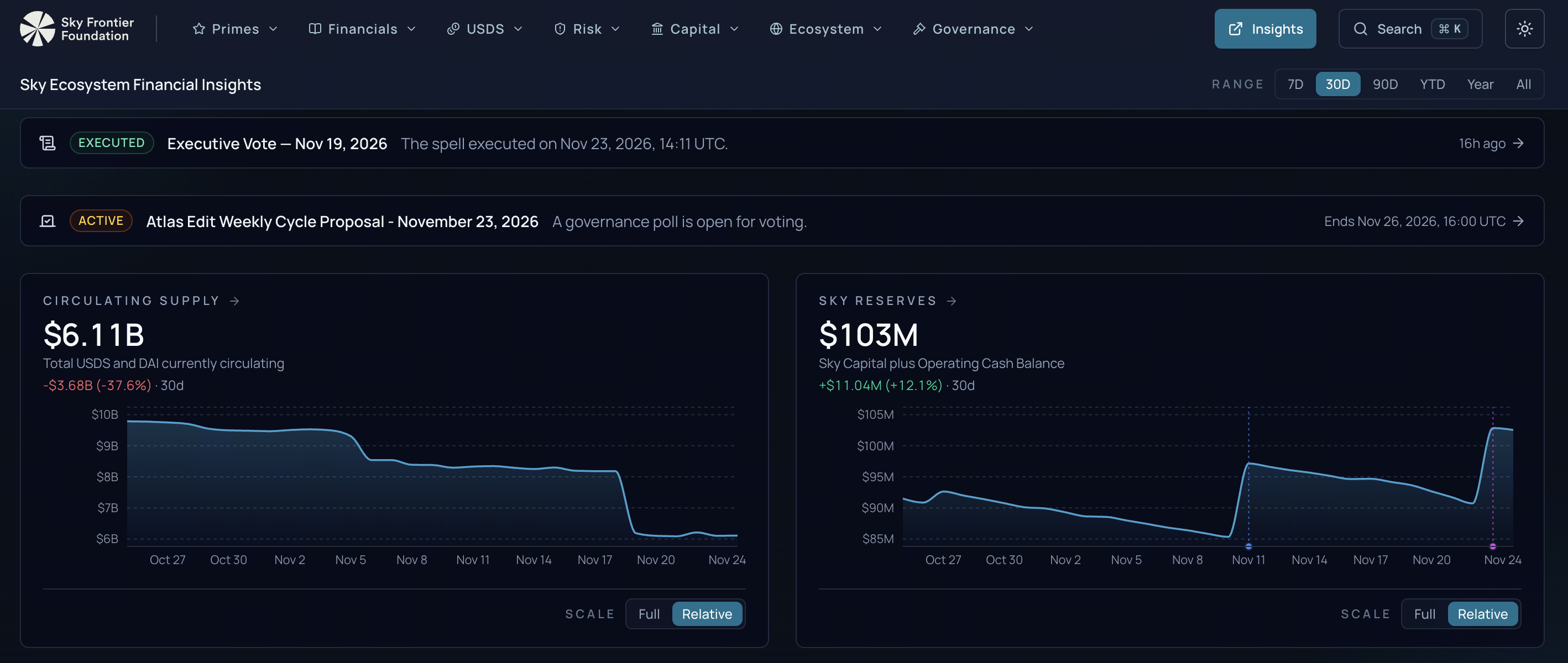
Sky subsequently disclosed that USDS and sUSDS had nearly $10 billion in backing collateral, and that the protocol processed more than $2 billion in outflows in a single day. According to its overall liquidity reporting methodology, stablecoin liquidity used to support the peg remained above $2 billion and at one point recovered to more than $2.25 billion.
However, the protocol's overall liquidity available to support the peg is not exactly the same as the stablecoin balance directly available within a specific smart contract. The balance in an individual PSM reserve pool may decline more significantly during concentrated conversions.
The importance of this event lies not only in the scale of the outflows, but also in Sky's need to process a large volume of stablecoin conversions within a short period while maintaining normal USDS operations through its existing reserves and fund allocation mechanisms.
For decentralized stablecoins that continue to grow in scale, events of this kind effectively serve as liquidity stress tests in real market conditions.
How Does USDS Maintain Its Dollar Peg Through Collateralized Assets?
USDS is a dollar-pegged stablecoin issued by the Sky protocol. It carries forward the collateralized debt mechanism from the MakerDAO system while supporting stablecoin issuance and protocol revenue through more diversified asset allocation.
Unlike assets that rely solely on market supply and demand to maintain their price, USDS derives its value support from collateral assets and related asset positions held or managed by the protocol. Its asset structure may include crypto-collateralized loans, stablecoin reserves, real-world assets, and other fund allocations approved through protocol governance.
These assets serve different functions within the protocol.
| Asset Type |
Primary Function |
Potential Risks |
| Crypto-collateralized loans |
Support stablecoin issuance and generate interest income |
Collateral price volatility and liquidation risk |
| Stablecoin reserves |
Support immediate conversions and the price peg |
Issuer credit, freezing, and depegging risks |
| Real-world assets |
Generate returns from traditional financial markets |
Credit risk and asset liquidation timelines |
| Institutional credit and fund allocations |
Expand protocol revenue sources |
Borrower risk and fund recovery timelines |
Overcollateralization is an important safeguard for a stablecoin's solvency. By ensuring that the value of backing assets exceeds the amount of related debt, the protocol can absorb collateral price fluctuations and potential losses to a certain extent.
However, overcollateralization primarily addresses whether asset value can cover liabilities. It does not determine whether assets can be liquidated immediately at any time.
When concentrated redemptions occur, even a protocol holding substantial high-value assets must have sufficient immediate payment capacity to prevent the stablecoin price from being affected by insufficient liquidity.
Why Doesn't Having $10 Billion in Backing Assets Mean Having $10 Billion in Immediate Redemption Capacity?
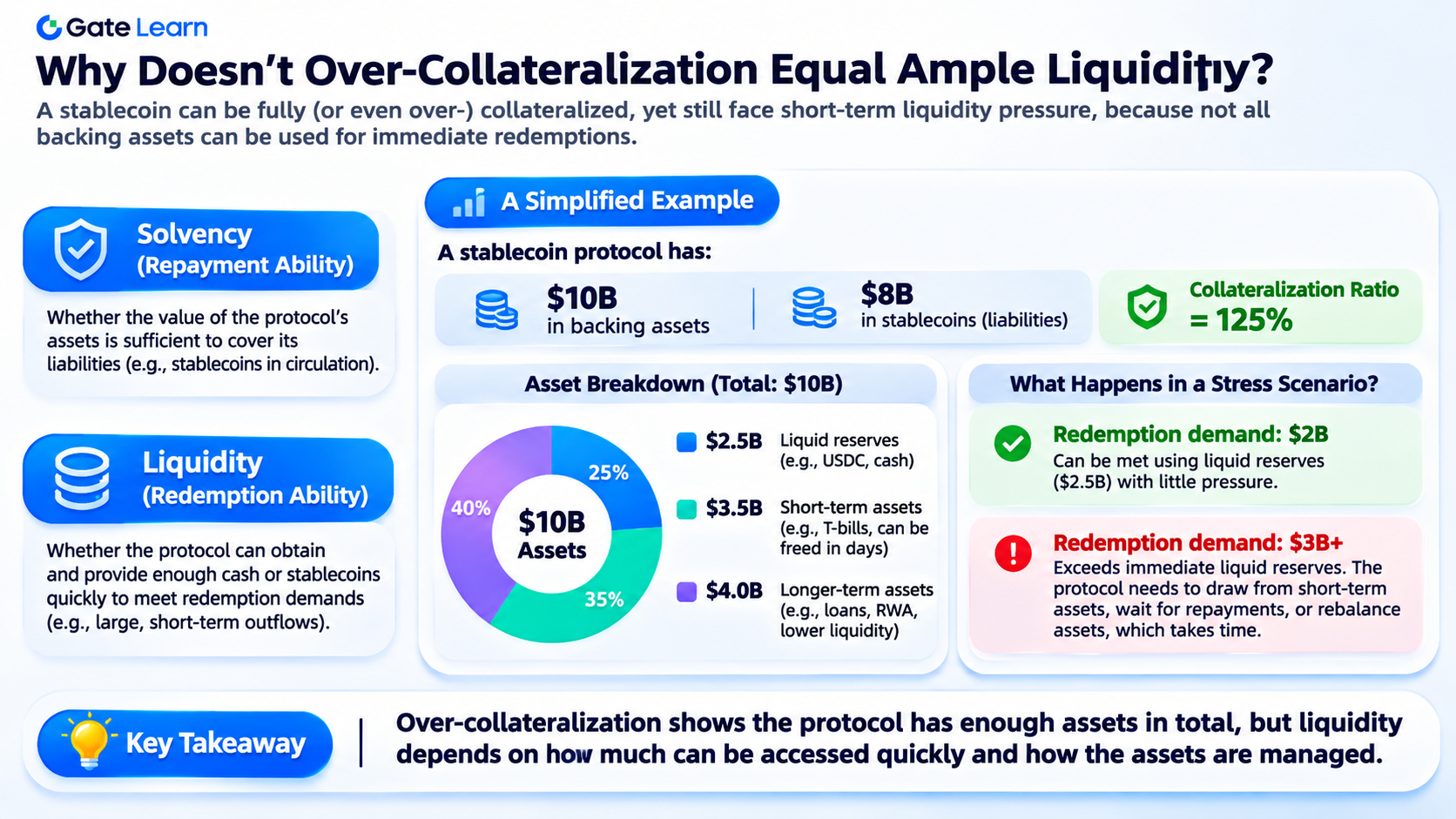
When analyzing stablecoin protocols, solvency and liquidity are two concepts that must be clearly distinguished.
Solvency concerns whether the value of the assets held by the protocol is sufficient to cover its related liabilities, while liquidity concerns whether the protocol can promptly provide funds for payments and conversions when needed.
Suppose a stablecoin protocol has $10 billion in backing assets and $8 billion in stablecoin liabilities. From an asset-liability perspective, the protocol has a certain overcollateralization buffer.
However, if only $2.5 billion consists of immediately available stablecoin reserves and the remaining assets are primarily allocated to collateralized loans, government bonds, and institutional credit, the protocol may still face liquidity pressure if $3 billion in conversion demand arises within a short period.
Even if long-term assets can ultimately be recovered in full, the related funds may not arrive immediately when users need to redeem.
| Comparison Dimension |
Solvency |
Liquidity |
| Core Question |
Can assets cover liabilities? |
Can funds be paid out promptly? |
| Primary Metrics |
Collateralization ratio and net asset value |
Available reserves and asset liquidation speed |
| Primary Risks |
Bad debt and declining collateral value |
Concentrated redemptions and maturity mismatch |
| Management Methods |
Overcollateralization, risk reserves, and liquidation |
Liquidity reserves, fund allocation, and asset liquidation |
For stablecoin protocols, solvency and liquidity are interconnected but cannot substitute for each other. If insufficient short-term liquidity forces a protocol to sell assets at a lower price, the original liquidity issue may further develop into a solvency issue.
This is why stablecoin protocols cannot focus only on the size of their collateral assets. They must also disclose asset composition, immediate liquidity, and potential fund recovery timelines.
How Does the Peg Stability Module Help USDS Handle Concentrated Conversions?
The Peg Stability Module (PSM) is important infrastructure for maintaining the stablecoin peg in the Sky ecosystem.
Where the relevant conversion routes and reserves permit, users can convert between USDS, DAI, USDC, and other supported assets at a nearly fixed ratio through this mechanism. Its core function is to connect stablecoins with external dollar liquidity, creating conversion and arbitrage channels when the market price deviates from its target.
For example, when the market price of USDS falls below $1, market participants can purchase USDS at a lower price and obtain nearly equivalent USDC through available stablecoin conversion routes. When conversion fees, transaction costs, and reserve conditions permit, this arbitrage activity can increase demand for USDS and help its price return toward the target.
Conversely, when USDS trades above its target price, market participants may increase the stablecoin supply through the relevant mechanism, helping alleviate the price deviation.
However, a PSM is not a conversion facility with unlimited funds. The scale of immediate conversions it can process depends on current reserve balances, the conversion parameters set by the protocol, and other available liquidity.
When a large number of holders convert USDS into USDC simultaneously, the USDC reserves in the PSM are continuously depleted. Even if USDS retains sufficient collateral assets, the effectiveness of the arbitrage mechanism may be affected if reserves are replenished more slowly than conversion demand grows.
During the Sky outflows, the PSM provided important exit liquidity to the market. Over the long term, however, the continued maintenance of the stablecoin peg will depend on the overall quality of the protocol's assets, its ability to replenish reserves, and market confidence—not on a single conversion module.
How Can Stablecoin Protocols Balance Asset Returns With Retaining Liquidity?
Modern stablecoin protocols generally do not keep all backing assets as idle stablecoins over the long term. Instead, they allocate some funds to collateralized loans, real-world assets, and other yield strategies to generate recurring income.
Sky disclosed that it generated approximately $400 million in protocol revenue over the past year. This revenue provides a funding base for savings product yields, protocol operations, risk buffers, and governance token economic mechanisms.
However, asset returns and immediate liquidity typically involve a trade-off.
If a protocol holds a large amount of stablecoin reserves available for immediate conversion, it may be better able to handle concentrated redemptions, but the yield efficiency of idle funds may be relatively low. If the protocol allocates more assets to yield products with maturity periods or restrictions on fund usage, it may increase revenue but make liquidity management more difficult.
In traditional finance, this issue is known as maturity mismatch: liabilities can be withdrawn or demanded for repayment within a short period, while the corresponding assets take longer to recover.
Stablecoin holders can submit on-chain transactions at any time, but real-world assets, institutional loans, and other fund positions backing the stablecoin may not be liquidated at the same speed.
To reduce this risk, stablecoin protocols can establish a layered liquidity management system.
The first layer consists of stablecoin reserves that can be used directly for immediate conversions, primarily meeting daily transaction needs and short-term outflows. The second layer consists of assets that can be recovered or reallocated within a relatively short period to replenish depleted reserves. The third layer consists of longer-term yield-generating assets that provide the protocol with recurring income but should not be treated directly as funds for immediate redemptions.
By allocating assets across different liquidity tiers appropriately, a protocol can establish a more stable balance between capital efficiency and redemption capacity.
Why Should the Risks of USDS, sUSDS, and stUSDS Be Assessed Separately?
During the Sky event, USDS maintained its dollar peg amid large-scale outflows, while stUSDS faced insufficient withdrawal liquidity. The simultaneous occurrence of these two conditions shows that different products can have independent uses of funds and risk allocation mechanisms.
USDS is the dollar stablecoin within the Sky ecosystem. It primarily serves functions such as unit of account, payments, trading, and storing funds.
sUSDS is a savings product associated with the Sky Savings Rate (SSR). After depositing USDS into the relevant module, users can earn savings yield by holding sUSDS. The yield is reflected in the growth of its redemption value.
stUSDS is a risk capital product. After users deposit USDS into the stUSDS module, the related funds are primarily used to support borrowing demand collateralized by the SKY governance token. Users receive potential lending yield while bearing the risks of insufficient lending pool liquidity, collateral volatility, and potential bad debt.
| Product |
Core Function |
Yield Source |
Primary Risk Characteristics |
| USDS |
Dollar stablecoin |
Holding alone does not automatically generate savings yield |
Collateral, depegging, protocol, and liquidity risks |
| sUSDS |
Stablecoin savings |
Sky Savings Rate |
Protocol, smart contract, and underlying asset risks |
| stUSDS |
Risk capital and lending fund supply |
Interest from SKY-collateralized loans and other sources |
High utilization, withdrawal restrictions, collateral, and bad debt risks |
Under Sky's product design, the stUSDS lending pool does not constitute backing assets for USDS. Direct lending losses are primarily borne by the corresponding risk capital system rather than being directly allocated to USDS and sUSDS holders.
This structure reflects the risk isolation design used in DeFi protocols, in which independent pools of funds and loss allocation mechanisms limit the direct risks of specific businesses to the corresponding products.
However, structural risk isolation does not mean that no indirect economic connections exist. Governance token price volatility, declining market confidence, concentrated user exits, and changes in protocol revenue may still affect the broader ecosystem through other channels.
Therefore, when assessing risk isolation mechanisms, it is necessary to understand not only the fund relationships at the smart contract level, but also the potential transmission of market risks between products.
Why Could a Higher stUSDS Yield Actually Indicate Greater Liquidity Risk?
In DeFi lending markets, deposit yields are generally closely related to fund utilization.
When borrowing demand increases and available funds decrease, a lending protocol may raise interest rates to attract new deposits and encourage borrowers to repay their debt. This dynamic interest rate mechanism helps regulate the supply and demand of lending funds.
However, when fund utilization approaches 100%, users may be unable to withdraw all of their funds immediately even if deposit yields rise significantly.
For example, suppose a lending pool has $100 million in USDS deposits, of which $99 million has been borrowed. Only $1 million would remain available for immediate withdrawals. If users collectively request $20 million in withdrawals, they would need to wait for borrowers to repay their debt, for new funds to enter, or for other liquidity recovery mechanisms to take effect.
As of November 23, the stUSDS lending pool's utilization rate had at one point approached 100%, while the annualized deposit rate rose to approximately 50% and available withdrawal liquidity was nearly depleted. Rune Christensen later stated that approximately $3 million in USDS loans had been repaid, while around $77 million in related debt still needed to be addressed.
This phenomenon shows that a higher yield does not necessarily indicate improved product performance. It may also reflect a severe shortage of funds.
When analyzing DeFi yield products, in addition to the annualized yield, it is necessary to monitor fund utilization, available withdrawal balances, borrower concentration, collateral quality, and potential liquidation risks.
Can Protocol Revenue and Governance Token Buybacks Solve Liquidity Problems?
During the outflows, Sky's core council announced a one-time SKY buyback plan that would use 750,000 USDS per day to buy back the governance token for seven days, for a total of 5.25 million USDS.
Token buybacks are generally an economic mechanism through which a protocol uses some of its discretionary funds to purchase tokens circulating in the market. They may affect token supply and demand as well as market expectations.
However, governance token buybacks and stablecoin liquidity management are different financial activities.
Stablecoin liquidity management focuses primarily on whether a protocol can meet users' conversion needs, while token buybacks involve the distribution of protocol surpluses and the value mechanism of the governance token. Buying back SKY does not directly increase USDC reserves in the PSM, nor can it replace debt repayment or fund recovery.
In addition, protocol revenue cannot be equated directly with distributable profit. Sky's disclosed annual revenue of approximately $400 million must be considered alongside savings interest expenses, operating costs, risk reserves, and other financial obligations before the actual surplus can be assessed.
For DeFi protocols with multilayered financial products, fund allocation mechanisms need to balance savings yields, risk reserves, liquidity management, and governance token economics.
The long-term stability of a stablecoin system ultimately depends on asset quality, sustainable profitability, and risk management—not on the size of short-term token buybacks.
What Lessons Does the Sky Event Offer for Decentralized Stablecoins?
As stablecoins gradually become foundational assets in on-chain finance, the market's evaluation criteria are expanding from a single collateralization ratio to a more comprehensive asset-liability management framework.
First, stablecoin scale does not fully represent a protocol's liquidity strength. The quality, maturity structure, and liquidation capacity of backing assets also determine how the protocol performs under extreme market conditions.
Second, the price-peg mechanism must be combined with actual liquidity. Even if smart contracts operate normally according to predefined rules, the price stability mechanism may be constrained if there are insufficient redeemable assets.
Third, different yield products need clear risk boundaries. Although stablecoins, savings products, and risk capital products may use the same underlying asset, their sources of yield, uses of funds, and loss allocation mechanisms may differ fundamentally.
When evaluating decentralized stablecoin protocols, investors may focus on the following metrics:
| Metric |
Analytical Value |
| Collateral asset quality and collateralization ratio |
Assess the protocol's solvency |
| Immediate stablecoin reserves |
Assess its ability to withstand concentrated conversions |
| Asset maturity and liquidation timelines |
Identify potential maturity mismatch risks |
| Lending fund utilization |
Assess withdrawal liquidity in the lending pool |
| Borrower and collateral concentration |
Identify localized credit and liquidation risks |
| Protocol net revenue and risk reserves |
Assess long-term operations and loss absorption capacity |
| Product risk isolation mechanisms |
Determine potential risk transmission paths between different businesses |
| Stablecoin price and circulating supply |
Monitor changes in market confidence and fund flows |
Together, these metrics form a risk assessment framework for stablecoin protocols. Strong performance on any single metric is insufficient to prove that an entire protocol is free of risk.
Conclusion
Sky's experience of more than $2 billion in outflows provides a case study of how decentralized stablecoins operate under extreme liquidity conditions. USDS maintained its peg during the concentrated conversions, demonstrating the importance of overcollateralization, the Peg Stability Module, and liquidity management mechanisms. However, the withdrawal pressure faced by stUSDS also shows that different financial products can have significantly different risk characteristics even when they are built within the same stablecoin ecosystem.
As decentralized stablecoins continue expanding into real-world assets, institutional credit, and multilayered yield products, the challenges facing protocols are extending beyond stablecoin issuance and price-peg maintenance to asset-liability management, fund maturity allocation, and risk isolation.
The long-term competitiveness of a stablecoin depends not only on the size and yield of its collateral assets, but also on whether the protocol can provide reliable conversion capacity when market pressure rises and maintain the normal operation of its financial system through clear risk allocation mechanisms.
FAQ
What Is Sky?
Sky is a decentralized finance protocol that evolved from the MakerDAO system. It covers stablecoin issuance, savings, collateralized lending, and various fund allocation mechanisms. USDS is one of its core stablecoins.
Does Sky's Outflow of More Than $2 Billion Mean That the Protocol Lost $2 Billion?
Not necessarily. Outflows mainly reflect the scale of users converting related assets or exiting the protocol. They have a different meaning from asset losses, bad debt, and operating losses.
What Is a Stablecoin's PSM?
A PSM is a Peg Stability Module. It supports conversions between a stablecoin and other designated assets, providing liquidity and a price-peg channel. Its effectiveness is limited by the size of its reserves and the protocol's parameters.
Can an Overcollateralized Stablecoin Also Face Liquidity Risk?
Yes. Overcollateralization primarily safeguards the ability of assets to cover debt. However, if the related assets cannot be liquidated in time, the protocol may still face pressure from concentrated conversions.
What Is the Difference Between sUSDS and stUSDS?
sUSDS is a savings product associated with the Sky Savings Rate, while stUSDS is a risk capital product that provides funds for SKY-collateralized lending. They differ in their sources of yield, uses of funds, and risk allocation mechanisms.
Does Restricted stUSDS Withdrawals Mean That USDS Has Depegged?
No. Restricted stUSDS withdrawals primarily reflect insufficient available funds in an independent lending pool. Whether USDS has depegged must be assessed based on its actual market price, conversion capacity, and overall liquidity conditions.
Why Do Yields on DeFi Lending Products Sometimes Rise Suddenly?
Yields may rise because of increased borrowing demand or excessively high fund utilization. When available funds in a lending pool are insufficient, the dynamic interest rate mechanism may raise yields to attract new funds and encourage borrowers to repay.