The crypto asset market continues to expand, and tokens have long served purposes beyond their early use cases of simple payments and value transfers. Today, the same blockchain technology can support network access credentials, digital collectibles, stable-value instruments, governance rights, and even digital securities representing traditional financial assets. These assets may use similar technical standards or circulate on the same trading platform or in the same wallet, but their economic characteristics and legal relationships are not the same.
This makes token classification an important connection point between the crypto industry and traditional financial regulation. Regulators need to determine what rights an asset represents, what mechanism generates its value, and whether the relevant issuance and trading arrangements involve securities offerings, investment contracts, or commodities regulation. For market participants, the classification affects not only issuance and disclosure requirements, but also how trading platforms, custodians, project teams, and investors understand their compliance responsibilities.
In March 2026, the SEC issued an interpretive release on the application of federal securities laws to certain types of crypto assets and related transactions. The CFTC participated in the release and stated that it would administer matters under the Commodity Exchange Act in a manner coordinated with the SEC's interpretation. The release categorizes crypto assets into five types: digital commodities, digital collectibles, digital tools, stablecoins, and digital securities. It also discusses how non-security crypto assets may be subject to investment contracts under specific transaction arrangements. The release provides an important reference for understanding the U.S. regulatory approach, but specific determinations still require consideration of the asset's characteristics, the transaction facts, and applicable law.
Key Takeaways
-
A token's name does not directly determine its legal status: An asset referred to as a Token may represent network functionality, collectible value, payment functionality, or securities rights.
-
Classification requires consideration of actual functionality and rights: An asset's source of value, holder rights, issuance method, and the ongoing responsibilities undertaken by the project team can all affect the analysis.
-
Securities status and investment contracts must be distinguished: An asset itself may not be a security, but an issuance or sales arrangement involving that asset may constitute an investment contract.
-
The SEC and CFTC have different regulatory areas of focus: The SEC primarily focuses on securities and investment contract matters, while the CFTC administers the Commodity Exchange Act with respect to commodities and related transactions within its jurisdiction.
-
Classification is not a permanent label: When network functionality, the project team's role, token rights, or transaction arrangements change, the related legal analysis may also need to be reassessed.
Why Is the SEC/CFTC Token Classification Framework Important?
In the past, discussions about crypto asset regulation often centered on a seemingly simple question: Is a particular token a security? In practice, however, the analysis is not simply about labeling a token as a "security" or "non-security." A token may technically be a network-native asset, economically serve a payment or utility function, and at the same time convey an expectation of profit to purchasers through a specific issuance arrangement. Characteristics at different levels may exist simultaneously, so the regulatory analysis must distinguish the asset itself from the transaction arrangements involving the asset.
The SEC's 2026 interpretive release provides a more structured approach: first classify a crypto asset based on its characteristics, use, and functionality, and then consider whether it falls within the definition of a security under federal securities laws and whether the related issuance and trading involve an investment contract. The five categories listed in the release are digital commodities, digital collectibles, digital tools, stablecoins, and digital securities. This classification does not mean that every asset can be simply and permanently assigned to a single category. Instead, it provides a common starting point for understanding an asset's primary economic characteristics.
This framework has practical significance for project teams, investors, and trading platforms. Project teams need to understand the legal implications that token issuance and functionality design may create. Investors need to distinguish whether they are purchasing a network utility asset, a collectible, or a digital security with financial rights. Trading platforms need to consider the characteristics of different assets when evaluating asset listings, disclosures, trading arrangements, and risk management. The value of classification does not lie in simplifying every complex issue, but in helping participants more accurately identify matters requiring further review.
What Do the Five Types of Crypto Assets Represent?
The SEC release categorizes crypto assets into five primary types. The categories are not based on the blockchain network, token standard, or market capitalization. Instead, they focus on the asset's characteristics, use, and functionality. To understand these five types, the first questions to consider are what problem each type addresses and what holders can obtain by holding or using the token.
Digital commodities are generally closely associated with a crypto system that already has functionality. Their value primarily derives from the system's programmed operation and market supply and demand, rather than from an expectation of profits generated by the continued performance of key managerial functions by a particular party. The release lists BTC, ETH, SOL, and XRP as examples of assets in this category. Digital commodities may be used within a network to pay transaction fees, participate in the network, or perform other system functions. However, they do not automatically confer rights to equity, debt, or distributions of business profits.
Digital collectibles are primarily used to collect, display, or express the value of particular cultural and digital content. They may involve artwork, music, videos, in-game items, cards, or symbols of internet culture. NFTs are a common technical form of digital collectibles, but digital collectibles are not necessarily NFTs, nor do all NFTs have the same legal characteristics. If a collectible is divided into fractional interests, or if its design and sales arrangement grants purchasers a form of investment interest, further analysis may be required to determine whether it involves securities characteristics.
Digital tools are primarily intended to provide practical functionality, such as memberships, tickets, identity credentials, access rights, or other services within a system. Unlike financial assets centered on investment returns, digital tools generally emphasize use cases and the delivery of functionality. The analysis should consider what services holders can actually use, whether the related rights are transferable, and whether the issuer creates an expectation of profit for purchasers through other arrangements.
Stablecoins are generally designed to maintain a stable value relative to a reference asset, such as tokens pegged to the U.S. dollar. However, "stablecoin" is not a label that by itself determines an asset's legal status. The composition of reserves, redemption mechanism, issuer, yield arrangements, and use of funds may all affect the regulatory analysis. The SEC release also distinguishes payment stablecoins from other stablecoins that may have different legal characteristics. The mere existence of a price-pegging mechanism is not enough to conclude that all stablecoins belong to the same regulatory category.
Digital securities are securities recorded or represented in the form of crypto assets. The underlying asset may be stock, bonds, or another financial instrument that meets the definition of a security, while the blockchain primarily serves functions such as issuance, transfer, or ownership recordkeeping. It is important to note that the rights of holders of tokenized securities may differ from those of holders of the traditional underlying securities. For example, voting rights, dividend rights, or other economic interests may not be identical. Accordingly, analyzing a digital security requires more than identifying the asset it represents. It also requires reviewing the specific legal documents and arrangements governing holder rights.
How Does the Howey Test Affect the Analysis of a Token's Securities Characteristics?
Under U.S. securities law, an investment contract is an important concept for determining whether certain transaction arrangements involve securities. The Howey test originated from a relevant decision of the U.S. Supreme Court. It focuses on whether an arrangement involves an investment of money in a common enterprise and whether purchasers have a reasonable expectation of profits to be derived from the essential managerial or entrepreneurial efforts of others. It is not a technical classification table designed specifically for blockchains or tokens, but a legal analytical method for determining whether an investment contract exists based on specific transaction facts.
For crypto assets, the analysis often focuses not only on the token's technical structure, but also on why purchasers buy it, how the issuer promotes it, how the funds are used, and whether the project team continues to undertake managerial responsibilities that have a substantial impact on the project's success or failure. For example, if a project has not yet achieved its primary functionality and purchasers primarily rely on the team to complete development, establish a market, or promote ecosystem growth, the related transaction arrangement may require further review to determine whether it constitutes an investment contract. By contrast, if a network already has practical functionality, the token's value primarily derives from the system's operation and supply and demand, and purchasers do not rely on a particular party to continuously create profits, the analysis may follow a different path.
The SEC's previous framework for analyzing digital asset investment contracts discussed factors such as an investment of money, a common enterprise, and reliance on the efforts of others in detail. However, that page is now expressly marked as withdrawn and has been replaced by the 2026 interpretive release. Accordingly, understanding the historical Howey analysis can help readers understand the legal reasoning, but the withdrawn framework should not be treated as a currently effective, standalone regulatory guide. A more prudent approach is to analyze the matter based on the current interpretation, relevant case law, and the specific issuance and sales arrangements.
Why Might the Same Token Involve Different Regulatory Analyses?
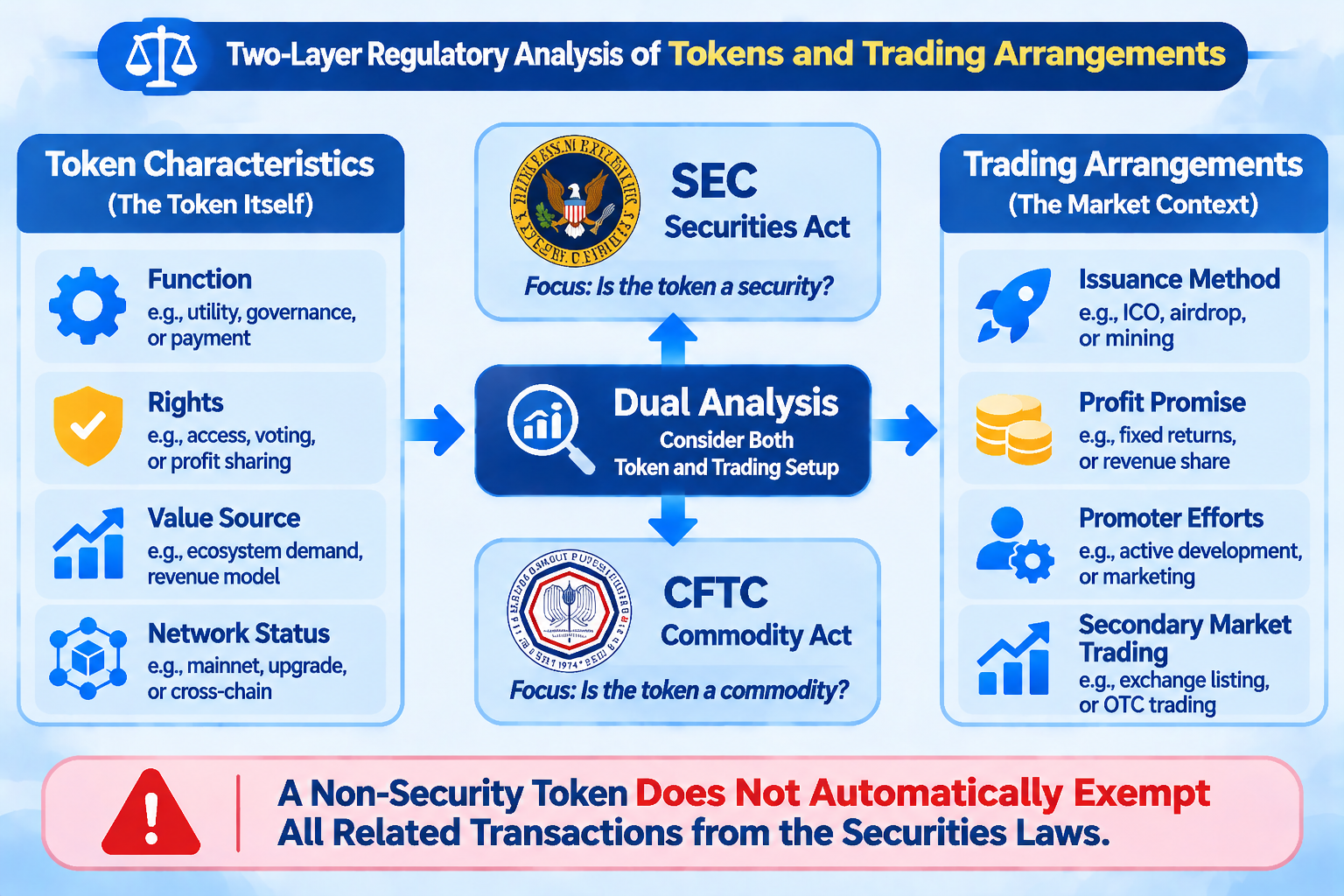
An asset's characteristics are not always fully consistent with the way it is issued, sold, and traded. A non-security token originally intended for network participation may still involve an investment contract if, in a particular offering, it is closely tied to the project team's financing commitments, expectations of profit, or ongoing management obligations. In other words, classifying a token as a digital commodity or digital tool does not mean that every transaction involving it is automatically outside the scope of securities laws.
Conversely, the fact that a token involved an investment contract during an early issuance stage does not mean that it will necessarily retain the same status at all times or in every trading environment. As network functionality develops, the project team's key managerial role diminishes, and the token's use changes, the economic substance of the relevant transactions may differ from that of the early issuance stage. The SEC's 2026 release specifically discusses how non-security crypto assets may be subject to investment contracts and how the investment contract relationship may change after the relevant commitments have been fulfilled or specific conditions are no longer satisfied.
This means that the regulatory analysis must distinguish at least three levels: what the token itself represents, how the token is issued or sold, and how the token is traded in the secondary market. These levels are related but cannot substitute for one another. Analyzing only the token's code, the functionality described in the white paper, or the asset name displayed on a trading platform is insufficient to fully determine the legal status of a transaction arrangement.
How Should the Regulatory Boundaries Between the SEC and CFTC Be Understood?
One of the SEC's core responsibilities is enforcing federal securities laws. Its analysis therefore generally focuses on whether an asset or transaction arrangement involves a securities offering, securities transaction, or investment contract. For digital securities, determining whether the asset meets the definition of a security is a fundamental question. For other crypto assets, it is also necessary to examine whether the issuance and sales process creates an investment contract under securities laws. The regulated subject may include not only the asset itself, but also activities such as issuance, sales, and intermediary services.
The CFTC administers commodities and related derivatives markets under the Commodity Exchange Act. The fact that a crypto asset is not a security does not mean that it is entirely outside financial regulation. It may still involve commodity characteristics, derivatives transactions, leveraged trading, or other activities regulated by the CFTC. The interpretive release issued by the SEC and CFTC in 2026 reflects a coordinated regulatory approach. The CFTC stated that it would administer matters under the Commodity Exchange Act in a manner coordinated with the SEC's interpretation and noted that certain non-security crypto assets may meet the definition of a commodity under that Act.
Accordingly, market participants should not view the relationship between SEC and CFTC regulation as a simple either-or choice. The legal analyses involving securities and commodities characteristics do not exist entirely on the same plane, and specific activities may trigger different regulatory requirements. In particular, in the contexts of derivatives, leveraged trading, tokenized securities, and cross-border transactions, the classification of the asset itself and the regulatory boundaries applicable to the trading activity must be identified separately.
What Does the Token Classification Framework Mean for Trading Platforms and Investors?
For trading platforms, the token classification framework helps establish a more systematic asset review process. When evaluating an asset, a platform needs to consider not only technical security, liquidity, and market demand, but also the token's issuer, actual functionality, holder rights, disclosures, and related transaction arrangements. Different categories of assets may require different risk disclosures, listing assessments, and ongoing monitoring methods. In particular, digital securities should not be treated the same as ordinary network utility tokens based solely on the trading interface or token name.
For investors, the classification framework provides a more structured research method. Before purchasing a token, investors can first determine whether it represents network access, digital content, payment functionality, or a financial interest. They can then assess whether the token's value depends on the network's own operation or on the ongoing efforts of the issuer or project team. Finally, they can verify whether holders have redemption, dividend, voting, profit distribution, or other rights. This analysis is more reliable than relying solely on labels such as "governance token," "utility token," or "ecosystem token" used in project promotions.
Trading platforms such as Gate provide users with access to trading and information in the crypto asset market. However, the ability to view or trade an asset on a platform does not constitute a regulatory determination of its legal status. When conducting spot transactions on Gate or learning about other digital asset products, users should independently assess the risks based on the asset description, trading rules, and requirements in their applicable jurisdiction. For products involving the tokenization of traditional financial assets, users should also distinguish among the underlying asset, tokenization structure, holder rights, and platform trading arrangements. A tokenized transaction should not be treated as equivalent to holding the underlying security.
FAQ
What Categories of Crypto Assets Are Included in the SEC/CFTC Token Classification Framework?
The SEC's 2026 interpretive release divides crypto assets into five categories: digital commodities, digital collectibles, digital tools, stablecoins, and digital securities. These categories are primarily analyzed based on the assets' characteristics, uses, and functionality. They do not mean that every token can be permanently assigned to a category based solely on its name.
Are Digital Commodities Completely Unregulated?
No. Digital commodities are generally not securities themselves, but related transactions may still be subject to other laws and regulations. For example, transactions involving commodity derivatives, leveraged trading, or other regulated activities may still fall within the CFTC's regulatory scope.
Can a Non-Security Token Involve Securities Laws?
It can. The fact that a token itself is not a security does not mean that an issuance or sales arrangement involving the token cannot involve an investment contract. The analysis still requires consideration of factors such as an investment of money, a common enterprise, an expectation of profit, and the essential managerial efforts of others.
Does the Howey Test Apply to All Crypto Assets?
The Howey test is an important legal standard for analyzing investment contracts in the United States, but it is not a checklist that can be used to label every token directly. Whether an investment contract exists must be determined based on the specific transaction arrangement and relevant facts.
Does Listing a Token on a Trading Platform Mean That a Regulator Has Approved Its Classification?
No. A trading platform's provision of a trading venue and a regulator's determination of legal classification are separate matters. Users should still independently understand the asset's characteristics, issuance arrangements, holder rights, and applicable legal requirements.