Render Price Prediction

Beginner
Quick Reads
Last Updated 2026-04-01 06:54:25
Reading Time: 1m
This article provides a detailed price prediction for Render (RNDR), analyzing short-term and long-term market trends based on historical data and expert insights. It highlights the factors influencing RNDR's value, including technological growth, partnerships, and market sentiment. Readers will also learn how to buy and trade RNDR on Gate.com, one of the top platforms offering both spot and futures trading.

Introduction

Render Network, powered by its native token RNDR, is revolutionizing the digital rendering industry by providing decentralized GPU rendering solutions. As the demand for high-quality graphics in gaming, virtual reality, and other sectors grows, RNDR’s role becomes increasingly significant. Understanding RNDR’s price trajectory is essential for investors aiming to capitalize on its potential.


Image Source: Render Homepage

Render Current Market Overview

As of April 15, 2025, Render (RNDR) is trading at approximately $3.75 USD, reflecting a 24-hour decrease of about 5.06%. The token’s market capitalization stands at roughly $1.94 billion USD, positioning it as the 43rd largest cryptocurrency by market cap. Over the past week, RNDR has experienced notable volatility, with daily closing prices ranging from $3.38 to $3.95 USD.

Despite recent fluctuations, RNDR has shown a 20.2% increase against the US dollar over the past month, indicating a positive trend in its valuation.


Image source: Render Coimarketcap Page

What Are The Factors Influencing Render’s Price

Technological Advancements and Partnerships: Render Network’s continuous technological improvements and strategic partnerships enhance its utility and adoption. Collaborations with major players in the graphics and entertainment industries can drive demand for RNDR tokens.​

Market Sentiment and Adoption Rates: Positive market sentiment, driven by the growing need for decentralized rendering solutions, can boost RNDR’s price. Increased adoption by developers and content creators further solidifies its market position.​

Regulatory Environment and Its Impact: Regulatory developments can influence investor confidence and market accessibility. Favorable regulations may encourage institutional investments, while stringent policies could pose challenges.​

Render (RNDR) Price Prediction Analysis

Short-Term (2025) Projections

Analysts predict that Render could trade between $3.62 and $4.10 in 2025, with an average price of $3.84. While a short-term decline of 2.72% is expected in March, the overall return on investment (ROI) is estimated at 4.05%, indicating a potential opportunity for long-term traders.​

Mid-Term (2026–2028) Expectations

Projections for 2026 suggest a trading range between $4.12 and $4.38, with an average price of $4.25. Analysts highlight January as a potentially bullish period, with prices possibly surging 27.75% from current levels.​

Long-Term (2029–2030) Forecasts

Long-term forecasts indicate that RNDR could trade within a wide range of $2.24 to $9.59, with an average expected price of $5.90. The potential ROI of 141.41% suggests a generally bullish outlook for RNDR by 2030.​
Source: Benzinga

Where To Buy And Trade Render Token

Gate.com offers a comprehensive platform for trading RNDR, providing both Spot and Futures trading options.​

Spot Trading: Investors can buy and sell Render on Gate.com directly using USDT pairs on the Spot market. This method is suitable for those looking to hold the asset or engage in straightforward trading.


Image source: Render Spot Trading Page

Futures Trading: For traders interested in leveraging market movements, Gate.com’s Futures market allows speculation on RNDR’s future price, offering opportunities for amplified returns.
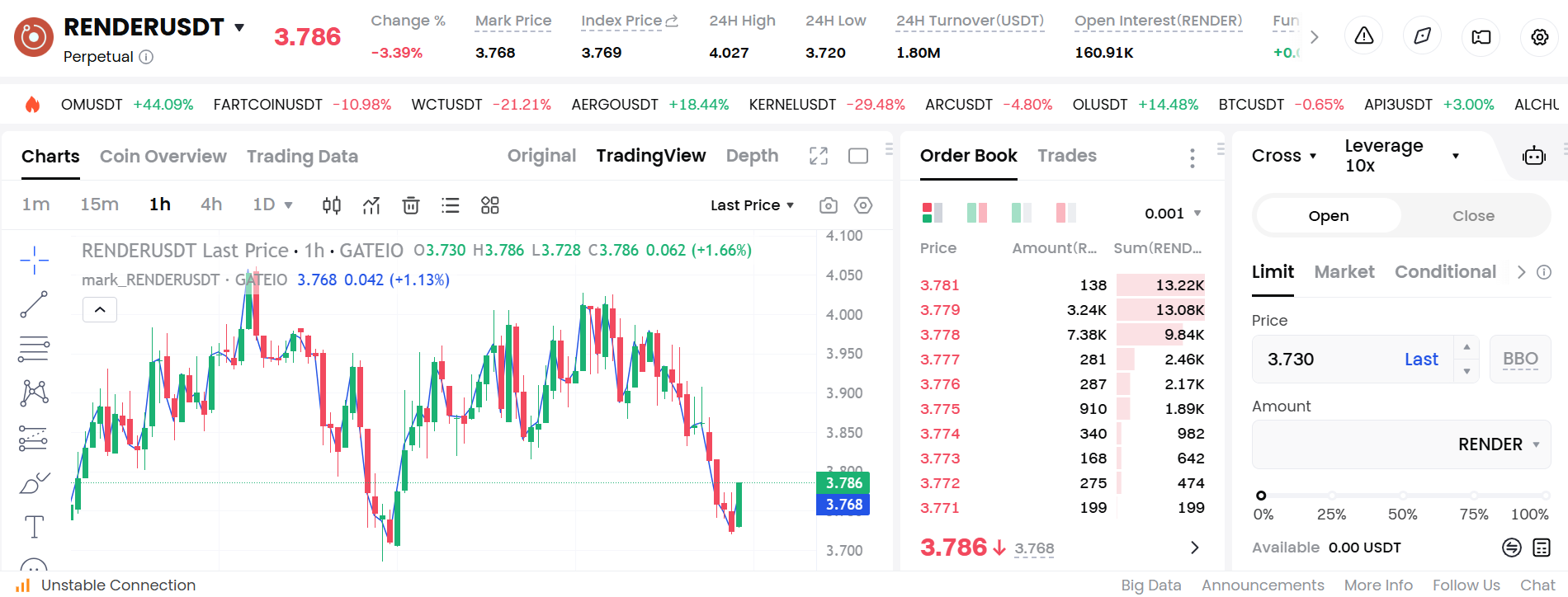

Image source: Render Futures Trading Page

Risk Warning

Cryptocurrency trading involves high market risk and price volatility. Render (RNDR), like other tokens, is subject to unpredictable fluctuations that may lead to significant gains or losses. Investors are advised to conduct thorough research and use proper risk management strategies. Never invest more than you can afford to lose.

Conclusion

Render Network’s innovative approach to decentralized rendering positions act as a significant player in the crypto space. While price predictions vary, the potential for growth exists, contingent upon technological advancements and market acceptance. Platforms like Gate.com facilitate access to Render tokens securely and smoothly.

Author: Abbey
Disclaimer
* The information is not intended to be and does not constitute financial advice or any other recommendation of any sort offered or endorsed by Gate.
* This article may not be reproduced, transmitted or copied without referencing Gate. Contravention is an infringement of Copyright Act and may be subject to legal action.

Related Articles

AI-Native Settlement Layers: How United Stables Is Building the Next Financial Rail
Beginner

AI-Native Settlement Layers: How United Stables Is Building the Next Financial Rail

Stablecoins were originally designed as dollar substitutes within exchanges, primarily used for asset pricing and trade settlement. As on-chain financial ecosystems have matured, their role has expanded beyond simple payments to include collateral assets, cross-chain liquidity mediums, and unified settlement units. In particular, as AI systems and automated agents begin to participate directly in economic activity, demand has risen sharply for programmable value units capable of instant settlement. This shift is pushing stablecoins toward the role of foundational financial infrastructure.
2026-03-25 03:16:17
The ve(3,3) Flywheel Explained: How AERO Tokenomics Powers Aerodrome’s DeFi Economy
Beginner

The ve(3,3) Flywheel Explained: How AERO Tokenomics Powers Aerodrome’s DeFi Economy

In the competition for DeFi liquidity, high-inflation mining alone is no longer enough to build lasting advantages. Aerodrome applies the ve(3,3) economic model to redesign token emissions, voting mechanisms, and revenue distribution, creating a liquidity flywheel centered on governance and cash flow. This article examines AERO tokenomics, the veAERO locking mechanism, and protocol revenue models to explain how Aerodrome builds a sustainable DeFi economic system.
2026-03-25 06:41:58
How Does PAXG Work? In-Depth Overview of the Physical Gold Tokenization Mechanism
Beginner

How Does PAXG Work? In-Depth Overview of the Physical Gold Tokenization Mechanism

PAXG (Pax Gold) is a tokenized asset backed by physical gold, issued by the fintech company Paxos and traded on the Ethereum blockchain as an ERC-20 token. The core concept is to tokenize physical gold on-chain, with each PAXG token representing ownership of a certain amount of gold. This structure enables investors to hold and trade gold in the form of a digital asset.
2026-03-24 19:12:51
Aerodrome Tokenomics: How ve(3,3) Powers Base's Most Profitable DEX
Beginner

Aerodrome Tokenomics: How ve(3,3) Powers Base's Most Profitable DEX

AERO is the native token of Aerodrome Finance, a core decentralized exchange and liquidity protocol in the Base ecosystem. It is primarily used for liquidity incentives and ecosystem operations. veAERO is a governance NFT that users receive by locking AERO, representing both voting power and the right to share protocol revenue. Through a dual track structure of AERO as a utility token and veAERO as a governance credential, Aerodrome separates liquidity usage value from long term governance power, allowing participants to act as liquidity providers, governance decision makers, and revenue sharers within the same system.
2026-03-25 06:40:31
How is the price of PAXG determined? Pegging mechanism, trading depth, and influencing factors
Beginner

How is the price of PAXG determined? Pegging mechanism, trading depth, and influencing factors

PAXG (Pax Gold) is a tokenized asset backed by physical gold reserves, launched by fintech firm Paxos and issued as an ERC-20 token on the Ethereum blockchain. The core concept is to digitally represent real-world gold assets, allowing investors to hold and trade gold via the blockchain network. Because each PAXG token corresponds to a specific quantity of physical gold, its price is theoretically expected to closely track the global gold market.
2026-03-24 19:11:40
Hybrid Collateral Stablecoins: Inside United Stables' Stability and Yield Architecture
Beginner

Hybrid Collateral Stablecoins: Inside United Stables' Stability and Yield Architecture

In the early stages of the crypto market, traditional stablecoins mainly relied on single-reserve or single-collateral models. Their primary focus was price stability and payment convenience, which allowed them to become foundational tools for on-chain trading and capital flows. As the market has entered a more mature financial phase, however, this structure has begun to reveal limitations, including high concentration risk and the difficulty of balancing liquidity with yield. These constraints have driven the evolution toward multi-layer collateral and portfolio-based designs, such as the dual-layer hybrid collateral architecture proposed by United Stables, which seeks to redefine the underlying logic of stable assets.
2026-03-25 03:17:39





