Over the past two years of Web3 financial evolution, "real-world asset tokenization (RWA)" has progressed from an early proof of concept to a market worth hundreds of billions of dollars. However, first-generation RWA products have primarily focused on low-risk, low-yield, or traditional fixed-income assets, such as U.S. Treasuries, real estate, and traditional commodities. As Web3 capital efficiency improves and institutional investors become more deeply involved, the RWA sector is expanding into areas with greater potential for growth—namely, the tokenization of Deep Tech and equity in leading private technology companies.
As a global leader in trapped-ion quantum computing valued at tens of billions of U.S. dollars, Quantinuum (QNT)'s exploration of RWA marks a significant intersection between frontier technology assets and on-chain capital markets. By bringing high-barrier, capital-intensive quantum hardware assets and equity income rights with long holding periods on-chain through blockchain technology, this approach not only challenges the traditional dominance of venture capital (VC) and private equity (PE) over the highest-value opportunities in Deep Tech, but also introduces crypto markets to assets supported by tangible technological value. This article provides a comprehensive analysis of Quantinuum's RWA tokenization framework from the perspectives of RWA financial architecture, liquidity restructuring, and cross-market coordination.
Key Takeaways
-
Analyze the financial rationale behind the evolution of Deep Tech assets from traditional VC/PE dominance to more accessible on-chain RWA tokenization
-
Examine the compliant framework through which Quantinuum (QNT) maps quantum computing hardware infrastructure, patent income rights, and equity interests to on-chain ledgers
-
Explain the advantages of blockchain tokenization in improving the liquidity of high-barrier technology assets and enabling fractional ownership
-
Explore how decentralized oracles and on-chain audits in the RWA ecosystem can provide real-time value verification for Deep Tech assets
-
Analyze coordinated approaches to asset allocation and risk hedging during the RWA paradigm shift, in combination with Gate's spot trading and asset management ecosystem
From Traditional Fixed Income to Deep Tech: The RWA Sector's Second Growth Curve and the Quantinuum Paradigm
To understand Quantinuum's value proposition in the RWA sector, it is necessary to first examine the fundamental differences between traditional RWA assets and Deep Tech RWA assets. The core logic of first-generation RWAs, such as tokenized U.S. Treasuries, is to bring the "risk-free rate" on-chain, meeting DeFi capital's demand for risk mitigation and fixed income during bear markets or periods of low volatility. However, the annualized returns of these assets are naturally constrained by macroeconomic central bank interest rate policies.
In contrast, "Deep Tech RWAs" represented by Quantinuum (QNT) target some of the world's most rapidly developing technological frontiers. Quantum computing is a capital-intensive industry requiring billions of dollars in R&D investment, extremely high technical barriers, and long commercialization cycles. Traditionally, participation has been limited to leading institutional investors or state-level funds. Through RWA tokenization, the flow of underlying value in frontier technology assets can be fundamentally simplified:
This model creates a channel for on-chain Web3 capital to directly connect with advanced physical-world technologies, while also opening diversified decentralized financing channels beyond traditional capital markets for companies such as Quantinuum.
Compliance Framework and Value Anchoring: The Financial Design of Quantinuum (QNT) Tokenization
Transforming the assets of a high-valuation, highly complex quantum computing company into compliant on-chain tokens requires a rigorous financial design across legal compliance, asset segregation, and on-chain data anchoring.
During its RWA process, the Quantinuum (QNT) framework demonstrates three core financial innovations:
-
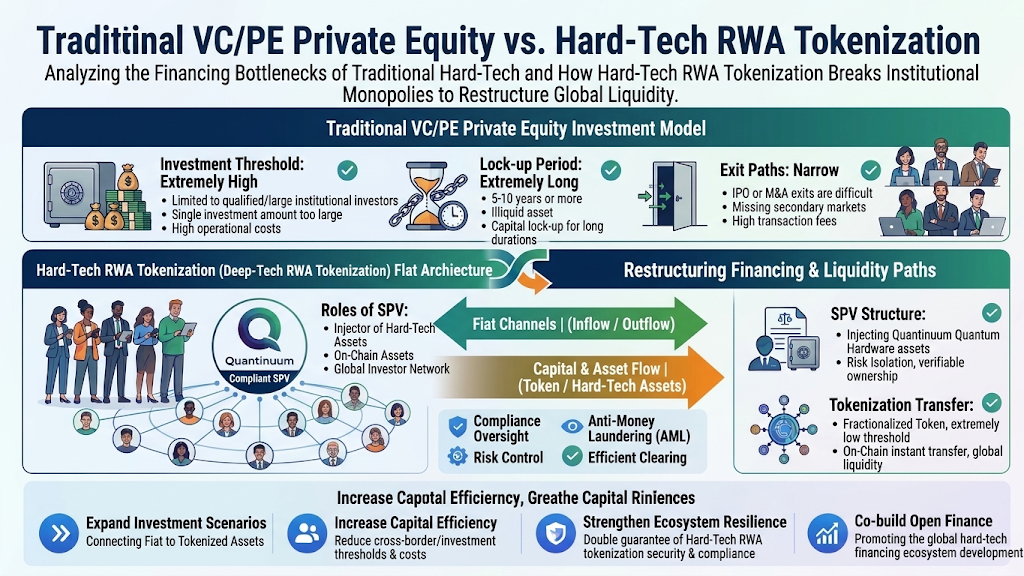
Bankruptcy Isolation and SPV Legal Structure: By establishing a Special Purpose Vehicle (SPV) in a compliant jurisdiction, quantum hardware income rights, patent licensing fees, or corresponding equity certificates can be injected into the SPV. This ensures a clear separation between the rights of on-chain token holders and the operational risks of the underlying company.
-
Fractional Ownership and Liquidity Release: Deep Tech equity investments that originally required a minimum investment of several million U.S. dollars can be divided into small programmable tokens (QNT). This substantially lowers the barrier to entry for investors worldwide and gives previously illiquid private assets access to continuous 24/7 secondary market liquidity.
-
On-Chain Oracles and Transparent Audits: Through decentralized oracle networks, Quantinuum's quantum cloud computing utilization, patent licensing revenue, and financial audit reports can be regularly synchronized on-chain, helping ensure that the price of on-chain QNT tokens reflects the operating conditions of their underlying Deep Tech assets in a timely manner.
| Evaluation Dimension |
Traditional Technology Private Equity |
Quantinuum (QNT) RWA Tokenization |
| Entry Threshold |
Limited to Accredited Investors, starting at $1 million |
No minimum threshold, supporting fractional micro-allocations |
| Liquidity and Trading Hours |
Lockup periods of 5–10 years, with no secondary market |
Instant 24/7 on-chain transfers with deep liquidity |
| Transparency and Auditing |
Delayed quarterly or annual financial reports |
Real-time oracle data anchoring and on-chain verifiable audits |
This financial design combines tangible Deep Tech with programmable on-chain capital, creating a new framework for higher-growth assets across the RWA sector.
On-Chain Derivatives and Liquidity Pools: Financial Leverage and Risk Management for Deep Tech RWA Assets
As frontier technology RWA assets such as Quantinuum (QNT) are introduced on-chain, the benefits of tokenization extend beyond fractional ownership and continuous 24/7 trading. More importantly, they connect previously highly illiquid private equity and hardware assets with DeFi-based secondary financial leverage and risk management channels. In traditional financial systems, investors holding equity in high-tech companies often face capital lockup periods lasting several years and may find it difficult to obtain short-term liquidity without selling their assets.
Under the on-chain RWA model, investors can use QNT assets held and verified by trusted oracles as collateral to access compliant decentralized lending protocols. This allows them to borrow stablecoins, such as USDT or USDC, to meet liquidity needs without giving up the potential for long-term capital appreciation. At the same time, as on-chain QNT perpetual contracts and options become available, market participants can use derivatives to hedge against periodic volatility during frontier technology R&D cycles. This on-chain DeFi combination of "asset-backed lending + derivatives hedging" enables Deep Tech RWAs to serve not only as value storage vehicles, but also as new types of on-chain foundational assets with strong liquidity and flexible risk management capabilities.
Asset Allocation During the RWA Paradigm Shift and the Coordinated Advantages of the Gate Ecosystem
As Deep Tech RWA assets such as Quantinuum (QNT) gain traction in the decentralized finance ecosystem, the global crypto asset market is entering a new stage marked by the return of tangible physical technology value. The continued expansion of RWA assets not only introduces assets with relatively low correlation to crypto-native assets into on-chain markets, but also provides global investors with channels to allocate to high-quality technology equity and hardware-related returns amid macroeconomic volatility.
In this significant financial paradigm shift, mainstream crypto asset trading platforms play an essential role as hubs for asset custody and trade matching. Gate, for example, is a globally leading crypto asset trading platform that has identified the trend of the RWA sector expanding into Deep Tech and provides deep spot trading pairs and liquidity services for RWA assets such as QNT.
Through Gate, users can conveniently allocate to and trade Deep Tech RWA assets such as QNT on the spot market. They can also combine the platform's compliant custody, wealth management products, and diverse derivatives tools to manage cross-market risk. This combination of compliant custody security, a broad range of RWA assets, and strong trading liquidity provides global users with a solid hub for value capture and asset management in the era of Deep Tech RWAs.
FAQ
What is a Deep Tech RWA, and how does it differ from a traditional RWA?
Traditional RWAs primarily tokenize conventional fixed-income assets, such as U.S. Treasuries and real estate, with relatively stable returns that are constrained by macroeconomic interest rates. Deep Tech RWAs, such as Quantinuum QNT, tokenize the equity or patent income rights of frontier technology companies in areas such as quantum computing and AI hardware, offering growth potential supported by technological value.
How does Quantinuum (QNT) tokenization protect the rights of on-chain investors?
Assets are segregated through a compliant SPV (Special Purpose Vehicle). Tangible hardware income or equity certificates are legally injected into the SPV, while on-chain oracles provide real-time on-chain audits of financial and computing-capacity data, helping ensure that on-chain tokens are closely linked to the value of underlying assets.
How can individual investors allocate to QNT and Deep Tech RWAs on Gate?
Investors can conveniently purchase and trade Deep Tech RWA assets such as QNT through Gate's spot market. With Gate's deep liquidity, secure custody, and wealth management and hedging tools, investors can participate in the long-term development of leading global quantum technologies.