Prediction markets turn assessments of political, economic, sports, and crypto industry events into tradable market prices. As on-chain asset issuance and tokenization tools develop, trading opportunities surrounding prediction markets are also beginning to extend beyond their native markets. However, event outcome shares, interests in prediction market platforms, and third-party PreAccess tokens are not the same type of asset. Understanding their differences is fundamental to assessing the value, risks, and long-term growth potential of prediction market tokenization.
Key Takeaways
-
Prediction market prices reflect how the market prices a specific event outcome, not the certainty that the event will occur
-
Tokenization can change how assets are represented, transferred, and traded, but it does not automatically create underlying rights or economic value
-
Third-party tokens associated with prediction market platforms should not be assumed to represent official platform tokens, equity, or rights related to a future public listing
-
Liquidity, settlement mechanisms, issuers, legal rights, and genuine demand jointly determine the sustainability of tokenized structures
-
Gate's prediction market product offers users another way to trade event outcomes, but prediction market trading and purchasing related third-party tokens follow different trading logic
How Prediction Markets Work: Turning Event Assessments Into Prices
Prediction markets are trading markets built around the outcomes of future events. Participants express their views on a verifiable event and take on risk by buying or selling shares in the corresponding outcomes. Unlike traditional financial markets, which primarily trade company stocks, bonds, or commodities, prediction markets focus on event outcomes. Examples include whether an economic indicator will reach a predefined level, whether a policy will pass, which team will win a match, or whether a crypto asset will meet a specific price condition within a designated period. Market participants submit trades based on the information they have, their probability assessments, and their risk preferences. Prices adjust as orders, capital flows, and information change.
In a typical binary outcome market, a contract may cover two outcomes: "Yes" and "No." If a share in the correct outcome pays 1 unit at settlement while a share in the incorrect outcome pays 0, its trading price can serve as a reference for the market's implied probability of that outcome. For example, a "Yes" share priced at 0.65 means the market is pricing that outcome at a level corresponding to approximately 65%. This number is not a verified, objective probability, nor does it mean the outcome is nearly certain. Trader information, market depth, risk preferences, trading fees, capital constraints, and short-term sentiment can all influence it. In markets with limited liquidity, even a small number of trades can significantly change quoted prices.
Prediction markets offer value not only by allowing participants to express their views, but also by bringing different participants' assessments together into a single observable price. Traditional surveys typically capture responses at a specific point in time, while social media discussions are susceptible to the speed at which information spreads and collective sentiment. Prediction markets, by contrast, require participants to bear the financial consequences of incorrect assessments. This mechanism may create an information aggregation process with stronger accountability. However, committing funds does not mean all participants have high-quality information, nor does it ensure that market prices are accurate. Sampling bias, concentrated holdings, manipulation, unclear settlement rules, or uneven information distribution can cause market prices to diverge from underlying probabilities.
Understanding prediction markets therefore starts with distinguishing three concepts: the event itself, the contract's definition of the event, and the market's pricing of the contract. The event is what ultimately happens or does not happen in the real world. Contract rules determine which conditions constitute a valid outcome, who determines it, and when settlement occurs. The market price reflects how much traders are willing to pay for a particular outcome at a given moment. These three concepts are related, but they are not interchangeable. A seemingly simple question about whether something will happen can lead to settlement disputes if it lacks a clear timeframe, data source, or dispute resolution process. A prediction market's ability to operate over the long term depends not only on trading volume, but also on sufficiently clear outcome definitions and settlement rules.
From Outcome Shares to Tokenization: Distinguishing Asset Structures
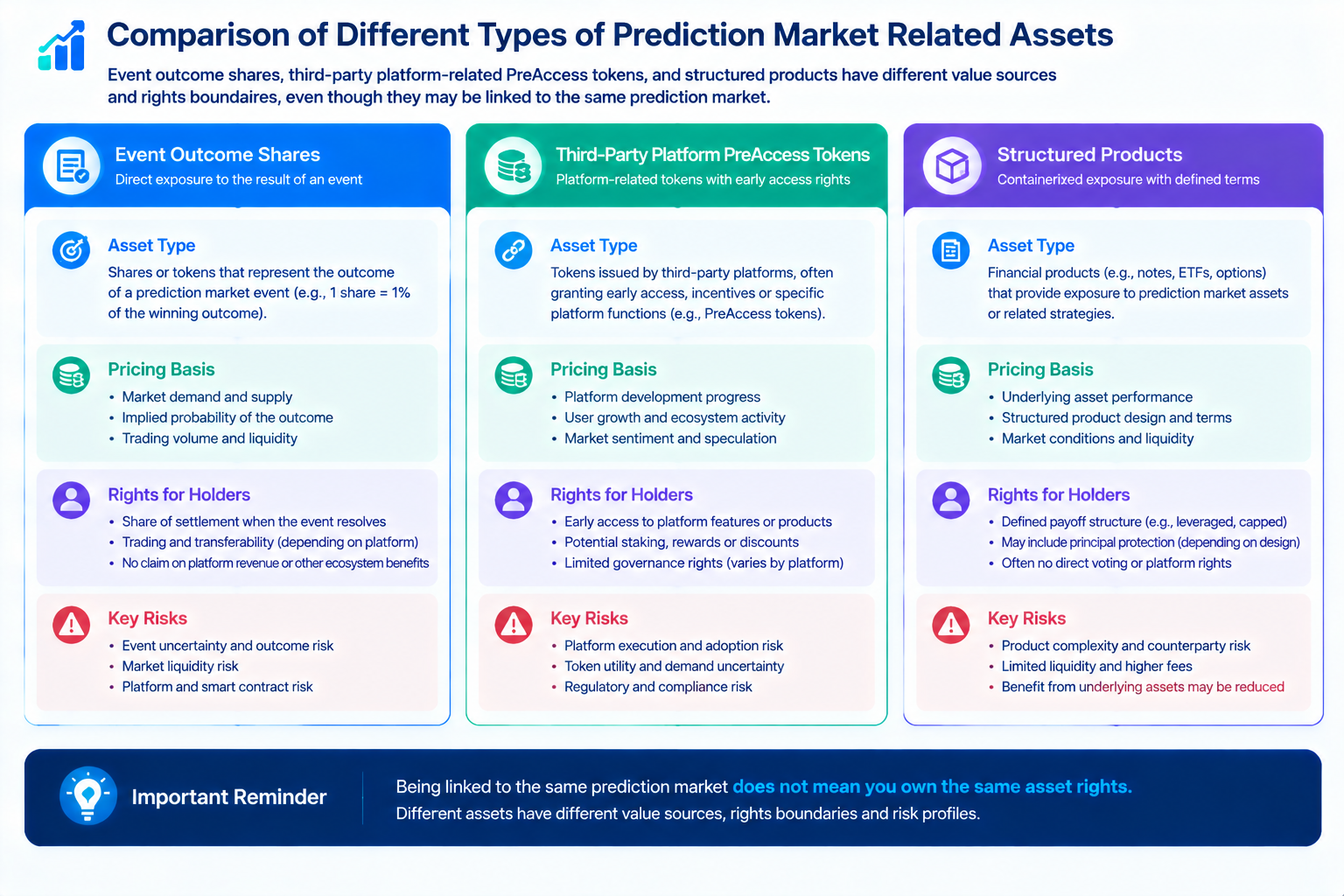
Prediction market tokenization is not a single technical approach, but an umbrella term for several asset structures. The most direct type represents prediction market outcome shares as tokens or transferable on-chain assets. Its economic logic still centers on the settlement outcome of a specific event, and the value of a share depends on the contract terms, market price, and final outcome. Tokenization may improve asset transfers, programmatic interactions, and on-chain composability, but it also requires the underlying contracts, asset custody, and settlement rules to align properly with the token structure. If an on-chain token is merely a certificate that does not clearly explain how holders receive the corresponding settlement rights, the token format itself cannot resolve unclear rights.
The second type consists of tokens that provide indirect exposure to prediction market platforms or related companies. For example, a third-party issuer may design a token that allows market participants to trade a particular economic exposure it describes, or to trade around expectations of a potential public listing, future valuation, or other developments. These assets are not equivalent to "Yes/No" shares in a specific event. Their value may depend on the issuer's terms, asset arrangements, supply and demand, market expectations, and secondary market sentiment. Even if a token's name includes a well-known platform, that alone does not establish that it represents equity, governance rights, revenue-sharing rights, or rights associated with an official platform token. Any connection between a name and legal rights must be supported by clear documentation and verifiable arrangements.
The third type involves broader financial structures, such as using prediction market positions as collateral, combining different event outcomes into investment strategies, or embedding certain market exposures in other on-chain applications. These structures may expand how assets can be used, but they also introduce additional risks: underlying market price volatility, smart contract vulnerabilities, collateral haircuts, liquidation rules, cross-chain bridge security, and settlement timing mismatches. Liquidity in the underlying market at a particular moment does not mean positions in a combined product can still be closed promptly under stressed conditions. The more layers a product has, the more important it becomes for participants to understand which rights the asset represents, who must fulfill the obligations, and whom they can seek recourse against if the system malfunctions.
This is also one of the most common misconceptions in tokenization discussions: treating technical transferability as certainty about economic rights. A token's ability to move on-chain does not mean it necessarily has an enforceable redemption mechanism. A smart contract's ability to run automatically does not eliminate the need for trusted data sources to determine real-world event outcomes. An asset's listing on a decentralized trading platform does not mean its market depth can support large trades. When evaluating a tokenized structure, participants should first identify the underlying asset, then verify the issuer and legal rights, and only afterward consider on-chain composability and trading convenience. They should not reverse this process by inferring asset value from a token's name or trading popularity.
Changes in Liquidity, Price Discovery, and Market Structure
One of tokenization's most appealing potential benefits is giving certain exposures, previously confined to specific platforms, accounts, or settlement systems, more flexible transfer options. On-chain assets can interact with other applications through public trading pools, wallets, and smart contracts, which could theoretically broaden participation and asset use cases. However, more circulation channels do not necessarily bring a corresponding increase in genuine liquidity. An asset may appear on multiple platforms while still offering little executable market depth. It may also trade actively under normal market conditions, only for its bid-ask spread to widen significantly when prices move rapidly.
Trading volume is only one measure of liquidity. Participants also need to examine order book depth, bid-ask spreads, price differences across platforms, trading volume concentration, liquidity pool size, and whether a small number of addresses generate volume through repeated trading. In on-chain markets especially, the same participant may use multiple addresses, so the number of publicly visible token-holding addresses does not necessarily correspond to the number of independent investors. If a token has high reported trading volume but limited available liquidity, or if a small number of trades largely determine its price, higher volume may reflect frequent turnover rather than the ability to move substantial capital in and out at prices close to the current market level.
Price discovery in prediction markets and related token markets may also proceed at different rates. Prediction market shares reflect expectations about the outcome of a specific event. Platform-related tokens, by contrast, may reflect valuations based on the issuer's business prospects, potential liquidity, future events, or market narratives. A thematic connection between the two does not mean their prices must move together. Growth in an event market's trading volume may indicate increased interest in the event's outcome, but it does not directly prove that a third-party token's underlying rights have increased in value. Conversely, a related token's price increase does not automatically indicate a change in the prediction market's probability assessment.
A more mature market structure requires clear asset classifications, reliable price information, appropriate trading rules, and transparent settlement arrangements. Market operators need to guard against fabricated trades, price manipulation, and information asymmetry. Issuers need to clearly disclose the scope of token rights, supply arrangements, use of funds, and risks. For participants, the most practical approach is to assess market attention, trading activity, and realizable economic rights separately. Only when trading mechanisms, underlying rights, and sustained demand align can tokenization potentially develop from a short-term trading concept into stable market infrastructure.
PreAccess tokens associated with well-known prediction market platforms offer a case study of how tokenization narratives enter crypto markets. For example, public materials describe the Paimon Polymarket SPV Token (PPOLY), introduced by Paimon Finance, as the first Polymarket-related PreAccess token launched on BNB Smart Chain. This case does not establish that the prediction market platform itself has issued a tradable token. Instead, it illustrates how third parties design tokenized products around expectations and market attention surrounding a well-known platform. The name, issuer, rights arrangements, and potential underlying exposure must each be checked separately.
For these assets, the first question is: What does the token represent? Does it correspond to an existing asset, contractual rights, or a specific arrangement for returns? Do holders have any governance, redemption, dividend, or equity rights? If those rights depend on future events, who defines the trigger conditions, are there deadlines, and what happens if the events do not occur? If issuance documents describe only market exposure or an expected association, participants should not interpret that as an assurance of a future platform public listing, token issuance, or equity interest. PreAccess is the name of a product or issuance mechanism; it does not automatically grant holders any particular legal rights.
The second question concerns the relationship between the issuer and the associated platform. A third party can issue an asset connected to a project, but that act alone does not mean the project participates in the issuance, approves the product, or assumes responsibility for fulfilling its obligations. Market participants need to verify official statements, issuance documents, contract addresses, and related disclosures, and confirm the token's trading, custody, redemption, and dispute resolution mechanisms. If the relationship between the issuer and the platform is unclear, participants should treat that uncertainty as a risk requiring careful assessment rather than infer undisclosed rights from a familiar name. Even if the token trades publicly on-chain, on-chain transaction records establish only that the token was transferred. They cannot, by themselves, prove that the described economic rights exist or are enforceable.
The third question concerns how prices form. Trading prices for these tokens may depend on issuance-stage pricing, initial circulating supply, market depth, social media discussions, trading platform listings, and investors' expectations about future events. If the market treats a potential public listing or future token event as its central narrative, prices may reflect optimistic expectations before the actual rights are clear or while the event remains uncertain. Prices may also fall rapidly if expectations change. Understanding this type of asset requires separating verifiable facts from market speculation. Token deployment, listing, and trading activity are on-chain or platform-level facts. Whether a future public listing will occur, whether the issuer has obtained specific rights, and whether holders can share in a particular form of value each require independent evidence.
This case also shows that the long-term value of prediction market tokenization cannot rely solely on associations with well-known platforms. Sustainable products need clear rights structures, transparent disclosures, verifiable asset arrangements, trustworthy trading and settlement mechanisms, and genuine demand that extends beyond short-term topics of interest. Without these conditions, token prices may reflect market sentiment more than sustained growth in the underlying business. For the industry, distinguishing native prediction market contracts, platform-related interests, and third-party PreAccess tokens is a necessary step toward a credible market classification framework.
Risks, Compliance, and Conditions for Sustainable Development
Prediction market tokenization faces market, technical, and regulatory risks. Market risks include price volatility, insufficient liquidity, counterparty risk, and market manipulation. Technical risks involve smart contract vulnerabilities, private key management, bridged asset security, and the irreversibility of on-chain transactions. Regulatory risks include differences across jurisdictions in how they classify prediction markets, derivatives, gaming, securities, or other financial products. Issuing a product as a blockchain token does not automatically exempt it from applicable laws or platform rules. Before participating, users need to understand the product's specific structure and the restrictions that apply in their location.
Event markets also face a distinctive settlement risk: real-world events do not always map directly to contract definitions. For example, a question about whether a company will go public before a certain date may involve different interpretations across markets of the listing date, the start of trading, what qualifies as an exchange, and official announcements. If the rules lack precision, participants may dispute the final settlement outcome even when they agree on the facts themselves. Reliable prediction markets therefore need to specify event definitions, data sources, settlement times, procedures for exceptional circumstances, and appeals processes before trading begins. They should not leave users solely responsible for interpreting these matters after a dispute arises.
The sustainability of tokenized markets ultimately depends on whether demand comes from genuine use rather than short-term narratives alone. For prediction markets, sustained demand may come from users' needs for information aggregation, risk management, event trading, and research tools. For related tokens, sustained demand depends on whether they have clear and verifiable economic uses. If an asset's main appeal is the expectation that another buyer will pay a higher price in the future, the market can easily become dependent on liquidity and cycles of sentiment. Conversely, tokenization has the potential to create a more resilient economic structure when products offer clear rights, reliable settlement, and sustained demand for their use.
Gate Event Markets offers users another way to trade real-world event outcomes, connecting prediction markets' probability-based pricing mechanisms with trading activity in crypto markets. Users can assess changes in the outcomes of specific events and observe through market prices how different expectations appear in trading. From a product perspective, Gate Event Markets focuses on event outcomes and their corresponding market trading mechanisms. Third-party PreAccess tokens issued around prediction market platforms, by contrast, may involve separate issuers, asset structures, and rights arrangements. Although market expectations may influence both, their pricing foundations differ. Understanding this distinction helps separate event outcome trading from platform-related token trading and avoids directly equating changes in an event's probability with changes in a related token's value. As prediction markets continue to develop, Gate Event Markets also provides a concrete setting for observing the relationship between event pricing, market expectations, and crypto trading.
FAQ
What does prediction market tokenization mean?
Prediction market tokenization generally refers to representing and trading event outcome shares or some form of economic exposure related to prediction markets as tokens or on-chain assets. The underlying rights can differ entirely from one product to another, so participants need to verify what a token actually represents before assessing its price and risks.
Is PPOLY an official Polymarket token?
The name or market association alone is not enough to make that determination. Public materials describe PPOLY as the Paimon Polymarket SPV Token introduced by Paimon Finance. Polymarket's official help center previously stated that, at that time, it had not announced an official token issuance or airdrop plan. Participants should rely on the latest official statements and formal documents from both parties.
Why doesn't high trading volume necessarily mean a token has greater value?
Trading volume measures trading activity over a given period. It does not directly measure an asset's legal rights, cash flows, or genuine demand. High volume may result from frequent turnover, short-term attention, or active trading by a small number of addresses. Assessing token value also requires examining liquidity depth, issuance structure, holder concentration, and actual use cases.
Prediction market trading centers directly on the outcome of a specific event and contract settlement. Trading in related tokens, by contrast, may be priced around a third-party issuer's arrangements, narratives linking the token to a platform, or future expectations. The two differ in their price drivers, rights structures, and risks.