As chain abstraction technology continues to develop, the relationship between actual infrastructure usage and token value is receiving increasing attention. Even if a network's transaction volume continues to grow, this does not mean its native token will necessarily experience a proportional increase in demand. Fee settlement methods, token velocity, staking mechanisms, and supply unlocks can all affect market supply and demand.
This article analyzes PARTI's primary uses, Gas settlement, staking governance, token allocation, and unlock mechanisms. It also focuses on whether the growth of the Particle Network ecosystem can translate into sustained demand for the token.
Key Takeaways
- PARTI is the native token of Particle Network. Its primary designed uses include Gas settlement, cross-chain liquidity, staking, and governance.
- Universal Gas does not require users to hold PARTI directly in all scenarios. Related fees can be paid with other assets, while settlement is handled by underlying mechanisms.
- PARTI has a total supply of 1 billion tokens. Each allocation category is released gradually according to its respective vesting schedule.
- Token unlocks do not equal immediate selling. Potential selling pressure must be assessed based on recipient behavior, circulating supply, and market liquidity.
- Growing network usage does not guarantee an increase in the price of PARTI. Actual value capture depends on factors such as fees, settlement demand, staking, and token supply.
What Is PARTI? What Role Does It Play in Particle Network?
PARTI is the native token of Particle Network. It supports the economic operations of Particle Chain and related chain abstraction infrastructure. Its designed uses include network fees, cross-chain liquidity settlement, staking, and governance.
Particle Network's core objective is to provide users with a unified cross-chain account experience through Universal Accounts. Users can use fragmented assets across supported networks without manually switching networks, transferring assets across chains, or preparing Gas each time.
Within this system, PARTI primarily serves underlying economic functions rather than acting as a transaction asset that every user must hold directly. For example, a user may pay the fee for a cross-chain operation in USDC, while the underlying infrastructure handles fee conversion and settlement in the background.
This design reflects a key characteristic of chain abstraction: the user interface minimizes reliance on tokens associated with specific blockchains, while the infrastructure layer still requires fee settlement and economic incentives. Therefore, understanding PARTI requires distinguishing between protocol utility and actual demand. Designing a token for a specific function does not mean that the function has already created sustained market demand for the token. Its economic value still depends on how the network operates in practice.
How Does PARTI Participate in Universal Gas Fee Settlement?
Universal Gas is a mechanism used by Particle Network to simplify multi-chain fee payments. In traditional blockchain transactions, users generally need to hold the native token of the target network to pay Gas. For example, Ethereum uses ETH, while Solana uses SOL.
Universal Gas uses fee sponsorship, asset conversion, and cross-chain coordination to allow users to pay transaction fees with other assets in supported scenarios, reducing the need to prepare different Gas tokens separately.
As the native Gas token of Particle Chain, PARTI also participates in related underlying fee settlement. For example, a user may initiate a cross-chain transaction through Universal Accounts and choose to pay the fee in USDC. The user sees a fee denominated in USDC, while the system handles the underlying network fees and related infrastructure settlement. However, Universal Gas does not mean that every transaction directly creates open-market buying demand for PARTI. Actual fees may be covered by service providers, liquidity mechanisms, or previously held token balances.
At the same time, underlying networks such as Ethereum and Solana must still meet their respective fee requirements. PARTI participates in the economic mechanisms related to Particle Network; it does not replace the native Gas assets of all blockchains. Therefore, growing network transaction volume may increase fee settlement activity, but whether it creates sustained demand for PARTI requires further observation of actual fee volumes, settlement paths, and token velocity.
What Are PARTI's Uses in Cross-Chain Liquidity and Transaction Settlement?
Universal Liquidity is a key mechanism through which Particle Network provides unified cross-chain balances. It coordinates assets and liquidity across different networks, allowing users to use funds distributed across multiple blockchains in supported applications. For example, a user may hold USDC on Ethereum and want to purchase a token on another network. Universal Liquidity can coordinate the source asset and liquidity on the target network, integrating the cross-chain transfer and conversion steps that would otherwise need to be completed manually into the transaction process.
In Particle Network's economic design, PARTI is also designed to serve as an intermediary asset for cross-chain liquidity settlement. Liquidity providers can participate in cross-chain transactions through related mechanisms and earn fees according to the protocol's rules. This design means that potential demand for PARTI may come not only from Gas but also from cross-chain liquidity activity.
However, using PARTI during a transaction does not mean that the participants involved need to hold the token over the long term. If liquidity providers use PARTI only briefly during settlement and then convert it back into other assets, growing transaction volume may primarily increase token turnover rather than demand for long-term holdings.
In addition, cross-chain transactions are affected by liquidity depth, price slippage, and execution costs. Therefore, determining whether PARTI can gain sustained demand from Universal Liquidity requires observing actual settlement volume, liquidity provider behavior, and related fee revenue. Cross-chain transaction volume should not be treated directly as buying demand for PARTI.
How Do PARTI Staking and Governance Work?
Staking is a common economic incentive mechanism in blockchain networks. Participants lock a certain amount of tokens according to protocol rules to support network operations or participate in related activities, and may receive corresponding rewards. PARTI is designed for staking and governance, supporting the economic security and ecosystem decisions of Particle Network. Governance mechanisms may allow eligible token holders to participate in decisions concerning certain network parameters and development matters.
From a tokenomics perspective, staking may have two effects.
- Token locking may reduce the amount of supply freely available for short-term trading. If more participants stake PARTI on an ongoing basis, some tokens may temporarily leave the active trading market.
- Staking rewards can incentivize network participants, but the source of those rewards affects the sustainability of the mechanism. If rewards primarily come from newly issued tokens, stakers may receive more tokens while the overall supply also increases.
- The amount staked does not fully equal the supply locked over the long term. The actual effect also depends on the withdrawal waiting period, reward rules, and whether participants can obtain liquidity through other mechanisms.
Governance also requires a distinction between designed utility and actual authority. Holding PARTI does not mean that a holder can directly decide all network operations. The scope of participation depends on the governance rules that are actually made available. Therefore, staking and governance provide PARTI with network-level utility, but their effects on token supply and demand must be analyzed together with actual staking data, reward sources, and withdrawal mechanisms.
What Are PARTI's Total Supply, Allocation, and Unlock Mechanisms?
PARTI has a total supply of 1 billion tokens. Token generation and initial distribution were completed in March 2025. The initial circulating supply was 233 million tokens, representing 23.3% of the total supply. Token allocations cover community growth, private funding, the team and advisors, public sales, liquidity, and ecosystem reserves. Each category is released gradually according to its respective lock-up period and vesting schedule.
PARTI Token Allocation
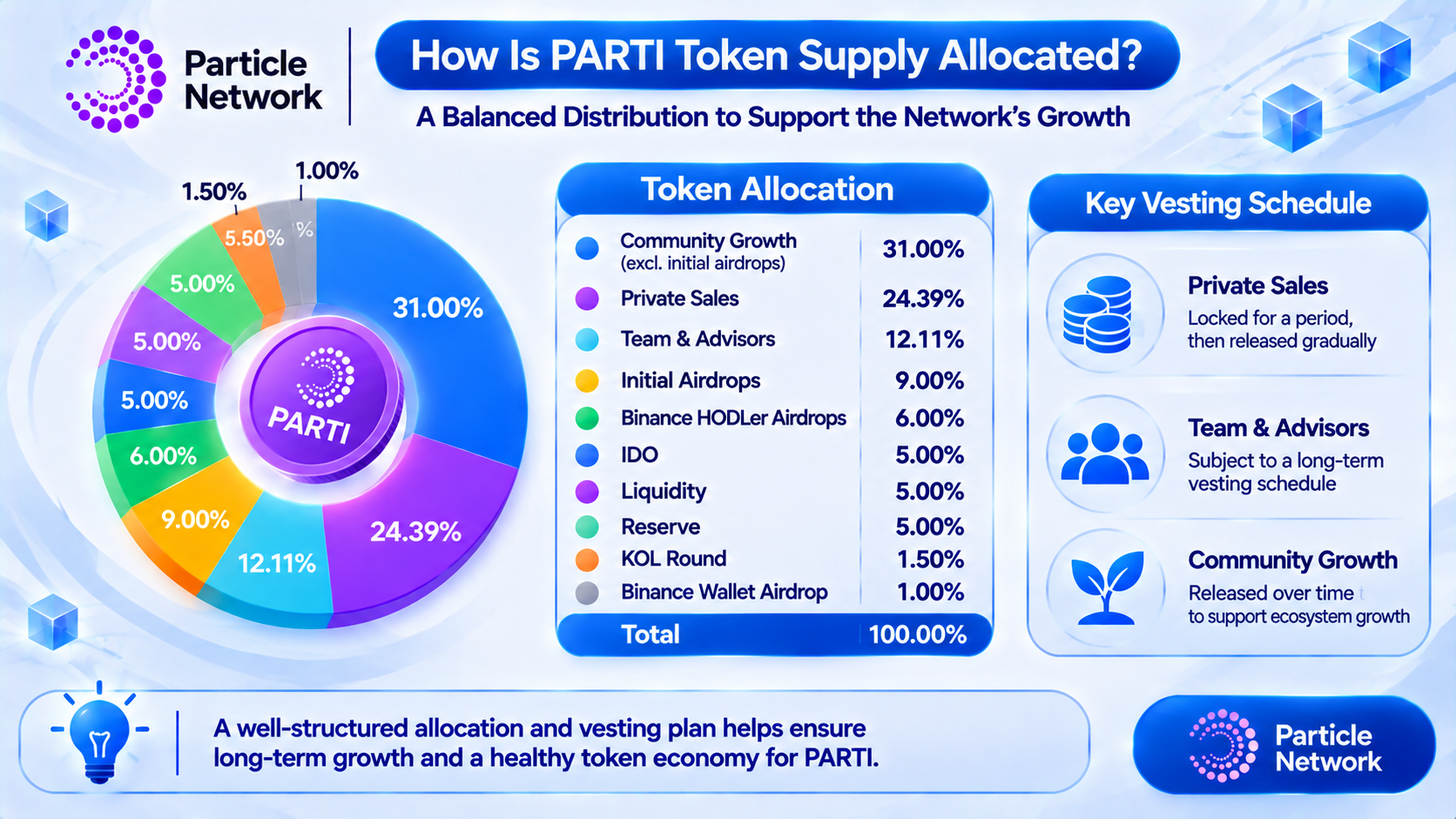
Token vesting refers to the process through which tokens gradually obtain the right to be transferred and used according to a predefined schedule. PARTI allocations for private funding, the team and advisors, and other categories are subject to corresponding lock-up and phased release arrangements. The purpose is to prevent all tokens from entering the circulating market at the initial stage.
However, phased releases do not mean that there will be no future supply pressure. Once a lock-up period ends, previously restricted tokens gradually obtain transfer rights, which may increase the supply available for trading. If market demand does not grow at the same time, the additional supply may put pressure on the price.
An unlock does not equal a sale. Some recipients may continue holding their tokens, participate in staking, or use them for ecosystem activities. Therefore, the actual selling pressure cannot be determined solely by the number of unlocked tokens.
Investors should focus on the proportion of each unlock relative to the current circulating supply, the types of token recipients, fund inflows to exchanges, and market liquidity. For PARTI, subsequent vesting schedules and actual circulating amounts should still be verified against the latest disclosures and on-chain data.
Does Growing Particle Network Usage Necessarily Increase Demand for PARTI?
Particle Network usage and the economic demand for PARTI are related, but they do not have a simple proportional relationship. Based on the protocol design, PARTI participates in Gas settlement, cross-chain liquidity, and staking governance. Therefore, as more users use Universal Accounts to execute transactions, related activity may increase some underlying fee settlement and liquidity demand. However, whether network growth translates into token value depends on several key factors.
Actual fee revenue. Suppose the network's daily transaction count increases tenfold, but the fee per transaction declines significantly. Total fee revenue may not increase at the same rate. Transaction volume and economic revenue must be analyzed separately.
Token velocity. If the same batch of PARTI can be repeatedly used for settlement, the network may process more transactions without significantly increasing demand for long-term holdings.
Fee distribution mechanisms. A protocol's collection of fees does not mean that all related revenue flows to PARTI holders. Fees may be used to pay network participants, maintain infrastructure, or serve other protocol purposes. Without a clear mechanism, it is not appropriate to directly infer that network revenue will be used for token buybacks or burns.
Changes in token supply. Even if network usage increases and staking demand grows, ongoing unlocks from private funding, team, and ecosystem incentive allocations may also increase the supply available on the market. Therefore, determining whether PARTI is actually benefiting from network growth requires observing the following indicators at the same time:
| Indicator |
Analytical Focus |
| Active accounts |
Whether the network is attracting real users who use it consistently |
| Cross-chain transaction volume |
Whether usage frequency and transaction value are increasing |
| Actual fees |
Whether transaction activity is generating economic revenue |
| PARTI settlement demand |
How many tokens are required for underlying settlement |
| Staking amount |
Whether staking is creating sustained locking demand |
| Token unlocks |
Whether additional supply exceeds the market's absorption capacity |
It is particularly important to distinguish transaction volume from protocol revenue. For example, a network processing $100 million in cross-chain transactions does not mean that the protocol earns $100 million in revenue. What matters is the fee generated by those transactions and how those fees enter the token economy. Growing Particle Network usage does not mean that the price of PARTI will necessarily increase. Network adoption and token value capture must be evaluated separately.
What Are the Potential Risks Facing PARTI's Tokenomics?
PARTI's tokenomics are closely linked to Particle Network's chain abstraction infrastructure, but its long-term performance still faces multiple uncertainties.
- Ecosystem adoption risk. Chain abstraction can simplify multi-chain transactions, but whether developers are willing to integrate Universal Accounts and whether users continue using the related features will affect the network's ability to generate stable demand. If the number of applications grows without corresponding real transaction activity, related economic revenue may fall below expectations.
- Value capture risk. Although PARTI participates in network fee and liquidity settlement, if actual fees remain low or the token is used primarily for short-term turnover, the effect of network growth on long-term token demand may be limited.
- Supply release risk. As allocations for private funding, the team, and ecosystem incentives are gradually unlocked, the supply of tokens available for trading may increase. If additional supply grows faster than market demand, PARTI may face price pressure. However, the actual impact will still depend on holder behavior and market liquidity.
- Sustainability of staking incentives. If rewards depend on newly issued tokens while network revenue is insufficient to support long-term incentives, ongoing supply dilution pressure may result.
- Technology and market risks. Particle Network involves smart accounts, cross-chain messaging, liquidity providers, and multiple underlying blockchains. Vulnerabilities or operational issues in these components could affect the user experience. At the same time, the chain abstraction sector is still developing, and the project needs to establish competitiveness through actual performance, security, and application adoption.
Therefore, PARTI's long-term value cannot be assessed solely based on the project's technical concept or short-term market sentiment. It is also necessary to observe whether network activity can generate sustainable revenue and whether token supply and demand remain relatively balanced.
Conclusion
PARTI is the native utility token of Particle Network. It primarily supports mechanisms related to network Gas, cross-chain liquidity settlement, staking, and governance. Its economic design seeks to connect token demand with the actual use of chain abstraction infrastructure, but different functions do not affect token supply and demand in the same way.
Universal Gas allows users to pay fees with other assets in supported scenarios, while PARTI participates in underlying network settlement. Universal Liquidity may increase demand for token usage through cross-chain liquidity activity, but transaction turnover does not equal demand for long-term holdings.
PARTI has a total supply of 1 billion tokens, with different allocations released gradually according to their vesting schedules. Future supply changes, staking participation, and market liquidity are all important factors when evaluating the tokenomics.
For investors, analyzing PARTI should involve more than tracking Particle Network account numbers or cross-chain transaction volume. It is also necessary to monitor actual fees, settlement demand, token velocity, and unlock progress. The development of chain abstraction technology may create new demand for network usage, but whether that demand can translate into sustained economic value for the token still needs to be validated through actual operating data.
FAQ
What Is PARTI?
PARTI is the native token of Particle Network. Its primary designed uses include Gas settlement, cross-chain liquidity, staking, and governance.
What Is the Total Supply of PARTI?
PARTI has a total supply of 1 billion tokens. Its initial circulating supply was 233 million tokens, representing 23.3% of the total supply.
Do I Need to Hold PARTI to Use Universal Accounts?
Not necessarily. Universal Gas allows users to pay fees with other assets in supported scenarios, while the related infrastructure handles underlying settlement.
Can PARTI Staking Generate Returns?
PARTI has designed utility related to staking, but actual participation requirements, reward sources, and withdrawal rules depend on the specific mechanisms made available. This does not represent guaranteed returns.
Will PARTI Token Unlocks Cause the Price to Decline?
Not necessarily. Unlocks may increase the supply available for trading, but whether they create actual selling pressure depends on holder behavior, market demand, and liquidity.
Will Growing Particle Network Transaction Volume Drive PARTI Higher?
Not necessarily. Growing transaction volume may increase some settlement demand, but the token price is also affected by fee volume, token velocity, supply releases, and market expectations.