Reports said that NVIDIA had reached an agreement to acquire Hugging Face for approximately $12.9 billion, but Reuters could not verify the report at the time, and neither party publicly confirmed it. That uncertainty matters: Any discussion should not assume that the transaction has already closed. The more important question is what would happen to the AI industry’s power structure if the world’s largest AI chip company controlled a foundational platform with millions of public models and developers.
Hugging Face’s Value Goes Beyond Being a Model Repository
Many people see Hugging Face as a website for storing models, but that view understates its role in the industry. Reference materials indicate that, as of 2025, the platform had approximately 13 million users and hosted more than 2 million public models. More importantly, its model repository connects researchers, open-source communities, application developers, inference services, and hardware ecosystems.
Models can be copied, but the surrounding layers—downloads, evaluations, version management, datasets, community collaboration, and toolchains—are much harder to replicate. Hugging Face is therefore better understood as a model distribution layer and developer network, not merely a content platform.
Why Would NVIDIA Be Interested in This Infrastructure Layer?
Over the past several years, the AI industry’s clearest value chain has been chips—cloud—models—applications. NVIDIA has substantial bargaining power at the chip layer, but as models become more open, selling GPUs alone no longer means controlling the full scope of AI demand.
The models developers choose, where they download them, which inference tools they use, and what hardware they ultimately deploy on can all influence compute procurement. Models and developer ecosystems have consequently become an upstream gateway to compute demand.
From this perspective, the acquisition logic is straightforward: extend NVIDIA’s compute advantage into the model and developer layers. If NVIDIA continues only to sell GPUs, it must wait for developers to generate demand for compute. If it can help organize and distribute the model ecosystem, it can influence developers’ technology choices much earlier.
This matters especially in open-source AI, where models can run on different types of hardware and developers have more freedom to choose. A highly neutral model platform also gives competing hardware providers such as AMD and Intel a way to reach developers. For NVIDIA, that represents both an ecosystem opportunity and a potential strategic vulnerability.
One of the most important benefits of open-source infrastructure is the user belief that a platform will not restrict choices for commercial reasons. Hugging Face supports hardware and software from multiple vendors, and that neutrality is itself part of the network effect.
More developers bring more models. More models make the platform more valuable. Greater neutrality makes it easier to attract competing vendors and independent developers.
If the platform were controlled by a major chip company, however, other hardware vendors and developers might reconsider whether to keep using it as their default gateway. The main risk, therefore, is not that competing models would be shut down immediately after an acquisition. A more realistic concern is subtle ecosystem bias: default recommendations, documentation examples, inference optimizations, partnership programs, compute subsidies, model rankings, and toolchain integrations could all influence developers’ real-world choices without changing the platform’s open nature.
AI infrastructure competition often does not involve blocking others from entering. Instead, it involves reducing friction within one’s own ecosystem so that developers naturally remain within the same technology stack.
From $4.5 Billion to $12.9 Billion: What Is the Market Really Valuing?
Hugging Face was valued at approximately $4.5 billion when it completed its Series D financing in 2023. The reported acquisition price from NVIDIA reached $12.9 billion. In just over two years, the valuation nearly tripled.
That premium is difficult to explain if Hugging Face is viewed only as a model-hosting platform. The logic becomes clearer when Hugging Face is viewed as part of the AI infrastructure chain.
The market is not focused solely on how much revenue Hugging Face generates today. It is also valuing the number of developers, models, and AI applications the platform connects. As the number of models continues to grow, developers need a reliable place to discover, download, test, and deploy them—and Hugging Face occupies that position.
For NVIDIA, connecting the model community, development tools, and GPU compute more closely could create an opportunity to turn developers’ use of models into sustained demand for compute.
The $12.9 billion price therefore appears to be valuing the AI developer gateway and ecosystem network effect, not simply the acquisition of a model platform company. The central question is whether future value in AI will remain concentrated in the models themselves or increasingly shift toward the infrastructure layer connecting models, developers, software tools, and compute.
Conclusion: The $12.9 Billion May Be Buying AI’s “Traffic Gateway,” Not Models
Whether or not the transaction ultimately closes, the episode shows that the AI industry is entering a new phase. Competition is no longer just about model parameters and benchmarks. It is increasingly about infrastructure—compute, models, developers, and distribution channels.
For industry participants, the key question is not whether open source will be acquired. It is who will define the default path developers follow in the future. Whoever controls that path will be better positioned to influence the next distribution of value across AI.
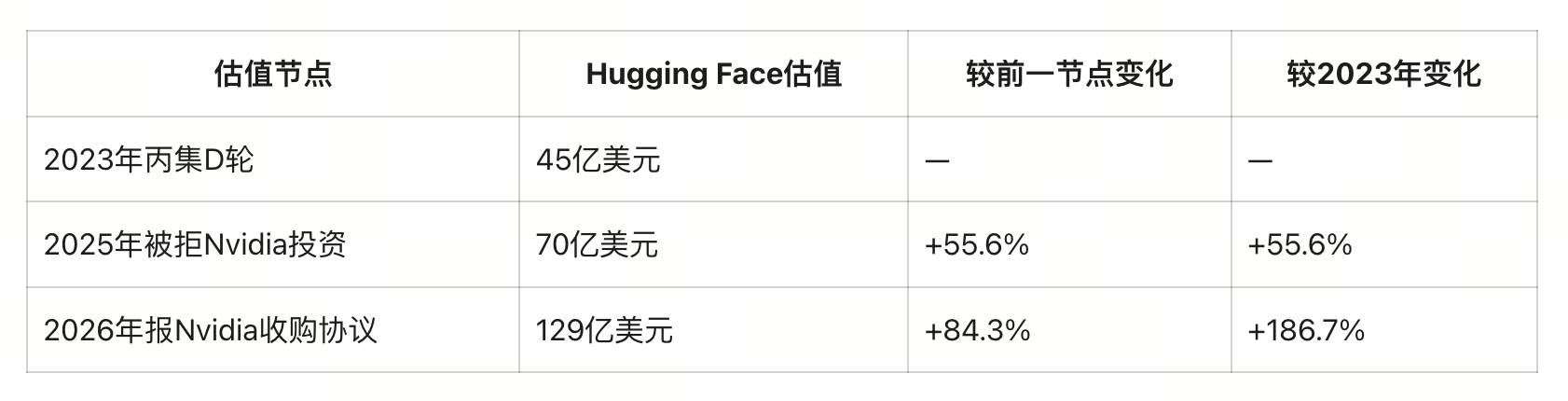
Table: Hugging Face valuation milestones in the relevant references (2023–2026; figures in billions of dollars; the 2026 figure is based on reported figures, and the transaction status is subject to official disclosure)
FAQ
Why Is Hugging Face Important to the AI Industry?
It does more than host models. It connects models, datasets, developers, tools, and deployment workflows. Its real value lies in its developer network and its role as a gateway for model distribution.
Would NVIDIA’s Acquisition of Hugging Face Make Open-Source AI Disappear?
Not necessarily. Open-source code, models, and data could remain open. The more important questions would concern the platform’s neutrality and the possibility of ecosystem bias.
Because models and developers determine future compute demand. Controlling the developer gateway allows a company to influence model deployment and hardware choices earlier in the process.
How Should Investors View AI Infrastructure Acquisitions Like This?
The key is to determine what assets the valuation actually represents and whether those assets can translate into compute demand, software revenue, platform revenue, or durable ecosystem moats.
How Can Developers Reduce the Risk of Ecosystem Lock-In?
Keep models, data, and workflows as portable as possible. Become familiar with multiple inference backends and cloud platforms, and avoid tying critical production processes to a single vendor.