On October 29, 2026, a wallet operated by Binance was subjected to a major digital asset theft, involving approximately $6.3 billion in affected assets. Following the incident, multiple stablecoin issuers, trading platforms, and other industry participants took measures to freeze funds, intercept transfers, and track the assets on-chain. On November 18, the Abu Dhabi Global Market Courts (ADGM Courts) further issued freezing and recovery orders concerning the assets, requiring certain entities to continue maintaining restrictions and supporting subsequent legal proceedings. The incident has drawn widespread attention to the relationship between on-chain technical control and traditional judicial authority.
When digital assets are stolen, do entities that can technically freeze the funds also have the authority to determine ownership? If an issuer takes emergency measures before a court issues a formal ruling, how should asset protection, user rights, and due process be balanced? This article examines the different roles of technical enforcement and legal adjudication in digital asset security governance, focusing on stablecoin freezing mechanisms, trading platform custody authority, court orders, cross-border enforcement, and asset recovery procedures.
Key Takeaways
-
On-chain transactions are difficult to reverse, but that does not mean that all on-chain assets are impossible to freeze. Some stablecoin contracts have address-restriction functions, and trading platforms can control assets in their custodial accounts.
-
Following the major crypto asset theft on October 29, 2026, approximately $2.85 billion in related assets were reported as frozen or intercepted. This figure does not mean that the assets had been judicially recovered or returned.
-
Stablecoin issuers may impose restrictions under applicable laws, court orders, or specific emergency security policies. However, a technical freeze does not itself constitute a final ruling on asset ownership.
-
Courts can establish legal constraints through freezing orders, asset preservation, disclosure orders, and recovery proceedings. However, whether a court order can directly affect on-chain assets still depends on available technical and legal enforcement mechanisms.
-
The degree of intervention varies across digital assets. USDC, USDT, BTC, ETH, and balances held in custodial accounts cannot all be subject to the same freezing logic.
-
A more sustainable governance approach is to establish clear boundaries of authority, evidentiary standards, transparency requirements, and remedies between emergency response and legal proceedings.
Why Can Blockchain Assets Also Be Frozen in an Emergency?
The immutability of blockchain primarily means that confirmed transaction records generally cannot be arbitrarily modified by a single participant. However, the irreversibility of asset transaction records does not mean that future transfers of those assets are completely unrestricted. Different digital assets rely on different issuance and operating mechanisms, and their control structures can vary significantly.
For some centrally issued stablecoins, tokens operate through smart contracts, and issuers can manage specific permissions according to the contract design and applicable rules. Once an address is added to a blacklist, the related tokens may no longer be transferable to or from that address. Completed historical transfers do not disappear as a result, but the address's ability to conduct subsequent operations involving the specific token may be restricted.
Another situation involves centralized trading platforms. Digital assets held in a user's platform account are generally managed by the platform through custodial wallets and internal ledgers. If an account is associated with theft, fraud, or another risk, the platform may restrict withdrawals or trading under applicable laws and its service rules. In this case, the platform controls the ability to operate assets within its custody system rather than directly modifying the consensus rules of a public blockchain.
In addition, some smart contract protocols include emergency pause functions that restrict specific contract operations when vulnerabilities or abnormal transactions occur. These mechanisms differ from stablecoin blacklists and cannot be equated with freezing an entire blockchain network.
Therefore, determining whether an on-chain asset can be frozen requires answering three questions first: Who issued the asset, who currently controls it, and whether the relevant smart contract or custodial system can restrict asset transfers.
What Did the Major Crypto Asset Theft in 2026 Reveal?
On October 29, 2026, a wallet operated by Binance was subjected to a major digital asset theft involving approximately $6.3 billion in affected assets. Following the incident, relevant entities tracked the movement of funds through on-chain analysis and worked with stablecoin issuers, trading platforms, and law enforcement agencies to try to prevent the stolen assets from being transferred further.
By mid-November, approximately $2.85 billion in related assets had been reported as frozen or intercepted. A distinction must be made between asset freezes, fund interceptions, and final recovery. A freeze means that transfers of the relevant assets have been restricted. An interception may involve control measures at different platforms or accounts. Final recovery generally also requires identifying the lawful owner and completing the asset return process. Different reporting methodologies may overlap, so frozen, seized, and returned amounts cannot simply be added together.
On November 18, ADGM Courts issued legal orders related to the incident involving 18 crypto businesses, including Circle and World Liberty Financial. The relevant entities were required to continue maintaining restrictions on the assets involved and were prohibited from lending, exchanging, or commingling the relevant tokens without authorization during the proceedings. The court expressly stated that the businesses named in the orders were not thereby accused of wrongdoing.
Notably, some technical freezing measures were implemented before the court orders were issued. Stablecoin issuers and other industry participants can quickly impose restrictions within the scope of their authority and policies, while formal judicial proceedings address continued freezing, evidence disclosure, and asset recovery.
This process reflects an important development in digital asset security governance: technical controls can help entities respond quickly to the risk of further fund transfers, but whether assets should remain frozen, who has a lawful claim, and how the assets should be returned still require an appropriate legal basis and procedural support.
Why Can Stablecoin Issuers Freeze On-Chain Funds?
Stablecoin issuers' ability to freeze assets generally comes from the smart contracts of the tokens they issue and the related administrative permissions. For stablecoins with blacklist mechanisms, issuers can use authorized accounts to invoke specific contract functions that restrict transfers between a target address and the token.
USDC is one stablecoin with a clearly defined address-restriction mechanism. Circle's policies provide that, under certain legal, regulatory, and security conditions, it may restrict an address from sending or receiving USDC. These restrictions do not reverse completed on-chain transactions. Instead, they affect the address's ability to use USDC going forward. After legal restrictions are lifted or security risks are resolved, Circle may assess whether to remove the restrictions under its policies.
USDT also has freezing mechanisms related to the protection of issuer assets. Tether can restrict specific addresses on some supported networks and contracts, but the technical implementation may vary across blockchains. Therefore, not all assets called stablecoins should be assumed to have exactly the same freezing capabilities.
The ability of stablecoin issuers to freeze specific tokens does not mean that they have full control over a user's wallet. For example, an address may hold USDC, ETH, and other tokens. Even if its USDC is restricted, the issuer generally cannot directly freeze the native ETH held by that address solely through its USDC contract permissions.
This means that a stablecoin issuer's technical control has a clearly defined scope. The issuer can affect tokens that it issues and manages, but it does not thereby acquire general control over all on-chain assets.
What Is the Fundamental Difference Between a Technical Freeze and a Judicial Ruling?
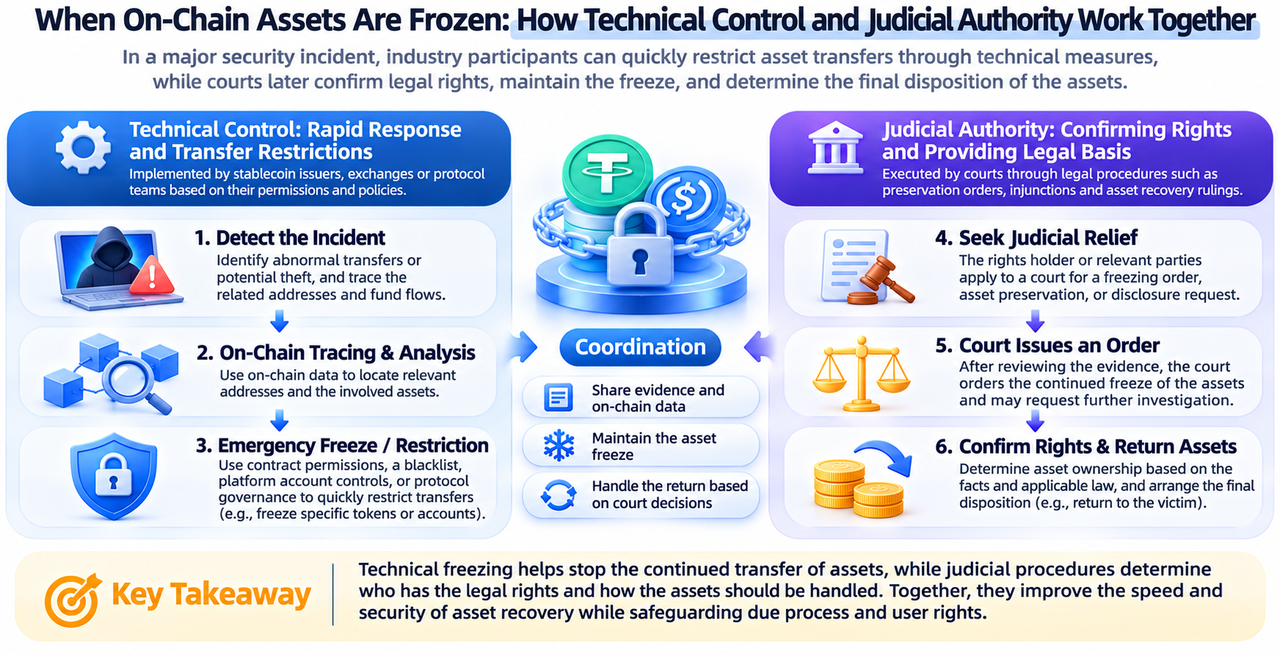
The primary difference between a technical freeze and a judicial ruling is that they address different questions. A technical freeze primarily answers whether further asset transfers can be prevented. Judicial proceedings must determine whether the legal basis for restricting the assets is valid, who holds the relevant rights, and how the assets should ultimately be handled.
For example, when a stablecoin issuer discovers that an address may be connected to a major theft, it may assess whether to impose emergency restrictions under applicable laws, its terms of service, and security policies. Because on-chain funds can move across multiple addresses within a short period, technical freezes have clear value in terms of timeliness. If action could not be taken until litigation had fully concluded, the assets might already have moved to other accounts or networks.
However, technical capability does not automatically give an issuer the authority to make a final determination of asset ownership. An address may hold funds with a complex history, and the assets may have been transferred multiple times. Even if on-chain analysis indicates a connection to an incident, the transaction context, actual controller, and legal rights involved still require further assessment.
Judicial proceedings provide an institutional basis for continued freezing and asset recovery through the examination of evidence, statements by the parties, application of the law, and court orders. Courts may require relevant entities to disclose information, preserve assets, or take specific actions. However, whether a court order can be recognized and enforced in a particular jurisdiction still requires consideration of local laws and the actual control held by the relevant entities.
| Comparison Dimension |
Technical Freeze |
Judicial Ruling |
| Primary objective |
Quickly restrict asset transfers |
Establish legal liability and rights |
| Enforcing parties |
Issuers, custodial platforms, protocol administrators, and others |
Courts and legally authorized entities |
| Main basis |
Contract permissions, service rules, applicable laws, and security policies |
Legal provisions, evidence, and judicial procedures |
| Response speed |
Can be implemented relatively quickly in certain circumstances |
Depends on judicial procedures and emergency relief mechanisms |
| Main limitations |
Scope of authority, identification accuracy, and risk of erroneous freezes |
Jurisdiction, evidentiary standards, and enforcement capability |
| Subsequent handling |
Maintain or lift technical restrictions |
Determine continued preservation, recovery, and other remedies |
The two are not necessarily in conflict. A more appropriate institutional arrangement is to connect emergency technical measures with legal proceedings so that funds can be protected promptly while necessary rights reviews are not replaced by technical control.
Why Do Court Orders Remain Important for Digital Asset Recovery?
Even when assets have been technically frozen, subsequent action may still require a court order. This is because a freeze only restricts the movement of funds; it does not automatically resolve ownership, the determination of loss, or lawful return.
For stablecoin issuers, reissuing frozen tokens to a specific party or taking other measures that change the legal status of the assets generally involves significant legal risk. Issuers need to confirm whether the requesting party has a lawful claim and whether the proposed action complies with applicable laws and their own terms of service. If an issuer were to transfer assets solely at the request of a private entity, this could lead to erroneous returns, disputes over third-party rights, or cross-border legal liability.
The relevant ADGM Courts orders issued in November 2026 demonstrate the role of judicial proceedings in digital asset recovery. In addition to restricting further movement of the assets, the legal measures provided procedural avenues for subsequent disclosure, continued preservation, and return. For issuers and platforms that had already imposed freezes, the court orders helped clarify what actions they were required to continue taking.
Court orders also protect rights. Freezing measures may affect account users, counterparties, or other third parties, making it necessary to specify the scope and duration of the restrictions and the channels available for seeking relief. Particularly when large numbers of addresses and complex fund flows are involved, judicial proceedings help distinguish allegedly illicit funds from lawful assets that may have been incorrectly associated with the incident.
However, a court order does not mean that all stolen cryptocurrency can be recovered. If funds have moved into wallets that the relevant entities cannot directly control or have been transferred to other jurisdictions, practical enforcement may still be difficult. Establishing legal rights and obtaining technical control over the assets are separate issues.
Why Do Different Digital Assets Have Such Different Freezing Capabilities?
The control structure of a digital asset determines whether emergency freezing measures can be implemented. For issuer-managed stablecoins, the relevant smart contracts may provide blacklist and asset-restriction functions. For assets held in custody by centralized trading platforms, platforms can restrict activity through their internal account and wallet management systems. The situation is significantly different for native blockchain assets that do not have corresponding freezing functions.
For example, ordinary BTC transfers do not have a global blacklist mechanism that a stablecoin issuer can invoke. As long as the holder of the relevant private keys can construct a valid transaction and satisfy the network rules, they can attempt to broadcast the transaction. A court can require a specific party to surrender assets or restrict its conduct, but it cannot directly modify the consensus state of the Bitcoin network solely by issuing an order.
The situation is similar for native ETH on Ethereum. Ordinary ETH is not controlled by the token contract permissions of the USDC issuer. However, if ETH is deposited with a centralized trading platform, placed in a specific smart contract, or held under another custodial arrangement, its practical usability may be affected by the rules of those systems.
In addition, cross-chain bridges, lending protocols, and other DeFi applications may have pause, upgrade, or administrator permissions. These permissions can affect asset operations within a specific protocol, but they do not mean that the protocol administrators can freeze a user's assets across all blockchains.
Therefore, the ability to freeze digital assets is not simply a binary question of centralization versus decentralization. It depends on the asset's issuance structure, custody arrangement, smart contract permissions, and actual control relationships. When assessing asset security, users need to understand whether they hold a native asset, an issuer-issued token, a balance in a custodial account, or an asset claim created through another protocol.
How Does Cross-Border Jurisdiction Affect the Freezing and Return of On-Chain Assets?
Blockchain networks operate across borders, but legal authority is generally limited by jurisdiction. A digital asset transaction may involve users, issuers, trading platforms, and custodial service providers in different countries. When funds are stolen or disputed, the relevant entities must determine the applicable law, the court's jurisdiction, and whether an order can be recognized and enforced in other regions.
For example, a stablecoin issuer may be registered in one jurisdiction, the user may reside in another country, and the funds involved may circulate through a trading platform in a third region. Even if a court in one location issues a freezing order, it is necessary to determine whether the order can bind the relevant issuer or platform. Different countries may have different rules concerning digital asset property rights, evidence disclosure, and cross-border judicial assistance.
Although technical freezes can restrict asset transfers relatively quickly in some circumstances, their legality and continuation remain subject to applicable laws. An issuer may face regulatory requirements, court orders, and user rights claims from multiple jurisdictions at the same time and must assess whether these obligations conflict.
The major asset recovery efforts in November 2026 demonstrate the importance of legal cooperation in cross-border digital asset governance. Courts, law enforcement agencies, stablecoin issuers, trading platforms, and on-chain analytics firms may each hold different resources. A single entity generally cannot independently complete the entire process of tracing funds, imposing technical freezes, and returning assets lawfully.
Therefore, an important issue for future digital asset regulation is not merely whether to give a particular entity greater freezing authority. It is how to establish cooperation mechanisms across jurisdictions that are clear, enforceable, and capable of protecting the rights of lawful holders.
Do Emergency Freezing Mechanisms Undermine the Principle of Blockchain Decentralization?
There is genuine tension between emergency freezing mechanisms and the principle of decentralization. One of the key reasons blockchain originally attracted attention was that users could control assets through private keys and transact without approval from traditional financial intermediaries. However, when stablecoin issuers, custodial platforms, or protocol administrators can restrict asset transfers, users' control over those assets is no longer fully independent of these entities.
Supporters of emergency freezing mechanisms argue that digital asset markets need the ability to respond to theft, fraud, and major security incidents. For stablecoins with clearly identified issuers, issuers themselves need to assume compliance and risk management responsibilities. If they had no intervention capabilities at all, some stolen funds could move rapidly, making recovery more difficult for victims.
Others are concerned that freezing authority may lead to excessive concentration and a lack of procedural transparency. If a small number of entities can restrict user assets without sufficient external oversight, there may be risks of erroneous freezes, selective enforcement, or abuse of power. When asset flows involve multiple innocent counterparties in particular, determining the scope of a freeze and the conditions for lifting it may be more complex than the technical implementation itself.
Therefore, evaluating whether an emergency freezing mechanism is appropriate requires more than determining whether it has centralized characteristics. It is also necessary to assess whether the scope of authority is clear, the conditions for activation are strict, operational records are auditable, and affected users can obtain review and judicial remedies.
Different types of digital assets also do not need to adopt exactly the same governance model. Native decentralized assets, regulated stablecoins, and centralized custodial services have different product characteristics and user expectations. The key is to ensure that users can clearly understand the relevant control powers and risks before holding an asset.
How Should Future Digital Asset Freezing Mechanisms Balance Efficiency and Rights Protection?
The central challenge in digital asset security governance is establishing an appropriate balance between rapid response and rights protection. Because on-chain funds can move across multiple addresses and networks within a short period, major security incidents often require swift action. However, without clear standards and external constraints, emergency powers can also become a new source of risk.
-
Freezing authority should have a clearly defined scope. Issuers and platforms should explain what circumstances may trigger restrictions, such as a valid legal order, sanctions obligations, a major security incident, or another circumstance covered by their policies. Different internal approval and review procedures can be established for different risk levels to avoid automatically imposing the same degree of asset restriction on every abnormal transaction.
-
Technical measures should be connected with evidence preservation and legal proceedings. On-chain transaction hashes, address-relationship analysis, transaction times, and fund flows can help establish evidence of an incident, but these data points may not independently prove the identity of the actual controller or the lawful ownership of the funds. Therefore, decisions during continued freezing and asset recovery still need to consider other evidence and applicable laws.
-
Clear mechanisms should be established for lifting freezes and seeking remedies. If users believe their assets have been wrongfully restricted, they should be able to identify the appropriate contact channel, submit supporting materials, and seek review or judicial relief to the extent permitted by applicable laws. Information disclosure may be limited when trade secrets or ongoing criminal investigations are involved, but this does not mean that the relevant decisions should be entirely free from oversight.
-
The industry also needs to improve the transparency of control permissions. For blacklist, pause, and upgrade functions in smart contracts, code audits, disclosure of permissions, and verifiable on-chain operation records can help users understand the relevant risks. Custodial platforms should establish corresponding internal controls and compliance governance mechanisms.
More mature digital asset governance does not mean allowing technical control to expand without limit, nor does it mean completely excluding emergency intervention. Instead, technical measures should have clearly defined boundaries and be subject to appropriate legal and institutional constraints.
How Are On-Chain Asset Freezes Changing the Power Structure of Crypto Finance?
As stablecoins, institutional custody, and compliant financial services continue to develop, the crypto market is forming a more complex power structure. Early blockchain narratives emphasized permissionless value transfer, but the digital asset ecosystem in practice includes native crypto assets, centrally issued tokens, custodial accounts, and upgradeable smart contracts. Different products rely on technical control and legal intervention to different degrees.
Within this structure, stablecoin issuers control the contract management capabilities of specific tokens, trading platforms control custodial accounts and trading services, on-chain analytics firms provide clues about fund flows, law enforcement agencies conduct investigations, and courts handle disputes over freezing, property rights, and asset recovery through legal proceedings. The responsibilities of these parties may be interconnected, but they cannot simply be treated as the same type of authority.
The major crypto asset theft in 2026 showed that digital asset recovery is developing from a process based solely on on-chain tracking into one involving technical controls, industry cooperation, and judicial proceedings. Technical freezes can improve the efficiency of preventing further fund transfers, while court orders can provide a legal basis for continued restrictions and subsequent recovery. This does not mean that judicial authority has been replaced by private entities. Rather, traditional legal procedures need to coordinate with new forms of asset control.
The issues that deserve the most attention in the future are whether technical control can be sufficiently constrained and whether judicial procedures can adapt to the rapid movement and cross-border circulation of digital assets. If technical freezes lack clear legal boundaries, they may undermine users' trust in their ability to control their assets. If judicial procedures cannot respond promptly to on-chain risks, asset protection may become less effective.
Therefore, the changing power structure of crypto finance is better understood as a renewed coordination between technical enforcement capabilities and legal adjudication mechanisms, rather than a simple shift from decentralization back to centralization. Establishing a balance among security, efficiency, transparency, and user rights will be an important issue for the long-term development of digital asset infrastructure.
Conclusion
The emergency freezing of on-chain assets highlights an important but often overlooked distinction in digital asset security governance: the difficulty of reversing blockchain transaction records does not mean that all tokens are immune from restrictions, and the technical ability to freeze assets does not mean that the relevant entity has the authority to make a final determination of ownership.
The major crypto asset theft in 2026 and the subsequent judicial proceedings demonstrated the cooperation among stablecoin issuers, trading platforms, on-chain analytics firms, and courts. Some assets can be restricted quickly in an emergency, but continued freezing, lawful recovery, and the return of funds still require a clear legal basis and appropriate procedures.
The future digital asset market may retain varying degrees of decentralization and intervention. What truly matters is not simply determining whether freezing mechanisms conflict with the principles of blockchain, but clarifying who has control authority, when it can be used, how it is supervised, and whether users can obtain effective remedies when their rights are affected. Establishing clear boundaries between technical capabilities and judicial authority will help create a more reliable digital asset security governance system.
FAQ
Can Assets on a Blockchain Really Be Frozen?
Some assets can be frozen. Stablecoins with blacklist functions may allow issuers to restrict transfers involving specific addresses, and centralized trading platforms can also restrict activity in their custodial accounts. However, digital assets have different technical structures, and not all cryptocurrencies can be frozen directly.
Can USDT and USDC Issuers Freeze a User's Wallet?
Issuers can restrict specific tokens within the scope permitted by the relevant contracts and policies, but this does not mean that they control the entire wallet. Other native assets or tokens not managed by the relevant contracts generally will not be automatically subject to the same restrictions merely because one stablecoin has been frozen.
Can Frozen Stablecoins Be Returned Directly to Victims?
Not necessarily. A freeze only restricts asset transfers. Returning the assets also requires identifying the lawful owner, determining the applicable law, and establishing a specific operational mechanism. Depending on the circumstances, the process may involve a court order, the destruction and reissuance of assets, or another compliant solution.
Can Courts Directly Freeze Bitcoin or Ethereum?
Courts can issue legal orders requiring entities within their jurisdiction to impose restrictions, disclose information, or surrender assets. However, a court cannot directly change the consensus rules of the Bitcoin or Ethereum networks solely by issuing an order. Actual enforcement depends on the person or entity controlling the assets, the custody arrangement, and the relevant legal mechanisms.
Do Emergency Freezes Mean That Blockchain Is No Longer Decentralized?
Not necessarily. Blockchain networks, token issuance, and custodial services may have different control structures. The existence of issuer freezing authority for a particular stablecoin does not mean that the entire public blockchain on which it operates has the same centralized control structure.
How Can I Determine Whether a Digital Asset Carries Freezing Risks?
You can check whether the token contract includes blacklist, pause, or administrator permissions, review the issuer's terms of service and the asset's custody arrangements, and determine whether those permissions have been audited and publicly disclosed. For assets held on centralized platforms, you should also understand the platform's account-restriction and compliance rules.