On November 17, 2026, NVIDIA released its fiscal 2027 third-quarter results for the quarter ended October 25. Quarterly revenue reached $115.8 billion, up 103% year over year, including $107.6 billion in data center revenue, up 110% year over year. The company also forecast revenue of approximately $130 billion for the next quarter. However, strong results failed to drive a sustained increase in the stock price. NVIDIA shares fell approximately 2.9% on November 18, reflecting differing market views on the returns from AI investment, management changes, and future valuation.
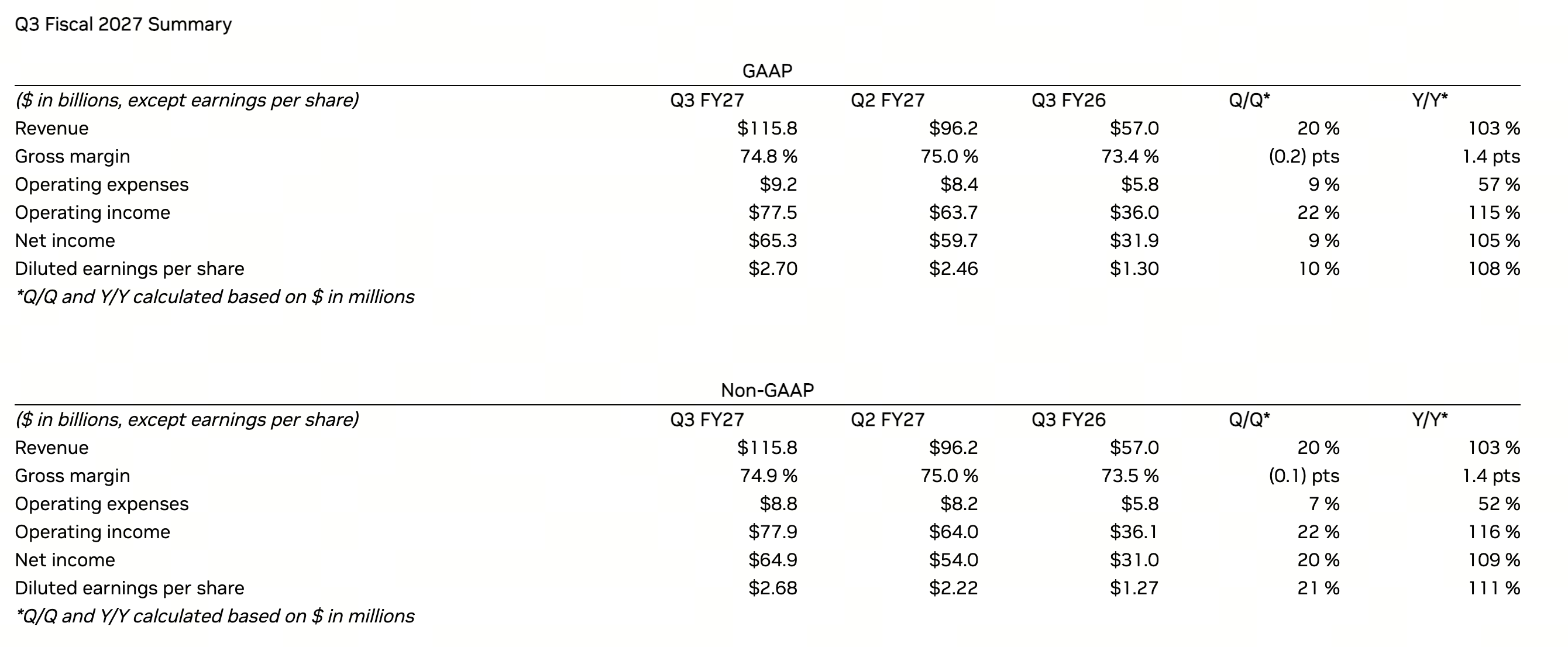
For investors, revenue growth represents an expansion in a company's business scale, while the stock price reflects the market's combined pricing of future earnings potential, growth sustainability, and risks. Understanding the difference between the two requires further analysis of gross margin, earnings expectations, valuation multiples, and the capital expenditure cycle across the AI industry. This article uses NVIDIA's latest financial results as a starting point to explain why a technology company with rapidly growing revenue may still face a stock price correction.
Key Takeaways
-
NVIDIA's fiscal 2027 third-quarter revenue reached $115.8 billion, up 103% year over year, with the data center business remaining the primary growth driver.
-
The company's GAAP gross margin for the quarter was 74.8%, down 0.2 percentage points from the previous quarter but above 73.4% in the same period last year.
-
The company expects next-quarter revenue of approximately $130 billion, but forecasts that gross margin will decline to 71%–72%, placing greater focus on the quality of growth.
-
Stock prices reflect future earnings expectations rather than historical revenue growth alone. Even strong financial results may not satisfy overly optimistic expectations already priced into the stock.
-
AI data center capital expenditures, product cycles, competition, export restrictions, and management changes may all affect NVIDIA's risk premium.
-
When evaluating AI chip companies, investors need to consider revenue growth, gross margin, operating profit, cash flow, and valuation multiples together.
How Did NVIDIA Perform in Its Latest Financial Results? Why Does Revenue Growth Remain a Focus?
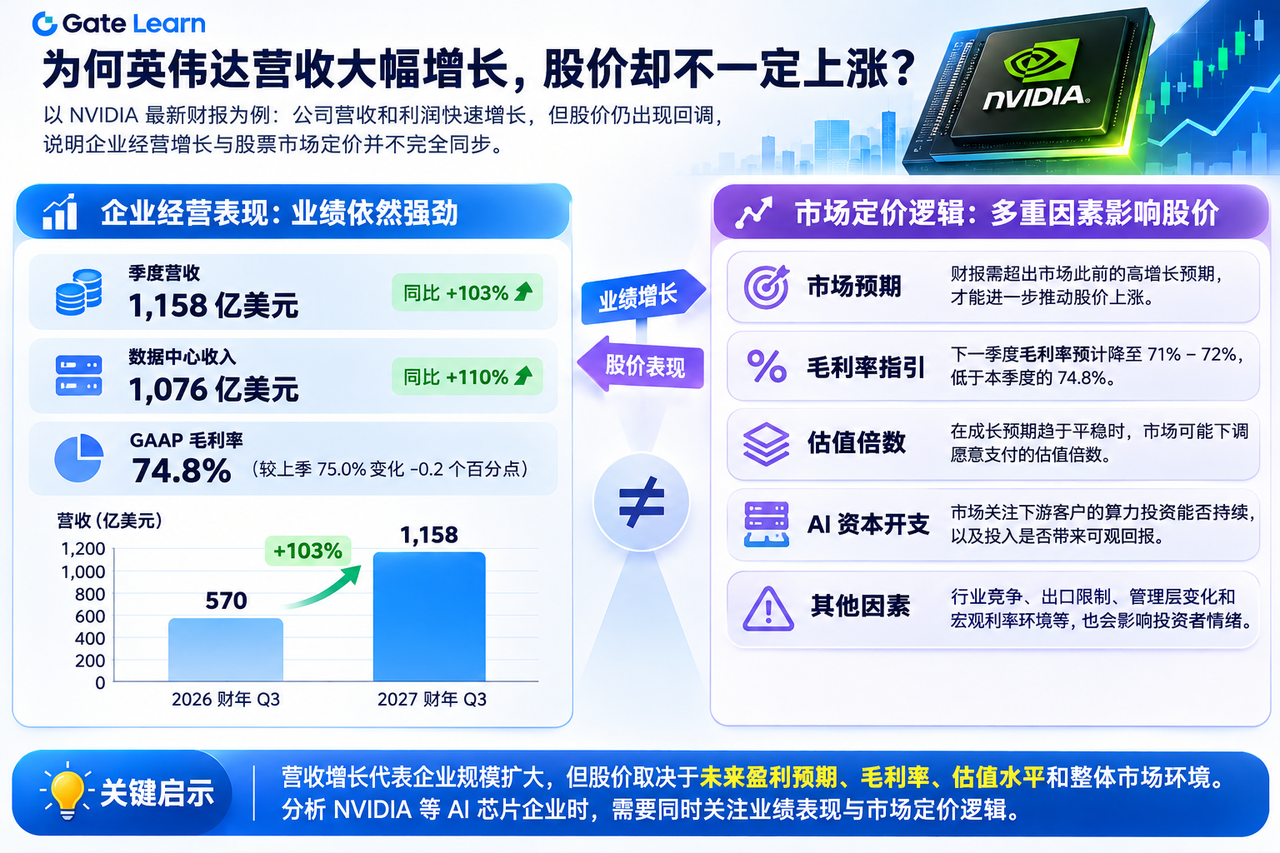
NVIDIA's fiscal 2027 third-quarter revenue reached $115.8 billion, up 20% from the previous quarter and 103% from the same period last year. Data center revenue reached $107.6 billion, up 110% year over year and accounting for more than 90% of total quarterly revenue.
This growth primarily reflects continued expansion in demand for AI infrastructure. Large cloud computing companies, AI model developers, and related infrastructure operators continue to purchase computing equipment to meet demand for model training, inference, and enterprise applications. NVIDIA participates in this market through GPUs, network interconnects, its software ecosystem, and complete computing systems.
In terms of profitability, the company's quarterly GAAP operating profit reached $77.5 billion, up 115% year over year, while net income was approximately $65.3 billion, up 105% year over year. These figures show that revenue growth has not remained limited to sales expansion but has also driven broader earnings growth.
At the same time, NVIDIA is moving forward with commercial deliveries of its Vera Rubin computing platform. The next-generation computing platform could further improve product performance and customer demand, but product upgrades typically also involve R&D, supply chain coordination, and system delivery costs.
NVIDIA's financial results therefore continue to reflect strong growth in demand for AI computing. However, for companies with already elevated market expectations, investors focus not only on whether quarterly growth is strong but also on whether similar growth and profitability can continue over the next several quarters.
Why Could the Stock Price Decline Even When Revenue Exceeds Expectations?
Stock prices do not simply assign value to revenue a company has already generated. Instead, they reflect investors' expectations for future earnings and cash flow.
Before financial results are released, the market has usually already formed certain revenue, profit, and growth forecasts. If investors broadly expect a company to achieve rapid growth, those expectations may already be reflected in the stock price. Even if the final results are strong, the stock may lack further upside if they do not significantly raise expectations for future growth.
For example, suppose an AI chip company generated $10 billion in revenue last year, and the market expects revenue to grow to $18 billion the following year. If actual revenue reaches $19 billion, it has exceeded expectations, but investors still need to assess whether this growth can continue. If management subsequently forecasts a significant slowdown in growth, the market may still lower its future valuation.
NVIDIA's fiscal 2027 third-quarter revenue exceeded previous market expectations, and its next-quarter revenue guidance also remained high. However, the stock price did not continue to strengthen. This shows that the market is focused not only on current results but also on future earnings quality, management stability, and the overall AI investment environment.
In addition, the stock price may be affected by factors unrelated directly to the financial results. Market interest rates, institutional capital allocation, industry risk appetite, and regulatory events can all change the valuation levels investors are willing to pay.
Therefore, there is no inevitable relationship between results exceeding expectations and a rising stock price. What matters is whether actual operating performance is sufficient to support or even raise the long-term expectations the market has already formed.
Why Has Gross Margin Become an Important Indicator of NVIDIA's Valuation?
Gross margin is the proportion of gross profit remaining after direct sales costs are deducted from sales revenue. For chip companies, gross margin helps investors assess product pricing power, manufacturing costs, and changes in business mix.
NVIDIA's fiscal 2027 third-quarter GAAP gross margin was 74.8%, slightly below 75.0% in the previous quarter but above 73.4% in the same period last year. Non-GAAP gross margin was 74.9%, broadly in line with the previous quarter's 75.0%.
This level indicates that the company continues to have strong profitability. However, NVIDIA's GAAP and non-GAAP gross margin guidance for the fourth quarter is 71%–72%, below the third-quarter level.
For a quarter with revenue exceeding $100 billion, even a change of a few percentage points in gross margin can have a significant impact on gross profit. Suppose a company generates quarterly revenue of $130 billion. At a 75% gross margin, gross profit would be approximately $97.5 billion. If gross margin declines to 71%, gross profit would be approximately $92.3 billion—a difference of about $5.2 billion.
This example is intended only to illustrate gross margin sensitivity and does not represent an actual profit forecast for NVIDIA. Actual operating profit is also affected by R&D, selling, general, and administrative expenses, as well as other items.
A decline in gross margin does not necessarily mean that competitiveness is deteriorating. Costs during the initial mass production of new products, a higher proportion of systems-level products, changes in supply chain pricing, and adjustments in customer purchasing mix can all affect gross margin.
Investors therefore need to determine whether changes in gross margin are temporary effects of the product cycle or reflect a long-term decline in pricing power. For highly valued AI chip companies, this distinction could significantly affect future earnings expectations.
Why Could AI Chip Product Upgrades Drive Both Revenue Growth and Changes in Profit Margins?
NVIDIA's competitive advantages come not only from individual GPU products but also from computing systems, networking equipment, its software ecosystem, and related technology platforms. As AI models grow in scale, customer demand is gradually expanding from individual chips to complete computing clusters.
This shift can increase the contract value of individual projects but also make the cost structure of products more complex. Compared with selling computing chips separately, complete systems may involve more components, network interconnects, rack design, cooling, and system integration.
When new products are launched, companies may face issues such as production ramp-up, supply chain coordination, and manufacturing yield optimization. These factors may temporarily increase unit costs and, in turn, affect gross margin.
On the other hand, as production scales up, supply chain efficiency improves, and products mature, some cost pressures may gradually ease. Therefore, a decline in gross margin in a single quarter is not enough to conclude that a new product lacks commercial value.
NVIDIA's Vera Rubin platform entering the delivery stage provides a new window through which to observe these changes. Investors need to assess whether the revenue growth generated by the new products can cover the additional costs and whether systems-level products can help expand customer demand and long-term profit potential.
For AI chip companies, the core value of product upgrades lies not only in improving computing performance but also in meeting customer needs at a reasonable cost and building sustainable profitability.
Why Could AI Data Center Capital Expenditures Affect NVIDIA's Long-Term Valuation?
NVIDIA's data center business is closely linked to global investment in AI infrastructure. The capital expenditure plans of large cloud computing companies, AI model developers, and data center operators affect the scale and timing of computing equipment purchases and deliveries.
When demand for AI services grows rapidly, companies may purchase large quantities of GPUs, networking equipment, and related infrastructure in advance to ensure sufficient computing capacity in the future. This concentrated purchasing can drive rapid revenue growth for chip suppliers but may also make revenue more sensitive to customers' capital expenditure cycles.
For investors, the key question is whether purchases of AI computing equipment can continue to generate economic returns. If cloud computing customers can generate stable revenue through model APIs, enterprise software, inference services, and other businesses, they are more likely to maintain long-term investment in computing capacity.
Conversely, if the commercialization of AI services progresses more slowly than expected or the expansion of computing capacity exceeds actual demand, some customers may slow their purchasing pace. This change may first affect order growth and then gradually appear in chip suppliers' financial data.
In addition, AI data center construction is affected by electricity, land, cooling equipment, and financing costs. Even when demand for chips exists, the pace of infrastructure construction may limit equipment deployment.
Therefore, assessing NVIDIA's long-term growth potential requires observing both the capital expenditure capacity of its direct customers and whether the broader AI industry chain can generate sufficient cash flow to support continued investment.
Why Could NVIDIA's Valuation Multiple Decline Even If Revenue Continues to Grow?
Valuation multiples reflect the price the market is willing to pay for a company's revenue or profits. For NVIDIA, which has already achieved a high level of profitability, the price-to-earnings ratio, forward price-to-earnings ratio, and enterprise value-related metrics can all be used as analytical tools.
When investors expect a company to maintain rapid growth in the future, they may be willing to pay a higher valuation multiple. However, as a company grows larger, maintaining the same percentage growth rate usually requires generating more absolute revenue.
For example, increasing a company's revenue from $10 billion to $20 billion requires an additional $10 billion. If revenue has already reached $100 billion, achieving the same doubling would require an additional $100 billion.
Therefore, even if NVIDIA's absolute revenue continues to expand, the market may gradually lower its assumptions about the company's long-term growth rate.
Suppose a company currently has earnings per share of $10 and the market assigns it a price-to-earnings ratio of 40x, resulting in a stock price of $400. The following year, earnings per share increase to $15, but the market lowers the price-to-earnings ratio to 25x, resulting in a stock price of $375.
In this hypothetical scenario, earnings per share increase by 50%, but the stock price declines by approximately 6.3%. This is because the contraction in the valuation multiple more than offsets earnings growth.
This is an important characteristic of growth stocks: a company's operating performance and stock investment returns are always connected through market valuation.
How Do Competition, Export Restrictions, and Management Changes Affect AI Chip Valuations?
In addition to revenue and gross margin, NVIDIA's valuation is affected by industry competition, the regulatory environment, and corporate governance.
-
The AI chip market is seeing more technology approaches emerge. AMD continues to develop data center GPUs, while some large cloud computing companies are also developing their own AI accelerators. Products differ in performance, cost, software ecosystems, and use cases. These competing solutions may not replace NVIDIA in the short term, but they could change some customers' future purchasing mix. Investors need to monitor whether market competition affects product pricing, customer relationships, and long-term gross margins.
-
Advanced computing chips are affected by export control policies. In its latest fourth-quarter revenue guidance, NVIDIA did not include data center computing revenue from the China market. This shows that regional market access and regulatory conditions can directly affect the company's sales opportunities.
-
Changes in corporate governance may also increase market uncertainty. In November 2026, NVIDIA faced management succession issues, requiring investors to reassess whether the new management team could maintain product development, customer relationships, and supply chain execution.
For highly valued companies, the market focuses not only on current operating results but also on the predictability of future growth. If regulatory, competitive, or governance factors increase uncertainty around future earnings, investors may demand higher risk compensation, reducing the valuation multiple they are willing to pay.
Therefore, even when quarterly financial results remain strong, other risk factors may put pressure on the stock price.
How Can Investors Assess the Quality of NVIDIA's Growth Through Its Financial Results?
When analyzing NVIDIA's financial results, investors can focus on four areas: revenue growth, gross margin, operating profit, and cash flow.
-
Revenue growth should be analyzed together with business mix. The continued increase in the proportion of data center revenue shows that AI computing has become the primary growth driver, but it also means that the company's overall performance is increasingly dependent on the AI infrastructure investment cycle.
-
Gross margin reflects changes in product mix and direct costs. Investors should compare both sequential and year-over-year data and consider the next-quarter guidance to assess whether margin changes are sustainable.
-
Operating profit reflects profitability after R&D, selling, and general and administrative expenses. Even if gross margin declines, operating profit may continue to grow if the increase in revenue is sufficiently large.
-
Cash flow helps determine whether accounting profits have been converted into actual cash. For rapidly expanding technology companies, investors need to monitor operating cash flow, inventory, accounts receivable, and supply chain-related funding arrangements rather than assessing growth quality based solely on the income statement.
Investors should also continue to monitor management's guidance for future revenue, gross margin, and expenses. Historical data in financial reports explain what the company has already achieved, while forward guidance influences the market's assessment of the next stage of operating performance.
Only by considering these indicators together can investors distinguish between business scale expansion, improved profitability, and rising market valuation.
How Can Investors Follow AI Chip Companies Such as NVIDIA Through Gate Stock Trading?
NVIDIA's financial results reflect not only the operating condition of a single company but also provide investors with a reference for observing the AI chip and data center industry chain. In addition to NVIDIA, AMD, TSMC, and companies involved in power, cooling, and infrastructure may also be affected by changes in demand for AI computing.
Gate stock trading services provide users with a way to follow the U.S. stock market. Investors can use the Gate TradFi stock section to view the stocks actually supported, market data, and trading rules, and conduct research based on company financial results, industry orders, and capital expenditure plans.
For AI chip companies such as NVIDIA, key areas of research may include quarterly revenue growth, gross margin changes, next-quarter guidance, and customer capital expenditures. By continuously comparing these indicators, investors can better understand the relationship between operating performance and stock price movements.
It is important to note that stocks, stock perpetual contracts, and other derivatives differ in terms of asset rights, margin, fee structures, and trading risks. Leveraged trading in particular may amplify gains and losses during market volatility and may result in forced liquidation. Specific product availability and trading conditions are subject to the actual product pages.
Therefore, following NVIDIA's financial results should not be limited to predicting whether the stock price will rise or fall. Investors should understand how revenue, earnings, valuation, and market expectations jointly affect stock pricing.
Conclusion
NVIDIA's fiscal 2027 third-quarter financial results show that demand for AI computing continues to drive rapid growth in the company's revenue and profits. However, strong financial performance does not necessarily mean that the stock price will rise, because public market trading centers on the ongoing pricing of future earnings potential and risks.
Changes in gross margin, product upgrade costs, customer capital expenditures, industry competition, export restrictions, and management changes may all affect investors' assessment of NVIDIA's long-term growth. Even if the company's revenue continues to grow, its valuation multiple may decline as expectations for future growth are adjusted.
For investors, understanding AI chip companies requires more than determining whether demand for AI will continue to grow. It also requires analyzing how much profit and cash flow this demand can generate and how much growth the current stock price already reflects. Only by considering operating quality together with market valuation can investors better understand the relationship between financial results and stock price movements.
FAQ
Why Could NVIDIA's Stock Price Decline Even When Revenue Grows by More Than 100%?
Because stock prices reflect future earnings expectations rather than historical revenue growth alone. Even when financial results are strong, a decline in valuation multiples, changes in market risk appetite, or other uncertainties may still cause the stock price to fall.
What Are NVIDIA's Latest Quarterly Revenue and Gross Margin?
Fiscal 2027 third-quarter revenue was approximately $115.8 billion, up 103% year over year. GAAP gross margin was 74.8%, and non-GAAP gross margin was 74.9%.
Does a Decline in NVIDIA's Gross Margin Mean That Its AI Chip Competitiveness Is Weakening?
Not necessarily. Product mix, new product mass-production costs, supply chain changes, and competitive factors can all affect gross margin. Multiple quarters of data should be considered when assessing the trend.
Why Is NVIDIA's Next-Quarter Gross Margin Guidance Receiving Attention?
The company expects fourth-quarter GAAP and non-GAAP gross margin to be 71%–72%, below the third-quarter level. Because of the large revenue base, changes in gross margin may have a significant impact on future profits.
What Is the Relationship Between AI Data Center Capital Expenditures and NVIDIA's Revenue?
Large cloud computing companies and AI service providers purchase GPUs, networking equipment, and computing systems, making them important sources of demand for NVIDIA's data center business. Changes in customers' capital expenditure plans may affect future order growth.
Does a Decline in NVIDIA's Stock Price Mean That Demand in the AI Industry Is Weakening?
This conclusion cannot be drawn directly. The stock price is also affected by valuation, interest rates, regulation, corporate governance, and market sentiment. Changes in demand should be assessed together with actual orders and financial data.