Monad: Redefining High-Performance EVM Public Chains
(Source: Monad)
Monad is a highly optimized Layer 1 blockchain, fully compatible with the Ethereum Virtual Machine (EVM), designed to address the longstanding blockchain trilemma of speed, decentralization, and security. Leveraging an innovative architecture, Monad dramatically boosts transaction throughput and finality while preserving both security and compatibility. The network can process about 10,000 transactions per second, with block times of just 0.4 seconds and final confirmation in 0.8 seconds.
Core Technological Breakthroughs
Monad’s performance is powered by four core technical modules, each tackling major execution, consensus, and storage bottlenecks that limit traditional blockchains.
- Optimistic Parallel Execution
Traditional public chains resemble single-lane highways, handling only one transaction at a time. Monad parallelizes transaction execution, so multiple non-conflicting transactions can be processed simultaneously. The system assumes transactions won’t conflict, and only re-executes those that do if a conflict is detected. This approach balances throughput and consistency. Monad’s testnet has already achieved 10,000 TPS while maintaining full EVM compatibility. - Asynchronous Execution
In Ethereum, nodes must execute all transactions before reaching consensus, which slows efficiency. Monad decouples consensus from execution by separating transaction ordering from actual execution. Nodes first agree on transaction order, then execute transactions in sequence, allowing the network to handle greater workloads in parallel and significantly speeding up both block production and finality. - MonadDB: Next-Generation On-Chain State Storage
To combat on-chain state bloat, Monad developed MonadDB. It stores blockchain state on SSDs so nodes can run on standard hardware without costly memory requirements. This not only reduces operational costs but also makes truly decentralized node deployment more feasible. - Block Propagation and Consensus Optimization
Monad features the MonadBFT consensus mechanism, which resolves tail-end fork issues and enhances block stability. RaptorCast accelerates block propagation across the network. Combined with just-in-time (JIT) compilation and pipelined processing, transaction execution becomes highly efficient—delivering both speed and decentralization.
Monad’s Value Proposition
Monad is built around speed, security, and decentralization. In contrast to traditional blockchains, it not only delivers higher performance but also lowers the barrier to node participation—anyone with standard hardware can join, promoting true decentralization. Its EVM compatibility enables developers to deploy Ethereum applications directly, reducing cross-chain costs and accelerating the growth of the Web3 ecosystem.
Tokenomics
Monad’s MON tokenomics prioritize long-term health and decentralization, with a fixed total supply of 10 billion tokens, no private sales, and no pre-mining. The following outlines the token allocation and key design features:
Token Allocation Structure
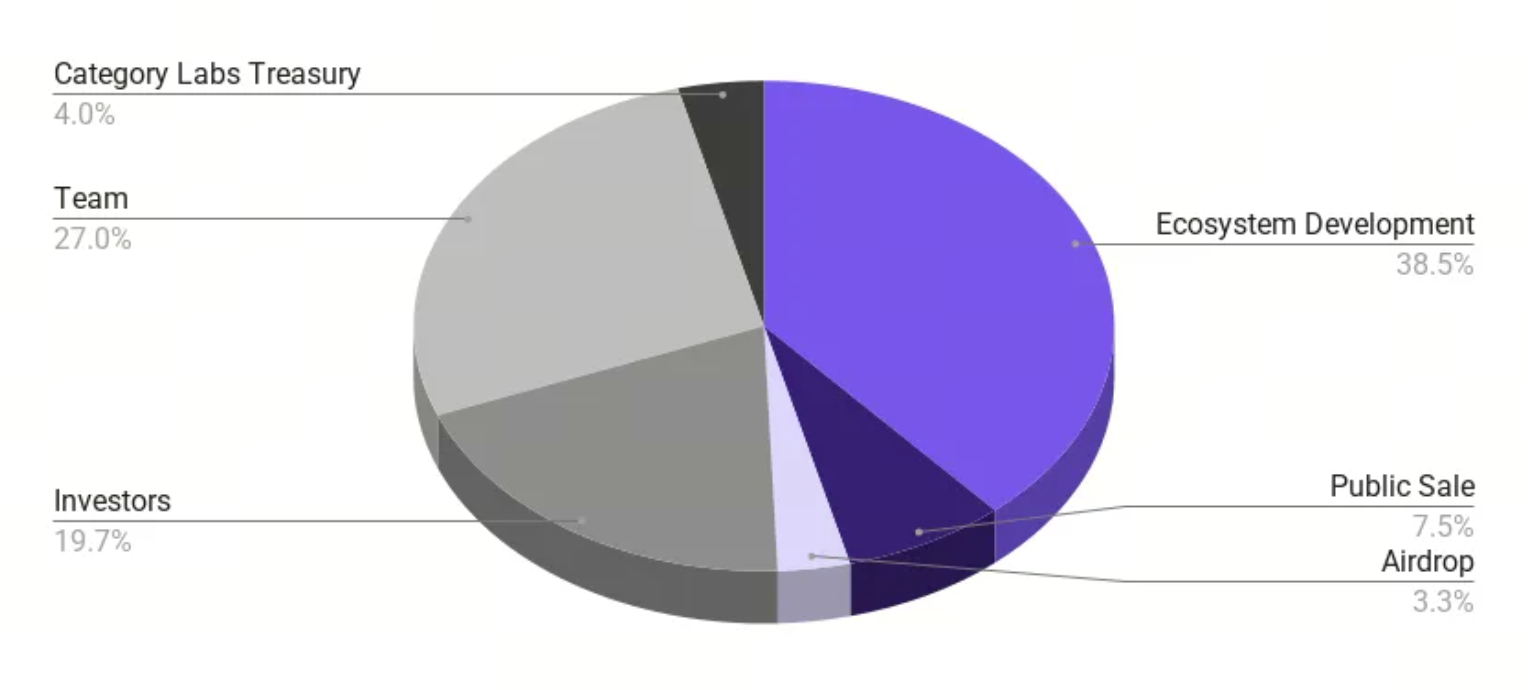
- Public Sale: 7.5% (750 million tokens), all circulating at TGE (Token Generation Event).
- Community Airdrop: 3.3% (330 million tokens), claimed between October 14 and November 3, 2023.
- Ecosystem Development: 38.5% (3.85 billion tokens), managed by the Monad Foundation and gradually distributed for subsidies, validator incentives, and dApp development.
- Team: 27% (2.7 billion tokens), locked for one year after Mainnet Launch, then linearly vested over three years.
- Investors: 19.7% (1.97 billion tokens), released in equal monthly portions after a one-year lock, over a total of four years.
- Category Labs Treasury: 4% (400 million tokens), subject to the same vesting rules as investors.
(Source: Monad)
Key Design Features
- Locking Mechanism: Locked tokens are ineligible for staking, preventing early reward monopolization by the team and investors and protecting the interests of retail participants.
- Mainnet Launch Circulating Supply: Only 10.8% (public sale + airdrop totaling 1.08 billion tokens), supporting price stability.
- Inflation and Deflation Model: 25 MON are minted per block (annual inflation rate approx. 2%), and all base gas fees are burned to maintain a dynamic long-term supply balance.
Monad’s tokenomics emphasize its allocation strategy and innovative design, aiming to achieve sustainable growth and decentralization.
Key Differences Between Monad and Ethereum
For smart contract developers, Monad and Ethereum differ in several major aspects of their execution environment and transaction mechanics. Monad raises the maximum contract size to 128KB, modifies certain opcode and precompile costs, and supports secp256r1 (P256) signature verification, enhancing VM flexibility and efficiency.
Their fee models also differ: Monad charges based on the gas limit instead of actual gas usage, reducing DoS risk during asynchronous execution. The Reserve Balance Mechanism ensures all transactions cover their costs, which means some transactions may ultimately fail but still incur a gas fee.
Furthermore, Monad does not support EIP-4844 blob transactions and lacks a global shared mempool. Instead, a leader node relays transactions to neighboring nodes. When an EOA uses EIP-7702 delegation, its balance must stay above 10 MON, and when called as a contract, the CREATE and CREATE2 opcodes are disabled. Due to its high throughput, Monad does not support querying arbitrary historical state data, and nodes do not store the complete historical state data.
MON spot trading is available at: https://www.gate.com/trade/MON_USDT
Summary
Monad establishes a new benchmark for high-performance public chains through parallel and asynchronous execution, innovative consensus, and efficient data storage.
Monad’s vision is not just to maximize TPS, but also to prioritize decentralization and security, delivering a practical, Ethereum-compatible Layer 1 solution suitable for production deployment.







