MEV, or Maximal Extractable Value, is the extra profit block producers such as miners and validators can earn by controlling the order of transactions in a blockchain block, often through opportunities like front-running, arbitrage, and sandwich attacks. For sophisticated crypto traders, DeFi users, blockchain developers, and other ecosystem participants, that makes MEV more than a technical detail: it can distort transaction fairness, raise execution costs, increase congestion, and affect how reliably decentralized markets work.
This article explores how MEV works in practice, the roles of miners, validators, and searchers, and how transaction ordering differs across Ethereum, Bitcoin, and Solana. It also examines the most common MEV strategies, their impact on DeFi users and liquidity, and the current mitigation approaches being developed across consensus, execution, application, and Layer 2 systems.
What is Maximal Extractable Value (MEV)?
Let’s start with the transaction implementation process: A node (such as Geth or MEV Geth) maintains a list of unconfirmed or pending transactions transmitted to other nodes through peer-to-peer connections or directly via RPC (Remote Procedure Call) endpoints. Each node has its own transaction pool (Mempool), and there is no concept of a global transaction pool. Different nodes’ transaction pools may vary depending on their location and connected peers. Additionally, nodes limit the number of transactions they store in their transaction pools to avoid being overwhelmed by excessive transaction information.

Source: Chainlink
Maximal Extractable Value (MEV) refers to the extra profits block producers (miners or validators) can obtain from the blockchain network by controlling transaction order. MEV depends on how nodes manage their transaction pools (Mempool), where they limit stored transactions to prevent network congestion. Block producers typically extract MEV by prioritizing high Gas fee transactions or inserting their own profitable trades, enabling them to profit from arbitrage, forced liquidations, or front-running opportunities to gain additional economic benefits.
MEV Ecosystem Participants
Miners
In Proof of Work (PoW) blockchains, miners validate and package transactions into the blockchain. With the power to select and order transactions, miners determine which transactions to include based on Gas fees and profit potential. They can exploit MEV opportunities through techniques like “front-running” and “sandwich attacks.” Miners may insert their own transactions to capture arbitrage opportunities or manipulate transaction order to maximize Gas fee earnings. The blockchain’s structure inherently gives miners this control over block content, creating natural opportunities for MEV extraction.
Validators
In Proof of Stake (PoS) networks, validators serve a role similar to miners in PoW, handling block validation and ordering. They have control over transaction order—particularly valuable in today’s high Gas fee environment—which lets them profit from MEV opportunities. Validators boost their earnings by prioritizing transactions with higher Gas fees. Some also partner with searchers and pay fees to MEV platforms like Flashbots to secure transaction priority, creating additional revenue streams. These activities stem from the validators’ blockchain-granted ordering rights, allowing them to pursue profits while staying within consensus rules.
Searchers
MEV bots and independent network participants pursue a profitable MEV opportunity by scanning blockchain data for arbitrage, front-running, and forced liquidations. In practice, searchers run complex algorithms to detect profitable MEV opportunities, while specialized bots monitor the public mempool in real time to analyze potential setups. They execute arbitrage trades when they spot price differences for assets across decentralized exchanges, buying low and selling high. For front-running, they identify pending orders and insert their own transactions beforehand to profit from price movements—a practice known as “sandwich attacks.” In liquidation scenarios, they watch lending protocols’ collateral levels and trigger liquidations immediately when conditions are met to claim protocol rewards.
To secure priority execution, searchers typically pay higher gas fees to miners or validators, or work with miners through platforms like Flashbots to ensure their transactions are ordered favorably. MEV involves competition between searchers seeking to maximize profits from transaction ordering, so mev bots compete for profitable transactions and often bid a higher gas price to win inclusion.
In summary, MEV fundamentally stems from block producers’ power to order transactions. This ability to extract value is inherent to blockchain’s decentralized structure and confirmation mechanisms, making it an integral part of the system.
Differences in Transaction Ordering Mechanisms Across Blockchains
MEV (Maximal Extractable Value) emerges from how blockchains handle transaction ordering and the uncertainties in block packaging. Each blockchain network implements its unique approach to transaction ordering, determining how validators prioritize and sequence pending transactions.
Ethereum
Ethereum uses a “Priority Gas Auction” mechanism, where transaction priority is determined by gas fees, with higher gas fees ensuring miners prioritize transactions. This incentivizes users to increase gas fees for priority, which has led to MEV phenomena such as front-running and sandwich attacks. Ethereum introduced platforms like Flashbots to help capture MEV through transparent auctions rather than only private channels, mitigating MEV and reducing negative externalities for user transactions.
Ethereum 2.0
In Ethereum 2.0, validators (instead of miners) control block production. Transaction ordering rights in PoS chains are similar to PoW chains but are optimized with tools like MEV-Boost to reduce gas fee auctions. Validators can still prioritize high-fee transactions and collaborate with platforms like Flashbots to minimize public front-running. The Danksharding design separates the roles of block proposers and transaction builders. In this proposer-builder flow, block builders assemble each transaction bundle from a proposer’s “transaction list” to maximize mev earnings and mev revenue, although they cannot modify or exclude transactions.
Bitcoin
Bitcoin’s transaction ordering relies on transaction fees. Miner extractable value is the original term for MEV, and mev exists because block producers can influence transaction sequencing. However, due to Bitcoin’s simpler design and lower transaction volume, gas fee auctions are less pronounced than in Ethereum. Bitcoin’s mechanism primarily facilitates value transfers rather than executing complex smart contracts, resulting in fewer MEV phenomena. Miners prioritize transactions based on fees and size to maximize income within block capacity limits.
During the Ordinals boom, MEV and network congestion became evident. Ordinals, leveraging Bitcoin’s Taproot upgrade, embed data like images and text directly on-chain, resembling NFTs. Miners prioritized high-fee Ordinal transactions for greater earnings. These transactions occupied significant block space, intensifying fee competition and altering traditional transaction ordering. Miners began front-running, identifying and packaging high-fee Ordinal transactions from the mempool for maximum profits. Even so, Bitcoin sees fewer such cases than Ethereum, but high maximum value incentives can still threaten consensus instability by encouraging validators or miners to re-mine blocks when gains from reordering exceed the block reward.
Solana
Solana’s consensus mechanism, which combines Proof of History (PoH) and Tower BFT, offers unique opportunities for MEV. Validators, upon rotating into the Leader role, have significant autonomy in transaction ordering. They can prioritize high-fee transactions or engage in front-running. Solana’s transaction pool is not fully public, and delays in information propagation enable Leaders to exploit information asymmetry for MEV extraction.
While Solana’s high throughput and parallel execution reduce congestion, validators can still profit by intervening in the ordering of transactions reliant on specific sequences, such as arbitrage or liquidation. Solana’s 2022 introduction of the Local Fee Market mechanism processes transaction fees through account sharding. However, in high-demand shards, validators may prioritize high-value transactions for MEV gains. The geographic distribution of validator nodes and network propagation delays also create opportunities for front-running and ordering manipulation.
To address these challenges, Solana is exploring Fair Sequencing Services (FSS), improved fee mechanisms, and decentralized sequencing nodes to mitigate MEV’s impact on user experience.
Other Blockchains
Other privacy-focused blockchains minimize MEV attack opportunities by encrypting transaction data and concealing transaction amounts. Mina Protocol, for instance, uses zero-knowledge proof technology to hide transaction content, which reduces the profitability of transaction ordering rights for miners and validators. Similarly, Aztec employs zk-Rollup technology to combine multiple transactions before on-chain submission, helping prevent front-running and order manipulation.
MEV Transaction Types
Common attack types in MEV include front-running, sandwich attacks, liquidation transactions, and time-bandit attacks. In practice, common mev strategies also include arbitrage, sandwiching, liquidations, and JIT liquidity. Transaction ordering is crucial because it can change execution prices and overall execution quality for user trades. Other forms, such as dark pool attacks and layer attacks, also exist.
Front-running

Source: hacken.io
Front-running refers to miners or validators inserting their own transactions ahead of a user’s transaction, especially when they anticipate the transaction will cause a significant price change. For example, if a large buy order on a decentralized exchange or another smart contract interaction is visible before execution, it can create measurable price impact; a miner may buy the asset first, then sell it at a higher price after the victim’s order pushes the market price up. This type of transaction leverages control over transaction ordering, effectively creating a short-term “transaction preemption.”
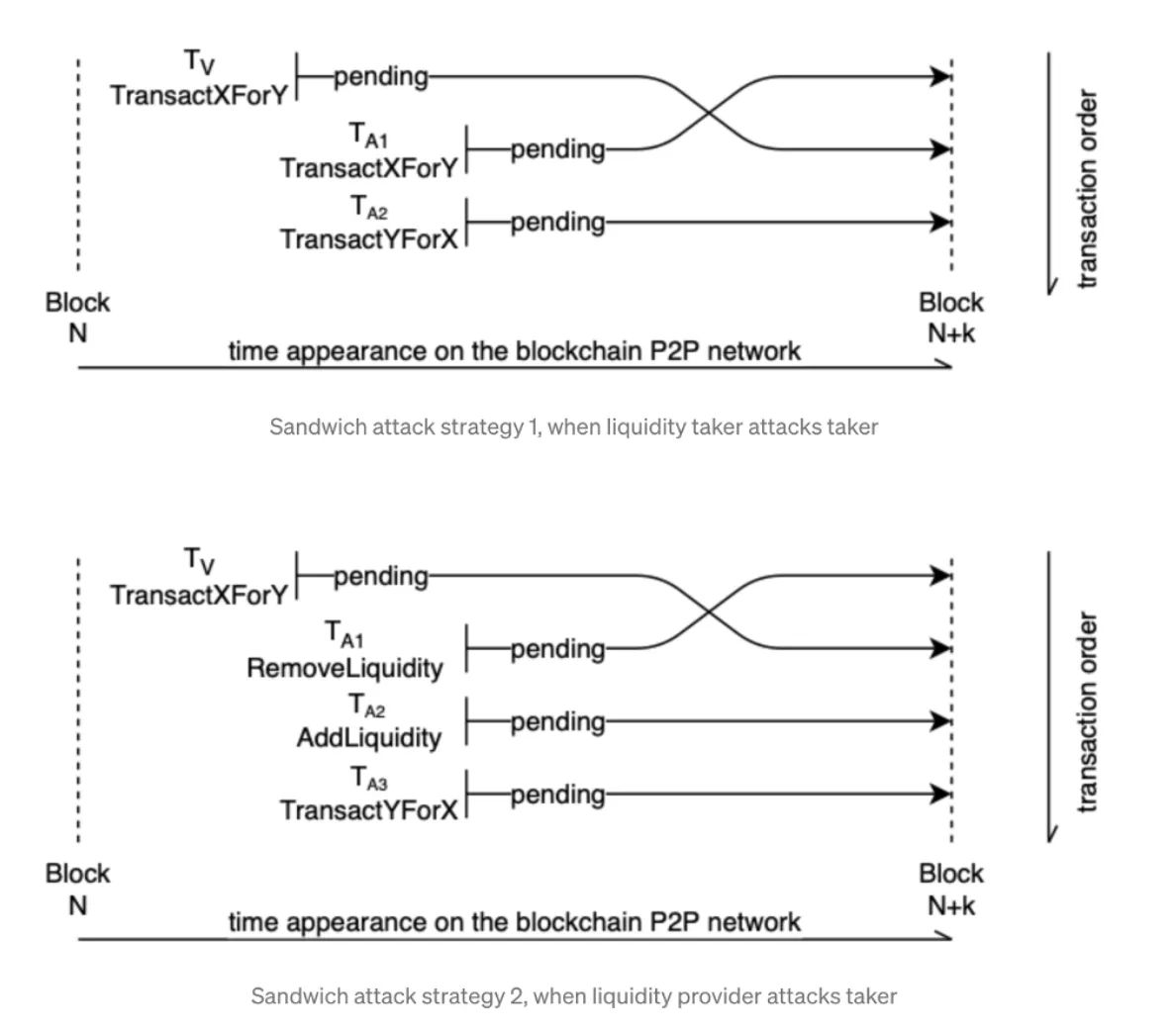
Sandwich Attack
Source: Ethereum
A sandwich attack is a specialized form of front-running, often seen in DEX trading. Attackers place a transaction immediately before the target transaction to inflate or deflate its execution price, then place an opposite transaction after it to capture the arbitrage opportunity. This “sandwiching” strategy worsens execution on user trades and, in some cases, can extract up to 1% while also increasing transaction costs, undermining fairness for regular users and decentralized markets. To reduce losses, set tight slippage limits and split large swaps into smaller pieces.
Liquidation
Liquidation transactions typically occur in lending protocols, and lending protocols rely on liquidators to trigger the liquidation of undercollateralized loans and keep the system solvent. When a borrower’s collateral value falls below a liquidation threshold, the protocol allows liquidators to repay part of the loan and earn a liquidation reward, often about 5–10% of collateral. Searchers monitor collateral values in real time and execute liquidation transactions when conditions are met, claiming rewards. These transactions are highly competitive, with liquidators often paying high gas fees to gain priority.
Time-Bandit Attack
A time-bandit attack is a chain reorganization attack where miners reorganize the blockchain state, reordering or even modifying past transactions to extract higher profits. High mev revenue can incentivize reordering attacks and, when extraction becomes excessive, distort true market prices across liquidity pools rather than only within individual blocks. This attack relies on the concentration of hashing power or validation authority, enabling control over a portion of the blockchain’s history. Such attacks undermine the stability and trust of the blockchain network, as frequent reorganizations reduce consensus efficiency, increase transaction delays and uncertainty, and erode user confidence in transaction finality.
Impact of MEV on Defi
MEV introduces new economic incentives for miners, validators, and searchers, allowing them to earn additional profits beyond standard transaction fees. These incentives drive priority bidding, so rising mev activity pushes gas prices higher, causes network congestion, and increases transaction costs for users. In DeFi, this also makes small transactions difficult to execute during periods of high fees, limiting participation for certain users. By 2023, MEV extraction on Ethereum had reached about $686 million.
MEV attacks, such as arbitrage and front-running, destabilize LP (liquidity provider) earnings and may even reduce them, while repeated arbitrage and frontrunning can also distort price discovery across pools. Attackers profit from price manipulation, which can lead to imbalances in liquidity pools and increase impermanent loss. Furthermore, LP profits are no longer solely dependent on trading volume but are also influenced by MEV searchers and miners manipulating transaction ordering, posing a potential economic threat to ordinary LPs.
Addressing MEV effectively involves redistributing the profits gained by searchers back to all participants and ensuring the efficient execution of trading mechanisms.
Current Solutions
Basic Approaches
DEXs reduce front-running risks by revealing partial order information and using auction mechanisms, which help traders anticipate market movements. Layer 2 solutions process transactions off-chain, limiting MEV searchers’ ability to monitor trades by keeping transaction details off the main chain. Privacy technologies such as zk-rollups execute transactions off-chain, restricting attackers’ access to transaction information. Time-locks enforce delays, requiring transactions to execute after a specific block, which mitigates risks from rapid arbitrage opportunities, particularly in countering flash loan attacks. Fair auction mechanisms and random ordering create more equitable transaction sequences. Encrypted ordering protocols protect transaction details until specific conditions are met, preventing early information leaks. Segregating sensitive transactions from the public mempool protects the integrity of MEV bundles. Finally, community governance and transparent incentives maintain system fairness through collective voting on MEV prevention measures, avoiding risks associated with unilateral control.
Solutions at Different Levels
To mitigate harmful MEV phenomena in blockchain systems, various solutions have been proposed across multiple levels and tools, including the consensus layer, execution layer, application layer, Layer 2 solutions, and specialized MEV tools.
Consensus Layer: The consensus layer aims to reduce MEV by adjusting block production and transaction ordering mechanisms, preventing block producers from arbitrarily manipulating transaction order. Ethereum 2.0’s Proposer-Builder Separation (PBS) is an innovative approach that separates the roles of block proposers and builders, allowing builders to construct blocks without directly controlling transaction order. Decentralized ordering protocols further enhance transaction transparency and randomness, reducing MEV risks and ensuring a fair block production process.
Execution Layer: At the execution layer, MEV is mitigated through privacy-preserving measures and optimized gas auction mechanisms. Flashbots’ private transaction relay system allows users to submit transactions privately, avoiding exposure to the public transaction pool. Additionally, some platforms have improved gas auction mechanisms to lower the need for users to pay high gas fees for prioritization, reducing the frequency of front-running and other MEV-related issues.
Application Layer: In the application layer, DeFi protocols and DEXs address MEV by implementing batch auctions and atomic swaps. Platforms like Balancer and Uniswap V3 process all transactions in time-based batches, effectively preventing harmful MEV behaviors such as sandwich attacks. Oracles like Chainlink provide on-chain price references, reducing arbitrage opportunities and lowering the likelihood of MEV exploitation.
Layer 2: Layer 2 scaling solutions mitigate MEV risks by processing large volumes of transactions off-chain before submitting them to the main chain. Technologies like Optimistic Rollups and ZK-Rollups batch and verify transactions before recording them on-chain, preventing block producers from manipulating transaction order. Additionally, certain Layer 2 protocols for DEXs use off-chain order matching and settlement, further reducing potential MEV opportunities.
Representative Solutions
Several specialized products in the MEV domain have addressed many issues. Leading providers like Flashbots and Blocknative assist miners, validators, and searchers in identifying and extracting MEV on DeFi platforms.
Flashbots
Flashbots addresses MEV challenges by introducing a transaction bundle, which submits a group of transactions as atomic operations—ensuring they either all execute or all fail, preventing front-running and preemptive transactions. Flashbots relays connect searchers and miners, offering a transparent transaction submission mechanism, while block builders submit bundles and bid to capture MEV within the broader mev supply chain. The platform employs an enhanced priority gas auction system, allowing miners and validators to select transactions based on MEV value while reducing network congestion. By providing transparent MEV extraction opportunities, Flashbots ensures fairness by helping auction MEV transparently rather than relying only on opaque ordering, enabling any capable user to participate in MEV extraction. These designs enhance both the efficiency and fairness of MEV processes.
Blocknative
Blocknative’s core innovation lies in providing a transparent and efficient MEV relay platform. By connecting to the platform, validators can access full blocks, while builders use full block and mempool visibility to identify a mev opportunity and package profitable transactions. Unlike traditional miner-driven systems, Blocknative uses an open relay model, allowing multiple builders and validators to compete fairly, and block builders compete to submit better blocks, thereby reducing the risks of MEV centralization; some arbitrage traders also use these systems to pursue a profitable arbitrage transaction. Additionally, Blocknative offers MEV bundle RPC endpoints, helping searchers optimize MEV strategies by bundling and submitting transactions to the blockchain.
BloxRoute
BloxRoute innovates through its “Blockchain Distribution Network (BDN)” protocol, which supports multiple nodes via open-source gateways or BloxRoute’s public APIs. This ensures low latency, high throughput, and protocol neutrality. This design lets nodes synchronize quickly, helping blockchain projects improve transaction speed, reduce congestion, and lower transaction costs.
Eden Network
Eden Network introduces a “slot tenant” mechanism, allowing users to stake EDEN tokens to rent priority block space. This ensures their transactions are processed in the designated block with MEV protection. This design safeguards traders against adverse MEV attacks, such as front-running, especially during periods of high network congestion.
Eden Network also incentivizes block producers with token rewards to adhere to protocol rules, ensuring transactions are processed in the correct order. Block producers who violate these rules face penalties, including potential removal from the network.
Conclusion
In summary, MEV has a complex impact on the blockchain ecosystem’s fairness, transactional integrity, and long-term development. While MEV provides miners and validators with additional incentives, attracting more projects and community participation, it also imposes high transaction costs on regular users. Practices like front-running and sandwich attacks hinder users’ ability to execute transactions in their intended order, increasing unpredictability. Technically skilled participants or resourceful miners in this environment leverage informational advantages for profit, leaving ordinary users at a disadvantage. This imbalance undermines the transparency and decentralization that blockchain originally aimed to achieve. Moreover, MEV contributes to information asymmetry and network congestion.
MEV poses significant challenges to blockchain fairness. Essentially, it represents an “arbitrage opportunity” within system design, allowing miners or validators to exploit informational and ordering advantages, disrupting the fair principles foundational to blockchain design. MEV centralization exacerbates the issue, with resource-rich validators capturing more profit opportunities while regular users and smaller miners struggle to benefit.
Future solutions may focus on improving consensus mechanisms and ordering rules, with continuous innovation across various layers. As more public chain ecosystems grow, cross-chain MEV will likely become a key focus in the coming developments.
FAQ
What is MEV in crypto?
MEV, or Maximal Extractable Value, is the additional value that block producers and other participants can capture by changing the order or selection of transactions in a block.
How does MEV work?
MEV works by identifying profitable opportunities in pending transactions and optimizing transaction ordering or inclusion to capture additional value.
What is an MEV bot?
An MEV bot is software that monitors blockchain transactions and searches for opportunities such as arbitrage, front-running, and sandwich attacks.
What is a sandwich attack?
A sandwich attack occurs when an MEV searcher places transactions before and after a target transaction to profit from the price impact caused by that transaction.