Over the past several decades of global financial evolution, international card networks represented by Visa and Mastercard have built the world's largest and most stable merchant payment and cross-border settlement networks. However, this architecture—built on the Correspondent Banking system and traditional Swift messaging—is now facing dual challenges from Web3 decentralized payments and the era of artificial intelligence. High cross-border fees, settlement cycles lasting several days (T+2 / T+3), and a lack of native support for programmable smart contracts are increasingly becoming obstacles to the globalization of the digital economy.
Recently, Mastercard's Agent Pay for Machines (AP4M) protocol, along with on-chain settlement trials conducted through collaborations between major card networks and compliant stablecoin issuers such as USDC and USDT, have marked a historic moment of convergence for the global payments industry. Traditional financial infrastructure no longer views blockchain as a competitor, but as the foundation for next-generation settlement that is more efficient, cost-effective, and programmable. This article provides an in-depth analysis of the convergence between traditional card networks and Web3 decentralized payments from multiple perspectives, including the evolution of financial payment systems, stablecoin settlement mechanisms, and cross-market coordination.
Key Takeaways
- Analyze in depth the cost and efficiency challenges faced by the traditional card network settlement system—the four-party model—in cross-border transactions and the era of intelligent payments
- Systematically explain how the Mastercard AP4M protocol introduces blockchain-based stablecoins as the underlying medium for instant settlement
- Explain the financial innovation of programmable stablecoins in reducing settlement counterparty risk and enabling "delivery versus payment (DvP)"
- Explore the comprehensive integration of compliant global crypto asset on-ramps, off-ramps, and merchant payment scenarios enabled by the convergence of card networks and Web3
- Analyze the coordinated pathways for users to allocate and hedge assets amid the transformation of payment paradigms, drawing on Gate's spot trading and asset management ecosystem
Bottlenecks in the Traditional Four-Party Model and the Introduction of Programmable Blockchain Settlement
To understand the significant financial value of combining Mastercard AP4M with stablecoin settlement, it is first necessary to clarify the traditional "Four-Party Model" used by card networks. In the traditional four-party model, an ordinary cross-border card transaction involves the cardholder, the issuing bank, the merchant, and the acquiring bank, while the card network provides transaction clearing and settlement services.
Although this model delivers authorization responses within seconds on the front end, the actual settlement of funds on the back end depends on complex interbank reconciliation, foreign exchange matching, and cross-border wire transfers. This process not only generates high fees of 1.5%–3.5%, but also involves several days of capital lockup and counterparty credit risk.
To provide a more intuitive comparison of the fundamental differences between traditional and stablecoin settlement in terms of process and efficiency, we can summarize them as follows:
| Settlement Model |
Transaction Process and Participants |
Settlement Speed and Reconciliation Mechanism |
Fees and Foreign Exchange Costs |
| Traditional Four-Party Model |
Cardholder → Issuing Bank → Card Network → Acquiring Bank → Merchant |
Relies on multiple layers of interbank reconciliation; settlement typically requires T+2 business days |
Involves multiple intermediary fees, high cross-border charges, and foreign exchange spreads |
| Stablecoin Settlement Model |
Payment Initiator (AI/Human) → Smart Contract/AP4M Protocol → On-Chain Stablecoin → Payment Recipient |
Uses blockchain ledgers to enable instant, atomic settlement of funds within seconds |
Eliminates intermediary layers and requires only minimal on-chain transfer gas fees |
Once Web3 stablecoin networks are introduced, the payment and settlement architecture is fundamentally simplified. Stablecoins transfer value directly on decentralized or permissioned blockchain ledgers, achieving absolute synchronization between the "information flow" and the "fund flow"—that is, instant atomic settlement. Mastercard AP4M retains the powerful risk management, identity verification, and user dispute resolution mechanisms, including chargebacks, of traditional card networks while separating back-end fund settlement and migrating it to an efficient blockchain-based stablecoin network. This fundamentally restructures the economic efficiency of global payments.
Stablecoins: From Crypto-Native Pricing Instruments to the Foundation of Global Programmable Settlement
In traditional finance, stablecoins were long classified simply as intermediary tokens used by crypto traders for hedging and leveraged trading. However, with deep involvement from payment giants such as Visa and Mastercard, the financial role of stablecoins is undergoing a transformation from "medium of exchange" to "globally accessible settlement infrastructure."
Stablecoins can serve as the settlement foundation for next-generation payment networks connecting machines and humans, such as AP4M, because of three core financial advantages:
-
Eliminating Counterparty Settlement Risk: Stablecoin transfers powered by blockchain smart contracts provide finality. Once a transaction is recorded on the blockchain, final settlement is complete and no longer depends on interbank credit support.
-
Highly Programmable Assets: By binding funds to conditional code, stablecoins support milestone-based payments, conditional escrow, and streaming payments, greatly expanding the ways in which commercial contracts can be executed.
-
Breaking Through Fiat Settlement Time-Zone Limitations: Traditional bank settlement is constrained by business days and banking hours, while stablecoin settlement networks operate continuously, 24 hours a day, 365 days a year. This significantly improves the capital velocity of businesses.
These dual breakthroughs in technology and finance enable traditional card networks to seamlessly connect to the borderless financial liquidity brought by Web3 while retaining the advantages of their global merchant networks.
RWA Tokenization and Compliant On-/Off-Ramps: The Value Loop and Compliance Bridge for On-Chain Stablecoin Settlement
Within the broader architecture of traditional card networks such as Mastercard integrating the AP4M protocol with stablecoin settlement, achieving second-level fund transfers and instant atomic settlement on the back end is still not enough to create a complete commercial loop. For this new decentralized settlement network to scale across the real economy and cross-border commerce, it requires the strong support of two core financial tools: tokenization of real-world assets (RWA) and seamless connectivity with global compliant fiat on-/off-ramp channels.
First, although stablecoins solve the efficiency problems involved in the movement of funds during payments, the value backing their reserve assets as the foundation of decentralized settlement is undergoing a profound paradigm shift. Traditional financial institutions and crypto protocols are tokenizing vast amounts of underlying reserves—such as short-term U.S. Treasury securities, highly rated commercial paper, and high-quality bank deposits—on-chain through RWA technology. This RWA tokenization mechanism not only provides stablecoin issuers with real and sustainable risk-free interest income, but also transforms stablecoins themselves into interest-bearing settlement assets that combine high liquidity with yield characteristics. When merchants or AI Agents receive or hold these stablecoins within card network systems, they benefit from second-level settlement while continuing to earn returns generated by the underlying real-world assets during the holding period. This fundamentally restructures the time value of funds in traditional merchant settlement.
Second, the completeness of compliant fiat on-/off-ramp channels directly determines the depth of the connection between crypto settlement networks and the real-world fiat economy. The core advantage of card networks such as Mastercard lies in their global connections with tens of thousands of issuing and acquiring banks. By embedding compliant identity verification and KYC/AML risk controls into AP4M protocols and stablecoin settlement access points, users and businesses can convert freely and with no delay between "fiat accounts – on-chain stablecoins – end merchants/service providers." Opening up these compliant settlement channels removes traditional multinational companies' concerns about the legal compliance and tax oversight of crypto assets. It allows decentralized stablecoin settlement to move beyond the boundaries of the "crypto-native community" and become an infrastructure bridge connecting hundreds of countries and regions worldwide and serving billions of people and intelligent agents.
Asset Allocation and the Collaborative Advantages of the Gate Ecosystem Amid a Financial Paradigm Shift
As innovative protocols such as Mastercard AP4M drive the convergence of traditional payment networks and Web3 on-chain settlement networks, the global crypto asset market is entering a period in which compliance and mainstream adoption advance in parallel. The continued expansion of stablecoin supply not only improves liquidity across the crypto market, but also injects a steady flow of real fiat capital into on-chain DeFi yields, RWAs (real-world assets), and related public blockchain infrastructure.
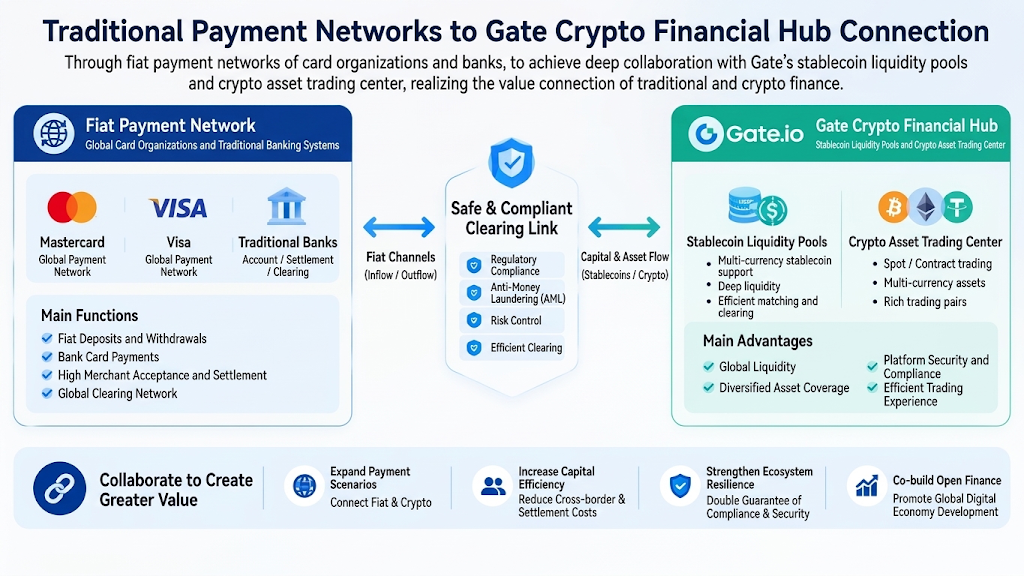
In the face of this historic transformation in financial paradigms, investors and everyday users need a comprehensive financial gateway that can connect conveniently to fiat assets while efficiently managing on-chain crypto assets. Mainstream crypto asset trading platforms play a key bridging role in this process. Gate, for example, is a leading global crypto asset trading platform that provides comprehensive stablecoin on-/off-ramp channels, spot trading pairs, and diversified financial management tools.
Through Gate, users can safely and efficiently convert and manage core stablecoins such as USDT and USDC, while conveniently allocating assets in underlying public blockchains, DeFi protocols, and AI payment infrastructure that are benefiting from this transformation in payments. The combination of strong compliance and asset security, abundant spot liquidity, and convenient fiat/crypto channels gives users worldwide a reliable hub for asset management and value capture as traditional card networks and Web3 payments become increasingly integrated.
FAQ
How Does Mastercard AP4M Change Traditional Cross-Border Payment Settlement?
By combining card network tokenized risk control protocols with a blockchain-based stablecoin settlement layer, Mastercard AP4M simplifies the traditional cross-border settlement process—which can take several days and involve high fees—into low-cost, around-the-clock on-chain atomic settlement completed within seconds.
Why Are Traditional Card Networks No Longer Rejecting Crypto Stablecoins and Instead Choosing to Integrate Them?
Stablecoins offer highly efficient transfers, programmability, and low costs. By integrating stablecoins, card networks can retain the advantages of their extensive merchant networks and front-end risk controls while significantly reducing back-end settlement costs and positioning themselves for the emerging machine-to-machine (M2M) payment market.
How Can Everyday Users and Investors Participate in the Benefits of This Payment Innovation Through Gate?
Users can allocate core stablecoins such as USDT and USDC, as well as related underlying infrastructure assets, through Gate's spot market and financial management center. With Gate's deep liquidity and secure custody, users can participate steadily in the broader adoption of Web3 payments while pursuing returns.