Crypto asset security depends not only on blockchain networks and smart contracts themselves, but also on wallets, account credentials, endpoint devices, trading interfaces, and various on-chain and off-chain infrastructure. As artificial intelligence continues to advance in code analysis, information generation, and automated task processing, attackers may use these tools to improve the efficiency of vulnerability research and attack preparation. They may also generate more deceptive phishing messages, causing certain traditional security risks to evolve.
However, AI does not automatically bypass system protections, nor does it make every attack easy. For the crypto asset industry, the more important task is to identify the specific risk entry points that AI may affect and establish appropriate security controls for different scenarios. This article reviews the main risks across five areas—smart contracts, wallet interactions, account credentials, endpoint devices, and infrastructure. It also introduces protective measures that project teams, digital asset platforms, and individual users can adopt, and further analyzes the value of applying AI to security monitoring and risk management.
Key Takeaways
-
AI is changing how attacks are prepared in the crypto asset industry. Information analysis, code comprehension, and content generation may improve the efficiency of certain attack activities, but they do not mean that an attack will necessarily succeed.
-
Smart contracts, wallets, and infrastructure form multiple risk entry points. Security issues may arise from code logic, transaction authorization, account credentials, endpoint devices, or third-party dependencies.
-
Project teams need to establish continuous security management systems. Asset inventory, code audits, vulnerability management, key protection, permission isolation, and incident response should form a complete process.
-
User protection should focus on identity verification and least privilege. Access services through official channels, protect private keys and seed phrases, check transaction authorizations, and use third-party AI tools with caution.
-
AI can support both attacks and security defense. Anomaly detection, code review, and threat intelligence analysis can improve security operations efficiency, but traditional security controls and human review are still required.
Why Does AI-Assisted Attacking Deserve the Crypto Asset Industry's Attention?
Security issues in the crypto asset industry have a clear multilayered structure. A digital asset application may depend simultaneously on blockchain networks, smart contracts, wallet software, browser extensions, API services, cloud infrastructure, and user endpoints. A permissions misconfiguration, code defect, or identity verification issue in any one of these areas may affect the security of the entire system. The public verifiability of blockchain transactions and the irreversibility of certain operations may also cause security issues to have a direct impact on assets.
The development of AI is changing how attackers and defenders address these issues. Capabilities such as code analysis, information organization, content generation, and automated task orchestration can help security researchers understand complex systems more quickly. They may also be used by malicious actors to improve the efficiency of attack preparation. Attackers do not necessarily need to develop entirely new attack techniques. If they can use AI to identify existing weaknesses more efficiently, generate deceptive content, or organize attack processes, the cost and scale of certain attacks may change.
However, AI does not mean that an attack will necessarily succeed, nor does it mean that all crypto asset projects face the same risks. Projects differ in their technical architectures, permission designs, asset sizes, and security operations capabilities. A more effective approach to risk management is to first identify the main attack entry points that AI may affect, and then establish layered protective measures based on the importance of the assets and business operations.
Five Types of AI-Assisted Attack Risks in the Crypto Asset Industry
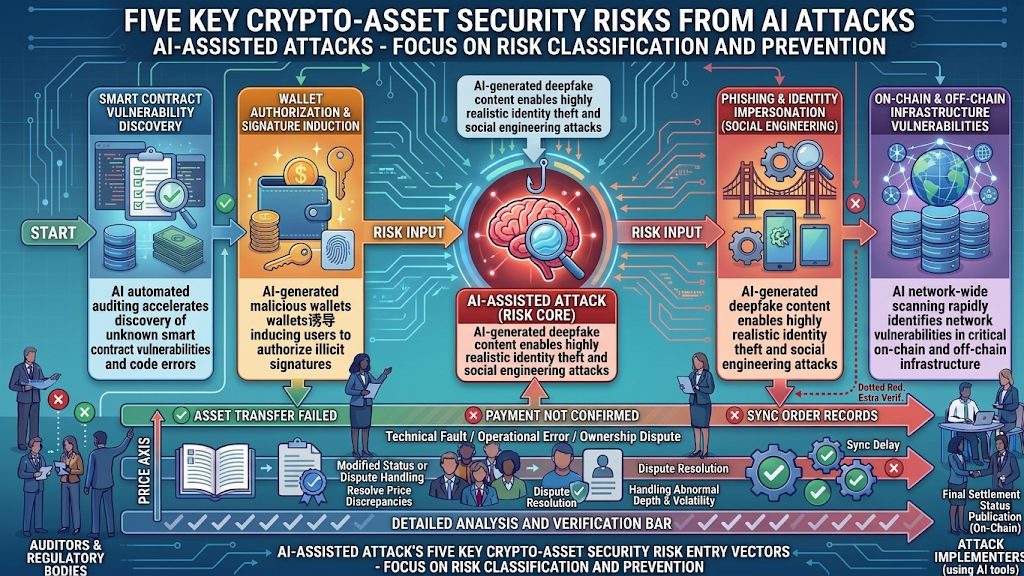
Smart Contract Code and Business Logic Risks
Smart contracts support important functions such as token transfers, asset custody, lending, trading, and governance. AI can help developers and security researchers understand contract code, map relationships between function calls, and identify logic that requires further review. Attackers may also use similar capabilities to analyze publicly available contract code, study the causes of disclosed vulnerabilities, and determine whether similar design issues exist in other projects.
Common smart contract risks include improper access control, insufficient input validation, reentrancy issues, incorrect use of price oracles, and business logic defects. AI can help locate suspicious code, but the actual risk still depends on call sequences, state changes, external contract interactions, and permission conditions. Issues identified by a model must be tested and professionally reviewed. They should not be directly treated as exploitable vulnerabilities.
Wallet Interaction and Transaction Authorization Risks
Wallets are important entry points for users to manage keys and interact with blockchain applications. Users may connect wallets to decentralized applications, sign transactions, or grant token usage permissions. Attackers do not necessarily need to obtain users' private keys directly. They may instead induce users to sign dangerous authorizations or confirm transactions they do not fully understand, resulting in asset loss.
AI can help generate more natural-looking spoofed notifications, customer service communications, and project announcements, making some deceptive content more closely resemble the language and scenarios familiar to users. Users need to distinguish between wallet connections, message signing, transaction signing, and token authorizations. Before confirming an operation, they should check the transaction recipient, asset changes, and permission scope. Any seemingly normal operation request should not be considered trustworthy simply because it is professionally worded or comes through a familiar communication channel.
Phishing and Identity Impersonation Risks
AI's content-generation capabilities may make phishing easier to customize. Attackers can adjust the tone, language, and communication scenario to create messages impersonating trading platforms, wallet services, project teams, or customer service representatives. Compared with traditional phishing templates that contain obvious grammatical errors, this type of content may be more difficult to authenticate based on surface-level language alone.
Crypto asset users should be especially cautious of fake airdrops, account anomaly notifications, promotional rewards, investment opportunities, and technical support requests. Attackers may use publicly available social information to learn which projects users follow and then generate more targeted deceptive content. Protection does not depend on identifying one fixed type of phishing language. Instead, users should verify information sources through official channels, avoid opening unknown links, and never provide passwords, verification codes, private keys, or seed phrases to anyone.
Malware and Endpoint Device Risks
The security status of a user's endpoint device may affect the safety of private keys and account credentials. Malware, applications disguised as wallets, unknown browser extensions, and tampered download files may all become attack entry points. AI may help attackers understand existing malicious code, modify content, or organize attack information. However, whether malware can have an actual impact still depends on factors such as system permissions, endpoint protection, and the operating environment.
Users should download wallets and related software from trusted sources, update operating systems and security components promptly, and avoid installing extensions or programs from unknown sources. For tools that need to access wallets, read account information, or execute transactions, users should carefully confirm their permission scope. Project teams and platforms should also focus on endpoint security education, anomalous login detection, and account protection mechanisms.
On-Chain and Off-Chain Infrastructure and Supply Chain Risks
The infrastructure supporting crypto asset services extends far beyond smart contracts. It also includes nodes, RPC services, trading interfaces, oracles, cross-chain bridges, cloud servers, and third-party dependencies. AI can help security teams organize asset inventories, analyze logs, and identify anomalous access patterns. Attackers may also use publicly available information to research exposed services or known software defects.
Cross-chain bridges, oracles, and external services typically involve trust relationships among multiple components. If a key component has a permissions misconfiguration, data source issue, or software dependency vulnerability, it may affect the security of the applications built on top of it. Project teams need to include infrastructure and the supply chain in their overall security assessments, rather than checking only whether smart contract code has passed an audit.
How Can Project Teams Establish a Defense System Against AI-Assisted Attacks?
Start by Identifying the Attack Surface Through Asset and System Inventories
Project teams first need to understand which components make up their systems, which components have critical permissions, and how different services depend on one another. Security assessments should not be limited to smart contracts. They should also cover wallet connection processes, account authentication, third-party interfaces, node services, cloud infrastructure, and the software supply chain.
When creating an asset inventory, teams can classify critical contracts, administrative accounts, key management systems, user data, and external services according to their business importance. For each type of asset, they should define its access permissions, dependencies, and potential impact. This is necessary to determine which issues could directly affect fund security or service continuity.
Incorporate AI Into the Security Review Process Instead of Replacing Audits
AI can assist developers in understanding code, summarizing suspicious logic, and organizing testing ideas, but it should not be treated as an independent security audit mechanism. Project teams can combine model-assisted analysis with static code analysis, dynamic testing, independent audits, and necessary formal verification. Each method can then handle information organization, issue identification, and result validation, respectively.
Vulnerability reports generated by models should be further reviewed for their triggering conditions, impact scope, and actual execution results. Unverified analysis should not be used directly to make high-risk system changes, nor should it serve as the sole basis for determining that a system is secure or has a serious vulnerability. AI can improve review efficiency, but security responsibility must still be handled by a professionally qualified team.
Strengthen Key Management and Permission Isolation
Private keys, seed phrases, access tokens, and administrative credentials are high-value information in digital asset systems. Project teams should limit access to sensitive credentials and avoid placing them in ordinary logs, shared documents, or unapproved AI tools. High-privilege operations can be combined with multiple approvals, separation of duties, and auditable records to reduce the impact of mistakes involving a single account or process.
For AI agents with tool-calling capabilities, teams also need to clearly define the data they can access and the operations they can perform. Models should not obtain keys, fund management permissions, or high-risk production environment capabilities without explicit authorization. Including AI systems in permission management and security reviews is an important step in preventing new tools from introducing additional risks.
Establish Continuous Monitoring and Incident Response Mechanisms
Security reviews should not take place only before a product goes live. Project teams need to continuously monitor anomalous access, permission changes, system configuration changes, and the status of critical services. They should also establish clear alert classification and incident handling processes. For important assets and critical systems, teams should define who is responsible for confirming risks, who has the authority to take restrictive measures, how investigation evidence should be preserved, and how subsequent recovery should be conducted.
AI can help organize alerts, analyze logs, and summarize incident leads, but it cannot replace clearly defined response responsibilities. Organizations should conduct regular security exercises to verify the effectiveness of their anomaly detection, risk isolation, communication and coordination, and recovery processes. Only by combining technical tools with operational systems can organizations establish a continuously functioning defense system.
How Can Crypto Asset Users Reduce the Risks of AI-Assisted Attacks?
Users should access digital asset services through verified official websites and applications. They should not determine the authenticity of information solely based on social media direct messages, group notifications, or advertising links in search results. For messages about account anomalies, promotional rewards, airdrop claims, or customer support assistance, users should actively verify the information through official channels instead of directly following the links or contact details provided in the message.
Protect Private Keys, Seed Phrases, and Account Credentials
Users should keep their private keys and seed phrases themselves and should not provide them to customer service representatives, project personnel, third-party tools, or AI services. Passwords and verification codes should not be submitted through chat windows or unknown webpages. For tools that claim to manage wallets, recover accounts, or automate trading on behalf of users, users should first verify the service source and permission requirements. They should be especially alert to requests to import seed phrases.
Check Permissions and Transaction Details Before Signing
Wallet signatures and on-chain authorizations may create different levels of asset risk. Users should check the contract address, asset amount, authorization scope, and actual operation involved in a transaction. They should not confirm a transaction hastily when they cannot understand its meaning. For authorizations that are no longer needed, users can review and revoke unnecessary permissions based on their actual needs.
Reduce Risks From Endpoint Devices and Software Sources
Wallets and related applications should be downloaded from trusted sources, and systems and software should be kept up to date. Users should be cautious when installing browser extensions, remote control tools, and third-party trading assistants, and should avoid allowing unknown programs to obtain excessive device or account permissions. For devices used to operate assets, users should minimize unnecessary software installations and exposure of sensitive information.
AI trading assistants, automated strategy tools, and agents may need to read market data, connect to accounts, or call external services. Before using these tools, users should verify the service provider, data processing practices, API permission scope, and fund operation permissions. Permission to read market data is not the same as permission to initiate trades or withdraw assets. Users should follow the principle of least privilege whenever possible and avoid granting unnecessary high-level permissions.
The Role of AI in Crypto Asset Security Defense
AI can be used not only to assist attacks but also as part of a defense system. During smart contract development, models can assist with code reviews and test case design, helping teams identify logic that requires further validation. In infrastructure operations, AI can help classify logs, summarize anomalous access patterns, and organize scattered alerts into investigation materials that are easier to understand.
At the user protection layer, AI may also be used to identify impersonation attempts, analyze suspicious links, and detect anomalous behavior patterns. For platforms and project teams that need to process large amounts of security information, models can help reduce repetitive information organization work and allow teams to focus more on risk confirmation and incident response. However, the actual effectiveness of these capabilities depends on data quality, model design, system integration, and human verification mechanisms.
AI defense tools themselves are also subject to false positives, false negatives, and insufficient contextual understanding. If security teams rely entirely on model judgments, they may mistakenly overlook genuine threats or reduce response efficiency because of a large number of false positives. Key decisions involving asset transfers, permission changes, and key operations still require clear permission boundaries, human review, and auditable records.
A more appropriate approach is to use AI as an auxiliary layer within security operations rather than giving models unrestricted system control. Models can improve analysis efficiency, traditional security tools can execute deterministic detection and controls, and professionals can validate high-risk decisions. This division of responsibilities helps control the risks caused by model misjudgments and permission abuse while making use of AI capabilities.
For digital asset trading platforms, security systems need to cover multiple areas, including accounts, trading, asset management, and user interactions. The risks associated with AI-assisted attacks remind industry participants that even when the underlying blockchain has features such as public verifiability and immutability, users may still be affected by phishing, credential theft, malware, and third-party service risks. Platform security cannot rely solely on the characteristics of the underlying network. It also requires continuous attention to account protection, identity verification, system permissions, and user risk education.
As a digital asset trading platform, Gate's business scenarios are also closely related to these security issues. When using platform services, users should access their accounts through official channels, properly protect their login credentials and verification information, and exercise caution with unusual requests that claim to come from platform customer service, project teams, or third-party AI tools. Any request for a password, verification code, private key, or seed phrase should not be considered part of a normal account support process.
From an industry perspective, AI technology also provides new tools for security operations. Risk analysis, anomalous behavior detection, and security information organization may all become technical components of a platform's ongoing efforts to improve security capabilities. However, the specific AI systems adopted by a platform, the business areas in which they are deployed, and the defense capabilities they provide should be determined based on information publicly disclosed by the platform. They should not be inferred solely from industry trends.
For users, platform security and personal security practices have always complemented each other. Choosing a trusted service platform, using appropriate account protection measures, verifying transaction information, and avoiding the disclosure of sensitive credentials can reduce many unnecessary risks. For the industry, the real challenge posed by AI is not a particular new attack tool. Rather, both attack and defense capabilities are changing, and security systems must continuously adapt to the evolving technological environment.
FAQ
Will AI-Assisted Attacks Make Crypto Assets Easier to Steal?
AI may improve the efficiency of information processing and content generation for certain attack activities. However, whether assets are affected still depends on whether the target system has vulnerabilities, whether accounts and permissions are protected, and whether the attacker can meet the conditions required for actual exploitation. AI does not mean that an attack will necessarily succeed.
What Are the Most Common Crypto Asset Risks Associated With AI-Assisted Attacks?
The main risks include assisting with the discovery of smart contract and infrastructure vulnerabilities, generating more deceptive phishing messages, supporting malware development, and using public information to analyze users and project environments. Different risks involve different attack entry points and protective measures.
Can AI Find All Vulnerabilities in Smart Contracts?
No. AI can assist with code comprehension and the identification of suspicious logic, but models may misjudge or overlook complex execution conditions. Smart contract security still requires static analysis, dynamic testing, independent audits, and necessary formal verification.
How Can Crypto Asset Users Protect Against AI-Assisted Phishing?
Users should access services through official channels, verify domain names and information sources, never provide private keys or seed phrases to anyone, and check the transaction recipient and authorization scope before signing a transaction. For information about AI trading agents, customer service, and airdrops, users should not judge credibility solely because the content appears professional.
Yes. AI can assist with organizing threat intelligence, analyzing anomalous behavior, and processing security alerts. However, it should be combined with traditional security controls, permission management, human review, and incident response mechanisms. AI should not be the sole basis for security decisions.