For technology companies led by their founders over the long term, key individuals often do more than manage the business. They may also be deeply involved in product road maps, technology strategy, capital allocation, and external partnerships. Their personal influence may gradually become an important factor in how investors assess the company’s competitive advantages.
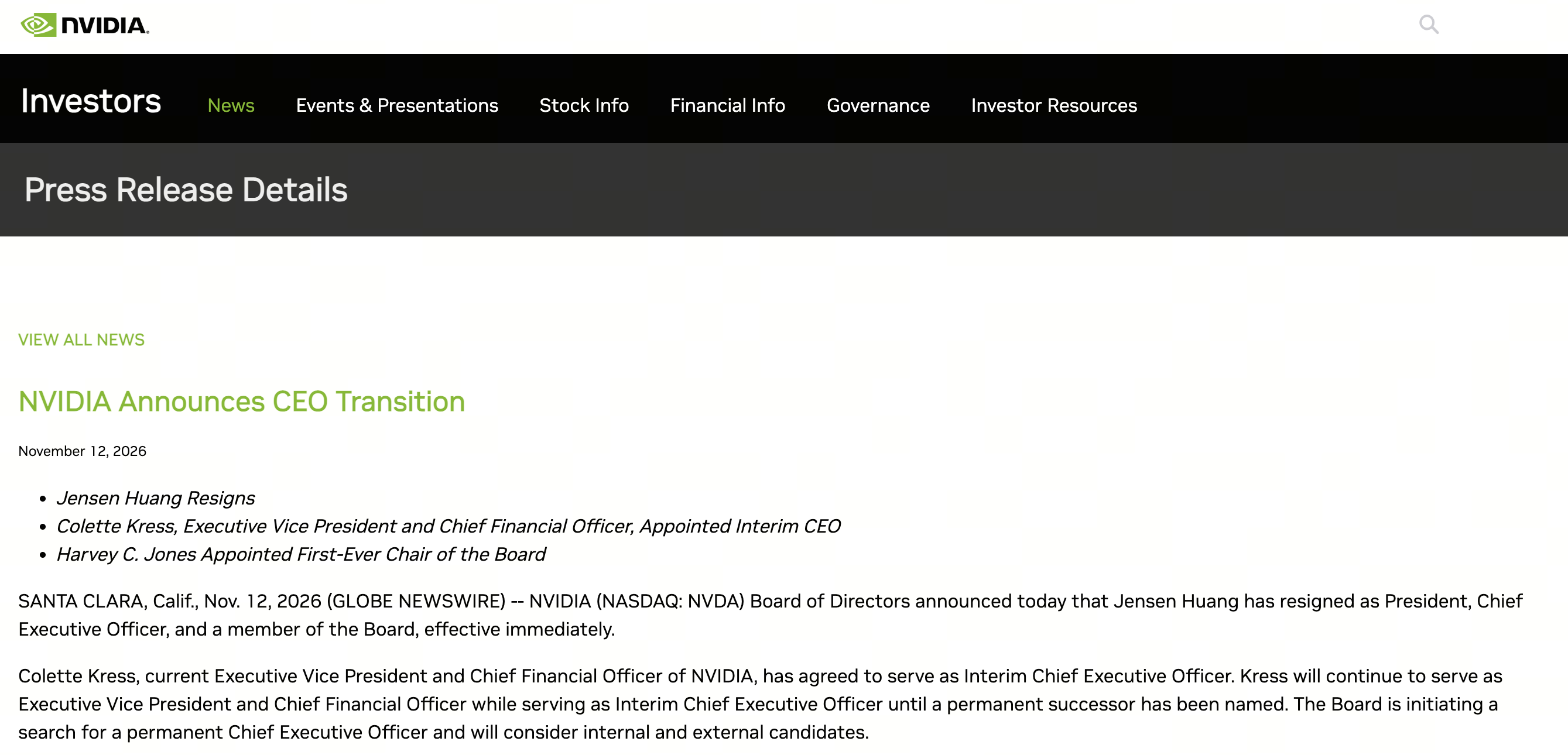
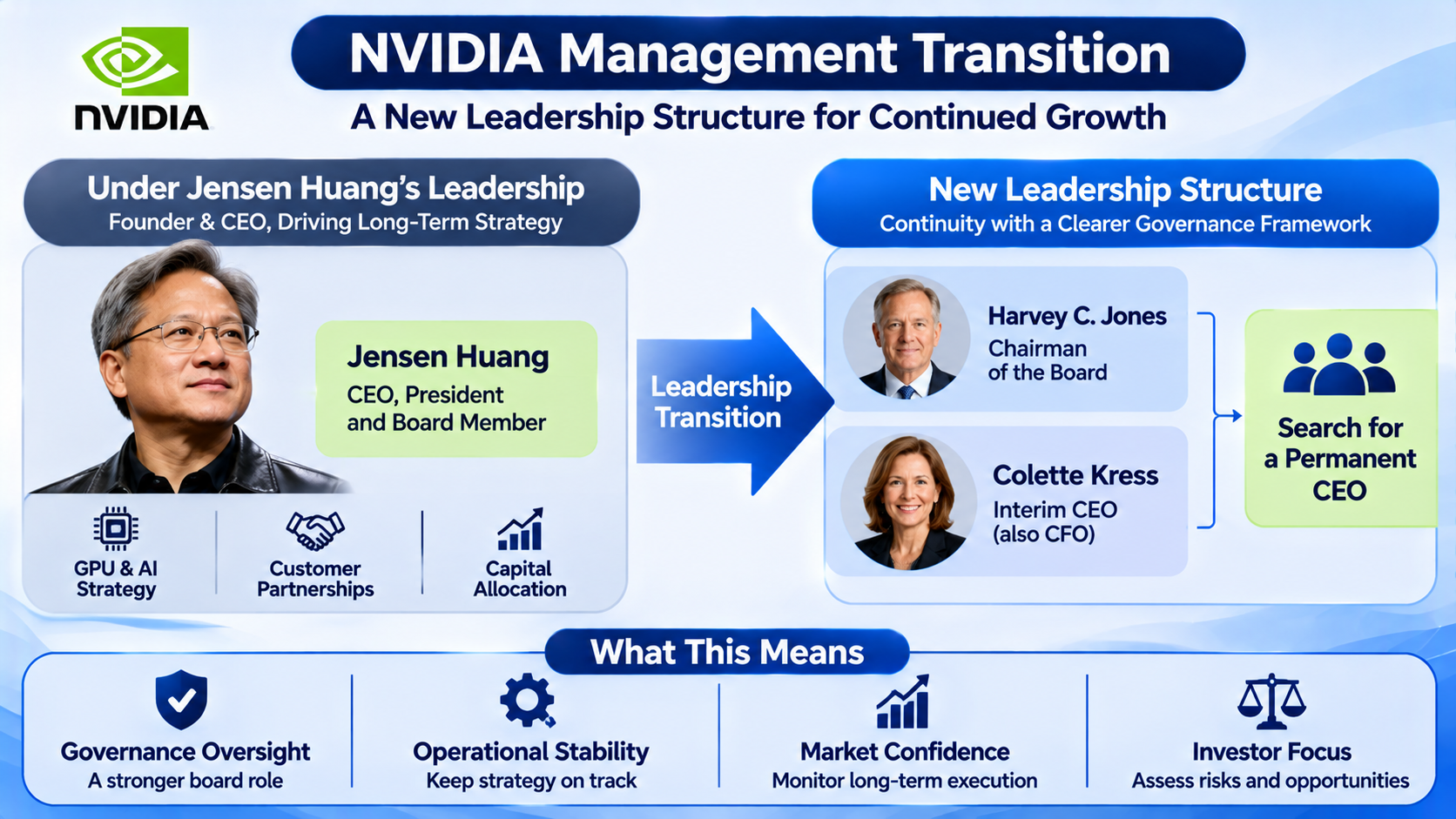
On November 12, 2026, NVIDIA announced that co-founder Jensen Huang had resigned as the company’s president, chief executive officer, and director. Former CFO Colette Kress became interim CEO while continuing to serve as CFO. The board appointed Harvey C. Jones as chairman and began the process of selecting a permanent CEO. Earlier, the NVIDIA board had launched an independent investigation into reports related to potential foreign intelligence activities involving Jensen Huang. In a November 8 statement, the board said there was no reason at that time to believe that national security or company secrets had been compromised. The investigation would continue to rely on actual evidence and subsequent disclosures.
Jensen Huang has long led NVIDIA’s transformation from a graphics processor company into an AI computing platform company. His departure has refocused market attention on management succession, board independence, continuity of technology strategy, and the company’s major investment decision-making mechanisms. For investors, the key issue is not simply whether NVIDIA will lose its competitive advantages. It is understanding how a company that relies heavily on founder leadership can convert an individual’s decision-making capabilities into organizational systems that can operate sustainably. This article examines how key person risk develops and analyzes how management changes may affect corporate governance, the AI supply chain, and stock valuation.
Key Takeaways
-
Key person risk primarily arises from a company’s heavy reliance on a small number of individuals for strategy, technology, customer relationships, and major decisions.
-
Jensen Huang’s departure does not mean that NVIDIA’s technology, customer contracts, or product road map will immediately change. However, the management transition increases uncertainty around future strategy execution.
-
NVIDIA has appointed Colette Kress as interim CEO and begun selecting a permanent successor. Board oversight and the division of management responsibilities have become new areas of focus.
-
A founder CEO may help a company establish long-term strategic advantages, but may also concentrate major decisions excessively, making succession and internal oversight more difficult.
-
Corporate governance risks may affect stock prices through risk premiums, earnings expectations, and valuation multiples. However, short-term stock price movements cannot be attributed entirely to management events.
-
Assessing NVIDIA’s long-term operating capabilities requires monitoring its CUDA software ecosystem, GPU product road map, customer relationships, capital allocation, and management team stability.
I. What Is Key Person Risk? Why Are Technology Companies More Exposed?
Key person risk is a type of concentration risk in enterprise risk management. It refers to a situation in which one person’s knowledge, experience, relationships, or decision-making authority is highly important to a company, while the organization lacks mechanisms that can quickly replace those functions. A key person may be a founder, CEO, chief technology officer, or head of core research and development. It may also be an employee who controls important customer resources or possesses unique technical capabilities. When a company becomes overly dependent on one person, a sudden departure may affect future project execution, employee stability, and investor expectations even if the financial statements do not change immediately.
Technology companies are more prone to this risk because of the nature of their businesses. The semiconductor, artificial intelligence, and cloud computing industries require sustained, long-term research and development investment. Many major technology decisions cannot be validated through financial indicators in the short term. Managers must assess future computing architectures, software platforms, and market demand, then commit substantial resources when commercial returns remain unclear. Founders with extensive technical experience and industry influence may play an important role in this environment. As a company grows, a founder’s personal judgment may also become increasingly intertwined with its corporate strategy.
However, key person risk does not mean that founder leadership necessarily indicates a governance deficiency. An effective long-term leader may help a company maintain strategic consistency and reduce the extent to which short-term market pressure disrupts research and development investment. The key issue is whether the company has developed organizational capabilities that can preserve these advantages, including a strong technical talent pipeline, clearly defined management authority, independent risk review mechanisms, and an executable succession plan. If a company can maintain product delivery, customer service, and major decision-making processes after a key person leaves, the practical impact of key person risk may be mitigated.
II. Why Is Jensen Huang’s Departure a Typical Case of Key Person Risk at NVIDIA?
Since helping found NVIDIA in 1993, Jensen Huang has served as the company’s long-term core leader and has been deeply involved in the development of GPU technology, the CUDA software ecosystem, and AI-accelerated computing strategy. NVIDIA’s competitive advantages come not only from chip performance but also from its software tools, developer ecosystem, system-level design, and customer relationships. These capabilities have accumulated over many years and formed an interconnected commercial system. Jensen Huang played an important role in strategic decision-making and external communications during this process, and his personal leadership became closely associated with the company’s long-term development.
The management changes in November 2026 have placed this long-established personal influence into an organizational transition. In its November 12 statement, NVIDIA confirmed that Jensen Huang had resigned as president, CEO, and director, while Colette Kress became interim CEO. The board would consider both internal and external candidates. The company emphasized that the existing management team would continue advancing customer commitments and the technology road map. However, this statement reflects management’s expectations for operational continuity and does not mean that all future strategic and execution risks have been eliminated.
The market must reassess which capabilities have become embedded in NVIDIA’s organizational systems and which remain highly dependent on Jensen Huang personally. For example, GPU architecture development relies on engineering teams and technical processes built over many years, while the CUDA ecosystem is maintained collectively by numerous developers and partners. These foundations will not disappear immediately because of a CEO transition. However, major capital allocation decisions, cross-industry partnerships, regulatory communications, and new business strategies may be affected by changes in management style. Distinguishing sustainable organizational capabilities from strategy that depends on an individual is an important starting point for understanding NVIDIA’s key person risk.
III. Why Can a Founder CEO Bring Both Strategic Advantages and Governance Risks?
Founder CEOs often have a strong commitment to long-term strategy. They can establish a clear product position during a company’s early development and continue investing resources when the market has not yet fully recognized a new technology. For NVIDIA, the development of general-purpose GPU computing, the CUDA software platform, and AI-accelerated computing all required long research and commercialization cycles. A stable long-term leadership structure can help a company maintain consistency in its technology direction and coordinate investment across hardware, software, and ecosystem development.
This advantage may also be accompanied by a concentration of power. As a founder’s track record grows, the board, management team, and external investors may become increasingly reliant on the founder’s personal judgment. Even when formal approval and oversight procedures exist, major decisions may receive greater support because of the founder’s influence. The governance challenge is not simply to restrict the founder’s decision-making ability, but to ensure that major investments, related-party transactions, conflicts of interest, and risk-taking receive adequate review.
Founder leadership and good governance are not inherently incompatible. A company can use independent directors, professional committees, risk management procedures, and management authorization mechanisms to improve oversight while preserving strategic execution efficiency. The key questions are whether the board can raise opposing views when necessary, whether the management team can perform its duties independently, and whether the company has decision-making procedures that do not depend on a single individual. When a founder suddenly leaves, these institutional arrangements directly affect how external investors assess business continuity.
IV. Why Does NVIDIA’s Board Adjustment Affect Corporate Governance Expectations?
The board is an important part of a public company’s governance system. It oversees management, reviews major matters, assesses operating risks, and protects the long-term interests of the company and its shareholders. In companies where a founder has served as CEO for a long time, the board’s ability to independently oversee management is particularly important. A manager’s deep understanding of technology and the business can improve decision-making efficiency. However, if the board lacks sufficient information, expertise, or independent judgment, it may have difficulty identifying major operating risks in a timely manner.
NVIDIA’s management adjustment includes two changes worth noting. First, Colette Kress is temporarily serving as both CEO and CFO, assuming responsibility for operational and financial management. Second, Harvey C. Jones has been appointed chairman, creating a new division of responsibilities between the board and executive management. Jones has served as an NVIDIA director since 1993 and has extensive experience participating in the company’s governance. The effectiveness of the new leadership structure will depend on how the board oversees management, organizes the permanent CEO selection process, and handles major investments and risk management matters.
Separating the chairman and CEO roles can clarify the board’s oversight responsibilities, but it does not automatically improve governance quality. It is equally important to consider whether board members can express independent views, whether the audit and risk committees operate effectively, and whether major transactions receive adequate review. Having the interim CEO also serve as CFO does not necessarily create a governance problem, but it may increase the concentration of management responsibilities and workload. These issues will need to be coordinated through delegation to the finance team, board oversight, and subsequent management arrangements.
In addition, the NVIDIA board previously established an investigation mechanism overseen by independent directors and supported by external independent legal counsel. Launching the investigation indicates that the board is addressing relevant risk matters, but the investigation itself does not confirm any unverified allegations. For investors, the more important issues are whether the subsequent investigation process is complete, whether disclosures are sufficient, and whether the company uses the findings to improve its governance systems.
V. Colette Kress as Interim CEO: What Changes Might NVIDIA’s Operating Strategy See?
Since joining NVIDIA in 2013, Colette Kress has served as CFO for many years and participated in the company’s financial management, capital allocation, and operating planning. Unlike a technical executive directly responsible for GPU architecture development, a CFO’s core responsibilities generally include financial forecasting, financing arrangements, cost control, and investment return assessments. Having the head of finance serve temporarily as CEO can provide some operational continuity during a sudden management transition. However, the company’s future technology strategy will still need to be executed by the full research, development, and business management teams.
NVIDIA’s primary competitive advantages do not depend entirely on any single executive. GPU architecture, the CUDA software platform, networking, system design, and the developer ecosystem have already formed a large organizational and technical system. In the short term, existing product development processes, customer orders, and supply chain arrangements generally will not terminate automatically solely because of a CEO transition. However, the new management team’s decisions regarding research and development budgets, customer financing, long-term partnerships, and new business investments may gradually affect the company’s approach to capital allocation.
NVIDIA’s role in the AI supply chain has also expanded beyond traditional chip sales. Through strategic investments, customer partnerships, and other commercial arrangements, the company participates in the AI infrastructure ecosystem. Some projects involve long-term capital commitments, and their returns may depend on customers’ future financing capabilities and computing demand. After the management transition, the market may pay closer attention to whether these investments have independent commercial returns and whether NVIDIA needs to adjust the level of financing support it provides to customers.
Kress’s long-term financial management experience may support the review of capital allocation. However, it does not justify concluding that the company will necessarily reduce investment or abandon its existing strategy. Reports on November 13 indicated that some people familiar with the matter believed she had previously expressed different views on several large AI financing arrangements. Such reports may provide a reference for assessing management style, but specific strategic changes should continue to be evaluated based on the company’s subsequent disclosures regarding investment plans, capital expenditures, and operating results.
VI. How Could Key Person Risk Affect NVIDIA’s Stock Valuation?
Stock valuation reflects not only a company’s current profits but also investors’ expectations regarding future growth, operating stability, and risk levels. When a company has strong earnings and clear competitive advantages, the market may be willing to assign it a higher valuation multiple. However, if investors believe that a management transition may affect future strategy execution, they may demand greater risk compensation even if short-term revenue and profit do not change immediately. This may reduce the valuation they are willing to pay.
Key person risk mainly affects valuation in three ways. First is earnings expectations. Management changes may cause investors to reassess the company’s ability to execute on product development, customer partnerships, and capital expenditures. Second is the risk premium. If future operating results become more difficult to predict, investors may lower the value they assign to long-term cash flows. Third is market sentiment. Unexpected events can trigger concentrated trading and short-term volatility, causing stock price movements to exceed the actual changes that have occurred in the fundamentals.
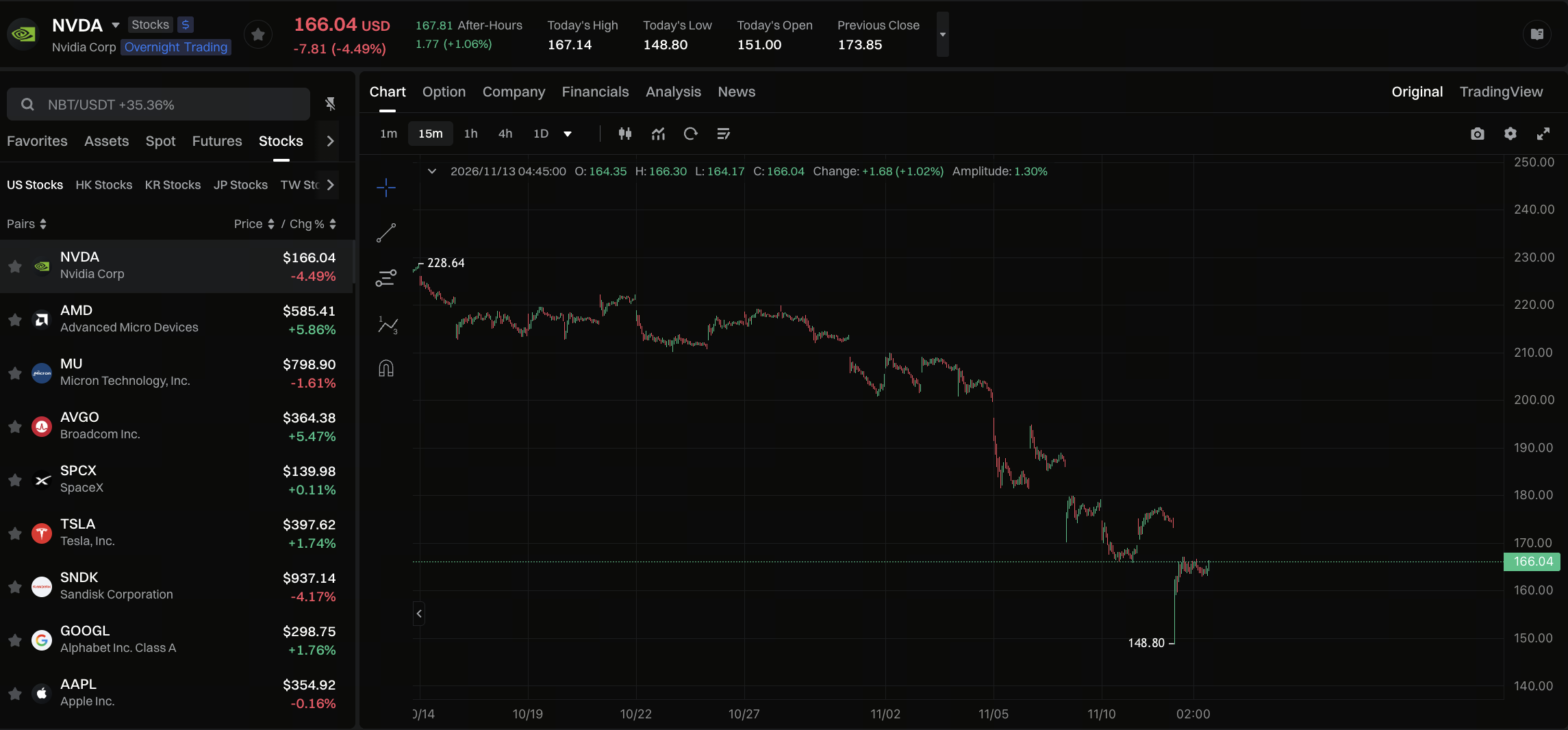
On November 12, 2026, NVIDIA’s stock price experienced significant volatility after the management change was announced. The intraday decline widened at one point before narrowing, and the stock ultimately closed down approximately 4.3%. This market reaction reflected investor uncertainty surrounding the unexpected event. However, a single day’s price movement cannot be used to estimate the company’s long-term loss of value, nor can all of the volatility be attributed to key person risk. Industry valuations, capital flows, and overall market conditions during the same period may also have affected trading performance.
From a long-term investment perspective, whether key person risk leads to a sustained valuation discount depends on subsequent operating performance. If the new management team can maintain product delivery, customer relationships, and financial targets, the market may gradually become less concerned about the management transition. Conversely, if research and development delays, loss of key personnel, major investment changes, or shifts in customer relationships occur, investors may further revise their future earnings expectations. A stock price reaction to an event is only the starting point for risk repricing, not the final conclusion.
VII. Can NVIDIA’s Technology Competitive Advantages Continue Without Its Founder?
Analyzing key person risk in technology companies requires distinguishing personal leadership capabilities from competitive advantages that have already become embedded in the business. NVIDIA’s CUDA software ecosystem, GPU computing architecture, development tools, system-level products, and developer network have accumulated over many years and created substantial technology and ecosystem switching costs. These capabilities do not exist only in the founder’s personal experience. They are also reflected in engineering teams, software platforms, research and development processes, and customers’ established usage patterns.
For example, training large AI models typically requires coordination among GPUs, networking, software frameworks, and cluster management systems. When selecting a computing platform, customers consider not only the performance of an individual chip but also software compatibility, deployment costs, developer experience, and long-term support capabilities. NVIDIA’s established technology ecosystem will not immediately lose its value because the CEO has left. However, maintaining its competitive advantages will continue to require research and development investment, technological innovation, and effective product execution.
Management changes may affect how research and development resources are allocated and whether the company continues to undertake high-risk, long-cycle technology investments. The new management team will need to balance continuity with adjustments to capital allocation. Excessive reliance on past successful approaches could cause the company to miss new technology directions. Changing the existing strategy too quickly could also weaken the ecosystem advantages already in place.
Therefore, assessing whether NVIDIA has long-term competitiveness independent of its founder requires monitoring the development and delivery of next-generation GPU platforms, the continued growth of the CUDA ecosystem, the stability of its core engineering team, and customer confidence in its product road map. These operating indicators provide a more meaningful view of the company’s actual competitive capabilities than simply comparing the personal styles of the former and new CEOs.
VIII. What Potential Effects Could the NVIDIA Event Have on the AI Supply Chain?
NVIDIA is an important global supplier of AI computing infrastructure. Its GPUs, networking products, and software platforms are widely used for large-model training, inference, and data center construction. Management changes may affect not only NVIDIA’s internal decisions but also customers’ expectations regarding long-term supply, technology road maps, and commercial partnerships. However, actual supply chain changes typically emerge gradually through contract execution, procurement plans, and product deliveries. The management transition alone is not sufficient to conclude that the entire AI supply chain has undergone a major adjustment.
For large cloud computing companies, key areas of focus may include the supply schedule, performance, and system compatibility of next-generation GPUs. Companies such as Microsoft, Amazon, and Google have long-term plans for building AI infrastructure. Their procurement decisions must account for computing demand, chip supply, energy consumption, and deployment costs. If NVIDIA’s product road map and delivery arrangements remain stable, the direct impact of the management change on existing procurement plans may be relatively limited.
For AI computing infrastructure companies such as CoreWeave, NVIDIA’s influence may also involve equipment procurement, financing partnerships, and industry investments. Some computing companies rely on high-performance GPUs to build data centers and support expansion through long-term customer contracts and debt financing. If NVIDIA adjusts its strategic investment or commercial support policies in the future, the financing conditions and expansion plans of these companies may be affected. However, the impact will depend on specific contracts, capital structures, and partnership arrangements. NVIDIA’s management change cannot be equated directly with an interruption in customer financing.
From a competitive perspective, developments in AI chips from AMD, Broadcom, and large cloud service providers also deserve attention. NVIDIA’s management transition may prompt customers to reassess supply chain concentration. However, alternative computing platforms still need to address software compatibility, system deployment, and real-world performance. A change in short-term market attention does not mean that competitors have already gained corresponding market share. The true industry impact must be verified through future orders, product deployments, and customer capital expenditure data.
IX. How Should Investors Assess NVIDIA’s Corporate Governance Risk?
Key person risk cannot be assessed solely by whether the CEO has left. For a mature public company such as NVIDIA, investors need a more comprehensive framework that combines management succession, board oversight, technology execution, and financial performance. A management transition may create short-term uncertainty. However, if the company has already developed a complete organizational structure and effective governance mechanisms, the related risks may not affect operations over the long term.
First, investors should monitor the selection process for the permanent CEO. Internal candidates are generally more familiar with the company’s technology systems and customer relationships. External candidates may bring different management experience and strategic perspectives. Both options have corresponding advantages and challenges, so the quality of a successor cannot be judged solely by whether the candidate is internal or external. More important considerations include whether the new CEO can coordinate technology development, the global supply chain, capital allocation, and major customer relationships, and whether the board establishes clear responsibilities and oversight mechanisms.
Second, investors should monitor major investment decisions and risk management. NVIDIA has expanded its investments and partnerships in the AI infrastructure ecosystem in recent years. These projects may involve long-term capital commitments and complex customer relationships. Investors can review capital expenditures, strategic investments, customer concentration, and related risk disclosures in financial reports to assess whether the company has systems for independently evaluating project returns. The board’s ability to effectively oversee these decisions is more important than simply characterizing management’s investment style as aggressive or conservative.
Finally, investors should monitor sustained changes in operating indicators, including revenue growth, gross margin, research and development investment, product delivery, customer demand, and free cash flow. If the company maintains stable research and development and delivery during the management transition, this may indicate that its existing organizational capabilities have strong continuity. If multiple core executives leave, product plans are repeatedly adjusted, or major customer relationships change, investors should further assess whether organizational-level risks are emerging.
NVIDIA Corporate Governance Risk Monitoring Framework
| Management Succession |
Permanent CEO candidate, management team stability, division of responsibilities |
| Board Oversight |
Progress of the independent investigation, governance systems, review of major decisions |
| Technology Execution |
GPU road map, CUDA ecosystem, product delivery |
| Capital Allocation |
Strategic investments, customer financing, research and development spending |
| Financial Performance |
Revenue, profit margin, cash flow, customer concentration |
For investors following NVIDIA (NVDA) stock, an unexpected management event may cause significant short-term price volatility. However, trading decisions should still consider the company’s fundamentals, valuation, and the investor’s personal risk tolerance. Even if a management transition does not immediately change the company’s earnings, changes in risk appetite may amplify short-term volatility. Analyzing governance events together with financial data can help investors avoid making decisions based solely on a single news report.
Conclusion
Key person risk is the operational and governance risk created by a company’s heavy reliance on core managers. For technology companies led by founders over the long term, the strategic judgment, technical experience, and industry influence of key individuals may help establish competitive advantages. However, they may also cause market confidence in the company’s future to become overly concentrated in one person. Jensen Huang’s departure from NVIDIA has transformed this risk from a theoretical issue into a real test of management succession.
NVIDIA has appointed Colette Kress as interim CEO and Harvey C. Jones as chairman while beginning the selection process for a permanent CEO. The management change does not mean that the company’s existing technical capabilities and customer relationships will immediately disappear. However, future strategy execution, capital allocation, and board oversight will become important factors as investors reassess the company’s corporate governance. In particular, as investment in AI infrastructure continues to expand, the company’s ability to establish independent, transparent, and sustainable decision-making mechanisms will affect how the market assesses its long-term operating stability.
For investors, key person risk should not be interpreted simply as meaning that a founder’s departure will inevitably reduce a company’s value. The more important question is whether the company’s competitive advantages have been converted into organizational capabilities and whether it can maintain product development, customer service, and financial discipline after a management transition. The NVIDIA event provides a case study in technology company governance: long-term competitiveness depends not only on outstanding leaders but also on whether the company can continue operating effectively after those leaders leave.
FAQ
What Is Key Person Risk (Key Person Risk)?
Key person risk refers to a company’s heavy reliance on a core manager, technical expert, or important business employee. If that person suddenly leaves or becomes unable to perform their duties, the company may face uncertainty related to operations, strategy, or market confidence.
Why Is Jensen Huang Considered a Key Person at NVIDIA?
Jensen Huang has served as NVIDIA’s CEO for many years since the company was founded. He has been deeply involved in the development of GPU technology, the CUDA ecosystem, and AI computing strategy. His personal leadership has been closely associated with the company’s long-term business direction.
Has Jensen Huang Already Left NVIDIA as CEO?
Yes. On November 12, 2026, NVIDIA announced that Jensen Huang had resigned as president, CEO, and director. Colette Kress became interim CEO, and the board is searching for a permanent successor.
Is Colette Kress NVIDIA’s Permanent CEO?
As of November 13, 2026, Colette Kress is serving as interim CEO while continuing to serve as CFO. The selection of a permanent CEO has not been completed.
Will Key Person Risk Necessarily Cause a Stock Price Decline?
Not necessarily. Key person risk may increase investors’ uncertainty regarding future operations, but stock prices are also affected by earnings expectations, valuation, market sentiment, macroeconomic conditions, and other factors.
Does the CEO’s Departure Mean That NVIDIA’s Technology Competitive Advantages Will Decline?
No direct conclusion can be drawn. NVIDIA’s GPU architecture, CUDA ecosystem, and customer relationships have accumulated at the organizational level. Its long-term competitiveness will need to be assessed through subsequent research and development, product delivery, and market performance.
Can Separating the Chairman and CEO Roles Reduce Corporate Governance Risk?
It may help clarify the division between oversight and operational management. However, its actual effectiveness depends on board independence, management authority, internal controls, and the mechanisms used to review major decisions.
What Subsequent Developments Should Investors Monitor at NVIDIA?
Investors can monitor the permanent CEO candidate, the progress of the board investigation, the stability of the core management team, the GPU product road map, major capital allocation decisions, and financial performance. They should avoid making judgments solely based on short-term stock price movements.