IREN (NASDAQ: IREN) is a digital infrastructure company actively transitioning from Bitcoin Mining to AI infrastructure. IREN's business has evolved from Bitcoin mining to include AI Cloud, GPU computing, and high-density AI data centers. The company owns substantial land, power, and data center infrastructure, delivering hashrate services for AI training and inference workloads using NVIDIA GPUs.
Accelerating AI computing demand is fundamentally reshaping the value of resources within the data center industry. Historically, low-cost electricity was synonymous with higher Bitcoin Mining returns. As GPU hashrate requirements soar, the same power infrastructure can now be reallocated to serve AI data centers. For operators, scarcity has shifted beyond servers and GPUs to encompass grid access, land, cooling, network connectivity, and construction velocity.
IREN stands at the pivot point of this shift. In fiscal year 2026, AI Cloud Services revenue surged to $128.8 million, while Bitcoin Mining revenue totaled $578.2 million. In Q4, AI Cloud Services revenue reached $70.5 million, surpassing Bitcoin Mining revenue of $66.7 million for the first time in the same period. The company plans ongoing conversion of mining farm capacity to AI Cloud and expects to complete this phase of transformation by the end of 2026.
Key Points
- IREN is shifting from Bitcoin Mining to AI infrastructure, advancing AI Cloud Services by reallocating power, land, and data center capacity.
- Bitcoin mining farms and AI data centers share critical infrastructure elements—power supply, data center architecture, network connectivity, and high-density computational capabilities—creating a foundation for business transformation.
- IREN's competitive edge is moving from low-cost mining to integrated power and hashrate infrastructure. By June 2026, the company had contracts for approximately 5GW in power capacity.
- AI Cloud has emerged as the growth driver. In fiscal year 2026, AI Cloud Services revenue soared to $128.8 million, up nearly eightfold year-over-year. Bitcoin Mining revenue in the same period was $578.2 million.
- IREN's transformation embodies a new trend: Bitcoin Mining enterprises with robust power and infrastructure are repurposing existing assets into AI hashrate resources.
Why Is IREN Reducing Its Bitcoin Mining Infrastructure?
IREN's reduction of Bitcoin Mining infrastructure does not mean Bitcoin Mining lacks commercial viability; rather, the company is reevaluating the economic value of its power and data center resources.
Bitcoin Mining profitability is determined by Bitcoin price, network-wide hashrate, network difficulty, mining machine efficiency, and electricity costs. Mining companies must continually upgrade to more efficient ASIC machines and contend with declining block rewards and rising network competition.
AI data centers feature a distinct revenue model. Enterprise, AI, and cloud customers secure GPU hashrate through long-term contracts, generating stable income for operators. IREN has signed multiple multi-year AI Cloud contracts and continues to expand its AI data center footprint.
Thus, the real question for IREN is not simply “Bitcoin Mining or AI,” but which computational business delivers greater long-term economic value per unit of power.
By June 30, 2026, IREN had started decommissioning Bitcoin Mining hardware and reallocating power and data center capacity to AI Cloud Services. The company targets completion of this transformation by December 31, 2026.
This process explains the significant asset impairments in fiscal year 2026. Annual net loss reached $702.6 million, including $638.8 million in non-cash impairments related to retiring Bitcoin Mining hardware and converting mining operations to AI Cloud. Asset values of legacy business segments must be remeasured as business applications change.
What Infrastructure Commonalities Exist Between Bitcoin Mining Farms and AI Data Centers?
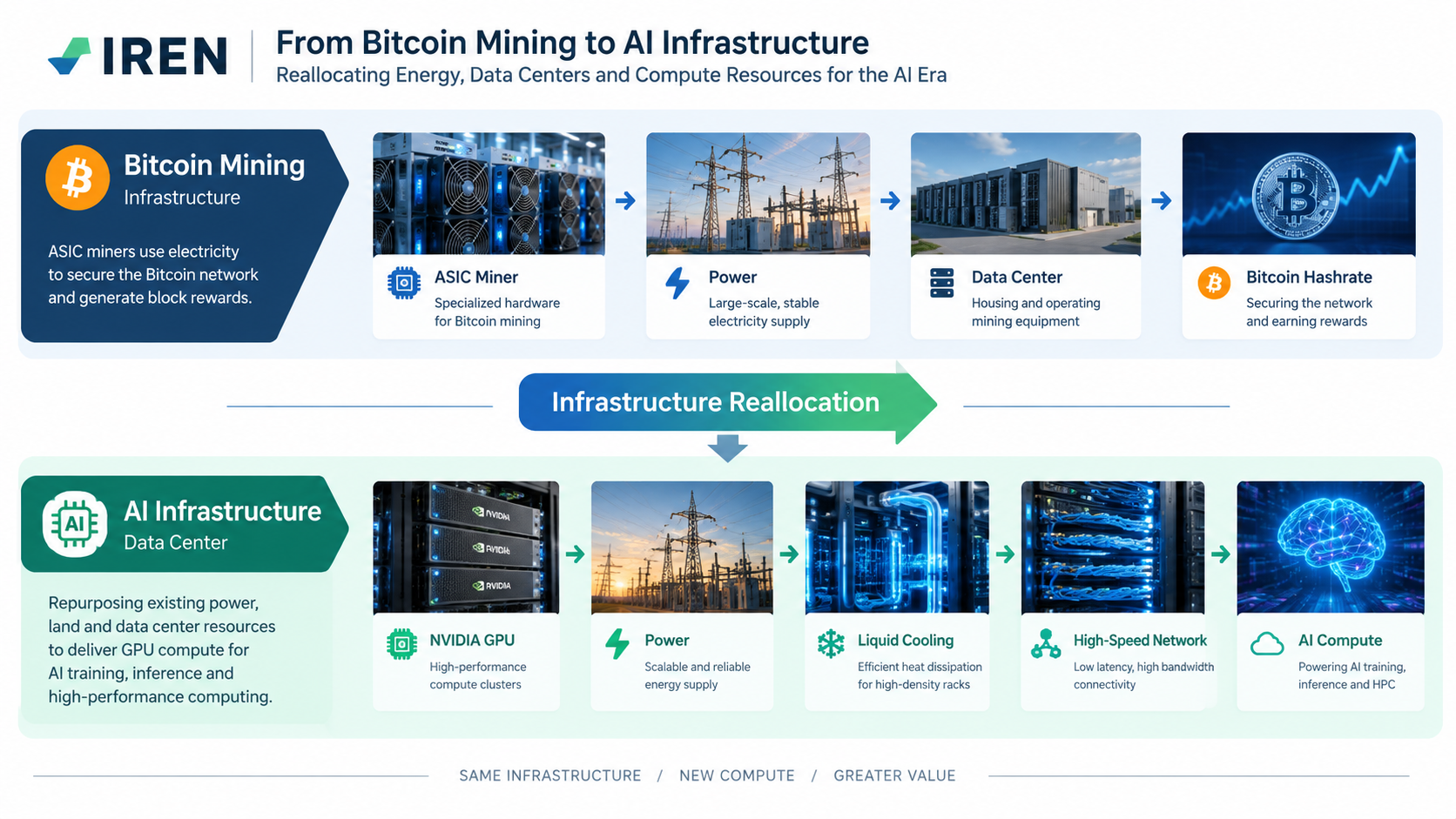
Bitcoin Mining and AI data centers seem vastly different, but they share remarkably similar foundational infrastructure.
- Power: Bitcoin Mining relies on stable, high-volume power for ASIC machines. AI data centers require continuous electricity supply for GPU clusters. Both are high-energy computation businesses—power cost and reliability are crucial for profitability.
- Land and data center facilities: Mining farms require construction—plants, substations, distribution networks, server racks. These assets can be retrofitted for GPU servers.
- Network connectivity: Bitcoin Mining needs only stable connections to the Bitcoin network, with modest latency demands. AI training requires intensive GPU data exchange, thus far tighter requirements for network architecture, bandwidth, and low latency.
- Operational capability: Both models demand ongoing maintenance for infrastructure—servers, power systems, cooling, network. Operators who run large mining farms can transfer relevant experience to AI data centers.
The real divergence lies in the computing equipment and cooling needs. ASICs are optimized for specific algorithms; GPUs are used for AI model training, inference, and a variety of high-performance computing tasks. AI data centers require more sophisticated server, network, and software infrastructure.
In short, mining enterprises cannot simply swap ASICs for GPUs; a full redesign of the data center is required.
How Does IREN Convert Power Resources Into AI Hashrate Infrastructure?
IREN's transition centers on converting resources through the chain: “power → data center → GPU → AI Cloud.” Historically, IREN sourced low-cost power and used ASICs to convert electricity into Bitcoin network hashrate. Now, part of that power is reallocated to GPU data centers, with GPU computing capacity sold to clients via AI Cloud Services.
Power has become the key asset bridging both businesses. As of June 30, 2026, IREN had signed grid connection agreements or similar arrangements for approximately 5GW of power capacity spanning the US, Canada, Spain, and Australia, with additional multi-GW development pipelines. All operational data centers use renewable energy or purchase renewable energy certificates.
Meanwhile, IREN is developing multiple AI data center projects. By year-end 2026, it aims to deliver 0.3GW IT capacity; the 2027 target is another 0.8GW IT capacity.
Childress stands out as a pivotal project. Horizon 1 has been delivered—the first of four 50MW liquid-cooled deployments. Horizon 2 is in the commissioning phase, while Horizons 3 and 4 are under final construction, targeting completion in Q4 2026.
IREN's AI transformation is not merely about adding GPUs—it’s about building a comprehensive computing infrastructure around already-secured power and data center assets.
What Are AI Data Center Requirements for Power Density and Cooling?
A defining difference between traditional and AI data centers is the leap in power density per rack.
Legacy servers typically suffice with air cooling, but high-performance GPU clusters generate significantly more heat. When racks house dense GPU configurations, legacy air cooling is often inadequate, making liquid cooling a crucial solution for high-density AI data centers.
IREN’s Horizon project illustrates this shift. The first 50MW IT liquid-cooled deployment for Microsoft achieved NVIDIA Exemplar Cloud status using NVIDIA GB300 NVL72.
AI data center value now depends not only on “having power,” but also on “effectively converting electricity into high-density hashrate.”
A facility with ample power capacity but inadequate GPU-grade supply, cooling, or networking cannot be repurposed as an AI data center. Building true AI infrastructure requires:
Power access + distribution systems + GPU servers + cooling solutions + high-speed networking + operational expertise. IREN’s strategic focus is integrating these elements to maximize commercial value per megawatt.
What Distinguishes IREN's Vertical Integration Model?
A standout aspect of IREN compared to traditional cloud giants is deep infrastructure vertical integration.
Typical cloud providers lease data centers, buy servers and GPUs, and deliver cloud computing via mature software platforms. IREN vertically controls land, power, construction, GPU deployment, and AI Cloud operations.
IREN's NVIDIA partnership is a hallmark of this integration. Announced May 2026, it covers IREN’s global data center pipeline and plans for up to 5GW of NVIDIA DSX architecture-based AI infrastructure, supporting power, land, construction, GPU rollout, and operations.
Through acquisitions of Mirantis and Nostrum, IREN expanded capabilities in software, services, and European infrastructure. Mirantis, in particular, enables customers to deploy, manage, and operate AI environments—extending IREN's business from data center management to full AI Cloud platform services.
Vertical integration reduces reliance on third-party suppliers and allows for agile project and resource management.
However, the model demands greater capital investment and operational complexity. IREN must manage GPU procurement, construction, financing, power, and software, bearing execution risks across the value chain.
How Has IREN's Revenue Structure Changed from Bitcoin Mining to AI Cloud?
IREN’s financials clearly chart its evolving business model. In fiscal year 2026, AI Cloud Services revenue reached $128.8 million—up from $16.4 million in 2025, a nearly eightfold increase. Bitcoin Mining revenue hit $578.2 million, up from $484.6 million. Total annual revenue was $707 million.
On a full-year basis, Bitcoin Mining remains dominant, but quarterly results highlight emerging trends.
In Q4 2026, AI Cloud Services revenue was $70.5 million, while Bitcoin Mining revenue was $66.7 million—marking the first quarter AI Cloud outpaced Bitcoin Mining revenue.
Contracted revenue is particularly noteworthy. By year-end 2026, IREN had approximately $4 billion of 2026 contract ARR, with $1 billion in current operating ARR. Nearly all 2026 capacity was sold, and multiple 2027 customer negotiations are underway.
IREN’s revenue mix is shifting from reliance on Bitcoin Mining to a dual Bitcoin Mining + AI Cloud structure, and ultimately toward AI Cloud dominance.
How Does IREN Balance Bitcoin Mining with AI Cloud Expansion?
IREN hasn't abruptly ended Bitcoin Mining operations; instead, it is realigning capacity gradually. As of June 30, 2026, it held around 23.2 EH/s of installed Bitcoin Mining hashrate—about 380MW of data center capacity. Decisions to continue or retire mining rigs depend on Bitcoin pricing, network difficulty, machine efficiency, power costs, and AI Cloud expansion needs.
This approach gives IREN flexibility to dynamically adjust operations.
When Bitcoin Mining economics are favorable, rigs remain active; when AI Cloud customers offer better pricing for data center capacity, power and infrastructure pivot to GPU services.
Rather than a simple “Bitcoin vs AI” switch, IREN is optimizing capital allocation for limited power resources.
There are costs involved: early mining rig retirement triggers asset impairments, and new AI data centers require substantive investment. IREN must manage both legacy exit costs and new business capital expenditures.
What New Business Model Is Emerging for Mining Companies Entering AI Data Centers?
IREN highlights an emerging data center business model: leveraging power and infrastructure from Bitcoin Mining to enter the AI hashrate market.
Both Bitcoin Mining and AI data centers are energy-intensive computation businesses, but their commercialization strategies for electricity differ.
Bitcoin Mining operates as “spot hashrate”—companies provide computational power to compete on the Bitcoin network, revenues are tied to market price and network conditions.
AI Cloud is “contract hashrate”—operators secure long-term agreements with AI firms, cloud, and enterprise clients, generating revenue based on GPU and data center capacity.
IREN's latest contracts reflect this shift. Some recent three-year contracts generate over $20 million per megawatt of IT capacity, with negotiations around $25 million/MW. Some client prepayments cover 45%–55% of GPU capital investment.
Risks remain: AI data center development requires major capital, and markets are increasingly attentive to financing cost, supply chain, and grid connectivity challenges. Reuters recently commented on cautious financing environments and possible delays in grid access and permitting, stretching revenue timelines.
The competitive differentiator for “mining company to AI data center” is not just low-cost power, but the ability to integrate power, land, GPUs, cooling, networking, financing, and customer contracts into a unified AI infrastructure platform with robust cash flow.
Summary
IREN’s transformation from Bitcoin Mining to AI infrastructure is, at its core, a revaluation and reallocation of data center assets.
Previously, IREN used ASICs to convert power into Bitcoin hashrate. Now, the same power, land, and data center assets are deployed with GPUs, providing computing power to AI and cloud clients.
Fiscal year 2026 demonstrates the transition: AI Cloud Services revenue jumped eightfold to $128.8 million, Q4 AI Cloud outpaced Bitcoin Mining, 5GW of power pipeline is established, and a strategic partnership with NVIDIA covers up to 5GW of AI infrastructure.
Looking ahead, IREN’s real focus is not “will it keep mining Bitcoin,” but how much AI hashrate each megawatt of power can deliver, how many long-term contracts can be secured, and what economic value remains after GPU, data center, and financing costs.
Industry-wide, IREN’s shift shows Bitcoin Mining and AI data centers are not fully disconnected. Both share energy and computational infrastructure, and surging AI demand is prompting mining firms to rethink the optimal use of their assets. IREN’s success hinges on data center rollout, GPU utilization, contract fulfillment, and efficient capital allocation.
Should the transformation advance, IREN may redefine its position entirely—from conventional Bitcoin Mining operator to AI infrastructure company connecting power, data centers, GPU, and AI Cloud.