In November 2026, Cloud Engines’ commercialization progress drew market attention. DFINITY moved the related services into an early access phase and began granting access to waitlisted users in batches on November 14. At the same time, AI Agents, automated software development, and demand for data sovereignty continued to attract attention, making decentralized cloud computing an important development direction for the ICP ecosystem. However, granting early access does not mean that the product has completed large-scale commercial validation. Its actual performance, customer adoption, and recurring revenue still require further observation.
The core value of Cloud Engines is not limited to increasing the processing capacity of a blockchain network. Instead, it attempts to transform server configuration, application deployment, and infrastructure management in cloud computing into services based on blockchain protocols. Understanding this model requires starting with how traditional cloud computing operates and then analyzing ICP’s Canister architecture, dedicated subnet mechanism, and relationship with ICP tokenomics.
Key Takeaways
-
ICP Cloud Engines allows users to configure dedicated subnets and independently select node operators, hardware types, geographic locations, and replication configurations.
-
Cloud Engines and the public Internet Computer network use the same core protocol, while applications continue to run through Canister smart contracts.
-
The primary features of Cloud Engines are dedicated resources, infrastructure configuration rights, and protocol-level replicated execution. This does not mean that every deployment can automatically achieve complete decentralization.
-
Cloud Engines can support Internet application backends, data services, and certain AI Agent workloads, but its specific capabilities depend on application design and resource configuration.
-
Mission 70 proposed using part of the revenue related to Cloud Engines to buy back and burn ICP, but the actual economic impact still depends on commercial revenue and implementation.
What Is ICP Cloud Engines, and Why Launch a Dedicated Cloud Computing Environment?
Cloud Engines is a dedicated computing environment on the Internet Computer network. It can be understood as an independent subnet configured and used by customers. Through the Open Cloud platform, users select suitable node machines and operators, after which the Internet Computer Protocol organizes these nodes into a computing environment capable of executing Canister smart contracts. Unlike the public network, where different applications share subnet resources, Cloud Engines allows customers to configure the underlying infrastructure more directly, including the regions where nodes are located, hardware specifications, the combination of operators, and the number of replica nodes.
This design addresses some of the limitations that enterprises may face when using public blockchain infrastructure. For ordinary decentralized applications, using a public network can reduce the initial deployment barrier. However, some enterprises may need to define where data is processed, select infrastructure providers that meet internal requirements, or configure dedicated computing resources for specific business operations. For example, a multinational enterprise may want to deploy an application within a specific jurisdiction while avoiding complete dependence on a single data center. Cloud Engines provides the ability to configure these conditions, but whether it can meet regulatory requirements depends on the actual deployment, data-processing methods, and applicable laws.
Cloud Engines is not an independent public blockchain separate from ICP. It is a dedicated subnet running on the Internet Computer Protocol. Applications continue to use Canister smart contracts, while the underlying system continues to rely on the state replication, message processing, and cryptographic mechanisms provided by the protocol. The main changes involve how computing resources are allocated and the degree of control customers have over node composition and deployment locations.
From a product-positioning perspective, Cloud Engines attempts to combine the resource-selection experience of traditional cloud computing with the execution mechanisms of blockchain protocols. This enables developers to configure dedicated computing environments without maintaining an entire blockchain infrastructure themselves. It also means that ICP is exploring an expansion from a public smart contract platform into the broader application infrastructure market.
How Does Cloud Engines Run Internet Applications Through Decentralized Nodes?
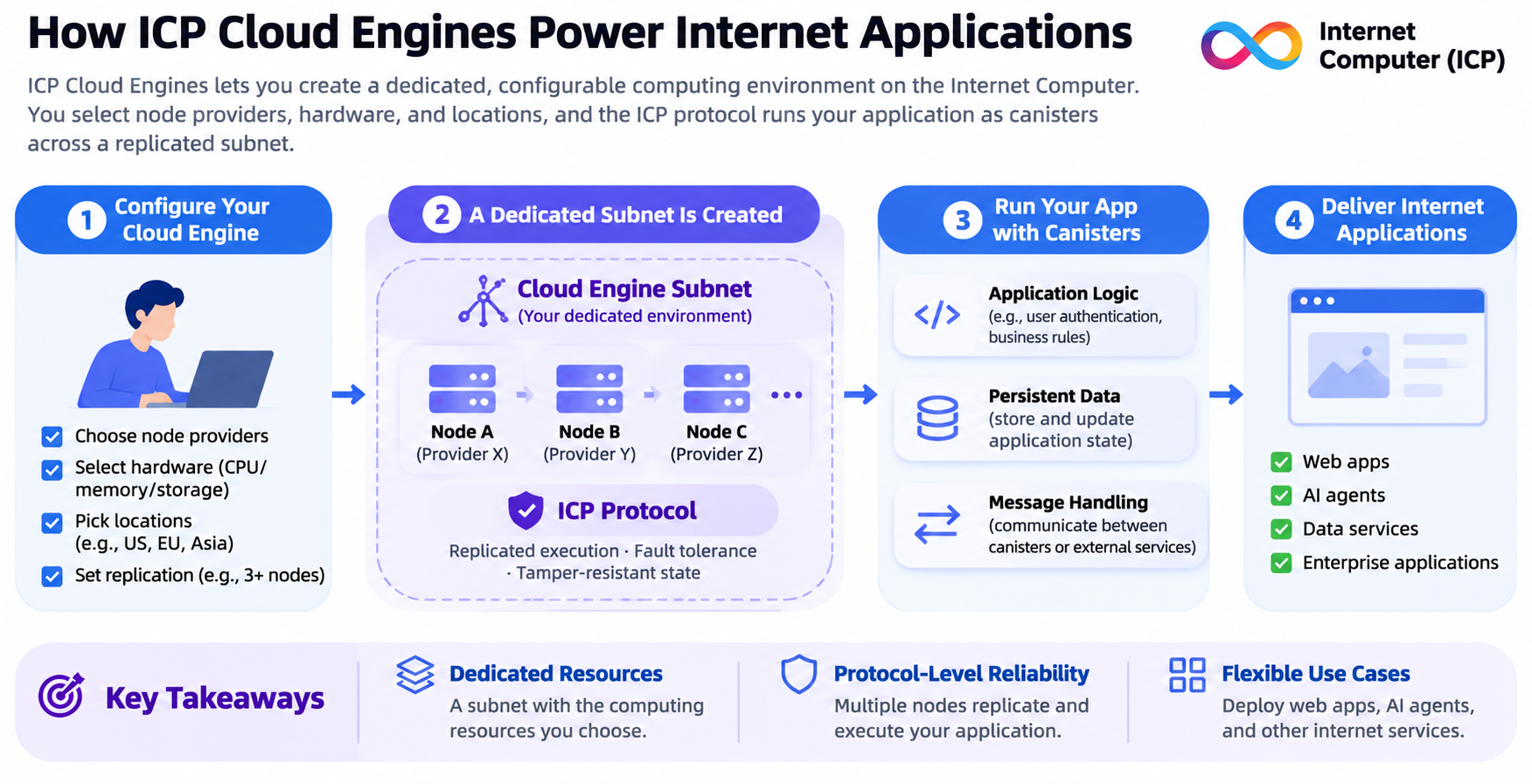
Traditional Internet applications usually require servers to execute programs, databases to store state, and network interfaces to provide services to users. In ICP Cloud Engines, these functions can be handled by Canister smart contracts and the dedicated subnets on which they run. Customers first select node machines and operators. The Internet Computer Protocol then organizes the selected nodes into a replicated execution environment, where applications are deployed as Canisters.
A Canister is the basic unit for running applications on ICP. It can contain both program code and persistent state. For example, an online collaboration application may need to process user logins, document editing, permission management, and data storage. Developers can deploy the relevant business logic to one or more Canisters. The Canisters receive requests, execute programs, and update data. When different application modules need to work together, Canisters can also communicate through a messaging mechanism.
An important feature of Cloud Engines is replicated execution. Depending on the configuration selected by the customer, multiple nodes can jointly store and execute application state, reducing the risk of service interruptions caused by a single node failure. The number of nodes, independence of operators, and geographic distribution affect the system’s fault tolerance, but replication does not mean that all failures can be avoided automatically. If multiple nodes depend on the same data center, power supply, or network service, common points of failure may still exist.
In addition, Cloud Engines’ node configuration is not completely fixed. The platform is designed to allow customers to adjust node composition as needed, including adding, removing, or replacing node machines, without having to redesign the application as a different computing system. This configuration flexibility can help enterprises adjust resources according to business needs. However, the actual migration process still requires consideration of protocol support, node availability, and operating conditions.
Therefore, the decentralization of Cloud Engines is not simply a matter of placing an application on multiple servers. It uses the ICP protocol to organize node execution, maintain application state, and provide a configurable computing environment. Its reliability depends both on the protocol design and on the infrastructure combination selected by the customer.
How Can Canister Smart Contracts Replace Traditional Application Backends?
Canister smart contracts are the technical foundation that enables ICP Cloud Engines to run Internet applications. Traditional web applications usually deploy the frontend, backend programs, and database across different services. Backend servers handle business logic and save user data through databases. Canisters, by contrast, can place program code and persistent state in the same execution unit, allowing some traditional backend functions to run directly on the Internet Computer network.
For example, a simple task management application needs to store task content, record completion status, verify user permissions, and return data to the frontend. With the Canister architecture, developers can write this business logic as smart contract methods and make it available to the frontend through network interfaces. When a user creates a task, the Canister performs the corresponding state update. When a user views a task list, the application can read existing data through a query call. For some applications, this approach can reduce the management work associated with separate databases and traditional backend services.
ICP also supports interaction with external web services through HTTPS Outcalls, allowing Canisters to obtain data from external interfaces under certain conditions. This means applications do not have to restrict all business functions entirely to the blockchain. They can connect to payment, data-query, or other Internet services as needed. However, external services may still be operated by centralized entities. Deploying an application on ICP therefore does not mean that all of its dependencies have been decentralized.
Canister execution also has technical limitations. Developers need to consider computational instruction limits, storage costs, message execution methods, data-access permissions, and dependencies on external services. For tasks that require specialized hardware, large-scale model training, or extremely low-latency processing, whether they are suitable for direct deployment on Cloud Engines must be evaluated based on specific resource capabilities and application architecture.
Therefore, Canisters are more accurately positioned as a new way to run backends for Internet applications, rather than as an unconditional replacement for traditional servers, databases, and cloud computing services in every scenario.
How Does ICP Cloud Engines Differ From Traditional Cloud Computing?
Cloud Engines and traditional cloud computing both require physical servers, storage devices, and network connections to run applications. The main differences lie in how resources are organized, who controls the infrastructure, how programs are executed, and how operational responsibilities are allocated. Traditional cloud computing is generally managed by cloud service providers that operate underlying data centers and large-scale infrastructure. Customers use computing resources through virtual machines, containers, or managed services. Cloud Engines, by contrast, allows customers to select node operators and deployment locations, then uses the Internet Computer Protocol to organize these nodes into a dedicated execution environment.
| Comparison Dimension |
Traditional Cloud Computing |
ICP Cloud Engines |
| Infrastructure organization |
Computing resources are managed by cloud service providers |
Customers select nodes, which are organized for execution by the ICP protocol |
| Application execution |
Virtual machines, containers, managed services, and more |
Canister smart contracts |
| Data storage |
Databases, object storage, and other independent services |
Canister state and related storage mechanisms |
| Node configuration |
Depends on the resource options provided by cloud service providers |
Customers can select node operators, hardware, and locations |
| Fault-tolerance mechanisms |
Multiple availability zones, backups, clusters, and more |
Protocol-based replicated execution and node configuration |
| Main limitations |
Provider dependence, configuration, and service costs |
Ecosystem maturity, application compatibility, and resource constraints |
The potential advantage of Cloud Engines is that enterprises can have more choice over the composition of underlying nodes while running applications through a unified protocol. This approach may be suitable for business scenarios that prioritize data-processing locations, infrastructure independence, and verifiable execution. However, traditional cloud computing has developed over a long period and already offers mature ecosystems for databases, networking, security, monitoring, and AI computing. It also has a strong practical foundation in application compatibility, tool availability, and commercial support.
Therefore, the two are not simply substitutes for each other. Traditional cloud computing may remain more suitable for businesses that require extensive off-the-shelf enterprise software, dedicated GPU services, or complex hybrid-cloud management. Cloud Engines provides another option for applications that want to use the Canister architecture and require dedicated node configuration. The final choice should be based on actual performance, total cost, development efficiency, and operational requirements rather than decentralization alone.
How Does Cloud Engines Support AI Agents and Automated Applications?
AI Agents are driving cloud computing demand beyond traditional website hosting and data storage toward continuously running automated programs, external tool calls, and multistep task execution. Unlike ordinary applications that operate only after a user clicks a button, AI Agents may need to store task state over extended periods, manage identity permissions, connect to external services, and execute actions automatically according to predefined conditions. These functions create new requirements for backend environments, data persistence, and security controls, while also creating potential use cases for ICP Cloud Engines.
For example, an enterprise AI Agent could handle customer requests, query business data, and update task status. Developers could deploy task records, access permissions, and part of the business logic in Canisters. The Canisters would store execution state and interact with external services through HTTPS Outcalls. When the Agent needs to call a large language model, it can connect to an external inference service based on the specific architecture or use relevant capabilities supported by the platform. This design can allow some business logic and state management to run on the ICP network, but it does not mean that all AI model inference must be performed on-chain.
Caffeine is an important product in the ICP ecosystem related to AI application development. It allows users to describe application requirements in natural language, after which the system generates the frontend, Canister backend, and related functions. Its technology stack includes components such as React, TypeScript, Motoko, and Internet Identity, enabling users to build applications with less manual coding. Cloud Engines provides a dedicated computing environment at the infrastructure layer. The two correspond to application development and runtime resource configuration, respectively, and are not the same product.
It is important to note that the reliability of AI Agents depends not only on the deployment environment but also on the accuracy of model outputs, tool-call permissions, key management, and the availability of external APIs. Even if an application backend runs on a replicated subnet, this does not automatically prevent model errors, malicious instructions, or external service failures. Therefore, the value of Cloud Engines in the AI field is better evaluated in terms of configurable computing resources, state management, and application deployment, rather than as a solution to every AI security issue.
What Is the Relationship Between Cloud Engines’ Business Model and ICP Tokenomics?
Cloud Engines’ business model differs in important ways from the resource-charging model of the public Internet Computer network. On the public network, Canisters generally need to consume Cycles to pay for computing, storage, message processing, and other resources. Developers can obtain Cycles by converting ICP, and the related conversion process burns ICP. Cloud Engines uses a dedicated computing resource model in which customers obtain computing capacity by purchasing or leasing a dedicated environment. Its fee structure is not fully equivalent to itemized resource charges on the public network.
According to Cloud Engines’ developer materials, dedicated CloudEngine subnets use a different Cycles fee arrangement. Canister execution, storage, messaging, HTTPS Outcalls, and other operations are not charged individually according to the public network’s standard. Therefore, it is not possible to directly estimate the amount of ICP burned by using the volume of messages processed or the number of computational instructions executed by Cloud Engines. For this type of product, the more important economic indicators are the actual service fees paid by customers, node operating costs, and how related revenue is distributed through the protocol’s economic mechanisms.
ICP’s Mission 70 proposal introduced a token buyback and burn arrangement related to Cloud Engines’ commercial revenue. The design includes using 20% of Cloud Engines-related revenue to purchase and burn ICP, while using most of the remainder to support node operators that provide computing resources. This mechanism attempts to connect commercial demand for cloud computing services with demand for ICP, allowing tokenomics to receive potential support not only from Cycles conversions on the public network but also from revenue generated by dedicated cloud computing services.
However, the planned buyback-and-burn percentage does not equal the amount of ICP that has actually been burned. Cloud Engines still needs to establish a base of continuously paying customers and verifiable commercial revenue. The related arrangements must also be implemented according to the applicable rules before they can affect ICP’s supply and demand. In addition, ICP has other sources of new supply, including node rewards and governance rewards. Therefore, even if the scale of buybacks and burns increases, this does not necessarily mean that the total token supply will decline.
For investors, analyzing Cloud Engines’ economic value requires focusing on the number of paying customers, dedicated subnet utilization, service revenue, node costs, and actual buyback-and-burn data, rather than directly interpreting the product launch as evidence that demand for ICP has already increased significantly.
What Are the Latest Developments for Cloud Engines in November 2026?
In November 2026, Cloud Engines moved beyond technical introductions and product previews into an early access phase for users. Around November 11, the relevant team announced a commercialization plan. It then began granting access in batches to users on the waitlist on November 14. This development means that some developers can begin configuring dedicated computing environments and testing application deployments. However, early access remains subject to certain limitations and cannot be directly equated with a full commercial launch for all users.
Based on the current product design, Cloud Engines provides dedicated subnet configuration capabilities through the Open Cloud platform. Users can select different tiers of node machines and determine infrastructure specifications based on their computing, memory, and storage requirements. The ICP Dashboard lists machine tiers such as Nano, Standard, Performance, High-Performance, and Dense, covering configuration scenarios ranging from relatively lightweight applications to applications with higher resource requirements. Users can also select node operators and geographic locations based on resource availability to meet requirements related to application performance, reliability, or data-processing location.
Another product development is the gradual improvement of development tools. Cloud Engine deployment materials updated on November 17, 2026, introduced the process for deploying Canisters through command-line tools and AI development tools. This indicates that the ecosystem is working to lower the barrier for developers using dedicated subnets and to create a more complete workflow from code building to infrastructure deployment.
However, the gradual release of product features and the validation of commercial demand are two different stages. The more important factors to continue monitoring are the actual number of Cloud Engines created and running, paid usage, customer retention, operational stability, and service revenue. Enterprise cloud computing products in particular typically require extended testing, procurement evaluations, and system integration before they can be deployed in stable production environments. Therefore, the developments in November are better understood as the beginning of Cloud Engines’ commercialization validation rather than the completion of large-scale market expansion.
What Technical and Commercial Challenges Does Cloud Engines Face?
Cloud Engines provides ICP with a new application infrastructure direction, but its long-term development still faces challenges involving technical adaptation, commercial competition, and market adoption.
-
Ecosystem maturity. Traditional cloud computing platforms already offer extensive mature tools for databases, middleware, monitoring, security, and AI development. The Canister architecture requires developers to adapt to different program execution methods, state management mechanisms, and resource limitations. For enterprises with complex existing systems, migrating applications to Cloud Engines may involve code adjustments, data migration, permission design, and system integration. The actual costs need to be evaluated individually.
-
Infrastructure reliability and cost competitiveness. Cloud Engines allows customers to select node operators and replication configurations, but increasing the number of nodes generally also increases resource costs. Enterprises need to balance performance, availability, data-processing locations, and expenses. If the total cost of a dedicated subnet is significantly higher than existing solutions and the business cannot make full use of its protocol features, adoption may be limited. In addition, replicated execution can improve fault tolerance in certain failure scenarios, but it cannot replace application security audits, backup strategies, or business continuity management.
-
Whether sustained commercial demand can develop. The technical characteristics of decentralized cloud computing may attract some developers and enterprises, but the market ultimately needs to validate product value through real payment behavior. Whether Cloud Engines can attract enterprise customers that use it continuously, support complex production workloads, and generate stable revenue for node operators will require long-term data. For emerging use cases such as AI Agents, it is also necessary to distinguish between technical demonstrations, test deployments, and actual commercial applications, rather than treating developer interest as evidence of large-scale market demand.
-
Balancing infrastructure control and decentralization. The development of Cloud Engines also involves a balance between control over infrastructure and the degree of decentralization. Dedicated subnets allow customers to select nodes and operators, which helps meet specific business requirements. However, if nodes become overly concentrated among a small number of providers or within the same jurisdiction, new dependencies may arise. The actual security and independence of Cloud Engines should therefore be assessed based on node configuration, operator distribution, protocol governance, and external dependencies.
How Should Investors Evaluate Cloud Engines’ Long-Term Impact on ICP?
From an investment perspective, Cloud Engines adds a commercialization direction worth monitoring for ICP. However, evaluating its long-term value requires distinguishing among three levels: technical capabilities, product adoption, and tokenomics. At the technical level, the key considerations are whether dedicated subnets can run applications reliably and whether node configuration, replicated execution, and deployment tools can meet developer requirements. At the product level, attention should be paid to actual usage, including the number of active Cloud Engines, paying customers, resource utilization, and customer retention. These indicators can help investors determine whether the product is moving from early testing toward sustained commercial operations.
At the economic level, Cloud Engines’ commercial revenue has a potential connection to ICP buybacks and burns, but this connection must be based on real revenue. Even if Cloud Engines’ usage continues to expand, it is still necessary to monitor node operating costs, the allocation of protocol revenue, and actual token burns. If product adoption grows but revenue remains limited, or if the related economic mechanism has not yet produced significant execution results, its impact on ICP’s supply and demand may remain small.
In addition, Cloud Engines’ value cannot be considered entirely separate from the broader Internet Computer ecosystem. Application development tools such as Caffeine may lower the barrier to building applications. Public subnets can continue to support shared computing demand, while dedicated Cloud Engines can serve customers that require independent resource configuration. If these products develop complementary relationships, ICP may gradually establish a service system spanning application development, shared computing, and dedicated cloud infrastructure. However, this direction still needs to be validated through developer adoption, customer payments, and long-term operating data.
Therefore, investors should not assess the project’s value solely based on Cloud Engines’ release progress or ICP’s short-term price performance. A more appropriate research approach is to continue monitoring whether technical delivery, customer adoption, commercial revenue, and tokenomics data form a stable connection. This can help determine whether decentralized cloud computing can truly become a long-term source of growth for ICP.
Conclusion
ICP Cloud Engines is an important product through which the Internet Computer is expanding into dedicated cloud computing services. It allows developers and enterprises to independently select node operators, hardware specifications, and geographic locations while running Canister smart contracts through the ICP protocol. Its core feature is the combination of dedicated infrastructure configuration with blockchain-based replicated execution, providing a new deployment approach for Internet applications, data services, and certain AI Agent workloads.
The early access progress in November 2026 shows that Cloud Engines is entering the stage of actual usage and commercialization validation. However, opening the product does not mean that market demand has been sufficiently proven. Whether it can develop a stable base of paying customers, recurring service revenue, and reliable production deployments will directly affect its growth potential.
For the ICP token, Cloud Engines’ potential value comes not only from increased network computing capacity but also from the connection between its commercial revenue and token buyback-and-burn mechanism. However, this economic impact still depends on actual revenue, implementation, and changes in overall token supply. Only when technical capabilities gradually translate into sustained commercial demand can Cloud Engines provide clearer support for ICP’s long-term fundamentals.
FAQ
What Is ICP Cloud Engines?
ICP Cloud Engines is a dedicated cloud computing environment built on the Internet Computer Protocol. It allows users to select node operators, hardware, and deployment locations while running Canister smart contracts through dedicated subnets.
How Does Cloud Engines Differ From the Public Internet Computer Network?
The public network primarily provides a shared computing environment, while Cloud Engines allows customers to configure dedicated subnets and underlying node resources. Both use the same core protocol, but they differ in resource allocation, infrastructure configuration, and fee models.
Can Cloud Engines Run AI Agents?
It can be used to deploy certain AI Agent business logic, state management, and external service interaction functions. However, its specific capabilities depend on the application architecture, computing resources, and external model services. Not all AI inference tasks are suitable for direct execution in Canisters.
Does Cloud Engines Require ICP?
Cloud Engines uses a resource-charging model different from that of the public network. Canister operations on its dedicated subnets are not charged individually according to the public network’s standard Cycles model. Its potential economic connection to ICP primarily involves buyback-and-burn arrangements related to Cloud Engines’ commercial revenue, rather than the burning of tokens for each individual message.
Will Cloud Engines Drive the Price of ICP Higher?
Not necessarily. Product development may improve market expectations regarding ICP’s long-term application value, but the token’s price is also affected by factors including commercial revenue, actual buybacks and burns, new supply, market liquidity, and overall cryptocurrency market conditions.