Internet content platforms have long faced a structural problem: content can be widely distributed, but the value relationship between creators and audiences is often determined by platform rules. Creators typically earn income through advertising, subscriptions, sponsorships, or platform revenue sharing. However, the distribution, collection, and secondary engagement generated by the content itself do not necessarily translate directly into a sustainable economic mechanism for creators to continue participating. As blockchain infrastructure has gradually matured, some projects have begun experimenting with placing content, identity, and digital assets within the same on-chain system, enabling creators and communities to build more direct relationships through transparent asset mechanisms.
Zora emerged against this backdrop. In its early stages, it was closely associated with NFTs and on-chain digital content creation. It later expanded its product focus to the Coins Protocol, enabling users to create tradable tokens around creator profiles, individual pieces of content, and trending topics. As a result, Zora is no longer merely a platform for publishing and collecting digital works. It has also become one of the infrastructures exploring ways to combine the creator economy with on-chain trading.
The key to understanding Zora is distinguishing between several easily confused layers: the Zora platform provides content creation and trading experiences; the Zora Protocol provides token creation and related trading mechanisms; blockchain networks such as Base host on-chain assets and transactions; and ZORA is an independent token within the Zora ecosystem. These elements are related, but they are not the same concept. Only by separating these layers can we more accurately understand Zora's ecosystem structure, how creator coins work, and how they relate to the crypto asset market.
Key Points
-
Zora is more than an NFT platform: it builds a product ecosystem around on-chain content, creator identity, and tokenization mechanisms.
-
The Coins Protocol is a key component: Creator Coins, Content Coins, and Trend Coins correspond to creator identities, specific pieces of content, and trending topics, respectively.
-
Base provides an on-chain operating environment: Zora-related tokens and application activities can be deployed and used through networks such as Base.
-
ZORA and creator coins are different types of assets: ZORA is an ecosystem token, while Creator Coins and Content Coins are independent tokens created around specific creators or pieces of content.
-
Content popularity does not equal asset value: community attention, trading activity, and token prices need to be evaluated separately.
Zora's Positioning: From On-Chain Content to the Creator Economy
Zora's development can be understood within the evolution of on-chain content infrastructure. Early NFT applications primarily addressed the on-chain registration, issuance, and collection of digital content. Creators could convert their works into digital assets with independent on-chain records, while collectors could use the blockchain to verify an asset's provenance and ownership. As use cases expanded, content platforms began exploring lighter forms of tokenization, seeking to create more direct connections between creator identity, content distribution, and community participation.
Zora's product approach gradually expanded from simply issuing digital content to building token markets around creators and content. Users can publish content on the platform and create tokens associated with personal profiles or specific content through the Coins Protocol. Unlike traditional content platforms, which primarily rely on follows, likes, and subscriptions, this model brings some forms of community participation into the on-chain asset trading environment. Creators, collectors, and traders can therefore play different roles within the same ecosystem.
However, tokenization does not mean that all content inherently has investment attributes. On-chain tokens can record ownership, provide access to trading, or support specific community interaction mechanisms, but their market prices are still affected by factors such as supply and demand, liquidity, market sentiment, and token distribution structures. In its token documentation, Zora clearly states that $ZORA does not grant holders equity ownership in or governance rights over Zora or its products. Therefore, when analyzing Zora, it is necessary to distinguish between platform services, protocol functions, and token rights, rather than conflating ecosystem participation with equity ownership or economic rights in the traditional sense.
How Does the Zora Coins Protocol Connect Creators, Content, and Tokens?
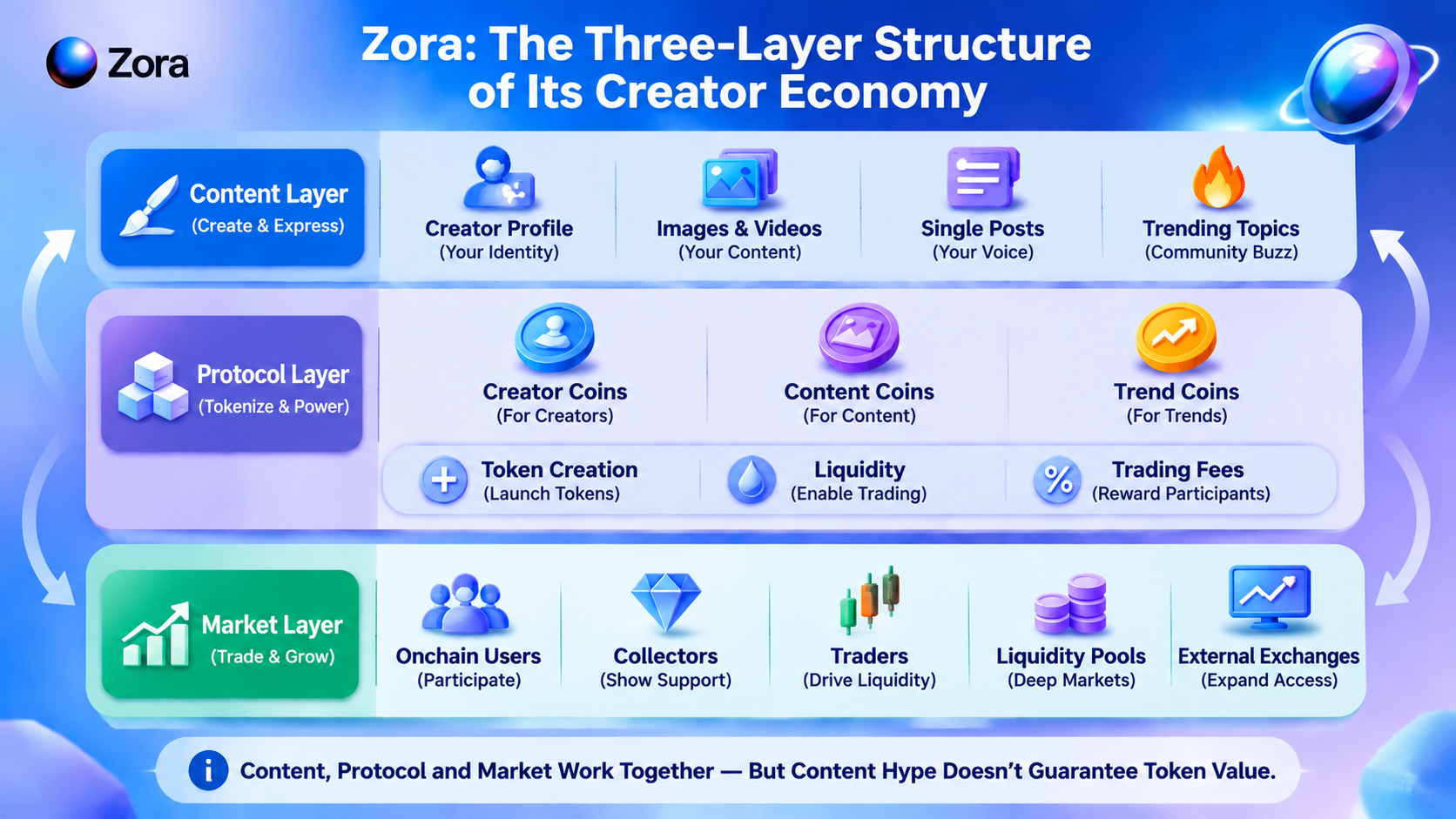
The Zora Coins Protocol links token creation to different types of content objects. According to the official Zora Coins documentation, the protocol primarily supports three types of assets: Creator Coins, Content Coins, and Trend Coins. These are not simply different names. They correspond to different objects, including creator identities, individual pieces of content, and trending topics.
Creator Coins are tokens associated with creator profiles. Each creator profile can correspond to one Creator Coin, and the username can serve as the token identifier. Under the mechanism described in Zora's current documentation, each Creator Coin has a fixed total supply of 1 billion tokens. Some enter the public market, while another portion is allocated to the creator and gradually vests according to a predetermined schedule. When creators publish content and community users participate in interactions, the profile token may serve as an asset gateway connecting content with trading activity. Its core characteristic is that it establishes a relatively ongoing token relationship around the creator's identity rather than corresponding to only one work.
Content Coins extend the tokenization target from creator identity to specific content. An individual piece of content published by a creator can correspond to an independent token, and users can collect, follow, or trade around that piece of content. Compared with Creator Coins, Content Coins are more closely aligned with an on-chain market structure centered on individual pieces of content. Trend Coins target trends, topics, memes, and other cultural themes, with a design that emphasizes lightweight and rapid creation. Their token distribution and fee structures also differ from those of the first two categories. Specific parameters should be based on the latest information in the Zora Protocol documentation.
The Infrastructure Relationship Between the Base Network and the Zora Ecosystem
Zora's Coins ecosystem is closely connected to the Base network. Base is a Layer 2 network within the Ethereum ecosystem. One of its goals is to lower the barriers to using on-chain applications and reduce transaction costs while providing infrastructure for consumer applications, developer tools, and on-chain asset activity. For the creator economy, network fees, transaction confirmation efficiency, and wallet usability all affect whether ordinary users are willing to participate in content publishing, token creation, and on-chain trading.
Within Zora's application structure, users can publish content and perform token-related operations through the platform interface, while the underlying tokens and trading activities are supported by smart contracts and the relevant blockchain networks. This division of responsibilities means that users see a relatively seamless product experience, but the actual operation involves multiple components, including wallets, networks, smart contracts, token contracts, and liquidity pools. Understanding this infrastructure helps determine whether a particular function comes from Zora's product design or from the blockchain network and other protocols on which it relies.
At the same time, the scope of support and specific functions of the Zora Protocol may change with version updates. Official developer documentation continues to provide Coins SDK resources, contract architecture information, and integration resources. Developers can build their own creator or trading applications based on the protocol. Therefore, the Zora ecosystem is not entirely equivalent to the zora.co website itself. When using different frontends or third-party applications, users should still verify the network, contract address, and asset type involved in the actual interaction to avoid mistaking similarly named tokens for official assets.
Participants and Value Flows in the Zora Ecosystem
At least several different types of participants exist in the Zora ecosystem. Creators generate content supply by publishing works, establishing profiles, and participating in community interactions. Collectors and fans express support by following, collecting, or purchasing related tokens. Traders buy and sell assets based on market liquidity, price movements, and expectations. Developers can use SDKs and protocol interfaces to build new application experiences. The goals of these participants are not entirely aligned, so ecosystem activity cannot be measured solely by token trading volume.
From the perspective of value flows, the creator coin mechanism attempts to establish a more direct economic connection between creators and the attention their content receives. Some trading fees may be distributed to creators, referrers, the protocol, or liquidity-related participants according to protocol rules. As a result, creators' economic participation may no longer depend solely on one-time sales of their works and may also be connected to subsequent trading activity. However, whether this mechanism can support creators over the long term still depends on genuine user participation, sustained trading, market depth, and the design of the fee distribution mechanism.
For collectors and traders, participating in the on-chain creator coin market involves risks that differ from those associated with traditional content consumption. Token prices may be affected by short-term topics, social distribution, and changes in liquidity. A piece of content receiving significant attention does not mean that its associated token will necessarily have stable demand. Users should separately evaluate the content itself, the creator's ongoing activity, the token contract rules, and market trading conditions rather than judging an asset's value solely by its social media popularity.
What Is the Relationship Between the ZORA Token and the Zora Protocol?
ZORA is a token within the Zora ecosystem, but it should not be confused with Creator Coins, Content Coins, or Trend Coins. Zora's official materials describe it as a token intended to commemorate and support the Zora community. They also clearly state that holding ZORA does not automatically grant holders equity interests in Zora or its products, nor does it represent protocol governance rights. Information about the token supply, initial distribution, and unlocking schedule is available in the official Zora Tokenomics documentation.
Creator Coins and Content Coins are tokens created through the Coins Protocol and associated with specific creators or content objects. They each have their own rules regarding issuance targets, token distribution, trading mechanisms, and fee arrangements. In particular, if a Creator Coin uses ZORA as its trading pair asset, this does not mean that it has the same token rights or economic attributes as ZORA. The paired asset is part of the trading mechanism and does not prove that the two tokens have an equivalent rights relationship.
Therefore, when analyzing the Zora ecosystem, it is useful to make the following distinctions: Zora is the platform and protocol brand; the Zora Protocol is the protocol mechanism supporting token creation and trading; ZORA is the ecosystem token; and Creator Coins, Content Coins, and Trend Coins are different categories of tokens supported by the protocol. Separating these concepts helps clarify how the ecosystem operates and reduces the risk of misjudging token characteristics during trading and research.
Long-Term Factors to Monitor in the Zora Ecosystem
Zora's long-term development will first depend on whether creators and ordinary users are willing to continue using its content tools. If the platform can attract creators from different fields and establish consistent habits around content publishing, collecting, and community interaction, the creator coin mechanism may have an opportunity to gain sustained real-world use cases. Conversely, if participation is driven primarily by short-term topics or token prices, ecosystem activity may be more vulnerable to changes in market sentiment.
Second, it is important to monitor protocol development and developer adoption. The Coins SDK, contract architecture, cross-application integrations, and fee mechanisms will all affect whether third-party developers can build products based on Zora. The stronger the protocol's composability, the greater the variety of applications that may emerge. However, protocol upgrades may also introduce new contract risks, higher user learning costs, and compatibility issues. Therefore, monitoring official documentation, code updates, and actual application deployments is more useful for assessing protocol development than simply tracking social media popularity.
Finally, token market data should be evaluated together with fundamental ecosystem activity. You can view indicators such as the price, circulating supply, trading volume, and market distribution of ZORA on its CoinMarketCap and CoinGecko pages, and then verify the token mechanism against Zora's official documentation. Market data can show changes at the trading layer, but it cannot independently prove that the creator ecosystem has established long-term value. For researchers, evaluating user growth, creator retention, protocol usage, and token market performance within the same framework provides a more accurate view of how the Zora ecosystem actually operates.
Conclusion
Zora's significance lies not only in adding a token trading gateway to content but also in its attempt to connect creator identity, digital content, and on-chain markets. Creator Coins, Content Coins, and Trend Coins allow different types of content objects to use different tokenization methods. They also extend the creator economy beyond the follows and subscription mechanisms of traditional platforms into on-chain assets and trading activities.
However, tokenization cannot automatically solve every problem in the creator economy. Content quality, user relationships, the ability to create consistently, protocol security, and market liquidity remain key factors in the ecosystem's long-term development. Zora should be analyzed across multiple layers, including the platform, protocol, network, and tokens, rather than judged solely by social media popularity or price performance during a particular period.
In Gate's trading environment, users can view relevant market information on the ZORA/USDT spot trading page. Gate also provides services for other asset categories, including stock tokens and U.S. stock trading. These products belong to different markets and product systems from Zora's creator coin protocol and should be analyzed separately.
FAQ
What Is Zora?
Zora is a crypto ecosystem built around on-chain content, creators, and digital asset trading. Its products and protocol support content publishing, digital collecting, and tokenization mechanisms such as Creator Coins and Content Coins.
Is Zora Built on Base?
Zora-related tokens and application activities are closely connected to the Base network. The network used by a specific function or asset should be determined based on the official documentation and the relevant contract information.
What Is the Difference Between ZORA and a Creator Coin?
ZORA is a token within the Zora ecosystem. A Creator Coin is an independent token created through the Zora Coins Protocol and associated with a creator profile. The two differ in their issuance purposes, supply structures, and token rules.
Does Zora Only Support NFTs?
No. Zora's products have expanded to include the Coins Protocol. In addition to digital content and collecting use cases, the protocol supports creating tokens around creator identities, individual pieces of content, and trending topics.
What Are the Main Risks of the Zora Ecosystem?
The main risks include token price volatility, insufficient liquidity, changes in content popularity, smart contract and wallet security risks, and users' insufficient understanding of the rights and mechanisms associated with different tokens.