As the blockchain ecosystem continues to expand, users must manage an increasing number of wallets and tools. A user may use Ethereum, multiple Layer 2 networks, and Solana at the same time, while holding assets, participating in DeFi, purchasing NFTs, or using on-chain applications across different networks. Each chain has its own account environment and transaction rules. Users must not only manage private keys and wallet connections, but also understand network switching, Gas fees, and cross-chain asset transfers.
This experience differs significantly from traditional internet applications. In traditional applications, users generally only need to log in and select the action they want to complete. In a multichain Web3 environment, users often need to first understand which chain an application is deployed on, which network their wallet is currently connected to, where their assets are located, and whether they have enough native Gas tokens. Users with limited technical knowledge may be discouraged by these steps before they even begin using the application.
Account abstraction and chain abstraction are technology directions developed to address these challenges. Particle Network's Universal Account combines accounts, balances, and cross-chain transaction coordination, attempting to shift users from "managing different chains" to "completing specific actions." Understanding how it works can help determine which processes these tools actually simplify and which complexities they move to the underlying infrastructure.
Key Takeaways
- Universal Account aims to provide a unified account entry point and cross-chain balance experience, reducing the burden of managing multiple on-chain accounts.
- Account abstraction enables smart accounts to execute more flexible authorization and transaction logic, while chain abstraction further hides differences between underlying networks.
- A single primary authorization from the user can trigger coordinated operations across multiple chains, but the underlying process may still involve multiple transactions and execution steps.
- Universal Liquidity coordinates cross-chain asset routing, while Universal Gas reduces the need for users to prepare native Gas tokens on each chain.
- A simpler tool experience does not mean that risks have disappeared. Users must still check signing details, authorization scope, target contracts, and transaction results.
From Traditional Multichain Wallets to Universal Account: How Is the User Experience Changing?
Traditional multichain wallets are generally organized by network. Users switch to different chains in their wallets, view the corresponding asset balances separately, and prepare native Gas tokens as required by each application. To use an application on another chain, users may also need to transfer assets through a cross-chain bridge before completing a swap or another operation on the destination chain.
This approach provides clear on-chain boundaries. Users can directly view the accounts and transaction records for each chain, but the process is relatively cumbersome. For experienced Web3 users, these steps may simply be part of their daily routine. For new users, however, differences between network names, asset standards, bridging methods, and Gas tokens can create significant barriers to understanding.
Universal Account aims to hide these underlying differences behind a unified account interface. Users can access supported multichain applications through a primary account entry point and view and use cross-chain assets through a unified interface. For developers, the Universal SDK can help applications integrate the relevant account capabilities, so users do not have to operate entirely like they would with a traditional multichain wallet.
However, this does not truly turn wallets and assets on different chains into accounts on a single chain. Universal Account still needs to deploy and coordinate smart account instances on each destination chain and maintain consistent account states through Particle Chain. The unified user experience comes from the coordination between the underlying accounts and cross-chain mechanisms.
What Problems Do Account Abstraction and Chain Abstraction Solve?
Account abstraction primarily focuses on the programmability of wallet accounts. Traditional externally owned accounts generally initiate transactions through private-key signatures, while account abstraction allows smart contract accounts to verify and execute operations according to configured rules. This supports more flexible signature verification, batch operations, Paymaster-sponsored transactions, and other account functions.
Chain abstraction focuses on the interaction boundary between users and different blockchains. It attempts to eliminate the need for users to constantly understand which chain a transaction occurs on, which network holds an asset, and how to complete a cross-chain transfer. Account abstraction makes accounts more flexible, while chain abstraction extends this flexibility to multichain environments.
Particle Network's Universal Account combines these two directions. According to the project's documentation, Universal Account is an ERC-4337 smart account implementation coordinated by Particle Chain, with related infrastructure used to deploy and maintain account states across different chains. Users can connect an existing Web3 wallet or access the relevant account capabilities through Particle's wallet services.
This means that Universal Account is not merely a dashboard for displaying multichain assets. It aims to serve as a unified account layer for users interacting with multichain applications. It must manage the relationships between account instances, signature authorizations, cross-chain messages, and transaction execution to present users with a relatively simple process on the front end.
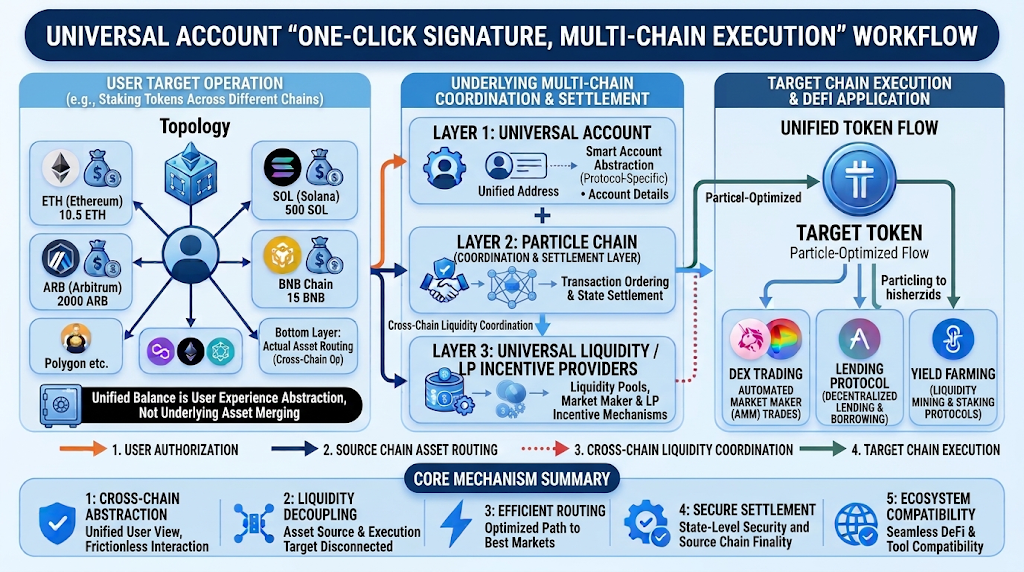
How Can One Signature Trigger Multichain Transactions?
"One signature" is an expression that can be easily misunderstood in a chain abstraction experience. It emphasizes that users can provide primary authorization for a target operation. It does not mean that all underlying blockchains produce only one transaction, nor does it mean that cross-chain transactions no longer require any confirmation or settlement process.
For example, a user may want to use stablecoins distributed across Base and Arbitrum to purchase an asset on Solana. A traditional process may require the user to transfer funds separately, wait for cross-chain confirmations, complete a swap, and prepare funds for fees on the destination chain. With a chain abstraction account, the user can select the target asset and operation in an application that supports this feature, then initiate the authorization through a unified account.
After authorization, Particle Chain coordinates the relevant operations, while Universal Liquidity uses cross-chain liquidity and swap mechanisms to route the assets. The underlying process may involve token swaps on the source chains, asset settlement between liquidity providers, and a final swap or contract call on the destination chain. Each step must be completed according to the execution and confirmation rules of the relevant chain.
Therefore, users see one primary authorization and a unified interaction entry point, while the underlying execution may still include multiple transactions across multiple chains. This distinction is important: chain abstraction reduces the steps that users need to manage manually, but it does not turn cross-chain execution into a single operation without dependencies.
How Is a Unified Balance Implemented, and How Does It Differ from Actual Asset Consolidation?
Universal Account's unified balance experience is enabled by cross-chain asset identification and transaction execution capabilities. Users can view assets on different networks through a unified account interface and use those assets based on their target operations. From the user's perspective, assets do not need to be manually transferred to a designated network before proceeding to the next step.
However, asset display, asset availability, and the actual location of assets must be distinguished. Asset display means aggregating balances from different chains in one interface. Asset availability means that the system can coordinate those assets to participate in a transaction based on the user's objective. The actual location of assets is still determined by the respective blockchains. These are not the same concept.
For example, a user may hold some USDC on Ethereum and another amount of USDC on Arbitrum. A unified account can include both balances in the same usage view. However, if the user wants to complete a transaction on a third chain, the system still needs to route and execute the relevant assets through cross-chain liquidity mechanisms.
Therefore, a unified balance does not mean that all assets have been transferred to Particle Chain, nor does it mean that users have a global account that can bypass all underlying rules. More accurately, it is an abstraction of cross-chain account states and asset usage. Users must still pay attention to the chain where assets are held, the available liquidity for the target transaction, and the final execution result.
How Does Universal Gas Simplify Transaction Fee Management?
Another common issue with multichain wallets is the distribution of Gas tokens. Ethereum, different Layer 2 networks, and other public blockchains generally use their own native assets to pay transaction fees. Even when users hold the tokens required for a target transaction, they may be unable to complete the operation because their wallets do not contain enough native Gas assets.
Universal Gas aims to simplify this process through the Paymaster mechanism. Users can pay transaction fees with other tokens without preparing the corresponding native Gas assets on every destination chain in advance. The underlying system then processes fee conversion and payment according to the transaction and settlement mechanisms.
For ordinary users, this may reduce the preparation required before a transaction. For example, users do not need to separately purchase a small amount of native Gas tokens and transfer them to their wallets just to complete an operation on a particular network. For cross-chain applications and users who frequently use multiple chains, this experience can reduce the burden of managing assets.
However, Universal Gas does not eliminate Gas fees. The destination chain still needs to execute the transaction, and the associated costs must still be covered by some economic mechanism. Users should also pay attention to the tokens supported by the Paymaster, fee quotes, conversion costs, and how failed transactions are handled. The interface no longer requiring users to directly hold native Gas does not mean that the transaction has no cost.
What Does Universal Account Mean for the Wallet and Web3 Tool Ecosystem?
If chain abstraction can operate reliably, its impact may extend beyond a single wallet product. Wallets, DeFi applications, NFT marketplaces, and on-chain payment tools could all use unified account capabilities to reduce the steps users take when switching between different networks. Users would not need to re-learn the network environment every time they enter a new application, and applications could focus more attention on their services.
For developers, a unified account layer could reduce the integration cost of multichain products. Developers can integrate the relevant capabilities through the Universal SDK, allowing applications to organize transactions around user goals without exposing complex cross-chain processes on every page. Particle Network also presents UniversalX as a chain abstraction application case that uses Universal Account to demonstrate cross-chain asset and application interaction experiences.
However, developer integration does not mean that all applications automatically gain the same cross-chain capabilities. The actual scope of support depends on the SDK integration, supported networks, asset types, liquidity sources, and the application's own smart contract design. The user experience and risk controls may also differ between applications.
From an ecosystem perspective, the long-term competitiveness of chain abstraction depends not only on whether the technology can complete cross-chain transactions, but also on whether developers are willing to integrate it, whether users continue using it, and whether the infrastructure can balance transaction costs, security, and execution efficiency.
What Security Issues Should You Consider When Using Chain Abstraction Tools?
First, check the signing and authorization details. A unified account may organize multiple underlying operations into a single user authorization process. Users should therefore look beyond the name of the final operation and understand the assets involved, target contracts, permission scope, and transaction conditions. In particular, when token approvals or long-term permissions are involved, users should confirm that the authorization does not exceed what is required for the current operation.
Second, understand the execution status of cross-chain transactions. After a user initiates an operation, the source-chain transaction, cross-chain message, and destination-chain transaction may be at different confirmation stages. An interface showing "Processing" does not mean that final settlement on the destination chain has been completed. Users should verify the execution result through the transaction status provided by the application and the corresponding block explorer.
Third, pay attention to liquidity and quotes. Cross-chain asset routing may involve swaps, liquidity providers, and intermediary assets. Market volatility, insufficient liquidity, or changes in the transaction path may affect the final amount received and execution time. Before confirming a transaction, users should check the estimated amount of assets to be received, fees, and slippage conditions.
Finally, consider account recovery and infrastructure dependencies. Smart accounts may use verification and recovery methods that differ from those of traditional externally owned accounts. Users should understand the mechanisms for signing keys, social login, account recovery, and permission updates. Cross-chain coordination infrastructure and the destination chain itself may also experience failures. The simpler the tool experience, the more users need to understand the underlying security boundaries.
How Can You Determine Whether Universal Account Fits Your Use Case?
If users frequently move assets between multiple chains or regularly access DeFi applications deployed on different networks, unified accounts and Gas abstraction may provide significant user experience benefits. For developers, if a product needs to support multichain users and cross-chain asset interactions, a chain abstraction SDK may also reduce some of the work involved in adapting accounts and networks.
However, if users only use one chain or conduct most transactions on a small number of applications on a single network, a traditional wallet may be sufficient. Chain abstraction infrastructure introduces additional coordination and execution dependencies. Whether it is worth adopting should be determined based on actual usage frequency, transaction costs, and security requirements.
When evaluating a solution, focus on four key metrics: the scope of supported networks and assets, cross-chain transaction success rates and completion times, fee and liquidity transparency, and account security and recovery mechanisms. You should also observe the number of applications that have actually integrated the solution, active users, and long-term retention, rather than focusing only on the number of supported chains or partners announced by the project.
For crypto tools, true value does not come from hiding every technical detail. It comes from making operations easier to complete without sacrificing security and verifiability. The long-term performance of Universal Account must also be validated through real-world usage and continued operation.
Gate and PARTI: From Tool Research to Market Participation
Users who want to learn more about Particle Network can first read the project's official documentation to understand the technical relationship between Universal Account, Universal Liquidity, and Universal Gas. They can then combine this research with hands-on application experience to observe how chain abstraction tools handle accounts, assets, and transaction authorizations.
Gate provides a PARTI/USDT spot trading market. Note that trading PARTI and using Universal Account are two different activities. Holding the token does not mean that you are using the related wallet or cross-chain tools, nor does it mean that you automatically receive protocol services or returns.
When researching PARTI, you should also distinguish between the token's uses for Gas, settlement, staking, and governance on Particle Chain and the account interaction functions provided by Universal Account. Tool usage, token holding, and market trading involve different risks and decisions.
FAQ
Is Particle Network's Universal Account a Wallet?
It is a chain abstraction account solution that combines smart accounts with cross-chain coordination capabilities to provide users with a unified account entry point and asset usage experience. It can connect to an existing Web3 wallet or be used with Particle's wallet services.
How Does Universal Account Use One Signature to Complete Multichain Operations?
After the user provides primary authorization for a target operation, Particle Chain coordinates the relevant cross-chain steps, while Universal Liquidity handles asset routing and liquidity execution. The underlying process may still involve multiple transactions across multiple chains. Not all operations are completed on a single chain.
Is Universal Account's Unified Balance Actual Asset Consolidation?
No. It is a unified display and availability abstraction for cross-chain assets. Assets remain on their original blockchains and must participate in operations on the destination chain through cross-chain coordination and liquidity mechanisms.
Can Universal Gas Use Any Token to Pay Fees?
Particle Network's design allows users to use supported tokens through the Paymaster to pay related transaction fees. However, the actual scope of support, quotes, and conversion paths depend on the specific application and current product configuration.
Does Universal Account Support All Blockchains?
You should not assume that all blockchains are supported. The actual scope of availability depends on Particle Network's current network coverage, asset support, and application integrations. Check the latest official list of supported networks before using the service.
Does Using Universal Account Eliminate Cross-Chain Risks?
No. Cross-chain messages, liquidity providers, smart accounts, destination-chain execution, and contract authorizations may still involve risks. Chain abstraction primarily reduces the complexity of user operations; it does not eliminate underlying technical dependencies.