The crypto market operates around the clock, is subject to rapid price fluctuations, and has significant differences in liquidity across assets. When the market experiences a broad decline or a rapid reversal, changes in spot prices may quickly transmit to the derivatives market. Traders who use leverage must not only bear the profit and loss resulting from changes in the underlying asset's price, but also manage margin requirements, funding fees, and forced liquidation mechanisms. If market volatility exceeds the range the account can withstand, an established trading position may be taken over and closed by the system.
Liquidation is often viewed as the endpoint of a trading loss. From a risk management perspective, however, it is more like the result of risk exposure. Why did the position approach the liquidation threshold? Was the leverage appropriate for the size of the account's funds? Were there multiple positions in the same direction with highly correlated risks? Did changes in market liquidity cause the planned stop-loss to become ineffective? These questions are often more important than simply recording the amount of the loss.
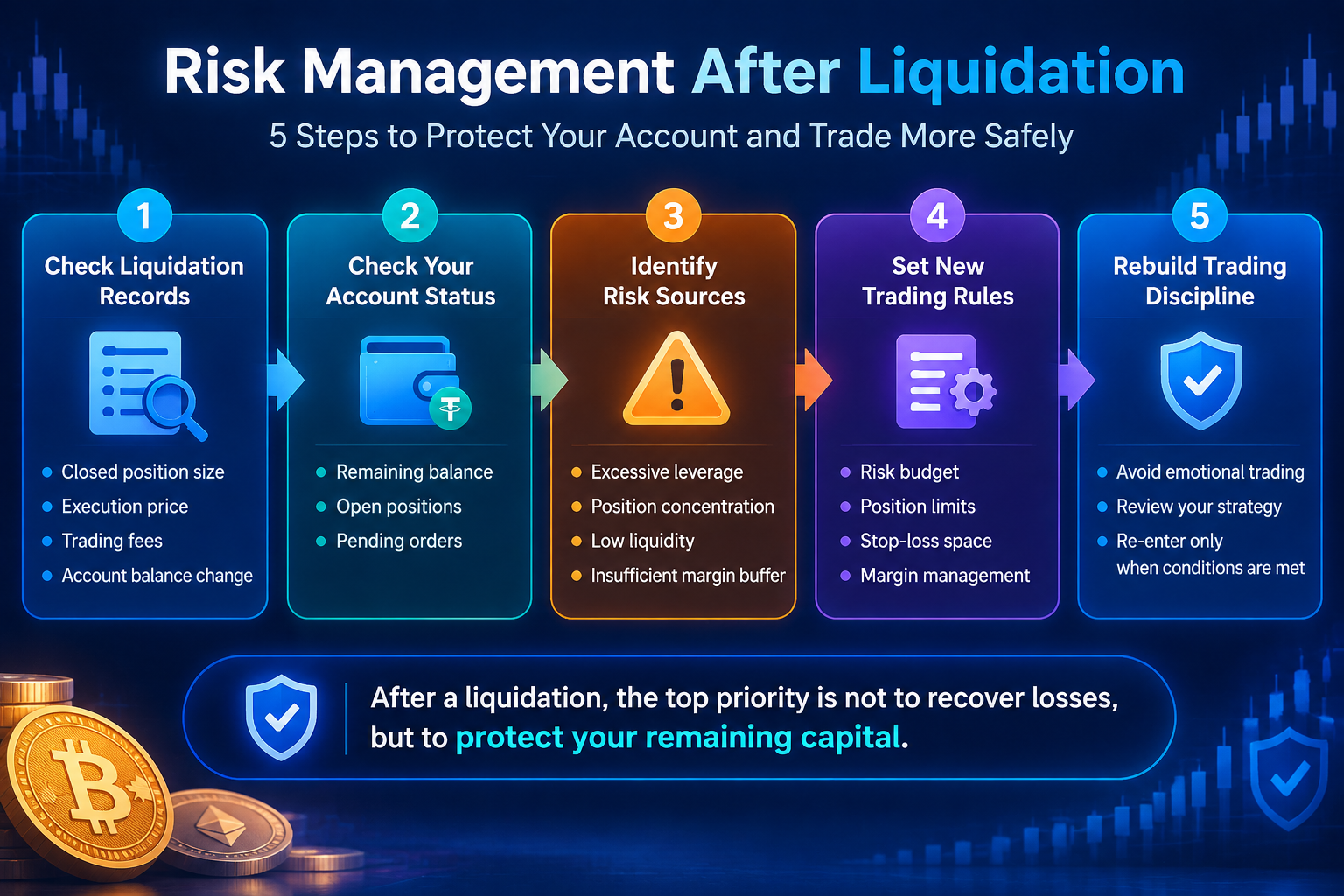
Therefore, risk management after liquidation should not focus solely on recovering the loss as quickly as possible. The first priority should be to regain control over the account and trading decisions. By checking asset conditions, distinguishing the sources of losses, adjusting the risk budget, and establishing trading discipline, traders can prevent a single liquidation from developing into a series of financial losses.
Key Takeaways
-
Liquidation closes a specific position but does not mean the account's overall risk has been eliminated. Traders still need to check their remaining margin, other positions, and account exposure.
-
The top priority after liquidation is to protect remaining funds and review the sources of risk, rather than immediately increasing leverage to recover losses.
-
Leverage, position size, liquidity, and account risk concentration must be evaluated together. Traders should not rely solely on the estimated liquidation price to assess safety.
What Should You Check in Your Account After Liquidation?
After a liquidation occurs, the first step is to confirm what actually happened. Traders should verify the liquidated contract, liquidation quantity, actual execution price, related fees, and changes in account equity and available balance. The estimated liquidation price is only a reference for the risk boundary. The actual liquidation result may also be affected by the mark price, market depth, execution speed, and platform rules. Looking at a single price on a market chart cannot fully reconstruct the account's loss.
Next, check whether any other positions remain open. Under isolated margin mode, the margin risk of an individual position is relatively independent, but other isolated positions may still exist in the account. Under cross margin mode, multiple positions may share the account's margin, and a loss in one position may affect the risk level of others. Therefore, after one position is liquidated, traders should still check the margin usage of the entire account rather than assume that other positions are unaffected.
You should also confirm whether there are any unfilled orders, conditional orders, or other active trading instructions. During extreme market conditions, traders may have placed orders or stop-loss conditions across multiple price levels. If these orders are not checked again after liquidation, the account may establish new risk exposure as the market develops. In particular, for automated trading or multi-strategy accounts, both order status and strategy status should be included in the review.
Finally, distinguish between losses that have already been realized and risks that the account still carries. A position that has been forcibly liquidated will not automatically be restored if the market rebounds, while other assets and open positions may continue to fluctuate. Only after completing an account status review can traders accurately determine how much available capital remains and whether they should suspend new trading activity.
Why Should Your First Response After Liquidation Not Be to Recover the Loss?
Liquidation can create significant psychological pressure. Traders may view a loss as a temporary deviation from their original profit target and rush to make up for it with their next trade. This behavior is commonly known as revenge trading. The core issue is not whether the market direction was judged correctly, but that decisions have begun to be driven by emotions and pressure from the loss.
When traders rush to recover losses, several typical changes may occur: increasing leverage, enlarging positions, shortening trading time frames, or entering and exiting the market frequently without sufficient analysis. These actions expose the account to greater price fluctuations. Even if a subsequent trade is profitable, that does not mean the earlier risk decisions were reasonable, nor does it prove that the account has returned to a sustainable state.
Pausing trading after liquidation does not mean abandoning the market. It gives you time to assess risk. Traders can first check whether their original trading plan remains valid, recalculate the maximum loss they can tolerate, and confirm whether subsequent trades align with their established strategy. If you cannot clearly explain why the previous position became uncontrolled, you should not re-enter the market simply because the market has rebounded or a technical indicator has appeared.
Market volatility can also amplify herd mentality. When prices fall rapidly, pessimistic views on social media and in trading communities may increase quickly. When prices rebound, the market may again develop an eagerness to buy the dip. In its analysis of why cryptocurrency prices are highly volatile, Investopedia discusses factors such as liquidity, market sentiment, social media information, and concentrated holdings. For traders, understanding these factors can help reduce the likelihood of making hasty decisions when emotions are strongest.
Identifying Structural Account Risks From a Single Liquidation
A single liquidation may result from an incorrect assessment of one position, or it may reflect problems with the account's overall risk structure. If a trader consistently uses high leverage, multiple positions may still create substantial actual exposure when combined, even if the notional size of each individual position does not appear large. In particular, when BTC, ETH, and related altcoins decline at the same time, multiple seemingly different trading positions may be affected by the same market factors.
Therefore, risk should be divided into individual-position risk and portfolio risk during a review. Individual-position risk includes the entry price, position size, leverage multiple, stop-loss arrangement, and estimated distance to liquidation. Portfolio risk includes the correlation between multiple positions, jointly used margin, asset concentration, and losses that may occur simultaneously during extreme market conditions. Analyzing only the liquidated contract may overlook broader sources of risk within the account.
Position size should also be assessed together with liquidity. When market liquidity is strong, relatively large buy or sell orders may still be executed within a limited price range. However, when market participants exit in large numbers and order book depth declines, a sell order of the same size may cause a greater price impact. For less liquid assets, traders should not assume that an order will necessarily be executed at the expected price even when a stop-loss has been set.
In addition, risk limits and maintenance margin requirements affect position management. As position size changes, the applicable risk tier and maintenance margin requirements may also change. Traders should not assess position safety solely based on the margin ratio at the time of opening. They should reassess the risk parameters after adjusting the position. The purpose of reviewing a liquidation is to identify which risks were previously underestimated and turn them into conditions that can be checked before the next trade.
How Can You Establish More Robust Capital and Position Management Rules?
Sound risk management begins with defining a risk budget. Traders should set a risk limit for each trade based on their available capital and tolerance for loss, rather than first deciding how much profit they want and then increasing leverage to enlarge the position. The risk budget should account for potential price fluctuations, trading fees, funding fees, and execution deviations. This helps prevent treating all available funds as margin that can be committed to trading.
Next, distinguish between account funds and trading funds. Even if a trader has substantial available assets, that does not mean all of those funds should be used as margin. Keeping a portion of funds outside trading can reduce the impact of a single market fluctuation on the overall financial situation. Different funding limits should also be set for assets and strategies with different risk levels to prevent highly volatile positions from using too many account resources.
Stop-loss and liquidation mechanisms should not be confused. A stop-loss is a trader's preset exit condition, while forced liquidation is a risk control measure executed by the platform when margin is insufficient. Stop-loss execution may be affected by the trigger method, market gaps, liquidity, and slippage. Therefore, sufficient risk space should be reserved before liquidation becomes a possibility. Traders should not treat the liquidation price as a normal stop-loss target, nor should they treat adding margin as the default choice without reassessing the trading logic.
Finally, position management should be practical to implement. Before opening a position, traders can record the reason for the trade, the risk limit, and the exit conditions. While holding the position, they can monitor margin and market liquidity, and after closing the trade, compare the actual result with the original plan. Consistent execution is more important than temporary adjustments. The purpose of risk control is not to eliminate every loss, but to prevent a single mistake from causing an unacceptable impact on the account.
Risk Management and Account Protection for Futures Trading on Gate
In Gate perpetual futures trading, users can view their positions, margin, and related risk information through the futures trading interface. Gate's Explanation of the Forced Liquidation Mechanism describes the process that applies when the maintenance margin ratio reaches the platform's risk threshold and distinguishes the scope of risk calculations under cross margin and isolated margin modes. Traders should understand their selected margin mode before opening a position rather than waiting until the position approaches the risk threshold to review the rules.
Under cross margin mode, the account's available margin may jointly bear the risks of multiple positions. Users therefore need to monitor the account's overall margin status. Under isolated margin mode, the primary focus is the margin allocated to an individual position and its corresponding risks. Neither mode is universally suitable for all traders. The key is to understand how funds are allocated and whether a loss in one position may affect other positions.
Gate's Explanation of Maintenance Margin Calculation can also help traders understand the relationship between position value, risk limits, and maintenance margin requirements. In practice, judgments should be based on the latest parameters displayed in the trading interface. Risk limits, margin requirements, and fee rules may differ across contracts, so the calculation results for one contract should not be directly applied to another trading pair.
Account protection after liquidation still depends on the trader's own capital arrangements and discipline. The margin information, risk parameters, and liquidation mechanism provided by the platform can help users identify risks, but they cannot guarantee that losses will be avoided. Users should also control position sizes based on their individual circumstances, reduce unnecessary leverage, and reassess their trading plans when market conditions change.
FAQ
Will all the funds in my account disappear after liquidation?
Not necessarily. The actual result depends on the liquidated position, margin mode, other assets in the account, and the applicable risk rules of the platform. Traders should check their actual execution records, account balance, and remaining positions rather than relying solely on the liquidation notification to determine the status of all account assets.
Should I resume trading immediately after liquidation?
There is no need to do so. First verify the account status and review the position risk and trading plan. If you cannot explain why the previous risk became uncontrolled, hastily opening a new position may continue the original problem.
Can adding margin after liquidation solve the problem?
Adding margin may increase the position's risk buffer, but it also means committing more funds. It cannot guarantee a price reversal or prevent further losses. Whether to add margin should be reassessed based on the trading logic, position size, and account risk.
Does setting a stop-loss prevent liquidation?
No. Stop-loss execution may be affected by rapid market fluctuations, slippage, insufficient liquidity, and order execution conditions. A stop-loss should be set before liquidation becomes a risk, with a reasonable buffer.
Which is safer, cross margin or isolated margin?
The two modes allocate risk differently. Isolated margin primarily limits the margin allocated to an individual position, while cross margin may allow multiple positions to share the account's margin. Choose a mode based on your position structure and capital management approach, and understand the applicable rules.