For readers who already know basic token-supply terms, the main failure mode is mixing definitions—stitching figures from different dates or methodologies into a false “missing coins” story. Align max, total, and circulating against XRP supply definitions before copying any dashboard number, then use XRP’s bridge-asset role in Ripple and XRP payments to keep supply math separate from payment-use context. Field meanings and a misread correction table come next.
As of about 26 November 2026, CoinMarketCap lists roughly 63.52 billion XRP circulating, about 99.986 billion total supply, and a 100 billion max supply; on-chain non-escrow readings often sit near about 68.7 billion (CoinMarketCap; verify on XRPScan-class explorers).
Key Takeaways
-
The goal is to align max / total / escrow / burned / market-site circulating on one timestamp—not to copy a single dashboard number.
-
Max supply is a protocol-fixed 100 billion; total supply ≈ 100 billion − cumulative fee burns; circulating supply has no single on-ledger field.
-
XRPScan and livenet.xrpl.org are suited to escrow locks and burn-related metrics; CoinMarketCap / CoinGecko report their circulating methodology results.
-
“1 billion unlocked monthly” is a release cap—most is typically re-locked; do not treat account counts as unique holders or CMC circulating as a native ledger field.
-
On Gate, objectively confirm the XRP market and any supply-related fields in market data/info areas; treat on-page fields as authoritative for that UI and cross-check with explorers.
What You'll Need Before You Start
Before you start, prepare four entry points and a blank checklist—no on-chain fees required.
-
Explorer tabs: livenet.xrpl.org or XRPScan (pick one as primary, keep the other for cross-check).
-
Market-data site: the CoinMarketCap XRP page (optionally open CoinGecko alongside).
-
Escrow background: Ripple’s explanation of XRP escrow.
-
Gate market or asset view: search XRP and open the spot market data/info area.
-
Checklist columns: record UTC time, max, total, escrow, burned, CMC circulating, on-chain non-escrow, and any Gate-visible supply fields.
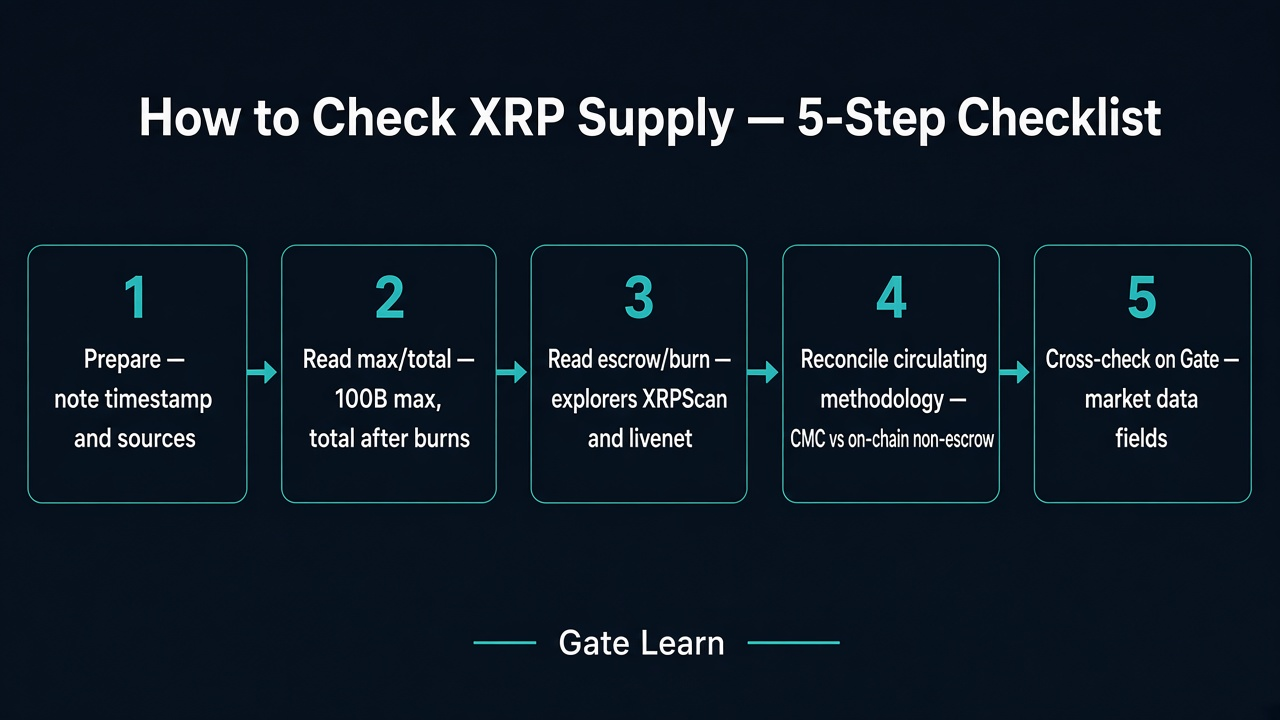
Figure 1. Five-step XRP supply check: Prepare → Read max/total → Read escrow/burn → Reconcile circulating methodology → Cross-check on Gate.
Step 1: How to Confirm Max Supply and Total Supply
Step 1 locks the hard cap and the slightly lower total after burns before discussing circulation.
XRP’s max supply is a protocol-fixed 100 billion tokens (100,000,000,000 XRP), created once when the ledger launched in 2012, with no mining and no later minting. Explorer overview pages typically show a supply total near 100 billion; if the UI labels max or genesis supply, it should read as that 100 billion constant.
Total supply answers “how much still exists on the ledger”: about 100 billion minus cumulative fee burns. The base fee scale is about 10 drops = 0.00001 XRP; as of about November 2026, cumulative burns are about 14 million+ XRP (~0.014%), leaving total supply near 99.986 billion (aligned with CoinMarketCap / on-chain totalCoins). Mislabeling total supply as “still minting” or “nearly equal to circulating” is the most common Step 1 error.
Step 2: How to Read Escrow and Burned on XRPScan / livenet.xrpl.org
Step 2 reads escrow locks and cumulative burns from ledger objects—not from market-site copy.
On XRPScan or livenet.xrpl.org, open supply, escrow, or network-stats panels and record XRP still in escrow and cumulative burned (or derive burns from totalCoins). A common on-chain “non-escrow” reading is total supply − escrow locks, often about 68.7 billion (mid-November 2026 magnitude; use the live page you open).
When reading escrow, keep the release rule in view: aggregate monthly releases are capped at 1 billion XRP, and unused amounts are typically re-locked into a new escrow at the end of the queue. Ripple’s escrow explanation frames 1 billion as an upper bound on what can enter circulation, not a promise of full monthly float addition. A verifiable historical example: Ripple’s Q1 2025 XRP Markets Report showed escrow falling from about 38.03 billion to about 37.13 billion—roughly 900 million net per quarter. That Markets Report series has been discontinued; newer checks should use on-chain escrow balances and monthly unlock/re-lock records.
Step 3: How to Read Circulating Supply Against CoinMarketCap / CoinGecko Methodology
Step 3 treats market-site circulating as a methodology result recorded beside on-chain non-escrow—not as a substitute for it.
As of about 26 November 2026, CoinMarketCap / CoinGecko list about 63.52 billion XRP circulating, a 100 billion max supply, and roughly 99.986 billion total supply (CoinMarketCap / CoinGecko public pages). That circulating definition typically excludes escrowed XRP plus Ripple/team-related holdings treated as non-circulating. On-chain non-escrow near 68.7 billion can still include Ripple-labeled balances that are not escrowed—a gap of about 4 billion+ XRP.
Write two parallel checklist rows: CMC circulating ≈ 63.52B and on-chain non-escrow ≈ 68.7B, each with a date. At one spot price, swapping a ~68.7B denominator for ~63.5B systematically changes market-cap arithmetic—a definition gap, not a ledger failure. CoinMarketCap circulating is not an XRPL protocol field; refresh cadence can also diverge from explorers, which is why same-timestamp notes matter.
Step 4: How to Cross-Check the XRP Market and Public Supply Fields on Gate
Step 4 objectively confirms the asset is XRP and checks whether the market data/info area shows supply-related fields.
On Gate, search XRP and open the matching spot market or asset info view. First confirm the pair and asset code point to XRP as the intended crypto asset (avoid lookalike tickers or wrong contract displays). Then inspect market data, info, or overview sections for any max, total, or circulating fields—treat on-page fields as authoritative for that UI. If the page shows only a subset or omits circulating supply, note “Gate fields limited” and finish the cross-check on explorers and CoinMarketCap instead of inventing missing numbers from a single screen.
The verification path is: search → open the market → read visible supply-related fields → compare with the checklist. It does not include registration prompts, trading incentives, or buy/sell advice. If Gate’s display tracks CMC more closely than on-chain non-escrow, annotate “Gate ≈ CMC methodology” for later review.
Common Errors and How to Fix Them
These misreads recur during supply checks; correct them once with an Error | Cause | Fix table.
| Error |
Cause |
Fix |
| Treating “1B unlocked monthly” as net float addition |
Confusing the release cap with full placement and ignoring re-locks |
Log unlocks and re-locks; watch net escrow balance change; historical net release is often far below the 1B cap |
| Treating account counts as unique holders |
Explorer account/address counts ≠ unique people |
Use account counts only as address-scale metrics; holders need a separate definition |
| Treating CMC circulating as an on-chain field |
Mixing publisher methodology with protocol fields |
Record CMC circulating beside on-chain non-escrow with date and source |
| Stitching a “gap” from different dates |
Inconsistent snapshot times |
Copy max / escrow / burned / CMC at one UTC moment; never mix days |
| Using total supply as circulating supply |
Ignoring escrow and non-circulating exclusion rules |
Walk max → total → escrow → circulating (methodology) in order |
Whenever a “tens of billions disappeared” story appears, first check whether ~68.7B non-escrow was compared with ~63.5B CMC circulating without labeling definitions. The ~4B+ spread mainly reflects whether Ripple non-escrow holdings are counted—not a sudden protocol burn or mint.
What Safety and Risk Points Matter When Checking XRP supply?
Checking supply does not require private-key actions, but information-security and misread risks still apply.
-
Phishing explorers: Use known domains only (for example xrpscan.com, livenet.xrpl.org, gate.com); do not enter “supply checker” clones via unknown search ads.
-
Definition mismatch: Mixing CMC with on-chain non-escrow invents false “missing XRP” narratives and distorts market-cap comparisons.
-
Unlock headline risk: Treating the 1B monthly cap as net sell pressure overstates near-term supply shock; prefer net escrow change.
-
Liquidity illusion: Large circulating supply is not order book depth; after the check, do not treat the circulating denominator as immediately tradable size.
-
Stale reports: Ripple Markets Reports have been discontinued; do not treat old quarterly PDFs as current escrow balances—re-check on-chain.
Separating fixed supply and visible escrow from “scam” slogans is easier when the checklist starts from XRP facts vs myths rather than headline labels. These points improve check quality; they are not trading or position advice.
Summary
How to check XRP supply: prepare a same-timestamp checklist, confirm the 100 billion max and post-burn total, read escrow and burned on XRPScan / livenet.xrpl.org, place CoinMarketCap circulating beside on-chain non-escrow as methodology results, then on Gate objectively confirm the market and any visible supply fields—using on-page fields as the UI source of truth and cross-checking explorers. Common misreads cluster around “1B net float,” accounts as holders, and CMC as a ledger field; the fix is one timestamp, clear definitions, and net release—not headline caps. Supply figures are educational reference points, not trading signals.
FAQ
How do you check XRP supply yourself?
Open an XRP explorer or XRPScan to record max supply, total supply, escrow, and burns, then open CoinMarketCap for its circulating figure and review any supply-related fields on Gate’s XRP market page. Write every number on one same-timestamp checklist so snapshots from different days are never mixed.
Where do you find XRP max supply and total supply?
Max supply is a protocol-fixed 100 billion, confirmed on explorers and XRPL documentation. Total supply is about 100 billion minus cumulative fee burns; as of about November 2026 it sits near 99.986 billion and can be cross-checked against CoinMarketCap’s total field.
Why does CoinMarketCap circulating differ from on-chain non-escrow by billions?
CoinMarketCap-style circulating (about 63.52 billion as of about 2026-11-26) typically excludes escrow and some issuer-related holdings; on-chain non-escrow (about 68.7 billion magnitude) can include Ripple non-escrow wallets and other Ripple-controlled funds that are not locked in escrow. The ~4B+ gap is methodological, not a ledger failure.
Does the “1 billion XRP unlocked monthly” all enter the market?
No. One billion is the monthly release cap; unused amounts are typically re-locked. Historical net release is often far below the cap (for example, about 900 million net per quarter in Q1 2025). Prefer on-chain escrow balance changes over headline unlocks.
How do you compare supply figures on Gate?
Search XRP, open the market or info page, confirm the asset, then compare any supply-related fields in market data; if fields are limited, treat the page as-is and cross-check explorers and CoinMarketCap. The step verifies display methodology only—it is not trading guidance.