This structure matters for readers assessing PoW scaling, dual-token roles, and EVM deployment paths. Unlike designs that move execution to a separate security domain while settlement stays elsewhere, Quai keeps Zone execution and Prime settlement under one miner set. Platform-side participation rules, reward flows, and campaign pacing can also be read through Gate Live mining.
Key Takeaways
- Quai Network uses Prime, Region, and Zone chains to combine parallel execution with hierarchical PoW settlement.
- QUAI supports smart-contract gas and value settlement; QI is the energy-denominated payment asset.
- PoEM gives the network a deterministic fork-choice rule, while merged mining lets one miner set protect multiple chains.
- Singularity and Polaris reduced genesis unlocks and introduced SOAP-based QUAI buybacks and burns.
What Is Quai Network?
Quai Network is a Layer 1 blockchain designed around three connected chain types. Prime Chain is the global settlement and coordination layer. Region Chains sit between Prime and user-facing execution chains. Zone Chains handle application execution and user transactions. Together, these chains create a hierarchical network where parallel Zones can process activity while eventually referencing their history toward Prime.
The design goal is to scale PoW without requiring every transaction to compete for the same blockspace. Instead of forcing all execution onto one chain, Quai spreads execution across many Zones and uses the chain hierarchy to maintain a global view of state. Project documentation reports more than 50,000 transactions per second and sub-cent transaction costs in test and network materials. Zone block times target roughly five seconds, while Prime targets about two minutes.
Quai also supports EVM-compatible smart contracts. Developers can deploy contracts using Solidity or SolidityX, Quai's upgraded contract language. Existing EVM tooling and contracts can therefore be adapted to the network without redesigning applications around a non-EVM execution environment.
How Does Quai Network's Architecture Work?
Quai organizes its network as a tree. Prime Chain is the root. Region Chains form the next layer, and Zone Chains form the execution layer beneath Regions. Each chain produces blocks through proof of work, but the layers serve different coordination roles.
Prime provides global ordering and settlement. Regions provide intermediate coordination between multiple Zones. Zones provide low-latency execution and user-facing blockspace. A transaction can execute on a Zone while its history is referenced upward through Region and Prime blocks. This reduces congestion on the root chain while still giving applications a path to global settlement.
Quai uses a shared miner set across these chains through merged mining. Miners submit workshares to multiple chains, allowing the same physical hash power to secure execution chains and settlement infrastructure. The project describes this as a way to avoid the common Layer 2 tradeoff where execution moves to a new security domain while settlement remains on a separate base chain.
Cross-chain transactions use a system of log references and hierarchical confirmation rather than external bridges for internal transfers. When activity moves between chains, one chain references the emitted logs of another. Finality follows the chain hierarchy, so confirmation speed depends on where the interacting chains sit in the tree and whether Prime settlement is required.
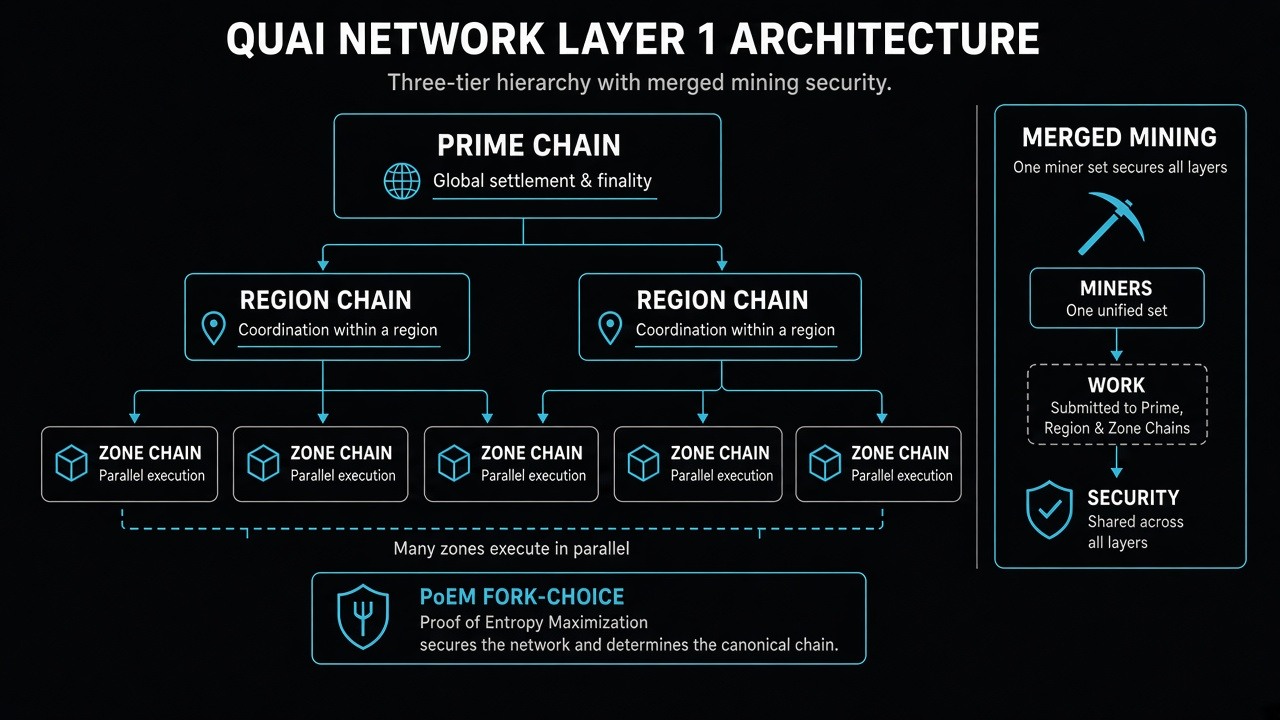 Figure 1. Quai Network hierarchy across Prime, Region, and Zone chains, with merged mining and PoEM fork choice.
What Is PoEM?
PoEM stands for Proof of Entropy Minimalization. It is Quai Network's proof-of-work fork-choice rule. Traditional longest-chain and heaviest-chain rules can leave multiple valid competing histories during network partitions. PoEM is designed to minimize the chance of competing branches of the same depth by ordering blocks according to an entropy-based score.
In practice, PoEM gives miners a deterministic rule for deciding which branch is canonical. It works alongside Quai's hierarchical chain structure and merged-mining design. The intended result is fewer reorganizations, faster finality for subordinate chains, and a more predictable settlement path for applications that need to know when a transaction is safe.
What Are QUAI and QI?
Quai Network uses two native assets with different monetary roles.
QUAI is the scarce protocol asset. It is used to pay gas for smart-contract execution and functions as the primary value-settlement token within the Quai economy. QUAI supply changes through genesis unlocks, mining emissions, and supply-auction burns. Supply upgrades reduced future scheduled issuance and increased the circulating share.
QI is the energy-denominated payment unit. Its issuance is designed to track energy expenditure rather than maintain a fixed cap. QI is intended for payments, remittances, and medium-of-exchange use cases where a lower-volatility unit is useful. It is not a fiat-backed stablecoin and does not derive its value from a reserve of dollars.
This separation gives Quai a dual-asset model: QUAI can absorb long-term value accrual while QI handles day-to-day payment throughput. Users can convert between the two inside the protocol.
How Does the QUAI-QI Conversion Work?
Quai includes an in-protocol conversion mechanism between QUAI and QI. A controller known as K-Quai adjusts the exchange relationship based on protocol parameters and network conditions. Users can swap between the assets without relying on a third-party liquidity pool for the core conversion.
The purpose is economic separation. QUAI's supply design emphasizes scarcity and burn-driven reduction, while QI's supply design emphasizes responsiveness to real mining energy. By placing conversion inside the protocol, Quai links the payment asset to the mining economy while preserving a distinct scarce asset for gas and settlement.
What Changed in the Singularity Fork?
The Singularity fork activated on March 19, 2026. Its core action was to burn approximately 1.67 billion genesis QUAI and cut future genesis unlocks by 81.1%. Before the fork, Quai had about 4.2 billion genesis tokens, of which roughly 77% were circulating. After Singularity, approximately 2.5 billion genesis QUAI remained, with about 93% circulating.
Singularity also introduced the Surplus of Activity Payments, or SOAP, mechanism. External miners can direct a portion of their rewards to the protocol. Quai converts those external contributions into QUAI repurchases and burns. This turns ongoing external mining revenue into a recurring reduction of QUAI supply rather than only a one-time fork event. The Singularity upgrade documentation states the burn size, unlock cuts, and SOAP pathway.
The upgrade changed Quai's supply profile in three ways: it removed a large pool of future unlocked tokens, increased the circulating proportion, and created a mechanism that can burn QUAI continuously if external miner participation remains strong.
What Is the Polaris Fork?
The Polaris fork activated on October 14, 2026. Quai burned approximately 236 million additional QUAI from the remaining genesis supply. After Polaris, monthly genesis unlocks fell from about 13 million QUAI to about 3.7 million QUAI.
The upgrade also reduced projected inflation. Genesis inflation dropped below 4%, and projected total inflation fell below 9% when combining genesis issuance and mining emissions. The burn did not make QUAI hard-capped, but it materially lowered the portion of total supply scheduled to enter circulation in the future.
Polaris therefore completed the transition from a high-unlock genesis schedule to a lower-emission supply profile. The remaining supply path now depends on scheduled genesis unlocks, PoW mining emissions, and SOAP burn activity, with parameters and timelines captured in the Polaris upgrade announcement.
How Does SOAP Affect QUAI Supply?
SOAP converts surplus activity payments from external miners into QUAI buybacks and burns. The mechanism is important because it connects external hash power to the scarce asset's supply rather than leaving mining rewards entirely outside QUAI's economy.
The supply impact is variable. If more external miners participate and direct surplus rewards to Quai, more QUAI can be burned. If participation is low, the recurring burn impact is smaller. This makes SOAP a conditional deflationary mechanism rather than a fixed schedule.
That distinction matters when interpreting the protocol's supply model. Polaris reduced scheduled issuance, but ongoing deflationary pressure is not guaranteed by the fork itself. It depends on miner participation, external revenue, and how much surplus activity payment is directed into the burn pathway.
What Can Users Do With QUAI?
QUAI supports three primary functions. First, it pays gas fees for smart contracts. Second, it transfers value across Quai's chains. Third, it stores protocol-level value in the network's economy.
Users can access QUAI through supported exchanges and wallets. Gate lists QUAI in its spot market. Kraken and MEXC also list the asset. Quai's ecosystem includes payment-oriented products such as Quainance and cross-chain infrastructure such as Symbiosis. Wallet support includes Pelagus, Blip, Tangem, and a MetaMask Snap.
New users can choose a wallet by device and custody preference: Pelagus runs as a browser extension, while Blip, Tangem, and MetaMask Snap offer other setups. Quaiscan shows production, settlement, and confirmation status across chains, making it easier to compare Zone's roughly five-second block time with Prime's longer settlement cycle.
Choose QI or QUAI by use case. QI fits high-frequency, fee-sensitive payments; QUAI fits gas, value settlement, and scarce-asset roles. SOAP then links external miner rewards to QUAI burns so supply changes remain easier to track.
How Does Mining Work on Quai Network?
Quai Network supports three proof-of-work algorithms and three hardware classes. KawPow supports GPU mining. SHA-256 supports Bitcoin-style ASICs. Scrypt supports Litecoin-style ASICs. This gives miners with different equipment multiple ways to participate.
Miners can merge-mine Quai chains and submit workshares to receive rewards. The reward structure uses shares rather than requiring every participant to win a full block individually. Tools include StratumX and ecosystem mining pools, which help distribute rewards across participating miners.
Mining plays two roles in Quai. It secures the PoW chains, and it feeds the economic loop through SOAP when external miners direct surplus rewards to the protocol. The network's security model therefore depends on both native participation and the broader external mining ecosystem.
What Can Developers Build on Quai?
Developers can deploy EVM-compatible contracts on Quai using Solidity or SolidityX. SolidityX extends Solidity with optimizations intended for Quai's execution environment. The project provides SDKs, Hardhat examples, and Quaiscan for deployment, monitoring, and transaction inspection.
Application categories include payments, DeFi, cross-chain transfers, tokenized assets, and general smart-contract infrastructure. Because execution is divided across Zone Chains, applications can target specific Zones while relying on the broader hierarchy for coordination and settlement.
The developer experience is designed to be familiar to EVM builders, but Quai's hierarchy adds an architectural choice that ordinary single-chain environments do not have. Developers need to understand which chain their contract resides on, how cross-chain references settle, and how confirmation times differ between Zones, Regions, and Prime. In a broader cryptography context, Proof of Prompt and Zypher Network outlines another verification path that helps contrast proof design choices.
What Are the Main Risks?
Quai Network's dual-token model depends on users understanding the different roles of QUAI and QI. If most activity settles in QUAI rather than QI, the payment-asset design may not fully realize its intended separation. If QI demand is weak, its energy-denominated role has less economic traction.
The protocol's throughput and cost figures come from project documentation and verifiable network parameter notes. Real-world performance depends on miner participation, application load, cross-chain traffic, and node distribution. Ecosystem adoption is still developing, so dApp liquidity, developer activity, and transaction demand should be tracked alongside architecture claims.
QUAI's supply reduction is partly conditional. Singularity and Polaris removed large genesis unlock pools, but ongoing burns through SOAP depend on miner participation and revenue. Mining economics, token unlock schedules, market liquidity, protocol upgrades, and smart-contract risk are additional considerations for holders and participants.
Summary
Quai Network is a programmable proof-of-work Layer 1 built around Prime, Region, and Zone chains. Its architecture uses parallel Zone execution, hierarchical settlement, merged mining, and PoEM fork choice to scale PoW while supporting EVM-compatible applications. QUAI functions as the scarce gas and settlement asset, while QI functions as an energy-denominated payment asset.
The Singularity and Polaris forks reshaped the token's supply path. Singularity burned about 1.67 billion genesis QUAI and cut future genesis unlocks by 81.1%. Polaris burned another 236 million QUAI, reduced monthly unlocks to about 3.7 million, and pushed projected inflation below 9%. SOAP adds a conditional recurring burn by converting surplus external miner rewards into QUAI buybacks and burns. Together, these changes position QUAI as a lower-issuance, burn-sensitive asset within a two-token economic system.
FAQ
What is Quai Network?
Quai Network is a programmable proof-of-work Layer 1. It uses a hierarchy of Prime, Region, and Zone chains to process transactions in parallel while maintaining settlement through merged mining and PoEM.
How do QUAI and QI differ?
QUAI pays smart-contract gas, transfers value across Quai's chains, and acts as the scarce settlement asset. QI is the energy-denominated payment token whose issuance tracks energy expenditure; it is not a fiat-backed stablecoin.
What did Singularity and Polaris change?
Singularity burned a large pool of genesis QUAI and introduced SOAP. Polaris activated on October 14, 2026, burned about 236 million QUAI, reduced monthly genesis unlocks to about 3.7 million, and lowered projected total inflation below 9%.
Is QUAI deflationary?
QUAI is burn-sensitive rather than automatically deflationary. Singularity and Polaris permanently removed large genesis pools, while SOAP creates recurring burn pressure that depends on external miner participation and revenue.
How can users mine Quai?
Quai supports GPU mining through KawPow, SHA-256 ASIC mining, and Scrypt ASIC mining. Miners can submit workshares through merged-mining systems and mining pools, including tools such as StratumX.