Internet infrastructure has long been dominated by large cloud service providers and content delivery network operators. Centralized architectures can provide mature service management, resource scheduling, and technical support, but they also mean that infrastructure construction, operations and maintenance, and service control are often concentrated in the hands of a small number of operators. As data volumes continue to grow, applications are placing increasingly higher demands on storage capacity, access efficiency, and service continuity. The market has therefore begun exploring more diverse ways to organize infrastructure.
DePIN, or decentralized physical infrastructure networks, attempts to incorporate real-world devices, storage, bandwidth, energy, and computing resources into open networks, coordinating distributed resources through software protocols and economic mechanisms. This does not mean that deploying nodes alone can create an effective service. Whether a network can develop over the long term ultimately depends on resource availability, service reliability, users' willingness to pay, and whether the protocol can establish a sustainable operating system.
Pipe Network can serve as a case study for examining DePIN storage infrastructure. The project focuses on distributed nodes and storage services, with its current official documentation primarily describing Pipe Storage and Firestarter nodes. Analyzing the project requires starting with its actual architecture and distinguishing between its infrastructure design, implemented service capabilities, and potential future areas of expansion.
Key Takeaways
-
The core of DePIN is not simply adding more nodes, but converting distributed resources into stable, verifiable, and usable services
-
Pipe Storage provides S3-compatible object storage through coordination among gateways, the control plane, and Firestarter nodes
-
Node participation currently operates by invitation. Node wallets must hold a LovePIPE position representing at least 10,000 PIPE and meet eligibility check requirements
-
Current official documentation clearly states that individual nodes currently receive no service rewards or direct payments. Running a node should not be described as a stable source of PIPE income
-
The network's long-term value depends on real customer demand, data integrity, node availability, service costs, and operational efficiency
Why Must DePIN Move From Resource Networks to Actual Services?
The basic idea behind DePIN is to divide infrastructure resources that were originally built and managed by a single organization into multiple participating nodes, and then use protocols to register resources, assign tasks, verify services, and settle payments. Compared with traditional infrastructure, this model can introduce more resource providers and may create differences in geographic coverage and resource organization.
However, distributed resources do not automatically mean reliable services. For a storage network, users ultimately need data to be written securely, read accurately, and remain available when nodes fail or resources change. If a network has a large number of nodes but cannot effectively coordinate data placement, integrity verification, and failure recovery, the number of nodes alone cannot demonstrate its commercial value.
Therefore, evaluating a DePIN project requires looking beyond resource supply and examining service delivery. Does the network have a clear customer access point? Can the resources provided by nodes be scheduled effectively? Can data or service results be verified? Are users willing to pay for the service? These questions reflect the maturity of the infrastructure more accurately than simply counting nodes.
How Does Pipe Network's Storage Architecture Work?
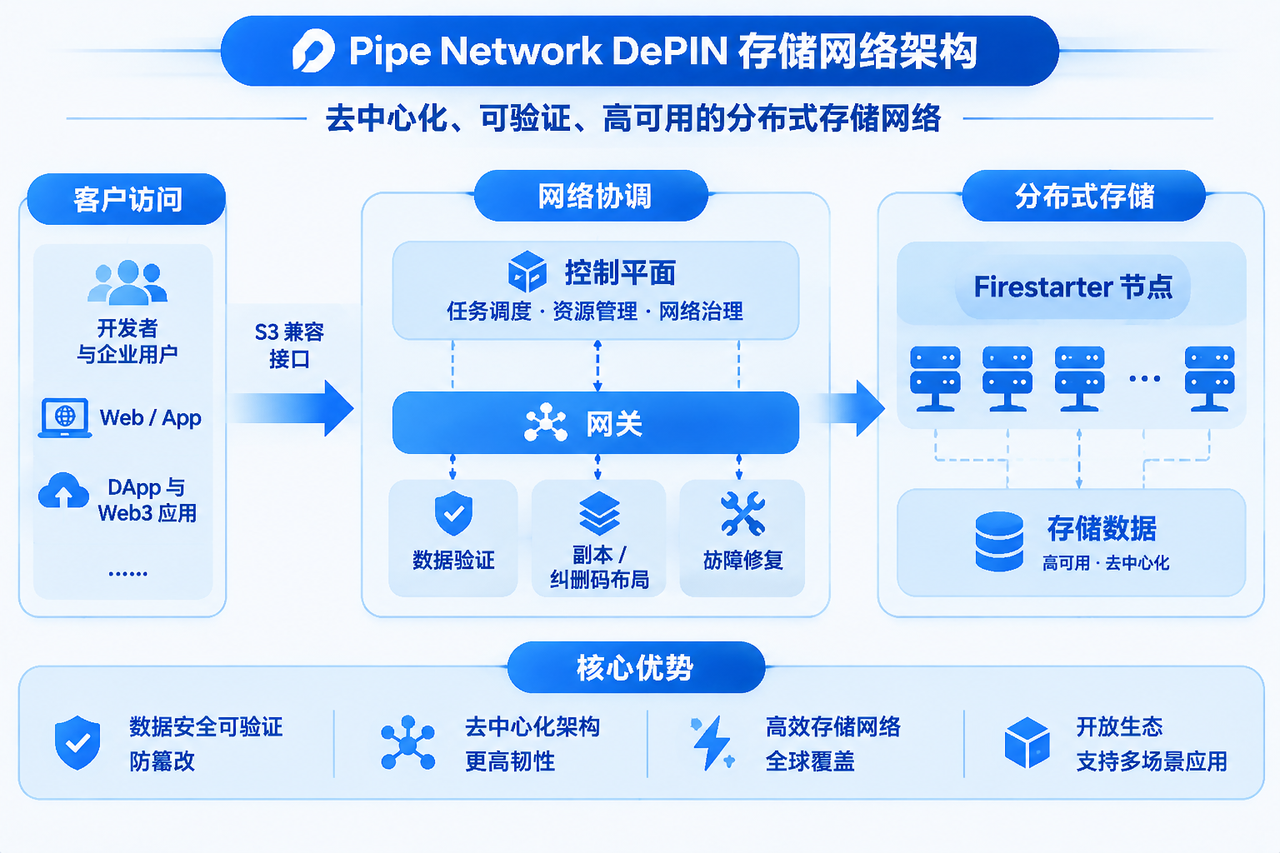
According to the current official Pipe Network documentation, Pipe Storage's core consists of three components working together: gateways, the control plane, and Firestarter nodes. Customers access storage services through an S3-compatible interface. Gateways authenticate requests, coordinate storage locations, and verify returned data. The control plane manages node admission, topology information, customer quotas, and storage tasks. Firestarter nodes store object data, process authorized read and write requests, and provide signed receipts and integrity proofs.
This layered design separates customer access, network coordination, and actual data storage. Users do not need to manage each underlying node directly. Instead, they can access the service through a relatively familiar storage interface. For developers, S3 compatibility helps lower the barrier to entry, allowing existing tools and applications to continue using established workflows to some extent.
For data reliability, the official documentation describes multiple replicas and erasure coding as storage layouts. Depending on the applicable policy, the system can use three complete replicas across eligible hosts or store data using Reed–Solomon 4+2 sharding. Data integrity is verified during reads. When replicas or shards become unavailable, the system can perform recovery based on node status, capacity, and policy.
How Do Node Interactions Affect Network Reliability and Scalability?
In a distributed storage network, nodes form the foundation of resource supply, but they are not simply connected as equals. Different nodes may have different storage capacities, uptime, network conditions, and operational capabilities. The protocol must determine where to place data based on these conditions and adjust storage layouts when nodes become unavailable. An increase in node count can translate into greater network service capacity only when the resources can be used effectively.
Pipe Network currently uses Firestarter nodes to participate in storage services. According to the official documentation, operating a node requires obtaining the relevant software and admission eligibility through an invitation. The regular public admission path requires a node wallet to hold a LovePIPE position representing at least 10,000 PIPE and to pass hourly eligibility checks throughout a complete UTC calendar month. Nodes must also meet requirements related to health status, capacity, and storage policies.
This mechanism shows that node participation is not completely permissionless. Staking requirements can serve as conditions for admission and resource screening, but they may also limit the participant pool and create capital lockup and eligibility maintenance costs. For DePIN networks, balancing resource quality, openness to participation, and operational efficiency is an important factor affecting long-term scalability.
It is also important to note that the capacity provided by a node is not necessarily used by the network. Actual data placement depends on customer demand, node health, available capacity, and storage policies. Expanding the scale of effective services ultimately requires both customer demand and stable operations.
How Does Pipe Network's Value Form as It Moves From Decentralized Resources to Commercial Services?
The long-term value of an infrastructure project usually comes from its ability to provide ongoing services, rather than simply from the amount of physical resources it controls. For a storage network, customers need to pay for capacity and data access services, while the operating system must handle node coordination, data integrity verification, service availability, and failure recovery. Only when customers are willing to use the service continuously can resource supply gradually form a sustainable commercial cycle.
Pipe Storage currently uses a prepaid storage credit model. Customers purchase credits with USDC on the Solana mainnet, after which the control plane reserves and deducts credits for authorized storage operations. This mechanism links customer payments to service usage and enables storage consumption to be managed through a relatively clear account system.
However, storage fees paid by customers cannot be directly equated with node operators' income. Current official documentation clearly states that storage services do not currently pay rewards or income to individual nodes. Node receipts and service records do not represent income that nodes can claim. The protocol's fund management and the deduction of customer credits must also be understood separately. Customer spending should not automatically be interpreted as node revenue sharing or token buybacks.
Therefore, researching Pipe Network's business model requires ongoing observation of customer usage, storage service revenue, resource utilization, data recovery costs, and network operating expenses. A DePIN network can move from a technical architecture toward a sustainable business only when service demand can cover infrastructure operating costs and generate stable customer retention.
What Development Challenges Do DePIN Storage Networks Face?
The first challenge is balancing service quality with dependence on centralized components. Distributed nodes can increase the sources of resources, but gateways and the control plane still perform important coordination functions. The official architecture also clearly identifies gateways and the control plane as dependencies for service availability. In other words, storing data across multiple nodes does not mean that every part of the system is free of centralized dependencies.
The second challenge is data reliability and operating costs. Multiple replicas and erasure coding provide different forms of data redundancy, but they also create additional storage, network transfer, and recovery costs. The network must choose appropriate strategies based on data type, access frequency, and node distribution. If storage costs are too high or node resource quality is unstable, both service prices and the user experience may be affected.
The third challenge is customer demand and competition. Distributed storage must compete with established cloud service providers, traditional object storage products, and other decentralized storage networks. S3 compatibility can lower the barrier to migration, but it cannot by itself guarantee that customers will migrate. Service pricing, access speed, data durability, technical support, compliance requirements, and long-term operational capabilities all affect whether enterprises are willing to adopt new infrastructure.
The final challenge is the relationship between token mechanisms and actual business activity. Tokens can serve functions such as protocol admission and governance, but their market value does not automatically increase with the growth of network resources. Researchers need to distinguish among mechanisms that are actually operating, economic policies explicitly stated by the project, and future concepts that have not been implemented or committed to.
How Can We Assess Whether Pipe Network's DePIN Development Is Sustainable?
Pipe Network can be monitored over the long term through a framework covering four areas. The first is product usage, including the number of real customers, storage usage, access frequency, and customer retention. The second is network operations, including node availability, effective capacity, data verification, and recovery performance. The third is economic sustainability, including customer payments, service costs, and protocol fund management. The fourth is governance and admission, including node participation rules, eligibility requirements, and the transparency of protocol upgrades.
These four dimensions need to be analyzed together. For example, growth in the number of nodes without corresponding growth in customer storage demand may represent only supply-side expansion. Growth in customer payments without a corresponding improvement in service quality does not necessarily indicate stronger network competitiveness. Conversely, if customer usage, node service capabilities, and operational efficiency continue to improve, the network is more likely to develop long-term infrastructure value.
For the DePIN industry, Pipe Network's significance lies not only in its use of distributed nodes, but also in its demonstration of how distributed resources can be organized into a storage service with practical interfaces, data management, and operating rules. Whether it can expand commercial adoption will still need to be validated by actual usage data and ongoing operational results.
Gate and PIPE: From Infrastructure Research to Market Participation
Users who want to learn more about PIPE can cross-reference the project's official materials, the Gate Learn Pipe Network project overview, and the Gate PIPE/USDT trading page. The Gate Learn article provides a basic introduction to Pipe Network and helps readers understand the project's early positioning as a decentralized CDN. When researching the current product status, users should also refer to Pipe Network's latest official documentation and distinguish between its early vision and the current mainnet storage mechanism.
It is important to emphasize that trading PIPE and using Pipe Network's storage services are two different activities. Holding or trading the token does not mean that a user is participating in node operations, nor does it mean that the user can earn storage service revenue or node rewards. Market participants should independently evaluate the token mechanism, liquidity, price volatility, and the project's actual progress.
FAQ
Is Pipe Network a DePIN Project?
Pipe Network uses distributed nodes to provide storage infrastructure, which fits the basic research framework of DePIN: building real-world service networks through distributed resources. However, assessing its stage of development still requires attention to the products currently available on the mainnet, the node admission mechanism, and actual service usage.
What Services Does Pipe Network Currently Provide?
The current official documentation primarily introduces Pipe Storage, which provides object storage through an S3-compatible interface. Gateways, the control plane, and Firestarter nodes work together to coordinate requests, store data, and perform verification.
Can Anyone Run a Pipe Network Node?
The current regular public admission process operates by invitation and requires node wallets to hold a LovePIPE position representing at least 10,000 PIPE. Nodes must also pass eligibility checks throughout a complete UTC calendar month and satisfy other operating conditions. Installing the software alone does not automatically allow a node to join the network.
Can Running a Firestarter Node Earn PIPE Rewards?
According to the current official documentation, individual nodes currently receive no rewards or direct payments. Therefore, running a node should not be described as a way to continuously earn PIPE income.
How Does Pipe Network's Storage Service Ensure Data Reliability?
Its architecture improves reliability through data integrity verification, multiple replicas or erasure-coded layouts, and data recovery when conditions are met. Actual performance still depends on node health, capacity, network policies, and the proper operation of the control plane.
Is PIPE's Market Value Directly Linked to Pipe Network's Usage?
They cannot be equated directly. The token's actual uses, protocol fund policies, circulation and supply structure, and real service demand all need to be analyzed. Growth in network usage does not necessarily mean that the token price will rise at the same rate.