The energy industry is undergoing a digital transformation. In the past, power equipment was usually seen simply as physical infrastructure, with its value mainly reflected in its ability to generate, store, or supply electricity. However, with the development of the Internet of Things, smart grids, and blockchain technology, energy devices are beginning to gain the ability to produce data and exchange value. Energy systems are evolving from traditional infrastructure networks into digital energy networks.
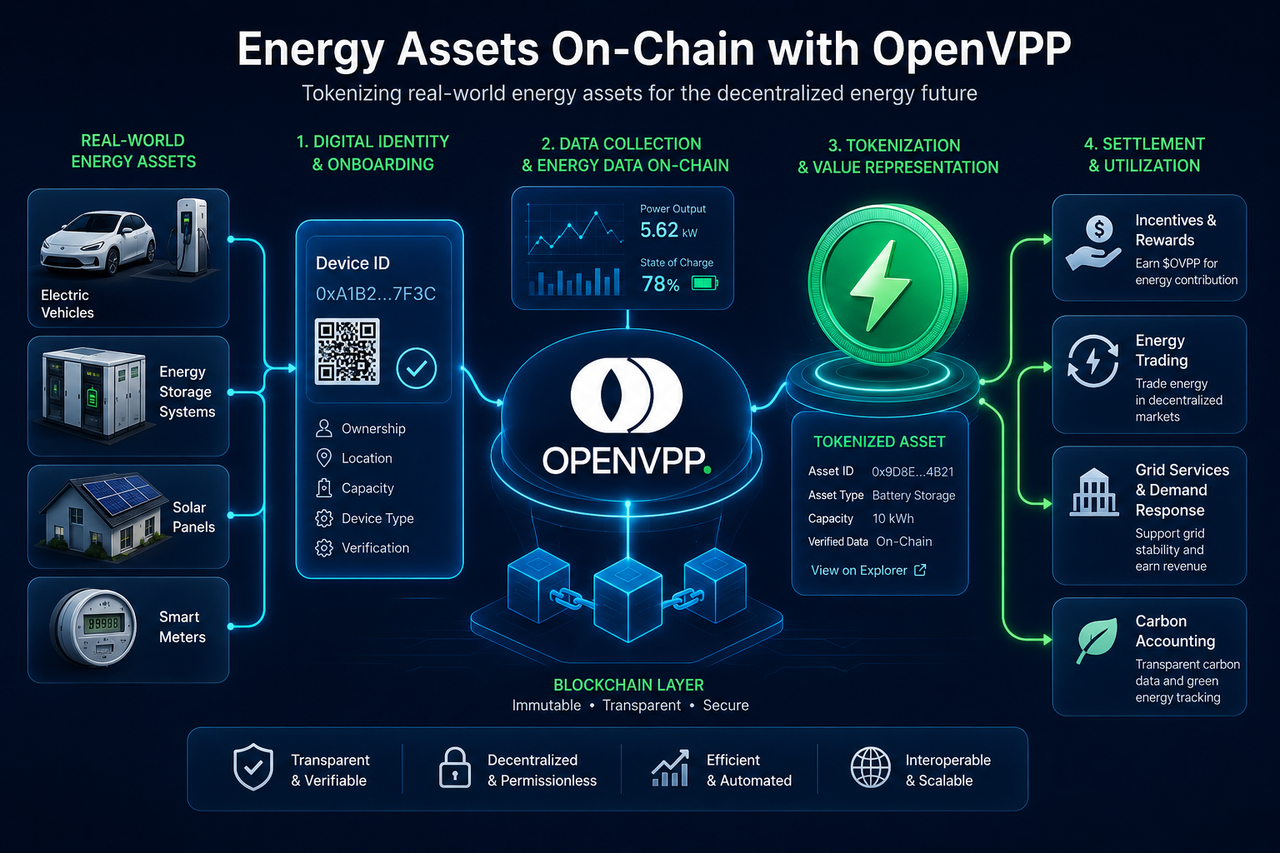
Against this trend, energy asset tokenization has become an important direction for the energy internet. As a major project in the energy DePIN sector, OpenVPP is attempting to use blockchain to bring distributed energy resources such as electric vehicles, battery energy storage systems, solar equipment, and smart meters into a unified network.
What Is Energy Asset Tokenization?
Energy asset tokenization is a digitalization process that uses blockchain technology to map energy devices and the value they generate onto the blockchain.
In traditional energy systems, electric vehicles, batteries, and solar systems can all generate energy value, but that value is often recorded in closed platforms or corporate databases.
The core goal of tokenization is to create a unified digital representation, giving energy assets verifiable, traceable, and programmable characteristics.
From a technical perspective, energy asset tokenization is a specialized form of bringing Real World Assets(RWA)on-chain. Its underlying assets are not real estate or bonds, but energy infrastructure and its operating capabilities.
Why Do Energy Devices Need Digital Identities?
Digital identity is the first step in bringing energy assets on-chain.
There are many types of real-world energy devices, including electric vehicles, battery energy storage systems, solar panels, and smart meters. Without a unified identity system, a blockchain network cannot identify where these devices come from or understand their operating status.
OpenVPP creates digital identities for devices and records their core attributes.
This information usually includes:
Digital identity allows each device to become an independent and verifiable on-chain entity within the network.
How Does OpenVPP Bring Energy Assets On-Chain?
OpenVPP’s process for bringing energy assets on-chain mainly consists of three parts: the identity layer, the data layer, and the value layer.
After a device connects to the network, it first completes identity verification.
Then, the device continuously uploads operating data to the network, including information such as power generation, power consumption, energy storage capacity, and grid response behavior.
Finally, the system generates corresponding value records based on device contributions and uses smart contracts to execute incentive and settlement logic.
The whole process can be understood as:
Real-world device → Digital identity → On-chain data → Value mapping → On-chain settlement
This structure allows real-world energy assets to form a complete digital lifecycle.
How Can Electric Vehicles Become On-Chain Energy Assets?
Electric vehicles are not only a form of transportation; they are also mobile energy storage devices.
As Vehicle-to-Grid(V2G)technology develops, EV batteries can switch flexibly between charging and discharging, allowing them to participate in grid regulation.
In the OpenVPP network, an electric vehicle receives a digital identity after connecting.
The system continuously records:
This data forms an energy contribution profile for the electric vehicle.
When the vehicle participates in demand response or energy storage services, its related contribution can be recorded and included in on-chain incentive calculations.
As a result, an electric vehicle in OpenVPP is not only an energy consumer, but can also become an energy service provider.
How Are Energy Storage Devices Tokenized?
Energy storage devices are one of the most typical use cases for energy asset tokenization.
Battery energy storage systems can store electricity when energy supply is abundant and release power during periods of peak demand.
In traditional energy markets, the value of energy storage devices is usually managed collectively by operators.
OpenVPP records storage behavior on-chain, allowing energy storage contributions to be quantified independently.
For example:
-
Amount of electricity stored
-
Number of discharge cycles
-
Response speed
-
Grid regulation capability
These indicators can form a device credit and contribution record.
Over time, energy storage devices can develop complete digital asset profiles.
How Does OpenVPP Record the Value of Energy Data?
Energy data is an important part of energy asset digitalization.
Traditional energy systems often focus only on the results of energy transactions, while overlooking the value of the data itself.
OpenVPP treats device operating data as an important network resource.
The system continuously records:
This data can support demand forecasting, grid dispatch, and energy market operations.
In the energy internet environment, data value and energy value together form the asset value system.
What Are the Use Cases for Energy Asset Tokenization?
Bringing energy assets on-chain is not just a technical innovation. It may also create new models for energy collaboration.
Decentralized Energy Networks
Devices can directly participate in energy network operations without relying entirely on centralized platform coordination.
Virtual Power Plant Coordination
Tokenized devices can become an important part of virtual power plant resource pools.
Energy Market Settlement
Device contributions can be recorded and settled in real time, improving market transparency.
Carbon Emissions Tracking
On-chain data can provide more transparent proof of green energy sources.
Energy Infrastructure Financing
Digital asset records can help improve the verifiability and transparency of energy infrastructure.
What Challenges Does Energy Asset Tokenization Face?
Energy asset tokenization is still in an early stage of exploration.
First, a reliable data verification mechanism is needed between real-world devices and on-chain data.
If data authenticity cannot be guaranteed, on-chain records lose their meaning.
Second, different countries and regions have different regulatory frameworks for energy markets and digital assets.
In addition, limited device standardization can also increase network compatibility challenges.
One future development direction is to establish unified energy data standards and device identity protocols.
How Is OpenVPP Different from Traditional Energy Asset Management?
| Comparison Dimension |
OpenVPP Model |
Traditional Model |
| Device Identity |
On-chain digital identity |
Corporate database |
| Data Storage |
Distributed records |
Centralized storage |
| Value Confirmation |
Smart contract calculation |
Manual or platform-based accounting |
| Asset Transparency |
Relatively high |
Relatively limited |
| Network Participation Method |
Open network |
Platform management |
| Incentive Mechanism |
Digital asset incentives |
Fixed subsidy mechanism |
OpenVPP places greater emphasis on energy asset digitalization and building open value networks, while the traditional model focuses more on centralized management and operation.
Conclusion
Energy asset tokenization is an important direction for the energy internet and for bringing real-world assets on-chain. By establishing digital identities, on-chain data records, and smart contract settlement mechanisms, energy infrastructure such as electric vehicles, energy storage devices, and solar systems can gain verifiable digital representations.
OpenVPP connects real-world energy devices through a decentralized virtual power plant network and maps energy contributions, device capabilities, and operating data into a blockchain environment.
FAQs
How Does OpenVPP Bring Energy Assets On-Chain?
OpenVPP connects real-world energy devices to blockchain networks through device identity verification, real-time data collection, and smart contract settlement mechanisms, while establishing corresponding digital identity and value record systems.
Why Can Electric Vehicles Be Viewed as Energy Assets?
EV batteries have energy storage capabilities. In Vehicle-to-Grid(V2G)scenarios, they can participate in grid regulation and demand response. As a result, electric vehicles are not only transportation tools, but can also provide energy services.
Can NFTs Be Used for Energy Device Management?
NFTs can serve as carriers for energy device digital identities, recording device ownership, operating history, and energy contribution data, thereby forming verifiable digital credentials.
Is Energy Asset Tokenization a Type of RWA?
Energy asset tokenization is a form of bringing Real World Assets(RWA)on-chain. Unlike traditional RWAs such as real estate or bonds, energy assets mainly come from real-world energy infrastructure and the data and service capabilities it produces.
OpenVPP uses blockchain to record device identities and energy data, and uses smart contracts to complete value settlement. Traditional energy management platforms usually use centralized databases and centralized operating models, so the two differ clearly in transparency and openness.