The development of generative AI is undergoing an important shift. Early applications focused primarily on text generation, knowledge-based Q&A, and content processing. New-generation AI Agents, however, are beginning to take on more complex tasks, such as querying external databases, calling business systems, analyzing real-time information, executing workflows, and completing specific actions with user authorization. This shift means that competition among AI applications no longer depends solely on whether models can generate accurate answers. It also depends on whether they can effectively access external information and turn their reasoning capabilities into executable actions.
However, connection barriers have long existed between model capabilities and external systems. Different applications typically have their own data interfaces, tool-calling methods, authentication mechanisms, and permission management systems. If developers want an AI assistant to connect to multiple data sources and business systems at the same time, they often need to write separate integration code and continuously maintain compatibility with different interfaces. As the number of tools and model applications continues to grow, this one-to-one integration approach creates significant development and maintenance costs. It also makes it difficult to reuse AI Agent capabilities across different platforms.
Model Context Protocol (MCP) has attracted attention in this context. It is an open protocol designed to standardize how AI applications connect with external data sources, tools, and context. MCP does not train models or determine how AI applications should reason. Instead, it provides a relatively unified communication mechanism that enables AI applications to discover and use capabilities provided by external systems. Its importance lies in providing the Agent ecosystem with a common connectivity layer, allowing models to move from relatively closed conversational environments into application environments where they can collaborate with real-world software systems.
Key Takeaways
-
MCP addresses the standardization of connectivity: It reduces the need to develop dedicated interfaces between AI applications and different external tools one by one, but it does not handle model reasoning or business decisions
-
MCP uses a Host, Client, and Server architecture: The AI application coordinates connections, the Client handles protocol communication, and the Server provides the application with data, tools, or prompt templates
-
Tools, Resources, and Prompts form its core capabilities: They support external operation calls, contextual data access, and reusable interaction templates, respectively
-
MCP makes it easier for Agents to move from information processing to task execution: However, whether tools can complete tasks safely and accurately still depends on permission design, data quality, and execution workflows
-
Standardized connectivity does not automatically establish trust: Authentication, authorization, user confirmation, logging, and risk controls remain essential components of real-world deployments
Why Do AI Agents Need a Standardized Connectivity Protocol?
AI models do not inherently have the ability to access external software systems. A model can generate analysis based on its training data and current context. However, if it needs to query the real-time balance of an account, read the latest records in a database, or submit an operation to an external service, it must do so through interfaces provided at the application layer. The model is responsible for understanding the task and generating the intent to make a call, while external tools access data or execute operations. A clear communication mechanism is needed between them.
Without a unified connectivity standard, each AI application may use a different integration method. One application may connect to a database through custom function calls, while another may connect to a business system through a dedicated API. Some applications may require additional plugins or middleware. Even when different applications ultimately call the same external service, they may still need to maintain multiple sets of interface integration logic. This fragmented structure makes tool integration more complex and increases the compatibility burden during system upgrades.
The value of MCP lies in shifting connectivity from an application-specific implementation to a more universal protocol layer. External services can expose their data or functionality through MCP Servers, while AI applications that support MCP can connect to these services through Clients. Developers do not need to redesign a completely independent connectivity mechanism for every model application. Instead, they can reuse existing Server implementations based on the protocol specifications.
This standardization has the potential to produce network effects. As more AI applications support the same protocol, external services can reach a broader range of application environments. As more services provide MCP interfaces, AI applications can access a wider variety of tools and data sources. Tool developers, model platforms, and end users can therefore form a mutually reinforcing ecosystem. However, standardization can only reduce connectivity costs. It cannot guarantee that all tools have the same level of data quality, stability, or security.
The relationship between MCP and AI Agents themselves also needs to be distinguished. MCP is not an Agent framework or an autonomous decision-making engine. It primarily addresses how context and tools are transmitted between different software components. How an Agent understands goals, breaks down tasks, selects tools, evaluates results, and decides whether to continue executing still depends on model capabilities, application design, and workflow control mechanisms. MCP provides Agents with connectivity, but it does not replace their planning and execution logic.
MCP Architecture: How Do Hosts, Clients, and Servers Work Together?
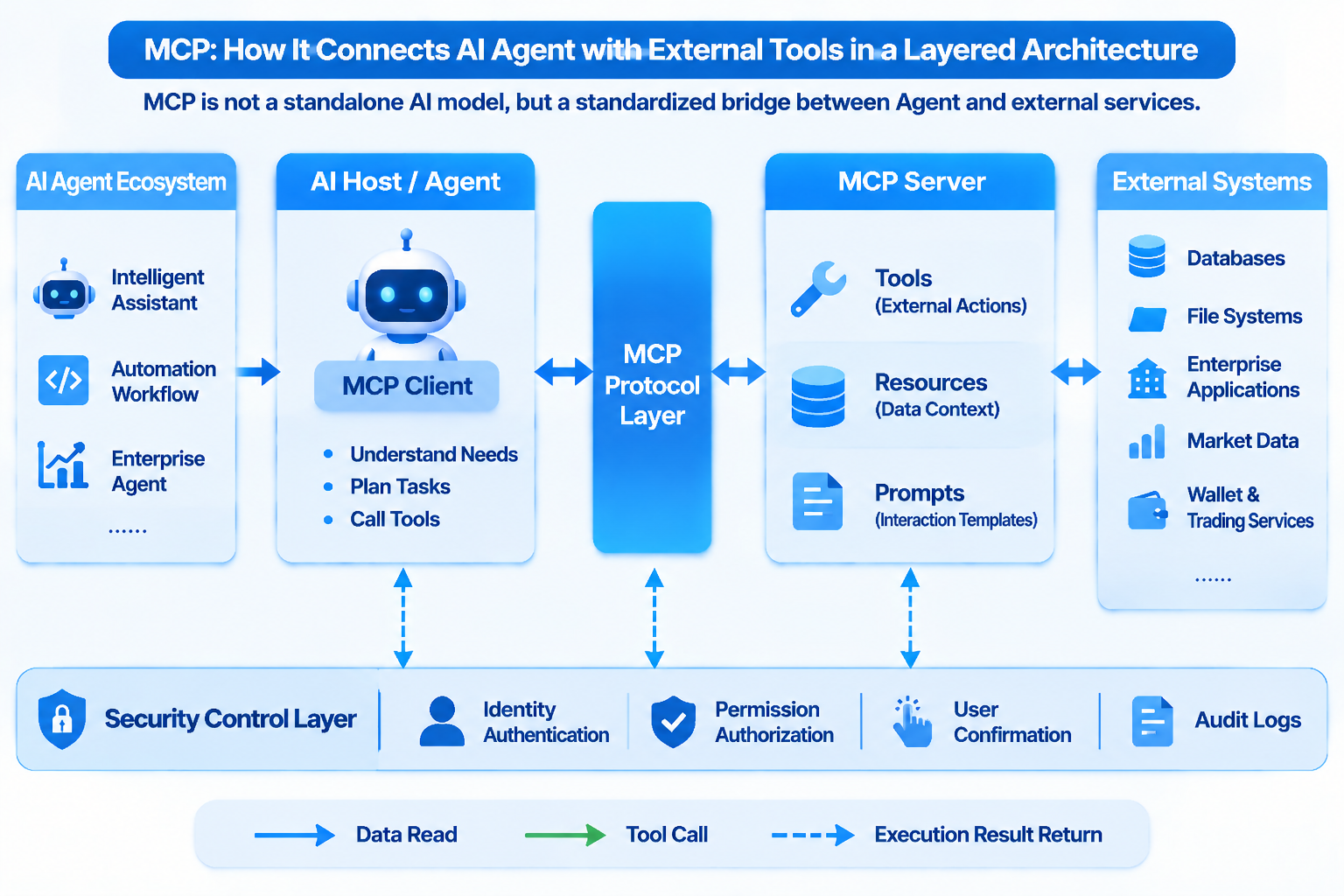
MCP uses an architecture that combines Clients and Servers. Its main participants include Hosts, Clients, and Servers. A Host is an application that provides AI capabilities, such as a desktop assistant, development environment, or other Agent application. A Client is a component within the Host that establishes connections with MCP Servers. A Server provides external data, tools, or interaction templates to the Client. Together, the three form the connection pathway between AI applications and external systems.
The Host generally coordinates the overall process. It receives user input, provides the relevant context to the model, and manages one or more MCP Clients based on the model's needs. An AI application can connect to multiple MCP Servers, such as file systems, code repositories, databases, and market data services at the same time. Each connection is maintained by its corresponding Client component, allowing the application to use capabilities from different services within a unified interaction environment.
The Client is responsible for protocol communication and connection management. It needs to understand the capabilities provided by the Server, send requests according to the message structures specified by MCP, and receive the corresponding results. A Client is not the same as the model. It is a component within the Host that handles protocol connectivity. The model may decide to use a particular tool based on the context, but the actual protocol interaction is completed by the Client and Server.
The Server provides external capabilities. It can connect to a database, encapsulate a set of APIs, or provide a unified access point for a particular business system. A Server does not necessarily need sophisticated AI reasoning capabilities. Its primary task is to expose the functionality of external systems according to the protocol requirements so that compliant Clients can discover and use those capabilities.
This architecture separates model reasoning, application coordination, and external system access. The model does not need to understand the internal implementation of every database or business API, and the Host does not need to design a completely different communication method for each service. As long as all participants follow the protocol requirements, tools become easier to reuse and maintain.
From a technical implementation perspective, MCP's data layer uses JSON-RPC for message exchange and defines requests, responses, notifications, and related capability descriptions. The transport layer establishes communication channels and transmits messages. Different deployment environments can use transport methods suited to their scenarios, such as local interprocess communication or remote HTTP connections. For enterprise deployments, connection methods, authentication, and authorization mechanisms are equally important because external tools may access sensitive data or even have permission to execute real business operations.
One of MCP's most important design features is dividing the capabilities provided by external systems into different types. Tools, Resources, and Prompts are not three different types of models. They are three types of context and functional interfaces. They correspond to operation execution, data access, and interaction templates, respectively, allowing AI applications to select the appropriate capabilities based on the task.
Tools are the MCP capabilities most closely associated with task execution. A Server can expose specific functions through tool interfaces, such as querying databases, calling external APIs, calculating data, searching records, or submitting an operation. Tools typically have clear names, purpose descriptions, and input parameter structures. Clients can discover available tools and initiate calls when appropriate.
For example, a financial research Agent may need to query market data for an asset, obtain historical prices, or read the transaction records of a specified account. The relevant service can package these capabilities as different tools. The model selects the appropriate call based on the user's task, and the MCP Client sends the request to the corresponding Server. After the Server executes the operation, it returns the result, and the application provides the result to the model for further analysis.
The significance of Tools is not limited to giving models access to more functionality. More importantly, Tools give tool calls a relatively clear structure. Compared with relying entirely on models to generate natural-language instructions, structured tool interfaces can define parameter types and calling boundaries, reducing certain types of ambiguous operations. However, properly formatted parameters do not mean that an operation is necessarily safe. Tool execution still requires permission checks, input validation, and necessary user confirmation.
Resources: Providing External Context to Models
Resources are mainly used to provide AI applications with readable data or content. They can represent files, database records, documents, business information, or other external resources. While Tools emphasize executing operations, Resources focus on providing the context models need to complete tasks.
For example, a development Agent can read project files and code structures, an enterprise assistant can access documents in an internal knowledge base, and a financial research tool can read authorized data records. The model uses this content to understand the current task and generate analysis based on the user's question.
Resources can reduce a model's reliance on static training knowledge and enable it to work with external data. However, data access does not mean that the data is inherently trustworthy. External content may be outdated, contain errors, or include malicious instructions. Applications need to determine how to process the content based on its source, access permissions, and nature. They should not treat all retrieved text as trusted instructions.
Prompts: Providing Reusable Interaction Templates
Prompts are another type of capability supported by MCP. They are primarily used to provide reusable prompt templates and interaction structures. A Server can provide templates for specific business scenarios, helping AI applications organize inputs and task context more consistently.
For example, an enterprise system can provide a template for generating meeting summaries, while a data analysis service can provide a prompt structure for explaining query results. When needed, the application retrieves the template and combines it with user input and actual data to organize the task. This reduces the need to repeatedly write prompt content and makes interaction methods for specific business scenarios easier to reuse.
However, Prompts are not complete workflows. They can help organize model inputs, but cannot independently guarantee accurate model output or replace business rules and permission controls. When the three capabilities are used together, MCP can more comprehensively support the process from obtaining context to calling external tools.
How Does MCP Change the Way AI Agents Work?
Traditional AI assistants generally center on user input and model output, with most interactions taking place within a chat window. Agents can call external tools in addition to model reasoning and execute multistep tasks based on user goals. MCP provides a standardized way to connect these tools, making it easier for Agents to incorporate different services into the same task workflow.
A typical Agent workflow can be divided into several stages. First, the application receives the user's goal and provides it to the model for interpretation. The model then identifies the data or tools needed for the task. The Host queries available capabilities through the relevant MCP Client and provides the appropriate tool information to the model. The model generates a call request, and the Client sends the request to the Server. The Server executes the operation and returns the result. Finally, the model continues its analysis based on the data returned by the tool, making another call if necessary until the task is complete or user intervention is required.
This model enables Agents to break complex tasks into multiple executable steps. For example, when a user asks for an analysis of a project, the Agent may first query project information, then retrieve market data, call a calculation tool for comparison, and finally generate a structured report. Each step can be supported by a different external service, while MCP provides a relatively consistent way for these services to connect with AI applications.
MCP may also change how software services are productized. In the past, service providers generally designed web interfaces, operating procedures, and APIs around human users. As Agents gradually become a new entry point for using software, service capabilities also need to be understandable and callable by machines. An MCP Server can serve as a capability interface for AI applications, allowing external services to provide functionality to Agents in a structured way.
However, the ability to call tools does not mean that an Agent can execute tasks autonomously without restrictions. For low-risk operations such as reading public data or organizing files, the level of automation can be relatively high. For operations involving account funds, asset transfers, order submission, or sensitive information, stricter permission design and confirmation procedures are required. An Agent's level of autonomy should match the risk of the task rather than simply seek to reduce human involvement.
MCP's Security Boundaries: The Broader the Connectivity, the More Important Permission Management Becomes
MCP lowers the barrier for AI applications to connect to external services, but it also allows models to access more data and operation interfaces. As connectivity expands, systems face risks beyond incorrect model output, including unauthorized data access, unintended tool calls, malicious content injection, credential leakage, and the abuse of external services.
Authentication and permission management require particular attention. When an MCP Client establishes a connection with a Server, it needs to verify the connection target and its access permissions. For remote services, authentication, authorization scope, and credential management are especially important. Applications should not expose all tools to the model by default. Instead, they should configure accessible capabilities based on the user's identity, task requirements, and risk level. Read-only permissions and permissions to perform financial operations should be clearly separated, and sensitive operations should not rely solely on the model to determine whether they should be executed.
Prompt injection and malicious context must also be addressed. An Agent may read content from webpages, documents, database records, or third-party services. This content may contain malicious instructions intended to change the model's behavior. If a system cannot distinguish external data from trusted instructions, untrusted content may induce it to call tools or disclose information. Applications therefore need to isolate and label external content and avoid directly elevating text from data sources into high-priority instructions.
Tools themselves can also become attack vectors. A malicious or improperly configured Server may provide tools with excessive permissions or access resources beyond the expected scope when executing an operation. Developers need to review the Server's source, code implementation, permission scope, and data handling practices, and establish update and monitoring mechanisms during deployment. For third-party MCP Servers, compliance with the protocol alone is not enough to assume that they are secure and reliable.
For applications involving financial assets, risk controls should also cover transaction confirmation, fund permissions, and operational auditing. Models can help users query market information, organize asset data, or generate trading plans. However, before submitting an order, transferring funds, or executing an irreversible operation, the system should establish confirmation mechanisms based on the business risk. The system needs to clearly record who initiated the operation, which tools the model called, which parameters it used, and what the final execution result was.
Therefore, MCP security cannot be guaranteed by the protocol alone. The protocol specifications, Client implementation, Server trustworthiness, identity authorization, and application-layer risk controls jointly determine the final level of security. Standardized connectivity provides clearer technical boundaries, but real-world deployments still require ongoing security reviews and accountability management.
MCP's Long-Term Value: From an Interface Standard to Agent Ecosystem Infrastructure
MCP's long-term value lies not only in reducing the amount of interface integration code developers need to write. It may also help establish new forms of collaboration between AI applications and software services. As more tools and data sources provide capabilities through a unified protocol, Agents may be able to complete tasks across different applications and business systems instead of being limited to the functionality of a single product.
This change may also affect how software service providers compete. In the past, service providers primarily attracted customers through user interfaces, feature design, and API ecosystems. In the future, the ability to be reliably discovered, understood, and called by AI Agents may also become an important part of a service's capabilities. Service providers need to consider how to describe tool functionality, restrict access permissions, provide reliable data structures, and ensure that tools can operate safely in automated scenarios.
For developers, MCP can reduce integration costs across different model applications, but it will not make all tools automatically compatible. Protocol versions, supported capabilities, transport methods, authentication mechanisms, and implementation quality may still vary. The continued development of the ecosystem will depend on the stability of the specifications, tool quality, developer adoption, and interoperability across different platforms.
For enterprises, the value of MCP depends on whether it can address real business problems. Connecting internal knowledge bases, customer management systems, analytics platforms, and business tools to Agents may improve information retrieval and cross-system collaboration. However, enterprises must also address data permissions, privacy protection, compliance requirements, and audit responsibilities. The more convenient the technical connectivity becomes, the more important it is to clarify which data can be accessed, which operations can be performed, and who is responsible when errors occur.
From a broader industry perspective, MCP represents a trend in which AI applications are extending from the capabilities of a single model toward system-level collaboration. Models provide understanding and reasoning, tools provide external action capabilities, protocols provide connectivity, and applications handle coordination and control. In the future, competition within the Agent ecosystem may take place not only at the model layer, but also across tool quality, infrastructure, security mechanisms, service networks, and other areas.
The Connection Between MCP and the Gate AI Ecosystem
MCP's core value lies in providing a standardized way for AI applications to connect with external tools and services. The crypto industry itself relies heavily on tools and data. Market data, asset information, wallets, on-chain data, trading services, and payment functionality are distributed across different systems. If AI Agents are to participate in these scenarios, they need stable data access and tool-calling capabilities. Therefore, the combination of MCP and the crypto industry represents one direction in which AI Agents can evolve from information assistants into coordination layers for financial tools.
Gate for AI Agent is one specific application of this direction. According to Gate's official introduction, its architecture combines Gate Skills, CLI, MCP, and other tools to provide AI Agents with capabilities related to trading, market data, wallets, news, and on-chain analysis. Its architecture separates the application, capability, protocol, and infrastructure layers. MCP and CLI are positioned in the protocol connectivity layer, while Skills are used to organize and orchestrate related capabilities. This layered approach helps explain how Agents can connect to crypto services through standardized interfaces and how different tools can work together to support more complex tasks.
Gate.AI provides a user-facing AI interaction entry point, with MCP and Skills included among its underlying capabilities. Users can submit questions or tasks in natural language, and the AI application can process the relevant requests using the available capabilities. For users, the significance of these products is not simply the addition of another chat interface. Rather, they make market information, asset analysis, and certain business functions easier to access through a unified interaction method.
However, connecting AI Agents to trading and wallet capabilities also means that permission boundaries must be taken seriously. Users should understand which data an Agent can access, which operations it can perform, how authorization is managed, and whether tasks involving funds and trading require additional confirmation. Natural-language interaction lowers the barrier to using these functions, but it cannot replace the user's judgment regarding trading conditions, risks, and final execution results.
It is important to clarify that MCP is an open protocol, while Gate's application of MCP and Agent tools is a specific ecosystem implementation. The tool permissions, service scope, and execution mechanisms of different platforms are not the same. When using related features, users should refer to the capabilities actually supported by the product, its authorization instructions, and its risk disclosures.
In the long term, the development of AI Agents will depend not only on models' reasoning capabilities, but also on whether they can reliably connect to external services and complete tasks within clearly defined permissions. MCP provides a standardized foundation for this connectivity, while Gate for AI Agent demonstrates the potential applications of this technical direction in crypto market tools, data, and trading scenarios.
FAQ
What Is MCP?
MCP (Model Context Protocol) is an open protocol used to standardize connections between AI applications and external data sources, tools, and context. It helps AI applications discover and use external services in a relatively consistent way, but it does not handle model training or autonomous decision-making.
How Is MCP Different from an API?
An API typically defines the interface that a particular service provides externally, while MCP further standardizes how AI applications connect and interact with the capabilities of external services. An MCP Server can call existing APIs internally and then expose tools or data to AI applications through a unified protocol.
What Are the Responsibilities of the Host, Client, and Server in MCP?
The Host is the application that provides AI capabilities and coordinates tasks. The Client establishes a protocol connection with the MCP Server. The Server provides tools, resources, or prompt templates to the Client. Together, they handle communication between the AI application and external services.
Tools are used to call external operations, Resources provide data and context, and Prompts provide reusable prompt templates. They support execution, information retrieval, and interaction organization, respectively.
Does MCP Mean That AI Agents Can Execute Tasks Completely Autonomously?
No. MCP provides tool connectivity, but an Agent's level of autonomy depends on the model, application design, permission configuration, and risk controls. Appropriate authorization and confirmation mechanisms should still be established for operations involving funds, trading, and sensitive data.
Is MCP Only Available for Anthropic's Claude?
No. MCP is an open protocol designed to standardize connections between different AI applications and external tools. Whether MCP is supported depends on the implementation of the specific application and tool.
What Does MCP Mean for the Crypto Industry?
The crypto industry involves a wide range of services, including market data, wallets, trading, on-chain analysis, and payments. MCP can provide a standardized way for AI Agents to connect to these external capabilities, making it easier for them to perform cross-tool information queries and business workflows.