With the streaming industry entering a mature competitive phase, user growth is shifting from sheer expansion to optimizing experience and elevating user value. Unlike traditional TV and film distribution, Netflix leverages massive viewing data and AI algorithms to deliver a personalized entertainment experience, tailoring content recommendations, homepage displays, and viewing paths to each user's preferences.
From an industry evolution perspective, Netflix's AI strategy not only shapes its recommendation system but is also transforming content production at its core. Through generative AI, multimodal analysis, automated localization, and intelligent decision-making tools, Netflix is working to reduce content operation costs, enhance global distribution efficiency, and propel the streaming sector into a data-driven era of intelligent entertainment.
Why Netflix Prioritizes AI Technology
Netflix was among the first global streaming platforms to deploy artificial intelligence at scale. For Netflix, AI isn't just an isolated innovation—it's an integrated technical backbone supporting user experience, content operations, and business decisions. The key distinction between streaming and traditional entertainment lies in the platform's ability to continuously capture user behavior data. Details such as what users watch, viewing duration, pause points, completion rates, and search keywords all serve as critical training data for AI models.
As Netflix's user base has grown, the platform faces immense content matching challenges each day. Unlike traditional TV, which relies on channel schedules and fixed programming, streaming must solve a more complex problem: how to help each user rapidly find the most relevant content among tens of thousands of titles. AI enables Netflix to address this at scale. By analyzing user behavior and content characteristics, algorithms predict likely user interests, boost content exposure efficiency, and minimize user churn from poor discovery experiences.
AI also enhances Netflix's content investment efficiency. With rising production costs, the platform needs sharper insights into which genres, actor combinations, and story types have market potential. Data analytics and machine learning models provide valuable guidance for content strategy.
How Recommendation Algorithms Shape the Viewing Experience
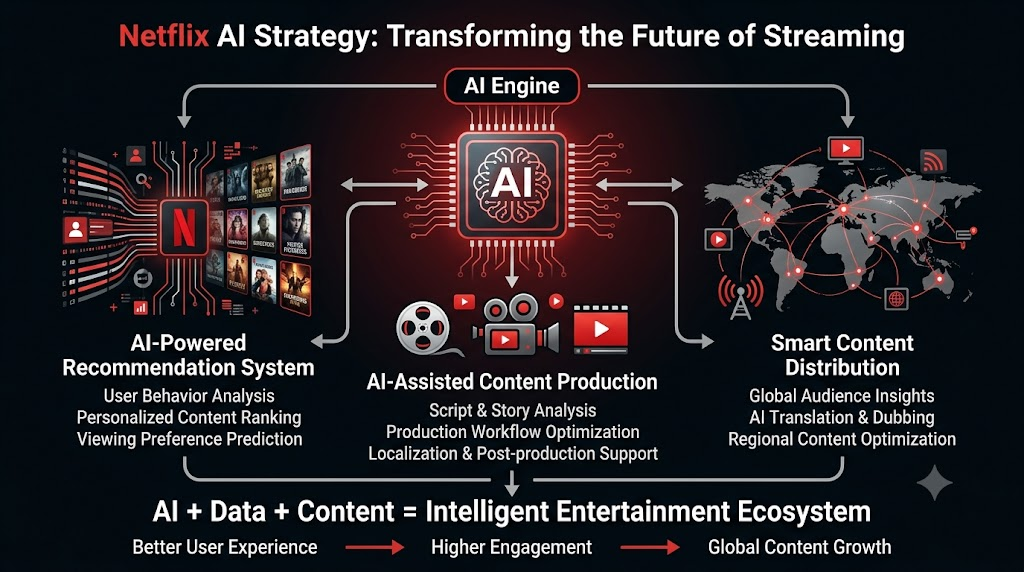
Recommendation algorithms are central to Netflix's AI applications and represent the most immediate AI interaction for users. When a user opens Netflix, the homepage layout varies from person to person. Rather than simply displaying popular titles, the platform generates personalized recommendations based on individual viewing history, interest tags, viewing times, and the behaviors of similar users.
For example, a user who regularly watches sci-fi films will be shown more science fiction, futuristic, and AI-themed titles, while documentary enthusiasts will see more recommendations in history, nature, and social topics.
This personalized recommendation engine streamlines content discovery for users. For Netflix, user watch time is a core metric of platform value. If recommendations help users quickly find appealing content, both viewing duration and member retention improve.
Netflix's algorithm also analyzes multiple content dimensions—actors, directors, story themes, language, and style. Complex data models help uncover hidden relationships between works.
For instance, a Korean suspense series might be recommended to fans of Spanish crime dramas if AI detects similarities in pacing, audience demographics, or viewing patterns.
This recommendation system is a key differentiator for Netflix compared to traditional studios, which rely on manual curation and marketing, while Netflix connects content and viewers through data and algorithms.
How AI Optimizes Netflix's Content Distribution
Beyond recommendations, AI is transforming Netflix's global content distribution. Serving audiences across numerous countries and regions, Netflix faces diverse market preferences. Content popular in the US may not resonate in Asia or Europe, so the platform must tailor content displays for each region.
AI helps Netflix analyze viewing trends by market. By tracking genre performance across countries, the platform can identify titles with international breakout potential.
AI also streamlines localization. Previously, bringing a show to overseas markets required extensive manual work for subtitles, dubbing, and cultural adaptation. Now, machine learning assists with translation and voice processing, accelerating global releases.
For a global platform like Netflix, localization directly impacts content's commercial value—a successful non-English title that quickly enters multiple markets can drive significant user growth.
Recent global success of Korean, Japanese, and Spanish content further demonstrates that Netflix's distribution model is breaking down language and regional barriers.
AI is making Netflix more than a streaming platform—it's evolving into an intelligent content distribution network linking creators and audiences worldwide.
How Machine Learning Predicts User Preferences
Machine learning is foundational to Netflix's AI system, enabling prediction of future behavior from historical data.
Netflix analyzes a vast range of user interactions: watch history, search activity, completion rates, repeat viewing, and content feedback.
Processed through machine learning models, this data builds detailed user interest profiles.
Unlike basic classification, modern AI models detect nuanced preferences—a user might not just like action films, but prefer certain actors, pacing, or visual styles.
These models continuously refine predictions as new viewing data arrives, keeping recommendations relevant.
This dynamic learning is a major source of Netflix's long-term competitive edge. As user interests shift, adaptive recommendations maintain engagement.
Looking ahead, with generative AI and large language models, Netflix's recommendations may evolve from simply “suggesting content” to truly “understanding entertainment needs.” Users could describe what they want to watch in natural language, and AI would generate highly tailored suggestions based on mood, context, and interests.
How AI Supports the Film and TV Production Pipeline
Beyond enhancing the viewer experience, AI is now integrated into Netflix's production pipeline, boosting efficiency and decision quality.
Traditional production relies on the expertise of writers, directors, producers, and marketing teams, with significant uncertainty at every stage. AI analyzes large datasets to inform creative decisions.
In early development, AI assesses the market performance of genres, character types, and narrative structures, helping Netflix better evaluate a project's potential.
During script development, machine learning tools analyze story structure, character dynamics, and audience trends. Still, Netflix sees AI as a tool for creators—not a replacement for writers or directors. Human creativity, cultural insight, and emotional nuance remain essential.
In post-production, AI is applied to processes such as subtitle generation, translation, audio processing, image enhancement, and content review. Automated speech recognition speeds up subtitle creation, while AI-powered dubbing accelerates global rollouts.
For Netflix, AI's primary value is not in fully automating content creation, but in reducing repetitive tasks so creators can focus on innovation.
AI also enhances marketing. User interests in a single title may differ by region, so Netflix adapts promotional materials accordingly—emphasizing different characters, scenes, or visuals for each market.
This data-driven approach allows Netflix to connect content and audiences with greater precision.
How Netflix, YouTube, and Disney Differ in AI Content Strategy
As AI advances, entertainment platforms worldwide are exploring its applications, but each takes a distinct strategic path.
Netflix's AI strategy focuses on professional content production and streaming experience. With extensive content and user data, AI powers recommendations, content analysis, global distribution, and production efficiency.
YouTube's AI ecosystem is more open, emphasizing user-generated content (UGC) and creator tools. YouTube relies on a vast creator base, using AI for recommendations, video moderation, auto-captioning, creator support, and generative features.
YouTube's strength is its massive, ever-growing content base, requiring AI to manage a highly dynamic environment. Netflix, with centralized, high-quality content, emphasizes production and commercialization.
The Walt Disney Company centers its AI strategy on IP assets and the entertainment ecosystem. Owning global brands like Marvel, Star Wars, and Pixar, Disney uses AI to boost production efficiency, optimize themed experiences, and extend IP value.
While Disney leverages decades of entertainment assets, Netflix's edge is in data and technology. Lacking a deep library of legacy IP, Netflix builds competitive barriers through algorithms, user data, and original content.
These three companies represent distinct AI strategies in entertainment:
Netflix: “How to use AI to optimize streaming efficiency”
YouTube: “How to use AI to expand the creator ecosystem”
Disney: “How to use AI to extend traditional entertainment IP”
As generative AI matures, competition may converge—streaming platforms will need both top-tier content and advanced intelligent production and distribution.
Challenges for AI in Entertainment
Despite new opportunities, AI adoption in entertainment faces several challenges:
-
Copyright and intellectual property. Generative AI requires vast training data, raising questions about using films, scripts, music, and visuals for model development. For Netflix, balancing creator rights with AI-driven efficiency is a critical issue.
-
Quality of AI-generated content. Film and TV require not just technical skill but also emotional resonance, cultural context, and artistic creativity. While AI aids production, fully replacing top creators remains a significant hurdle.
-
Shifts in industry employment. AI automation may reduce repetitive tasks like basic subtitling, content organization, and some post-production, but also creates new roles in AI content management, model training, and intelligent workflow design.
-
Content homogenization risk. Heavy reliance on similar data models could lead to content that caters to existing preferences and stifles innovation.
For Netflix, the strategic challenge is using AI to boost efficiency while sustaining creative innovation.
The Future of Netflix's AI Strategy
Looking ahead, Netflix's AI strategy will likely focus on personalized experience, intelligent content production, and a global entertainment ecosystem.
-
User experience: Recommendation systems will advance, enabling users to interact with Netflix through natural language—e.g., “Recommend a light suspense film for the weekend”—with the system delivering precise suggestions based on viewing history and current preferences.
-
Content production: Generative AI will further support creative teams with concept design, visual previews, language conversion, and market analysis, raising efficiency.
-
Globalization: AI-powered translation and voice technologies will lower language barriers, enabling rapid multi-language releases and simultaneous global viewing.
-
Advertising: As ad-supported plans grow, AI will enhance ad targeting, matching user interests to relevant ads and maximizing marketing value for brands.
-
Platform expansion: AI will help Netflix evolve into a comprehensive entertainment hub, with games, interactive content, and sports all benefiting from intelligent technologies.
Over the long term, Netflix's competitive edge may shift from content volume to intelligent content management and distribution. AI will become the infrastructure connecting users, creators, and business models.
Summary
Netflix's AI strategy signals the streaming industry's transformation from content platforms to intelligent entertainment ecosystems.
Through artificial intelligence, machine learning, and data analytics, Netflix is continuously refining recommendations, optimizing content distribution, and exploring AI-driven production. Its vast user data and global infrastructure give it a unique edge over traditional entertainment companies.
At the same time, AI brings new challenges—copyright, creator rights, content quality, and industry shifts. Netflix's future success depends on balancing technical innovation with content value.
As generative AI, multimodal models, and intelligent content tools evolve, Netflix has the opportunity to further enhance global entertainment services. Ultimately, true competitiveness will hinge on the synergy between technology and high-quality content. AI can boost efficiency, but cannot replace content with genuine cultural impact and emotional resonance.
For the streaming industry as a whole, Netflix's AI journey is not just a case study in technological advancement—it's a blueprint for the future of digital entertainment.